Curtains for Champi.
The Typhoon was wrecked by Taiwan.
Not much left. The mountainous terrain disrupted the inner-core circulation and broke the "heat engine"
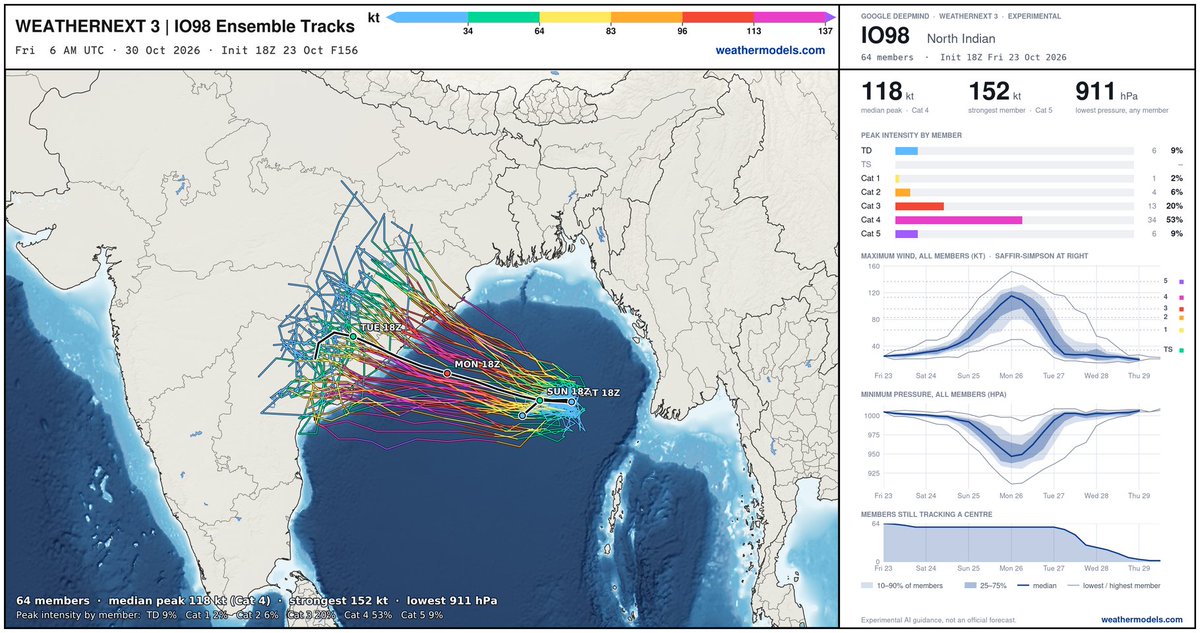
A tropical disturbance has formed in the Bay of Bengal (Invest 98B)
Weather models show an intense cyclone of Category 4 intensity (115 knots) making landfall somewhere along Indian coast.
This will be a dangerous storm ⚠️
Vance the hurricane is nearly at major intensity.
However, there's a cold pool of water along the path, so Vance has 48 hours to peak, and then it's downhill from there w/potential of significant weakening.
Eye still ragged. 90 knots winds
Most Americans don't appreciate the power of the "bomb cyclones" that slam into the British Isles and France. Barometric pressure collapsed.
Storm Austen is the equivalent to a hurricane rolling through the English Channel -- damaging winds and power outages.
Redfin deserves scrutiny for its business relationship, which apparently remains intact.
This video was not a compelling defense.
Zillow removed the faulty scores in December 2025 after taking incoming fire from all directions.
Redfin is apparently "guaranteeing" the accuracy of "black box" climate models by maintaining third party "climate scores" on their property listing website.
"Knowledge is power" won't hold up in court when asked for evidence of "due diligence" on score accuracy.
UPDATE: climate risk company First Street (recently acquired) is being sued by Nebraska for misleading "climate scores" put on real estate market pages.
A reckoning for the "climate intel" space🍿
We filed a lawsuit against climate risk company First Street for inaccurate and misleading property-specific loss predictions that have depressed Nebraska’s real estate market and made it difficult for Nebraskan homeowners to sell their homes.
First Street’s climate risk scores on Zillow, Redfin & https://t.co/Q5aKnhSgdm are presented as accurate and scientific. They’re not.
We are taking them to court because Florida homeowners deserve facts, not alarmist scores that hit their property values and their wallets.
@AndyHazelton The Canadian model GEM is now a hybrid with machine learned nudging, and is a winner 🏆
I'm looking forward to the day soon when we have hybrid full-physics systems. ECMWF is close but still a little too expensive on their current compute.
@kris_kinder The added friction and disruption to the inner-core actually created more intense thunderstorms or convection. These are "hot towers" working to balance out the inclusion of high terrain as part of the Typhoon circulation.
@USWeatherExpert@TonyPannWBAL *Your criticisms are always valid. However, I saw a lot of incorrect assumptions made that were easily debunked, and then the algorithm wouldn't stop feeding me nonsense.
No one died from "climate change" which is a 2°F rise in global temperature since 1850 during the Little Ice Age.
Everyone died because of lack of cooling and adaptation due to policy trade-offs made by European governments to prioritize long-term mitigation (Net Zero) rather than resilience today.
A "buddy system" to check on elderly melting in their homes is not a serious solution.
https://t.co/13EoHBxyJE
Do the "heat attribution" studies take into account the humidity in Europe?
Here in United States "Deep South" we use air conditioning to both cool and dehumidify our homes.
Electricity is cheap in Georgia, our homes are typically kept around 72°F in summer & winter.
Attribution science is so morbid.
The researchers could calculate the number of deaths likely caused by lack of air conditioning due to maladaptation caused by climate/energy policy.
Instead, they set up counterfactual experiments to compare the climate of 1850 with 2026, and conclude what?
The people in 1850 were better off? Gross.
https://t.co/Yb1hNuwZIf
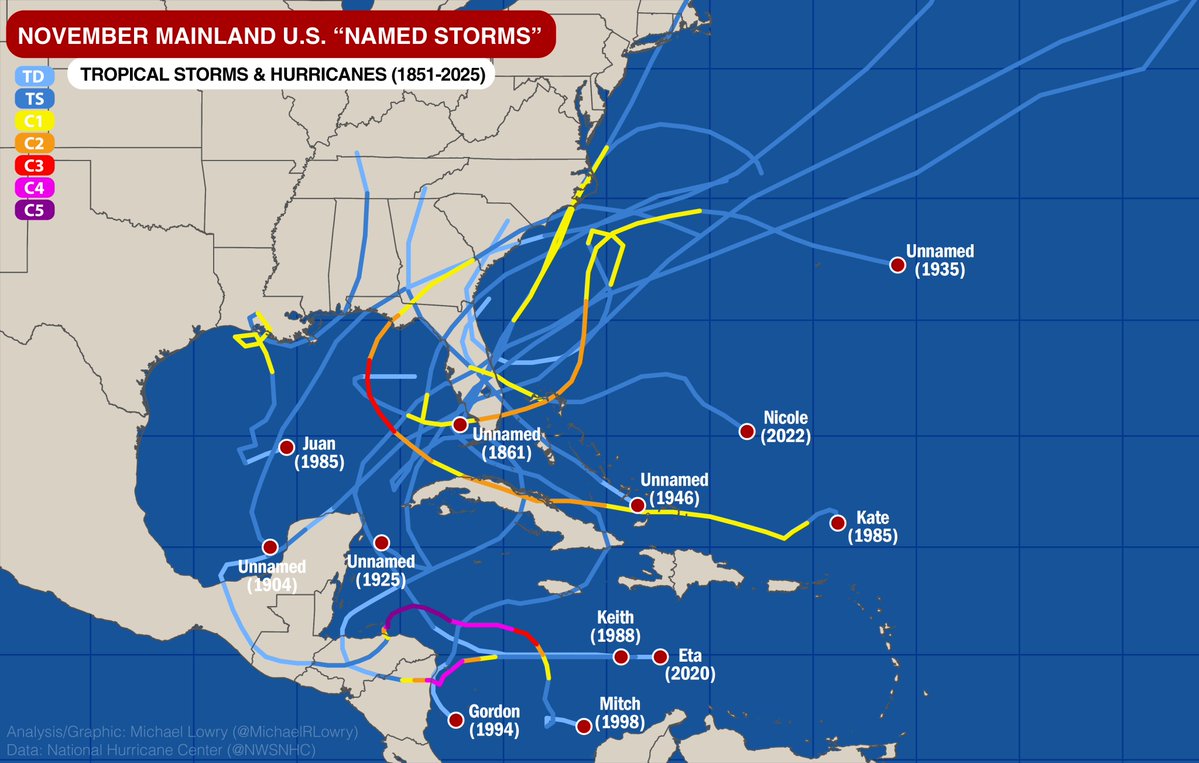
If you believe the models, we should finish off October without any additional tropical threats or development contenders. But what about November? In today's newsletter, I dive into just how common tropical threats are in the season's final month. ⬇️
https://t.co/UsRMK2jccv