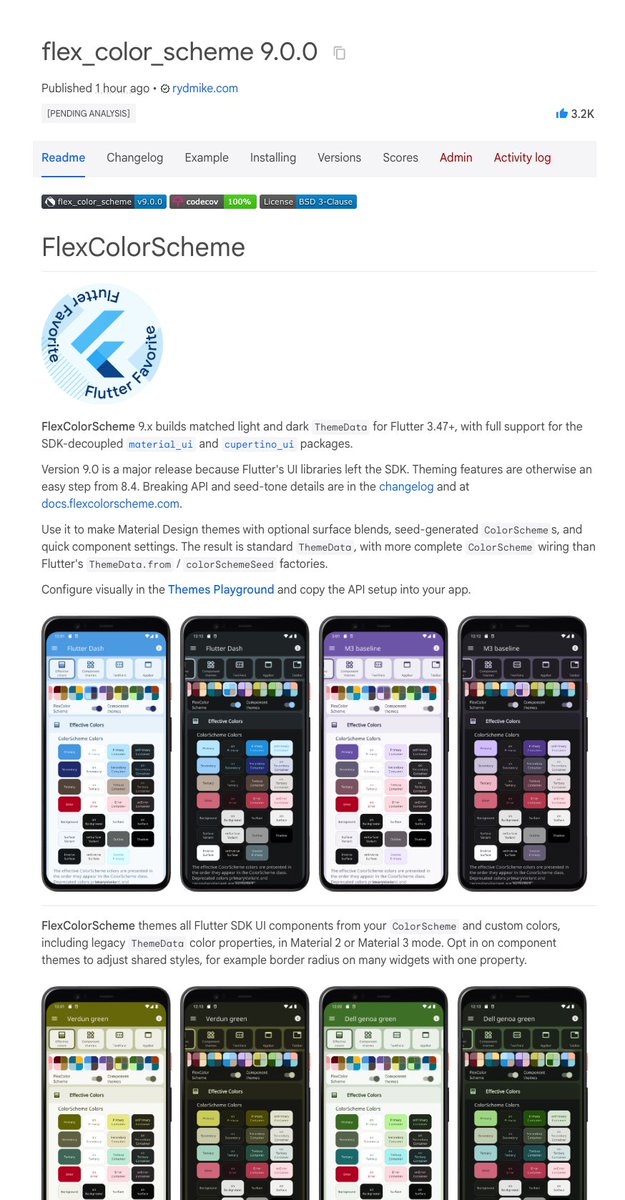
Dear #Flutter friends, #FlexColorScheme v9 with support for decoupled Material and Cupertino has been released https://t.co/bkgQYxYQzS 🎉 Thank you all for your patience. This is an easy step-up update for @FlutterDev 3.47+ users. New features development will resume next 💙😃
@alwayspriyesh@theo@Google Via YT and X post income, but yes they paid him, but not for AI reviews, but I guess it can have a remote slight influence. Have not seen it though, the criticism was super harsh when model was meh
@luke_pighetti Yes I see that too, most people and most companies have no idea what is coming, plus AI will speed run robotics too, development of it will accelerate, if anyone thinks plumbing is a safe choice 10years down the road, I would not bet on it
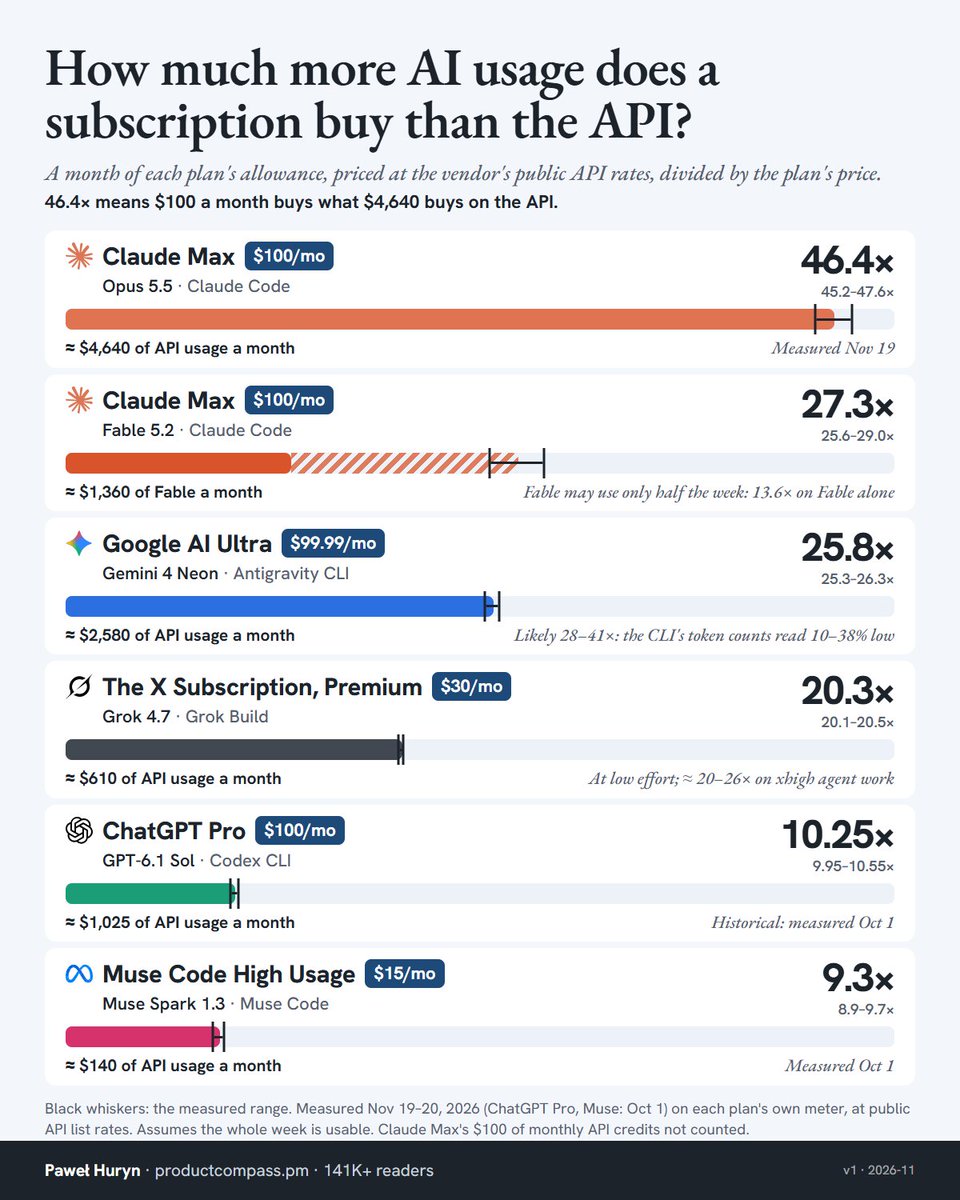
Just measured how much more AI usage you get from a subscription. $100 of Claude Max buys about $4,640 of Opus at API prices.
The results:
- Claude Max ($100): 46.4x on Opus 5.5, 27.3x on Fable 5.2
- Google AI Ultra ($99.99): 25.8x on Gemini 4 Neon
- X Premium ($30): 20.3x on Grok 4.7
- ChatGPT Pro ($100): 10.25x (measured in October)
- Muse Code High Usage ($15): 9.3x (October)
How this affects the Bug Hunt Benchmark: 🧵
Not long ago, nobody would have argued that duplicating code is a good idea. Now, the rise of AI has made it a popular opinion. Many “agentic engineers” say that reuse doesn’t matter because an agent can build a new library in an hour. Or that cross-platform doesn’t matter because the AI can just copy your app to another platform.
I understand why people think this. AI has certainly sped up code generation, but the last 10% is still 90% of the work. Getting the details right and ironing out the last edge cases takes a lot of time. This isn’t free, even with the best agents.
Building your apps on a solid base is now more important than ever. I’ve spent years at companies like Google and Zynga, and I’ve seen first hand how hard large codebases are to maintain. When it comes to full app rewrites, even large companies still struggle to keep their duplicated codebases in sync. With quickly generated code, that drift between the platforms also happens faster.
Choosing a framework where you can share as much code as possible, both across different platforms and between frontend and backend, remains the right choice. The less code we generate with AI, the more reliable and consistent your users’ experience will be.
For me, Flutter really hits the sweet spot between code reuse and flexibility. Version 3.50 makes it even easier to implement the things you need in native code while keeping the bulk of the code the same across all devices. Serverpod makes it possible to use the same code on the backend, too.
Good engineering principles were not invented because typing was slow. They were invented because software is complex. AI doesn’t change this.
Read this to the end, I promise it’s worth it.
Imagine that you’re ordering food at a restaurant.
You: “I’ll have the steak medium rare with fries”
Waiter: “What about the fries?”
You: “…huh?”
Waiter: “do you want the fries medium rare too?”
You: “idk what that means just cook them normal”
Waiter: “okay got it, coming right up!”
15 minutes pass, waiter comes back out
Waiter (panic’d): “hey man, we REALLY need to know if you want your fries cooked at 413 degrees or 471 degrees. Whole kitchen is held up until you decide!”
You: “wtf just do whatever the chef wants”
Waiter: “okay got it!”
30 minutes pass.
The waiter comes out with mostly passable fries, and an entirely burnt steak
You: “wtf happened this steak is burnt!”
Waiter: “so sorry, the chef got distracted when waiting for your answer about the fries. We can put the steak in the fridge to cool it off if you’d like?”
This is how it feels to use GPT-6.2 Astra.