A Buddhist monk asked his students - If you're carrying a cup of coffee and someone bumps into you, why did you spill the coffee?
Each and every one of his students said because someone bumped into me.
No, he said, the reason why you spilled the coffee is because that's what you were carrying in your cup. If you were carrying water, you would have spilled water.
Then he said something profound.
Whenever life shakes you, whatever you're carrying is going to spill out. So if you're carrying fear, jealousy, anger, greed, that's what's going to spill out.
But if you're carrying love, compassion, kindness, that's what's going to spill out.
So, each and every day, you should pause and think to yourself, What am I carrying in my cup today?
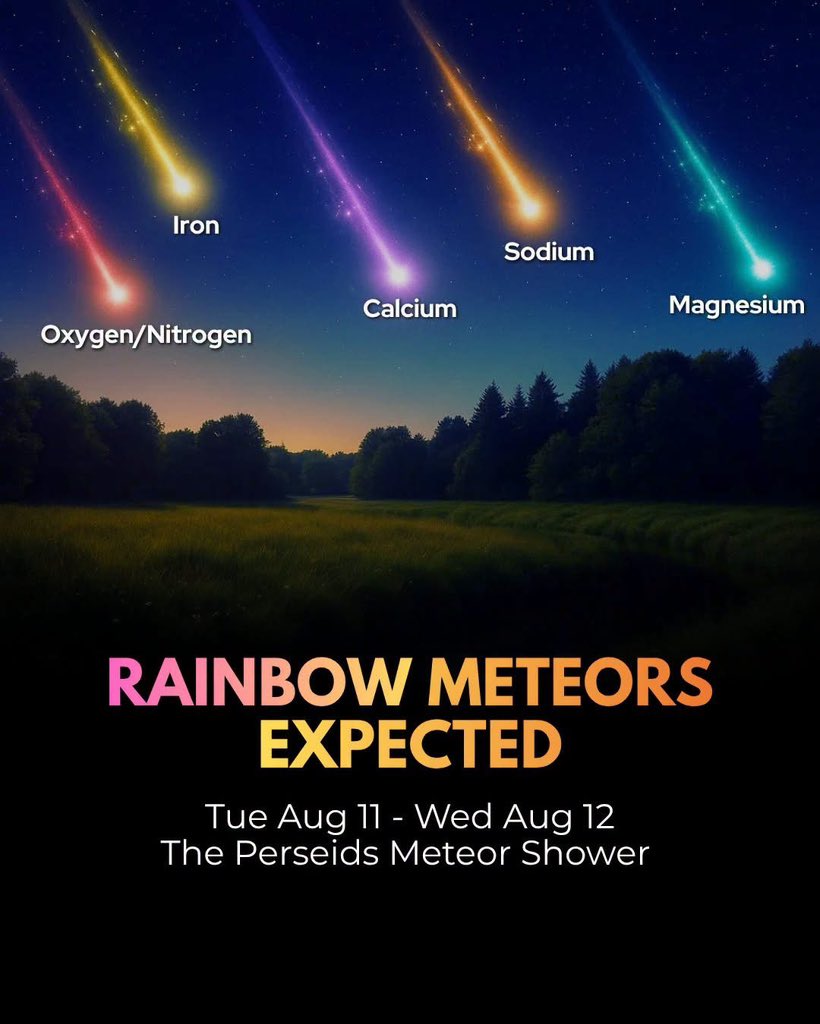
Colorful fireballs are expected next week!
The highly anticipated peak of the 2026 Perseid meteor shower is arriving on the night of August 11–12, offering stargazers a stunning celestial show.
To catch the absolute best views, experts recommend heading to a dark location far from city lights between the hours of 2:00 AM and 4:30 AM local time. Be sure to give your eyes about 15 to 20 minutes to adjust to the darkness.
While you can look toward the northeast near the constellation Perseus to find their origin, these meteors can streak across any part of the sky—and you won't need telescopes or binoculars to enjoy the spectacle.
What makes the Perseids truly magical is their vibrant, multicolored display.
Entering Earth's atmosphere at a blinding 132,000 mph (212,000 km/h), these tiny particles compress and heat the air, exciting atoms to release distinct hues. Observers can look out for red from atmospheric oxygen and nitrogen, yellow-gold from iron, violet from calcium, orange from sodium, and blue-green from magnesium. Because these fragments often contain multiple elements, they can change colors mid-flight, leaving behind the brilliant fireballs and long-lasting, glowing wakes that NASA notes make the Perseids the year's premier meteor event.
source: NASA. (2026). Summer Star Shower: Watch the Perseids with NASA! NASA Marshall Space Flight Center.
You might catch yourself thinking "Orion's belt is highkey the lamest constellation" then you look attentively up at the starry night sky for the first time in a while and you realize: actually, hold up, those three stars are really in a distinct ass little line, that's sick