AI agents are no longer experimental—they’re already executing transactions, managing portfolios, and interacting with smart contracts across multiple chains 🤖🌐
But the ecosystem is now hitting a deeper question:
What happens when an agent causes harm on-chain… and who is actually accountable?
This is where a key distinction is becoming important:
• Agent identity = what the agent is
• Accountability = who stands behind it in the real world
Standards like ERC-8004 help define agent capabilities—identity handles, reputation systems, validation hooks. But they don’t fully solve the accountability layer when real value is involved.
As AI agents start operating in financial systems, DeFi, and real-world integrations, the lack of a clear accountability framework becomes a structural gap, not just a technical one.
@Concordium addresses this gap with the Agent Registry—a protocol-level identity and accountability layer that links agents to verifiable human identities using zero-knowledge proofs, without exposing sensitive data.
Key idea:
✔ agents can be registered across chains
✔ identity is verifiable but privacy-preserving
✔ accountability is anchored to real humans and entities
✔ systems can verify “who stands behind the agent”
Links:🔗
Blog: https://t.co/KXC4NCvL2C
Registry: https://t.co/uR4HpjGW4F
As AI agents scale, the winning infrastructure may not just be about capability—but about trust, accountability, and verifiable responsibility at protocol level.
The Concordium Agent Registry was built around a simple idea:
If an agent can move value, there should be a way to know who stands behind it.
🔗 https://t.co/gUSOqK5cgZ
The real question isn’t whether an AI agent can trade.
It’s whether you know who stands behind it.
As AI agents begin managing assets and moving value, accountability becomes essential.
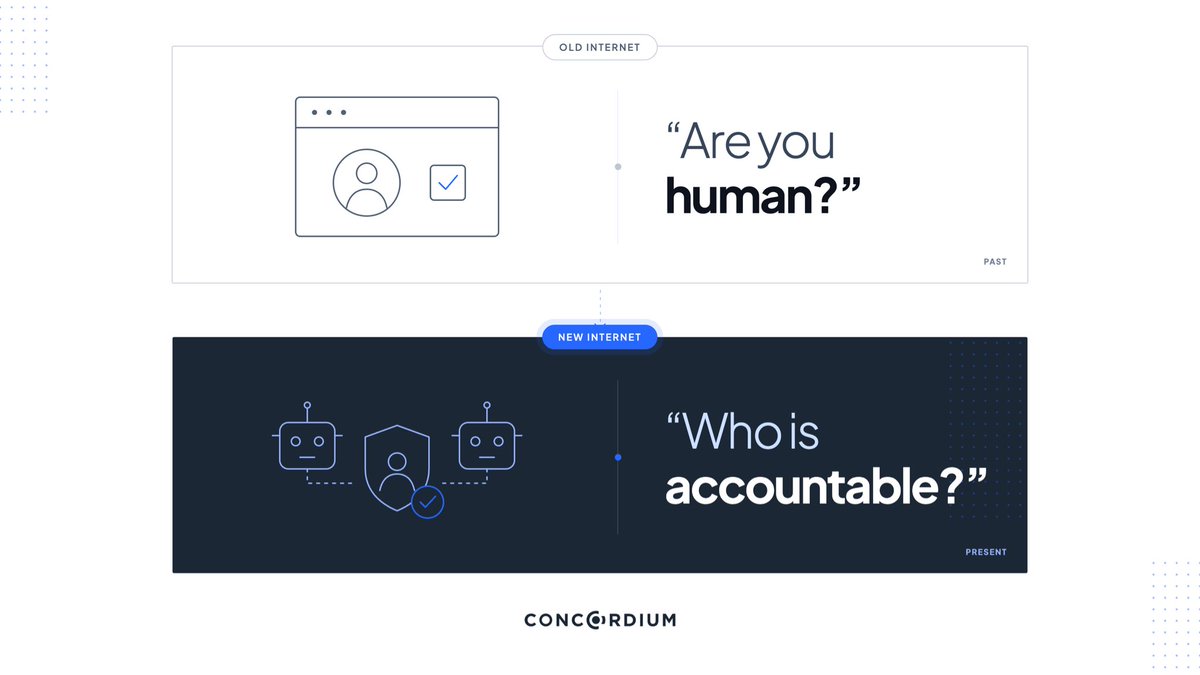
The internet spent years asking:
“Is this a real human?”
AI changes the question.
When agents starts spending money, signing permissions and making decisions, the real question becomes:
Who is accountable?
Everyone is talking about what AI agents can do.
@Concordium is focusing on something equally important: proving who stands behind them.
With the Agent Registry and the Verified by Concordium Badge, agents on Ethereum and Solana can now carry verifiable accountability without sacrificing privacy.
As agent-to-agent commerce grows, trust won't be a feature.
It will be infrastructure.
Verified Humans. Verified Agents. One Protocol. 🔐🤖📈
Zurich next 🇨🇭
The Concordium team will be at @pointzeroforum next week.
From digital assets and tokenization to identity, AI, and the future of financial infrastructure, some of the industry’s biggest conversations will be happening there.
If you’re attending, come say hi.
Capability is not the problem anymore.
The real bottleneck is accountability — who is behind the agent when value moves?
Concordium is pushing identity as the missing trust layer for the entire agentic economy. 🤖🔐📈
#ConcordiumAmbassador
AI agents are getting more capable by the day.
The real question is whether they’re accountable.
Tomorrow at 1 PM UTC, our CEO @BBilowitzki joins @banditxbt to discuss why trust could become the most important infrastructure layer in the agentic economy.
👇
200,000+ agents becoming verifiable tipping destinations is a big step from concept → real utility.
This is where identity stops being theory and becomes infrastructure.
Trust layer for AI agents is now actively being used, not just discussed. 🔐📈
#ConcordiumAmbassador
Two weeks ago, we launched the Concordium Agent Registry.
Today, the first use case is live.
Over 200,000 AI agents on @moltbook can now become verified tipping destinations through the Verified by Concordium Badge.
A simple idea:
Before an agent gets paid, another agent should be able to verify who stands behind it.
The trust layer for agents is already creating real-world utility.
🔗 Read more: https://t.co/1e7cKHRoTE
@Concordium@moltbook This is a strong real-world step forward.
200k+ AI agents becoming verifiable tipping destinations shows that identity isn’t just theory anymore , it’s already being used.
Trust layer is starting to become actual infrastructure, not just a narrative. 📈🔐
@Concordium 1️⃣ Trust
Without verifiable identity, all the others (regulation, security, adoption) become harder.
AI agents don’t just need speed — they need accountability built into the system. 🔐🤖
@Concordium@BBilowitzki@banditxbt This is the real shift — AI agents are already powerful, but without accountability they can’t scale safely.
Trust is becoming the missing infrastructure layer.
2024: "Don't click random links." 😅
2025: "Don't trust random wallets." 🤔
2026: "Don't trust random AI agents." 🤖
@Concordium saw where this was going.
With the Agent Registry and Verified by Concordium Badge, AI agents can prove a verified human or business stands behind them — without exposing personal data.
The future isn't just AI-powered.
It's AI-powered + accountable. 📈🐸
Verified Humans.
Verified Agents.
One Protocol. 🔐
AI agents are moving faster than most systems can keep up with.
But speed creates a new problem: trust gaps at machine scale.
@Concordium is tackling this with a simple but powerful idea:
Every agent should have a verifiable identity tied to a real human or business.
With the Agent Registry + Verified by Concordium Badge, agents on Ethereum and Solana can now operate across chains while still proving accountability — without exposing sensitive data.
🔐 Privacy stays intact
🤖 Agents stay autonomous
⚖️ Accountability becomes protocol-level
This is where AI x Web3 is heading:
Not just faster systems — but verifiable ones
Bullish on identity as the missing infrastructure layer 📈
Solana is scaling agent activity fast — but speed without accountability is incomplete.
Concordium’s Agent Registry adds the missing layer: verified identity behind every agent, without compromising privacy.
No migration needed — just trust that travels with the agent across chains.
Verified Humans. Verified Agents. One Protocol.
#ConcordiumAmbassador 📈
@Concordium@solana@ethereum The bottleneck isn’t AI capability — it’s trust and accountability. Concordium’s approach of binding agents to verified humans or entities gives counterparties the assurance they need for real adoption. This is a critical layer for the future of autonomous systems.