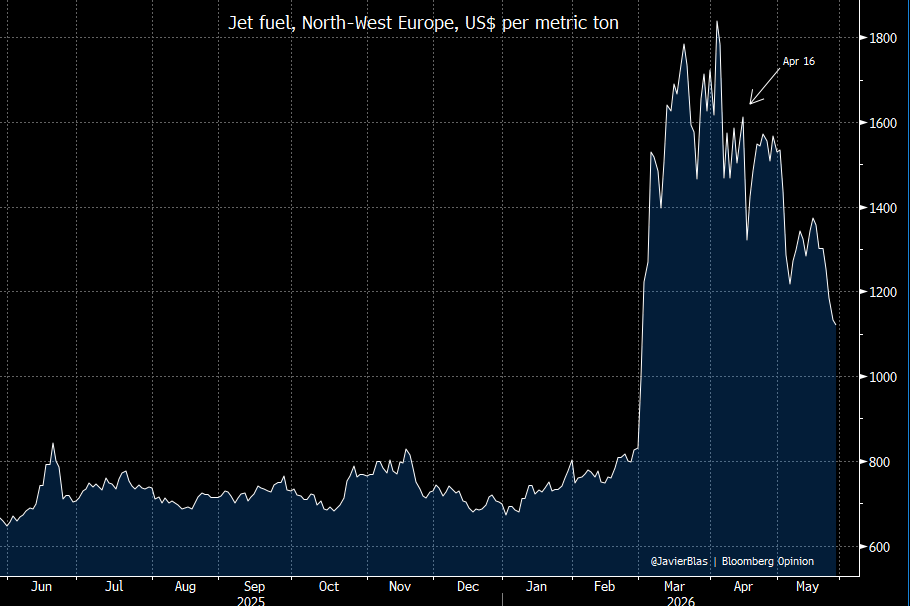
CHART OF THE DAY: On Apr 16, the IEA made a headline-grabbing warning: Europe had "maybe 6 weeks or so of jet fuel left." It's week seven; the planes are still flying. Since those headlines, European wholesale jet fuel prices have fallen ~30% to a ~3-month low.
Cyclical Stocks 101: Final highs don’t come at high P/Es. They come when earnings are peaking and P/Es look deceptively “cheap.” Semis—especially MU—are classic: they screen undervalued right before the cycle turns.
I read all 277 pages of SpaceX's IPO filing so you don't have to.
Losses up 700%. Revenue decelerating. 107x price-to-sales multiple.
It's a trainwreck. Full breakdown below 👇
A hard lesson from administering my late mother's estate: read the fine print on life rights before your parents sign one.
For those unfamiliar: a life right is a popular retirement-village model in South Africa. You don't buy the property. You pay a large lump sum (often R2m+) for the right to occupy a unit for the rest of your life. The operator retains ownership and the title.
When the holder dies, here is what nobody really explains up front.
1. The operator takes a fixed chunk regardless of how long you lived there. Typical contracts deduct around 40 percent of a notional "Listing Consideration" as the operator's effective fee, amortised over five years. If your loved one lives in the unit for two years, three years, or even just under five, that 40 percent disappears anyway. My mother paid R2 million in 2021. Five years later, the estate stands to receive less than half of it back.
2. The estate keeps paying levies after death. Indefinitely. The contract terminates automatically when the holder dies. But you, as the estate, remain liable for the full monthly levy, rates, and consumption charges until the operator finds a new buyer. There is no deadline. No reasonable-time obligation written in. We are six weeks past hand-over and the invoices keep arriving.
3. The estate cannot use, let, or even allow family to enter the unit. The right to occupy was "personal in nature." It died with the holder. The estate cannot put a tenant in, cannot let it on Airbnb, cannot even allow family to stay there without the operator's written consent. Every mitigation lever sits with the operator at their sole discretion.
4. The operator has zero incentive to re-sell quickly. They hold your capital interest-free until a buyer is found. They earn the levy every month you wait. They earn a remarketing fee on re-sale. The longer they take, the better for them. The worse for you.
5. The contract usually contains a CPA exemption-by-design. Most of these schemes acknowledge the Consumer Protection Act on paper, then carve themselves into clauses that allow exactly the kind of one-sided continuation of obligations the CPA was meant to police. Sections 48 and 52 of the CPA, and the Constitutional Court line on fairness in contract (Barkhuizen, Beadica), give real grounds to push back. But you have to know to push.
If you or a family member is considering a life right, please:
- Read the full agreement including every annexure, not just the marketing brochure.
- Model the worst case: holder dies within 3 to 5 years of taking occupation.
- Calculate the estate's expected net return, including post-death levy bleed if re-sale takes 6 to 12 months.
- Get independent legal advice before signing. Not advice from the village's referred attorneys.
- Ask explicitly: what is the operator's contractual obligation to re-sell within a reasonable time? If the answer is "none," walk away.
There are genuinely good retirement villages and well-structured life rights out there. But the structural risk to the estate is rarely disclosed up front.
If you've been through this and want to compare notes, please reach out.
I note the interim order handed down by the Gauteng Division of the High Court relating to the procurement and administration of Foot and Mouth Disease (FMD) vaccines.
I note that the practical effect of the matter is now largely overtaken by the gazetted Section 10 animal health scheme, which already provides a lawful framework for participation by private industry role players in the national vaccination effort.
Government has consistently supported a coordinated public-private approach to combating FMD.
Millions of vaccines have already been allocated to organised industry structures, including the Milk Producers’ Organisation (MPO), while further allocations are being rolled out to feedlots, stud breeders and commercial farmers.
Our primary focus remains the implementation of the national FMD Strategy through the Ministerial Task Team and the Industry Coordinating Committee on FMD.
Our objective remains to vaccinate at least 80% of the national cattle population with two doses of vaccine as swiftly as possible as part of South Africa’s pathway toward achieving WOAH-recognised FMD free with vaccination status.
This would unlock significant export opportunities for South Africa’s red meat sector.
In demonstration of this commitment, since February this year, the Ministry and Department have procured every available local and international matched vaccine available.
Approximately 13.5 million FMD vaccine doses from local and international sources have been procured as part of government’s intensified response to the outbreak.
We remain unwaveringly committed to ensuring the success of the strategy and ensuring this outbreak is the last major outbreak of FMD and becomes a turning point in strengthening South Africa’s long-term biosecurity capability and defeating FMD once and for all.
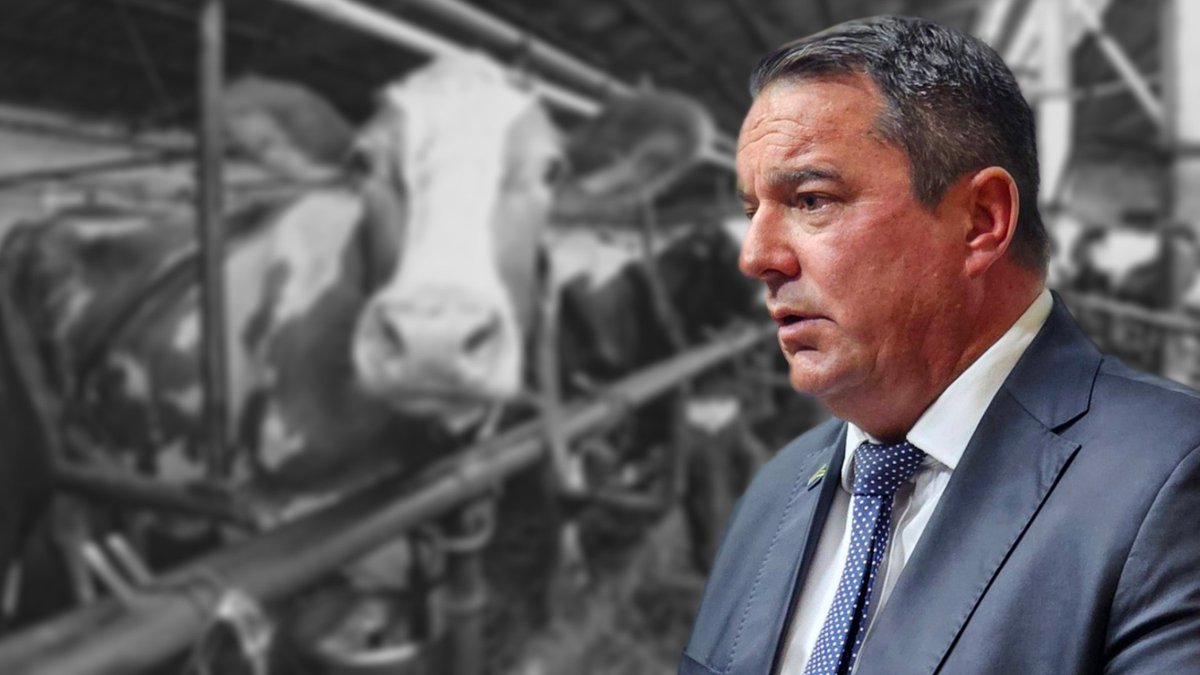
🔴 BREAKING: High Court blocks Agri Minister's foot-and-mouth vaccine prohibition
Minister John Steenhuisen is also interdicted from interfering in private commercial relations of those who lawfully import FMD vaccines.
Here's the latest 🧵
FWIT - Humanity progresses through a series of accidents, mutations and experiments. Some random, some explicit. This is a fascinating development to watch - long term consequences.
This from @Rory_Johnston is a must read:
China, as he puts it, is "the largest blind spot to the market’s collective statistical model of the oil industry."
He offers good data and insight on why China may be drawing a lot of crude (and refined products) from its opaque SPR.
Some very cool stats in this week's State of the Markets in 10 Charts - have a look at the growth in S&P Earnings.
https://t.co/YiDCBnIM3R via @charliebilello
a former Jane Street trader on the biggest mistake people make with AI and trading:
"you throw ML at a dataset, find something that predicts price movement 55% of the time, and think you've won."
"that thing can still lose a lot of money in production. because of adverse selection. you're only going to do a small fraction of the good trades. you're gonna do all the bad trades."
more complex ≠ more profitability.
@PioneerColumn22 Taking capital which is invested in really productive assets, and which will compound at a decent rate for a long time, to plug a hole in a dying business. Sometimes the right decision is to get out of a sinking ship and rather just swim to the one without the hole in the hull
@CapOnePartners There is another institution run by the elderly - the ANC and the country - and see where that got us. South Africa is blessed with a whole cohort of young, ambitious, talented leaders and people. Let them loose on our problems - in corporate and in society in general
@CapOnePartners In terms of what to do: I have learnt that entrepreneurs solve problems with ingenuity, not with cash. So as a start - let management understand that the 'family jewels' are not up for grabs to sell in order to plug holes. And then I would get some young retailers in there