Can digital technologies create new pathways to peace? The latest special issue of SAJIA explores how the Fourth Industrial Revolution is reshaping peace, conflict and diplomacy across Africa.
Read the introduction here (FREE): https://t.co/N0OyEKUGrm
@SAIIA_info@TandF_Africa
How does African Union authority become actionable in practice?
Nene-Lomotey Kuditchar examines how the AU's procedural authority interacts with member states, regional organisations and external actors across African regional governance.
https://t.co/TFgwEpgSO9
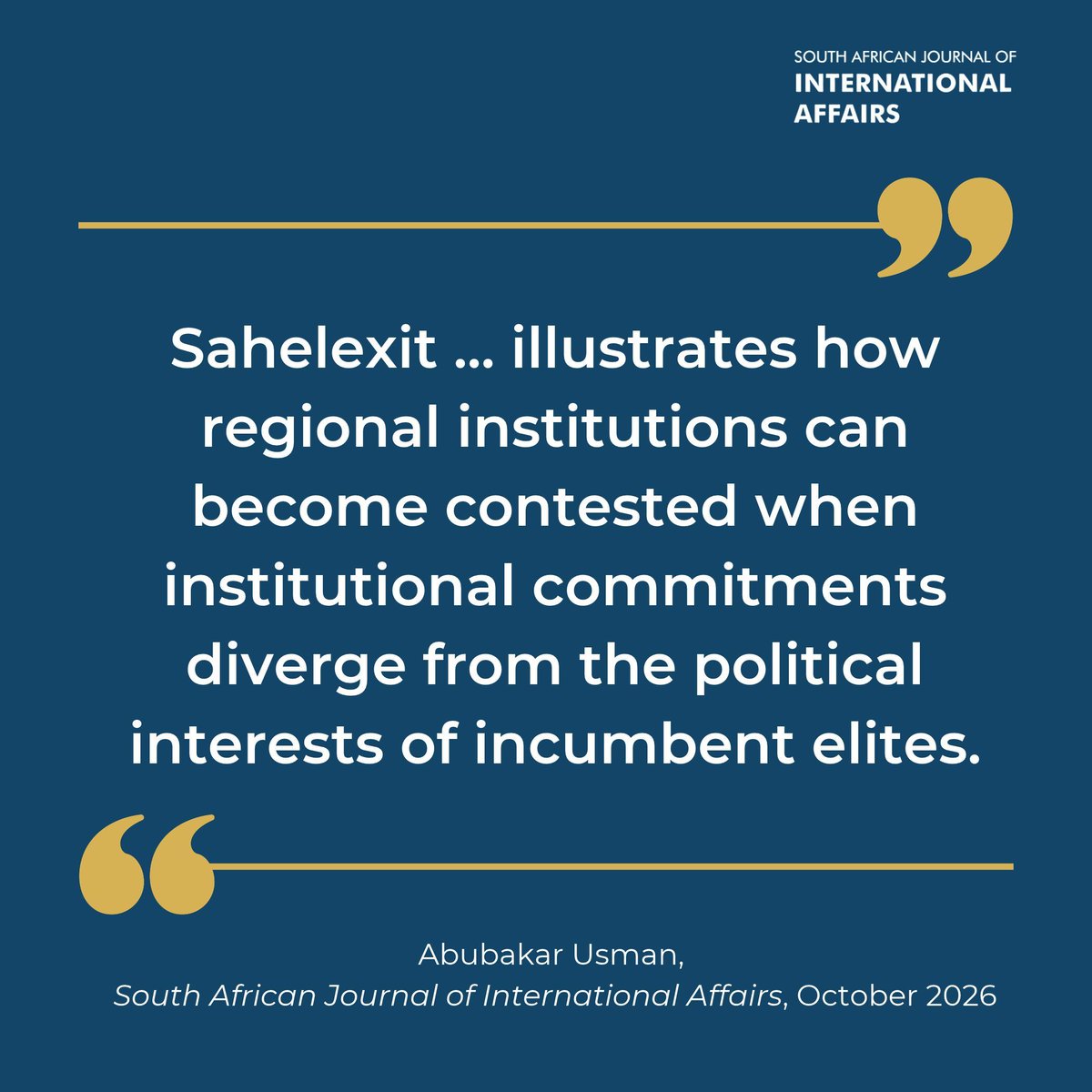
Why did Burkina Faso, Mali and Niger leave ECOWAS, and form AES, despite the economic and diplomatic costs of doing so? @sadiqsenior argues that the answer lies partly in the political survival interests of the countries' military leaders.
Read more here:
https://t.co/hVDquDvg4E
New article in the South African Journal of International Affairs: Sahelexit and the limits of liberal institutionalism.
Why did Burkina Faso, Mali and Niger leave ECOWAS? Competing elite survival strategies.
https://t.co/J0HdXwYnlz
#Sahel#ECOWAS
Why did Burkina Faso, Mali and Niger leave ECOWAS?
In a recent SAJIA article, Abubakar Usman Abubakar examines how the political survival interests of military leaders shaped their withdrawal and the emergence of the Alliance of Sahel States.
Read:
https://t.co/hVDquDvg4E
Coe, Nash and Campbell identify some unexpected shifts in REC engagement in peace agreements: ECOWAS and SADC have become much less active in formal peace agreements since 2015, while IGAD has maintained more consistent levels of engagement.
Read (OA): https://t.co/JKKnpZHz3n
Africa's RECs play important roles in peace agreements, but their engagement is uneven. In their SAJIA article, Coe, Nash and Campbell identify unexpected shifts in engagement, including a sharp decline in ECOWAS's formal role.
Read it here (FREE): https://t.co/JKKnpZHz3n
@KAshindorbe and @saheed_babajide examine ECOWAS's response to military coups in Mali, Burkina Faso and Niger, arguing that its approach undermined regional cohesion and contributed to the formation of the Alliance of Sahel States (AES).
https://t.co/tvxUJUYvSf
📚 BOOK REVIEW | Peace in Digital International Relations by Oliver P. Richmond, Gëzim Visoka and Ioannis Tellidis — Reviewed by Dr Tyne Williams
Don't miss this and other reviews of fascinating books in the latest issue of SAJIA:
https://t.co/3wvPn6SOtX
Why did ECOWAS's response to military coups in Mali, Burkina Faso and Niger contribute to their withdrawal and the formation of the AES?
@KAshindorbe and @saheed_babajide examine the implications for regional integration and security in West Africa: https://t.co/tvxUJUYvSf
📚 BOOK REVIEW | Nigeria’s Counter-Terrorism Strategy: Constructions of Threat, Response and Identity, by Kodili Chukwuma
Reviewed by Alex Vines
Don't miss this and other reviews of fascinating books in the latest issue of SAJIA:
https://t.co/wq182FnZqz
What would effective labour market reform look like in South Africa? @LwandaGeorge proposes a phased approach in which social protection infrastructure is strengthened before greater labour market flexibility is introduced.
Read the article here: https://t.co/dejRNIKZBx
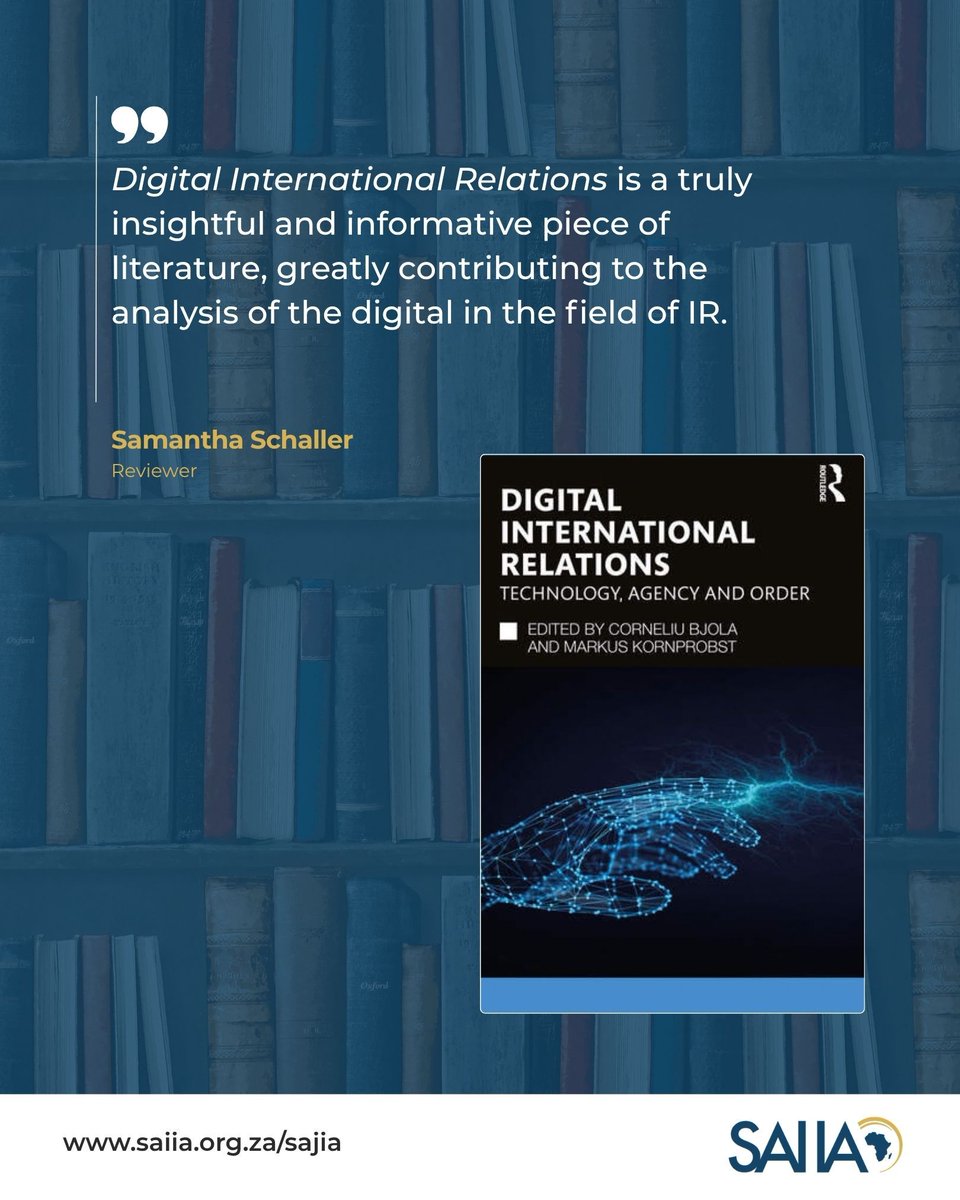
📚 BOOK REVIEW | 'Digital International relations: Technology, agency and order'
edited by Corneliu Bjola and Markus Kornprobst — Reviewed by Samantha Schaller
Don't miss this and other reviews of fascinating books in the latest issue of SAJIA:
https://t.co/suTvzNJOP0
Drawing on six comparative cases, @LwandaGeorge argues that labour market reform transcends traditional left–right political divisions. What lessons can South Africa draw about making reform politically feasible while protecting workers?
Read: https://t.co/dejRNIKZBx
South Africa's voting patterns at the HRC on a wide range of issues reveal that under President Cyril Ramaphosa, SA's position has shifted towards greater support for the principles of human rights, although inconsistencies remain.
Read the article here: https://t.co/oiOFCuQidp
📣 Call for papers | A special issue of SAJIA on African agency in an era of Sino-US competition
Deadline for submissions: 1 February 2027
Please see the full concept note and submission instructions here:
https://t.co/t7RFlEW2HB
📚 BOOK REVIEW | PeaceTech: Digital Transformation to End Wars, edited by Christine Bell, reviewed by Brooks Spector
Don't miss this and other reviews of fascinating books in the latest issue of SAJIA:
https://t.co/b507N2aQUe
In their recent article, @LyalWhite and Annabel Dennison examine what lessons Argentina's radical libertarianism experiment - Javier Milei’s ‘shock therapy’ - might hold for reform debates on the African continent.
Read the full article here (FREE): https://t.co/bua40E8DX7
Under Ramaphosa, South Africa has shown greater support for international human rights than under the Mbeki and Zuma administrations. Eduard Jordaan demonstrates this by unpacking SA's voting patterns at the UN HRC.
Read the article here (FREE):
https://t.co/oiOFCuQidp
📚 BOOK REVIEW | Digital Technologies, Elections and Campaigns in Africa edited by Duncan Omanga, Admire Mare and Pamela Mainye — Reviewed by Nanjala Nyabola
Don't miss this and other reviews of fascinating books in the latest issue of SAJIA:
https://t.co/f9Sk2x8dfY