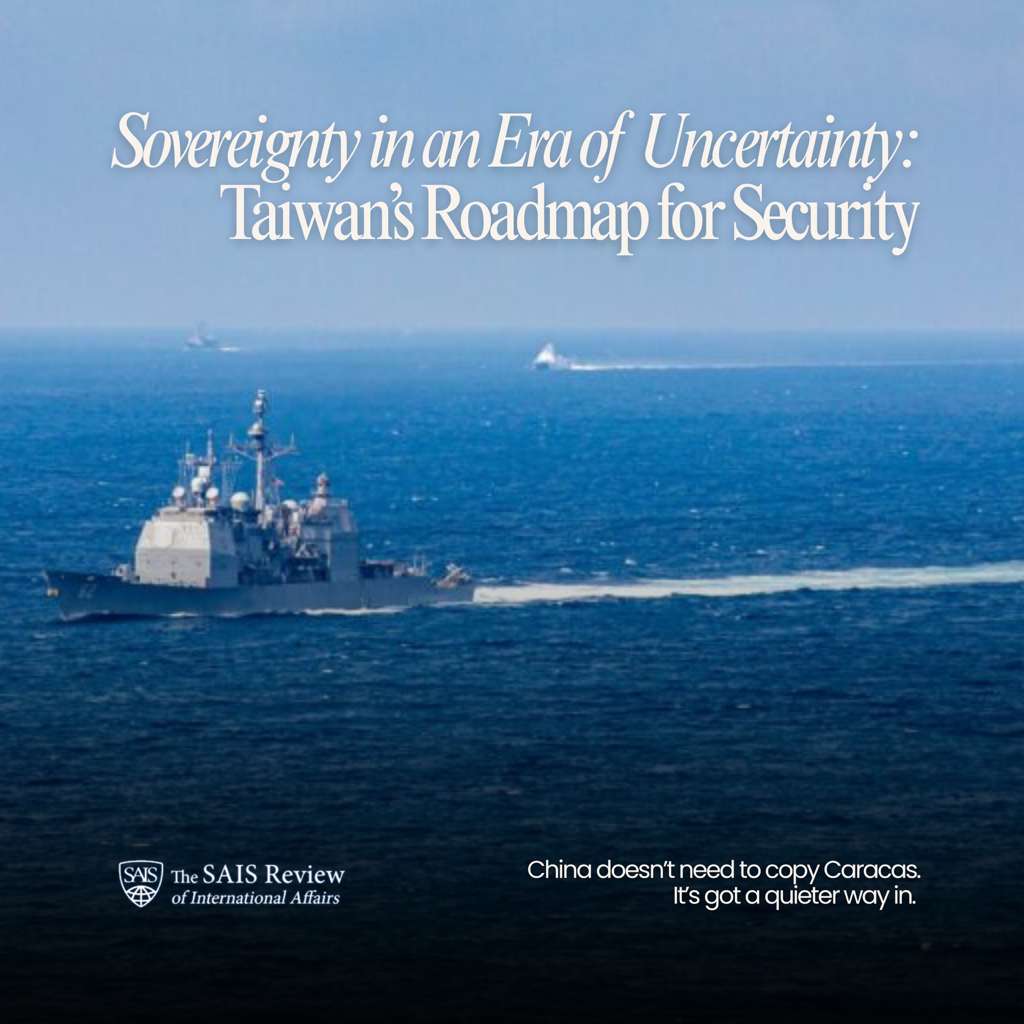
The answer for Taipei is to diversify its partnerships with Japan, the UK, and the EU, and to close the partisan gridlock over defense spending at home.
China doesn’t need to copy Caracas. It’s got a quieter way in.
@Sk_Nikhil13 argues in The SAIS Review that Beijing’s real playbook for Taiwan is gradual pressure, and that Taipei’s best defense is to stop relying on a single patron.
🔗: https://t.co/Yy0N8eYJA7
Meanwhile, Washington’s support has become strategic rather than ideological. The 2025 NSS values Taiwan for its chips and its geography, not its democracy.
Davis covers everything from the counterintelligence fallout and the risks of relying on third-party contractors to the implications of an offensive cyber response.
"You don’t need to be a nation-state to create a national security problem."
Fletcher Davis (@gymR4T), CEO of ArkLink and former principal red teamer, joins The Looking Glass to examine the September 2026 FBI breach and its consequences.
In September 2026, the cybercriminal group ShinyHunters breached the FBI’s online application system and exposed records on thousands of personnel, including agents working on sensitive investigations.
Havana does not need to win its standoff with Washington. It only needs to outlast it. In our US Midterm Election Special Edition and our first non-English article, Luiz Campos argues that Cuba is betting on time.
🔗 (EN): https://t.co/Ia7BnfdC9x
🔗 (ES): https://t.co/5x5cnOYxCf
HE @OmranSharaf, UAE Assistant Foreign Minister for Advanced Science & Technology, joined Aaryaman Shah on the Looking Glass podcast from @SAISReview to discuss the UAE's approach to AI governance and security & building a responsible tech ecosystem. https://t.co/Sulkel7zr3
Havana does not need to win its standoff with Washington. It only needs to outlast it. In our US Midterm Election Special Edition and our first non-English article, Luiz Campos argues that Cuba is betting on time.
🔗 (EN): https://t.co/Ia7BnfdC9x
🔗 (ES): https://t.co/5x5cnOYxCf
A negotiated deal that leaves Cuban President Miguel Díaz-Canel, widely seen as the leader most resistant to negotiating with Washington, in power could weaken the Republican position with Cuban-American voters in Florida.
A negotiated deal that leaves Cuban President Miguel Díaz-Canel, widely seen as the leader most resistant to negotiating with Washington, in power could weaken the Republican position with Cuban-American voters in Florida.
Havana is betting that Republicans lose Congress in November, giving a potential Democratic majority the tools to restrain President Trump’s Cuba policy. The midterms also constrain Washington before the vote.
✍️ Ambassador Shirin Tahir-Kheli, “A Disengaged United States at 250: The Rise of Middle Powers”
Allies now see the US-led order as “ruptured.” Amb. Tahir-Kheli looks at how Brazil, Canada, South Africa, and India are stepping into the space Washington is leaving.
Since 1776, America has been shaping the world, and the world has returned the favor.
On The Looking Glass, our authors sit down to unpack their articles, from the capture of Nicolás Maduro to the rise of middle powers. Here’s a behind-the-scenes moment with some of them.
✍️ Friedrich Conradi, “Chasing Hares: On the Failure of States in an Age of Transnational Crisis”
COVID-19 showed that states compete even when cooperation is the only way out. Conradi warns that climate change could follow the same pattern unless global civil society steps in.