Harvard to America: You're welcome. Experimental Drug Doubles Median Survival in Patients With Metastatic Pancreatic Cancer | Harvard Medical School https://t.co/GVHihS5rFm)
"The greatest sentence every written," as Walter Isaacson put it, laying out the rational prerequisites for morality, law, and government (notwithstanding the vague, deistic "creator"). This is what made America great: a nation conceived not in race, religion, or ethnicity, but in the ideals of the Enlightenment. https://t.co/AMACeWBtEk
Ever wonder what "the subjunctive" really is? A tense? A mood? Is it disappearing from modern English? And what's the deal with were in If I were a carpenter? All this and more in: The Sense of Style: The Thinking Person's Guide to Writing in the 21st Century: 9780143127796: Pinker, Steven: Books https://t.co/SHyhMRt1uI
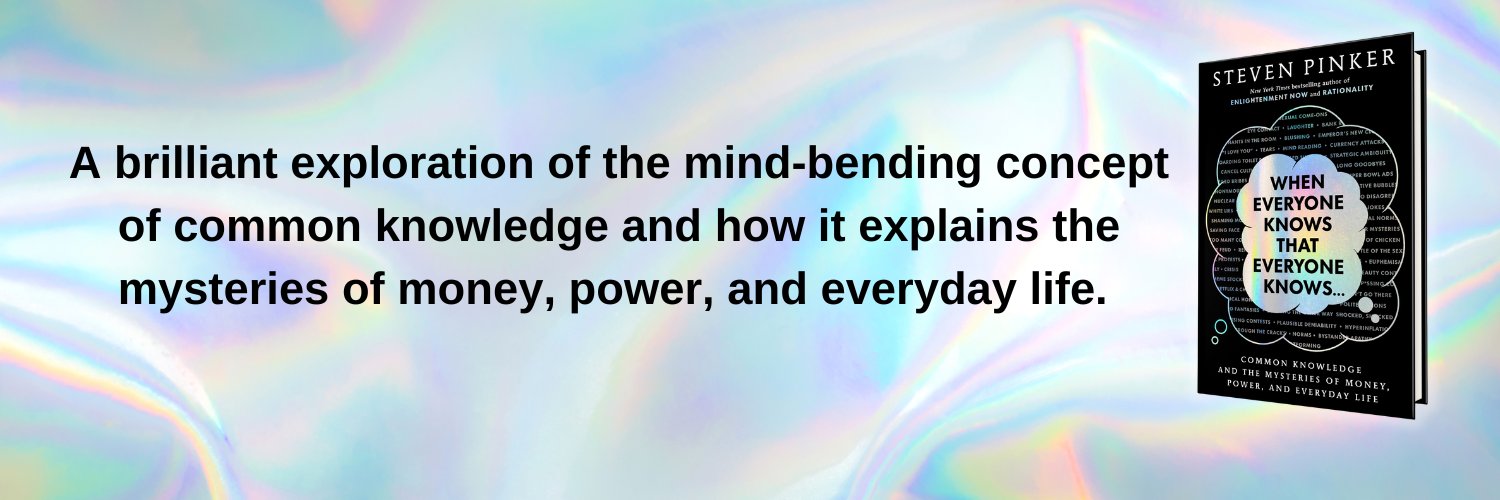
"How F.D.R.’s Most Famous Sentence ("The only thing we have to fear is fear itself") Remade America." I analyze it in WEKTEK as an illustration of the power of common knowledge (more precisely, common expectation) in driving economic phenomena: bank runs, panics, hoarding, inflation, currency attacks, runs for the exits, and in the other direction, bubbles, meme stocks, irrational exuberance. People act in the expectation that others will expect others to expect them to act, ad infinitum, triggered by a publicly salient announcement or event (in Roosevelt's case, reversing the reverberant doubt). https://t.co/DDjbtIhH3p
My top five bad arguments from this anti-robotaxi piece in @TheAtlantic:
🚫 Sure, 1.2 million die in car crashes each year, but "90% are in low- and middle-income countries, which are not in Waymo's expansion plans."
By that logic, why bother inventing vaccines? Most child deaths happen in the developing world anyway — except vaccines got rolled out everywhere, because adoption drives down cost. Smartphones weren't designed for poor Africans either, yet there are 700 millions of them in Africa now, with penetration rates around 70%.
🚫 Robotaxis could "displace millions of people employed as drivers."
So did the mechanical cotton picker, which replaced millions of stoop laborers. Does anyone wish that brutal work back? Before the industrial revolution, the vast majority of people worked in agriculture. Self-driving cars will actually help poor people by making private transportation affordable for everyone. Protecting low-wage jobs by forbidding the safer, cheaper alternative just traps people in poverty.
🚫 "When companies talk about safety… they just want to sell their product."
Sure, and so do the makers of seatbelts, fire extinguishers, and antibiotics. I guess you should never buy those? Companies profit from safety precisely because people value safety and will pay for it. That's not a gotcha; it's free markets working as advertised.
🚫 "The taxi is one of the few places we brush against other ways of living."
Nobody is banning human contact, not even in transportation. By all means, take a human Uber if you feel so inclined. Or chat with your barista, or strike up a conversation with a stranger on the street. Or pay for a human guide. Keeping people in dangerous, low-wage driving jobs is just using humans as set decoration.
🚫 "Studies show automated vehicles are less able to detect people of color."
This was a preprint. In the peer-reviewed version, the racial gap disappeared — a 29.71% vs 30.15% miss rate. And it tested generic open-source camera models, not Waymo, which navigates with lidar and radar, where skin tone is physically irrelevant. (See @KelseyTuoc's debunk: https://t.co/6dWXbnfM0I) Even if it were real, it would be a simple, solvable engineering problem. You're really clutching at straws.
✅ What the piece leaves out entirely: @Waymo reports ~92% fewer serious car crashes and ~92% fewer injury-causing pedestrian crashes than human drivers.
It's a shame that this was published in my favorite magazine @TheAtlantic, which is generally pro-progress and pro-abundance.
https://t.co/lnh6hDQXF8
‘Make American Great Again’ Was a Slogan Well Before Trump - The New York Times. (But make is not in the subjunctive mood in Reagan's Let's make America great again; it's a simple infinitive). https://t.co/iLwNhgA5SZ
I made similar arguments in the "Inequality" chapter of Enlightenment Now. "Strange" is an understatement when it comes to inequality in other measures like health: Would it be progress if tried to get the healthiest people do die sooner?
I find the political focus on inequality in this kind of work strange - as if one could make the poor better off just by making the rich worse off.
Inequality can sometimes have negative consequences that we should care about, but it's ethically confused to care about equality as an end in itself.
We should care about abundance, freedom, tolerance, beauty, knowledge, innovation, fairness, etc. - and only care about inequality when it threatens these other things.
The harms of social media (and AI relationships) are often explained by conspiracy theories blamed the problems on companies' profit motives, nefarious algorithms, & other malevolence. But the tech is harm-neutral on the face of it, and few predicted the problems when the tech was introduced, before billions of people put it to their own uses. A more insightful analysis, I think, is the analogy with junk food: human nature sometimes makes us want things that in excess are bad for us (social competition, solitude, virtue signaling) and the tech inadvertently enables that excess. Two examples of this argument: Is Social Media Destroying Democracy—Or Giving It To Us Good And Hard? https://t.co/hsP57g57EQ
Though battle deaths per capita and autocracy have crept upward in the past few years (while still well below 20th-century rates), most other indexes of nonviolence and well-being continue their progress and are at historical records. One example: decriminalization of homosexuality.
On the fiftieth anniversary of my own graduation from university, I was asked to write a commencement essay for the Harvard class of '26: Reflections on Half a Century of Progress | The Harvard Crimson https://t.co/yZFJJN9PUH
Are you neither woke nor MAGA nor complacent about contemporary liberalism? Normies of the world unite! LibCon2026 | Liberalism for the 21st Century. (I spoke at the debut conference last year - it was inspiring and fun.) https://t.co/IHOzuyIuWP
Was Donald Trump influenced by abstruse French literary theory? Not exactly, but he is its most powerful practitioner: Welcome to the Postmodern Presidency, by @DamonLinker. https://t.co/8MDK4GEOpa
A radical rumination by international relations scholar John Mueller: "Might the Iran War lead to lasting peace in the Middle East?" https://t.co/zEH1gGy0FH
"The British Used to Sound Like We (Americans) Did, explains @JohnHMcWhorter: British English at the time of early colonization was "rhotic" (they pronounced r's after vowels: they would have parked their cars if they had any). Southern British toffs dropped r's starting in the late 18th, and coastal Americans with British ties and Britain envy copied them, pahking their cahs. But settlement matters too: Canadians, with even closer ties to the mother country, kept their r's, probably because more of them came from northern England, Scotland, Ulster, & Ireland, or were British loyalists who defected from the American revolution when even coastal Americans were rhotic. https://t.co/dvBCmLx7Zg
"The British Used to Sound Like We (Americans) Did, explains @JohnHMcWhorter: British English at the time of early colonization was "rhotic" (they pronounced r's after vowels: they would have parked their cars if they had any). Southern British toffs dropped r's starting in the late 18th, and coastal Americans with British ties and Britain envy copied them, pahking their cahs. But settlement matters too: Canadians, with even closer ties to the mother country, kept their r's, probably because more of them came from northern England, Scotland, Ulster, & Ireland, or were British loyalists who defected from the American revolution when even coastal Americans were rhotic. https://t.co/dvBCmLx7Zg