Can AI discover new physics, or only do math?
My proposed test: train a model only on physics known before 1900. If it can't rediscover special relativity, it won't find the next Einstein.
Would it get there? Full conversation with Hans Busstra:
https://t.co/DTZ63Lumbc
Microsoft crashed last week.
Fortunately, Voyager 1 was programmed in assembly language back in 1977.
Imagine getting the Blue Screen of Death at 0.99999 light-days from Earth.
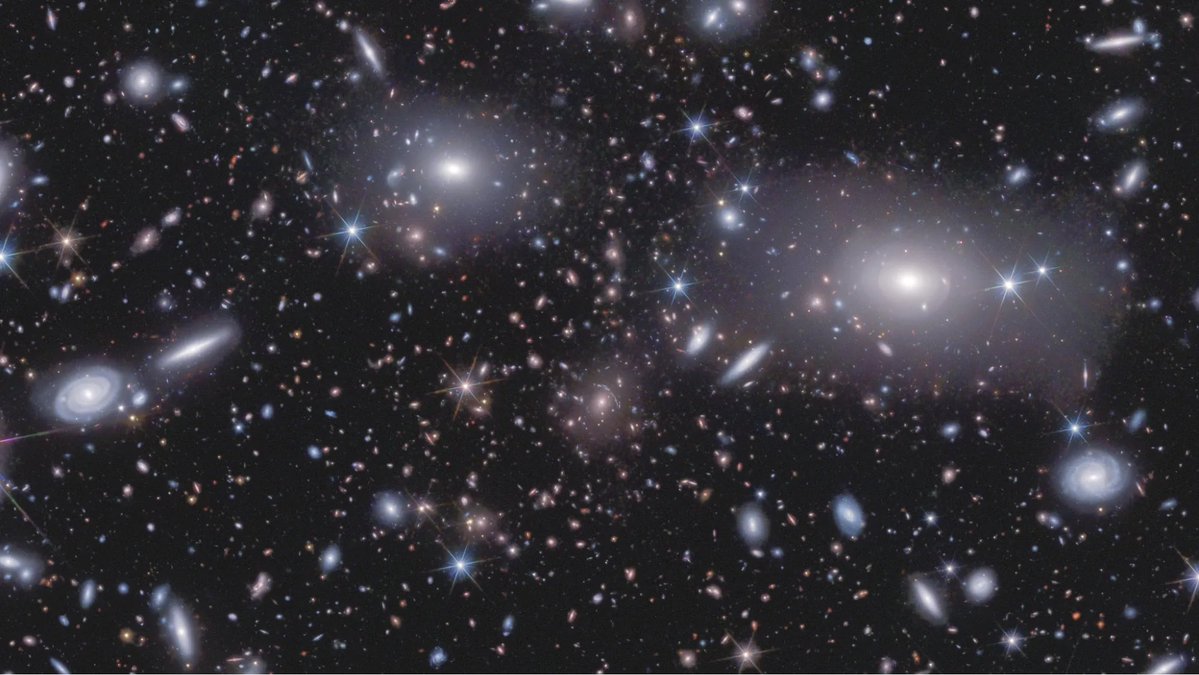
900 million galaxies. One data release. Free to the public.
@ESA_Euclid just gave cosmologists a spectacular headache.
We can map the universe in extraordinary detail, yet still can't explain why its expansion is accelerating or not.
If you've got a theory about dark energy, cancel your weekend plans. Mine are already ruined.
https://t.co/gdnM3Wxrhs
I pointed my backyard telescope at a galaxy 25 million light years away and caught it mid-firework.
NGC 6946 has produced ten supernovae in the last century, roughly ten times the rate of the Milky Way despite having far fewer stars. The same process that builds the elements in our blood is running hotter there, and we still do not know why the difference is so large.
Thought experiment I actually want to run:
Train an AI only on physics known before 1900. Maxwell, Michelson-Morley, all of it. Then see whether it invents special relativity on its own.
If it can't rediscover Einstein, it's not finding the next one.
Does it get there? Yes, no, or only with a human nudging it?
Full conversation with Hans Busstra:
https://t.co/3Kjf5r5Wkd
I pointed my backyard telescope at a galaxy 25 million light years away and caught it mid-firework.
NGC 6946 has produced ten supernovae in the last century, roughly ten times the rate of the Milky Way despite having far fewer stars. The same process that builds the elements in our blood is running hotter there, and we still do not know why the difference is so large.
Can AI discover new physics, or only do math?
My proposed test: train a model only on physics known before 1900. If it can't rediscover special relativity, it won't find the next Einstein.
Would it get there? Full conversation with Hans Busstra:
https://t.co/DTZ63Lumbc
Princeton Mathematician: The AI Singularity Is Absurd
Sergiu Klainerman is the Eugene Higgins Professor of Mathematics at Princeton. With Demetrios Christodoulou, he proved that empty spacetime, Minkowski space, is nonlinearly stable under Einstein's equations. That sounds technical. It is the difference between a solution that counts as physics and a solution that is only a ghost on paper.
In this conversation we talk about why slowly rotating black holes pass that stability test and why wormholes fail it. We talk about shocks that form no matter how small the nudge, about whether AI could reproduce a landmark proof, and about why Klainerman calls the AI singularity story absurd. He also has blunt advice for a 19-year-old who wants to do real mathematics, and a clear view of what universities still owe their students.
If you have been wondering which big claims in physics and AI survive a hard look, this is fifty minutes of a mathematician who has spent his career drawing that line.
Watch the video here: https://t.co/oRstIJ2bnb