The Deep Tech Week season has wrapped for 2026
This year we expanded to 5 new cities: Seattle, Berlin, Austin, Washington DC, and London.
Next year we'll add another 5 cities targeting Boston, Los Angeles, Bangalore, Paris, Zurich, and Denver
Lets create a Golden Age
Nicholas Kelez explains how more EUV light improves chip patterning.
“ultimately lithography is a stochastic process, so having more light actually gives you better patterning.”
@xLight_inc
Ben Nowack presented Reflect Orbital at SF Deep Tech Week 2025
Here he explains the basic concept, mechanics, use case and economics
Along with an explainer on the physics and mechanics of orbital mirror relays in Sun-Synchronous Orbit
@bennbuilds@reflectorbital
We’ve raised $73.5M, bringing total funding to more than $100M.
Huge thanks to existing investors @sequoia , @Lux_Capital and @starship_vc and new investors, including @BuckleyVentures, @convectivecap, @UncommonGP and @SalesforceVC.
They’re amazing partners and we’re fortunate to be on this journey with them!
Our first demonstration mission, planned for the second quarter of 2027, will test how our reflectors unfold in orbit.
We continue to build thoughtfully and will share research on how our technology interacts with the world around it soon.
Onward!
https://t.co/cPzmolGtOh
Edward Mehr explains why one manufacturing process cannot do everything.
“Bring everything in house and then allows you to move fast.”
@edmehr @MachinaLabs_
Mike Carter explains what a 1960 textbook taught a shipping founder.
“The first textbook I received was the Modern Marine Engineer's Manual that was written in 1960.”
@FleetzeroHQ
Goutham Subramanian explains the idea behind finding rare scenarios in a petabyte of ocean data.
“Now, to scale solutions like this, to scale ground truthing, to scale building evals, you also need really good data set management.”
@Saronic
Boom will be unusually quiet about details of our single crystal turbine tech. AFAIK we are years ahead of any other foundry—particularly those in China—so we will keep our work under wraps.
I usually love building in public but in this case it would not be responsible.
The Robocraftsman is a new manufacturing primitive, an entirely new way of metal forming that is immediately scalable and flexible, that can perform sheet forming, trimming, and scanning
Here you can see @EdwardMehr explain exactly how they've designed their flexible modular manufacturing to be easily and quickly deployable, running off a portable generator that fits in the back of a pickup truck.
Bloomberg: The Pentagon has tasked US robotics startup Machina Labs with trying to mass-produce cheap attack drones in quickly assembled modular factories as autonomous systems continue to change modern warfare. Link in comment
You would've seen this coming months in advance if you had been at the @deeptechweek SF 2026 event hosted by @Playground_VC
See the introductory physics beyond launching 20,000 megawatt data centers into sun synchronous orbit.
Giddy up, Space Cowboy @CowboySpaceCorp
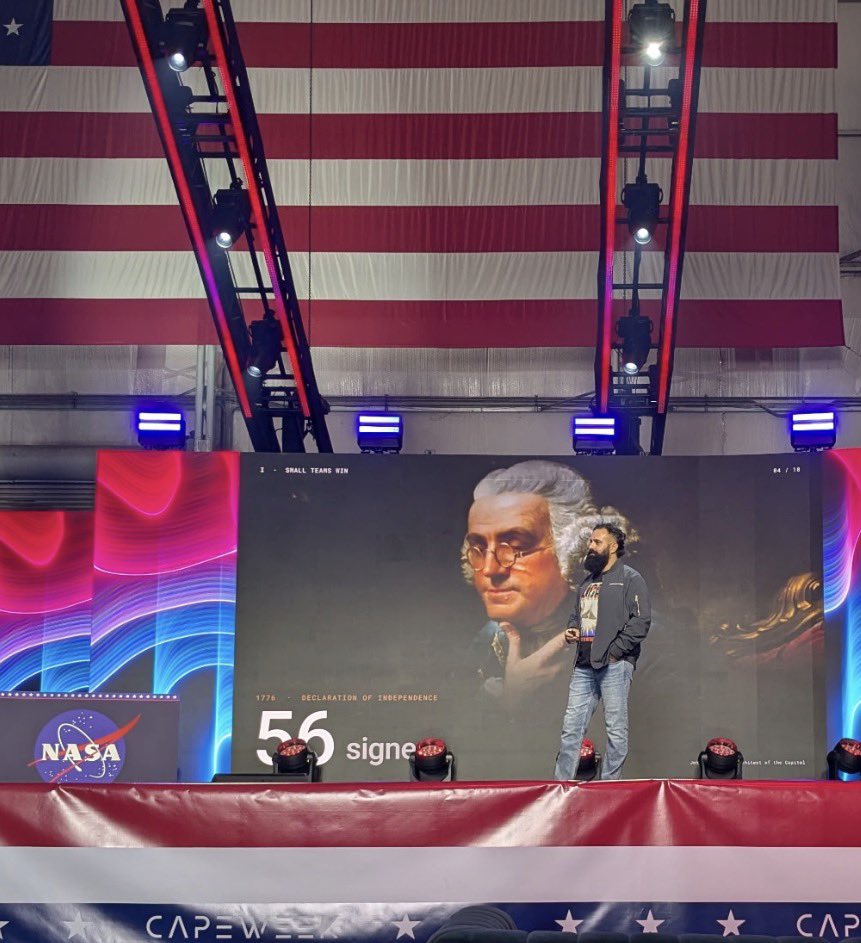
DC Deep Tech Week has officially wrapped.
Across six days, the program drew 3,691 unique registered attendees—including 695 founders—to 26 public events throughout Washington, DC and Northern Virginia.
Twenty-eight startups and 47 organizations presented across a week of founder talks, technical presentations, panels, demonstrations, screenings, roundtables, showcases, startup crawls and community gatherings.
Thank you to the hosts, organizing partners, venues and sponsors who made the week possible
https://t.co/xIyx0oz2mu
The United States of America is the only country on the planet with the capacity and foresight to bring humanity to the stars, and not in the name of a totalitarian political ideology, but as is stated in NASA's founding charter: For All Mankind.
Now, by any reasonable measure the technology and engineering skills required to construct a permanent human settlement on the moon was developed in the 1960s, mature and tested in DoE and NASA laboratories by the 1970s, and then shelved for four decades as America fought a different battle - against inflation, against religious extremism, and in the recent culture wars, against itself.
Today we face a different frontier and a more worthy adversary, the laws of physics, of material science, of electrical engineering and mechanical design, as Deep Tech Startups across the country are taking up the plans for fusion reactors, nuclear batteries, nuclear rockets, supersonic jets, lunar habitats, deep space communications, designs straight out of government funded white papers of the Cold War, and invigorating them with the leaps and bounds made since then in information processing, in compute density, robotics, automation, telecommunications, and artificial intelligence.
It was the defense industry that made possible both nuclear energy and the space industry, and today the defense industry is in the process of reinventing itself as new technology companies race to develop capacities that would protect the national interests of the country taking humanity to the stars.
It's not just defense, nuclear energy, aerospace, and the orbital economy, but all these things at once and combined together that will make humanity a space faring civilization
For all these reasons, and thanks to @FrankVTaylor, @deeptechweek is coming to Washington DC.
In just three weeks.
A stacked lineup of venture funds in defense and energy - @levelfivevc@KdT_ventures@venturesveteran@brave_cap@newVistaCap@redcellPartners@p72vc Squadra Ventures, Fulcum Venture Group, Cerberus Ventures
Just a sample of some of the startups participating: @TheNuclearCo@CowboySpaceCorp@TokamakEnergy@ElectraAero@phantom_neuro@zeno_power@AON3D@hiddenlevelinc@vatnsystems and Exodus Propulsion
Along with @deeptechagency@Fusion_Industry@SpaceWERXDOD@DIU_x@NSWCCarderock@jbgsmith@AEDBizInvest@SiliconVlyBank@Technical_ly
And everyones favorite nuclear influencers @isodope and @energybants
We're excited to announce a headline speaker for Washington DC's first ever Deep Tech Week, Major General Joseph Kunkel the Military Deputy of Department of War's Innovation Unit.
While these days he leads the effort to identify new technologies suitable for areas of operational innovation, in his early career he was an F-22 Pilot with over 2,776 flying hours.
Fourteen months before he established cloud seeding as a viable industry, @adoricko presented at @deeptechweek and explained the metrics and methods by which precipitation is induced via drones and verified via radar
The unicorns of tomorrow can be found at Deep Tech Week today
Rainmaker just produced ~19M gallons of water in Alaska via next-gen cloud seeding over 3 hours of operations.
We are the first company to provably produce precipitation in Alaska. As promised, we’ve linked our white paper and relevant data.
In the future, Rainmaker will protect and restore glaciers with man-made snowfall.
Immediately, this demonstration shows how Rainmaker will add new water to the Colorado River and Great Salt Lake in the coming months.
We turned around this analysis and white paper just a couple days after operating. There are many data sources I want to deepen our understanding of the atmosphere and increase our provable production; we’re building the instruments to collect that data in subsequent operations. But at Rainmaker, we won’t tout LOIs, simulations, or lab tests. What matters is physically measuring that you’ve affected the atmosphere; proving that we’ve produced water. We prefer sharing only the tech that has proven to make more water for farms, industries, and ecosystems in need.
Expect a regular cadence of these from us as we build the best atmospheric science lab in the world. Feedback is welcome in the interim.
Rainmaker Century.
https://t.co/QZikxP1KyH
The reality is we could've easily mastered energy, food, and material abundance with 1970s era Technology.
Instead, we loaded up on virtue signaling, stakeholder engagement, and regulatory capture.
I call this general phenomenon "The Blight"
In this never before seen talk, @ericweinstein explains the limitations of Einsteins General Relativity and the necessity of 'escaping' the model of a 4D spacetime if humanity is to ever make meaningful progress in leaving the solar system, and, where modern physics went wrong.
hosted by @M31Capital at NYC @deeptechweek 2026
Global production of high-temperature superconducting wire is being driven to millions of kilometers per year, first driven by nuclear fusion, but soon spilling over into power generation, transmission, data center design
Zero electrical resistance changes everything
The science fiction future is inevitable.
The space of possible future timelines is dominated by those trillions of thriving off-world humans colonizing the galaxy.
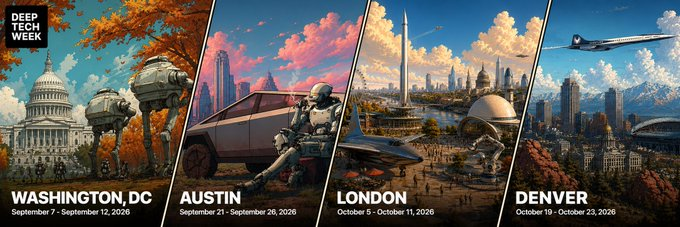
Come see it live:
Washington DC, Sept 7-12
Austin TX, Sept 21-26
London UK, Oct 5-11
Denver CO, Oct 19-23