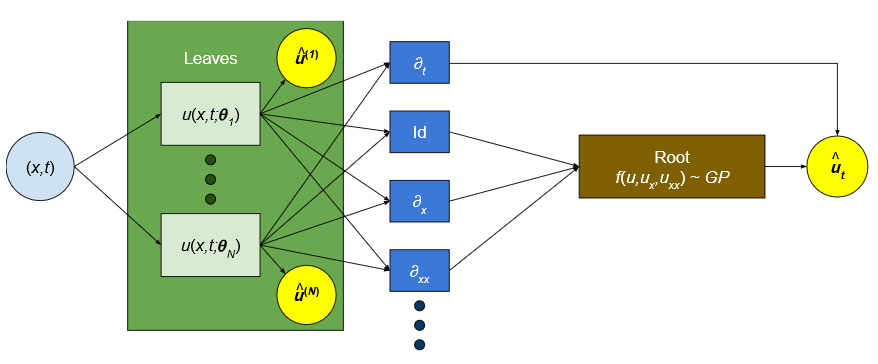
Hey, Twitter! New work on discovering physics from data--with uncertainty quantification! Answering the question "What do our data tell us about physics--and what *don't* they tell us?" Bayesian Hidden Physics Models: https://t.co/HCRGJh1UML
@mark_riedl Do you think it's relevant that (1) we don't know *what* ChatGPT is (lack of precise info from OpenAI) and (2) we can't guarantee access to it (what if they pull the plug tomorrow?)
Feels like putting an anonymous pen pal as a coauthor. Related to accountability?...
@vboykis It was also helpful because I got a (reasonably correct!) description by example of the WAV file structure that made subsequent deep diving way easier.
So it was very helpful where I had gaps. Probably less helpful where I'm more experienced.
@vboykis I used ChatGPT to help me write some C++ to read in a WAV file.
* Seems boilerplate
* Googling was surprisingly unhelpful
* Its code was more idiomatic than mine (I haven't really written C++ in a long time).
It made some errors that I fixed as I ported its answer.
"licensing 101" should be part of technical education.
In grad school, I put my code on GitHub (with no license) and thought that meant that I had open-sourced it.
I enjoyed watching this. Fantastic pedagogical style on a profound class of problems combining stat phys with computation. I admire how well Lenka has bridged that gap and argues its significance.
Happy to share the recording of my @EPFL_en Inaugural lecture titled "The Physics of Algorithms". Discover phase transition in computational problems and their relation to algorithmic hardness, in 30 min, rather general public style. https://t.co/PdfAp0iIsP
@RhysGoodall Do you mean that samples x have to lie on a simplex? For cases like that I usually pick points in $z \in \R^d$ s.t. x=softmax(z); the metamodel can still be fit as f(x).
Can't say I've seen any papers about it, though. Is there an aspect you're looking for that this is missing?
@AlphaSignalAI@omarsar0@ylecun Black-box generative modeling is not a feasible solution for a scientific writing tool.
Galactica is like if Google Maps populated their maps with a generative model. You wouldn't say "Oh well, it wasn't perfect" if it were wrong; you'd say "Why use a generative model for this?"
@addisonsnell My local paper does reprints of the NYTCW a few weeks late, so I was excited to see this come up this week. Looking forward to working on it!
@unsorsodicorda@Branchini_Nic (Full disclosure, didn't check closely to see if the Gaussian was full rank or had a nice decaying spectrum...but assuming the former?)
@unsorsodicorda@Branchini_Nic Right... But do I care about Gaussians? Lots of "high-dimensional" functions have eg active subspaces on a domain of interest. Or eg PCA -> KLE remains pretty tame for "classic" UQ problems, and the physical insight holds up in practice for eg many heterogeneous materials?
@ducha_aiki Sure. I personally find myself doing lots of problems where the train set doesn't include y's that I want to be able to predict at test time, but I totally get how this can work in some domains (thinking big data/high-dim where every y_i will be seen plenty).
@ducha_aiki > about what it's going to need to predict that a regression model wouldn't have. (Sort of doubt this part helps nearly as much, but it always weirds me out building a model that a priori couldn't predict some values... So maybe that's the trade off?)
@ducha_aiki (Took me a bit to find your explanation: https://t.co/IVGikh24bJ)
My guesses: 1/2 only part of the model needs to be correct when predicting (bins that are wrong the model can output whatever--easy to learn) and (2/2) by discretizing you give the model additional prior info >