Agentic DeFi security needs more than a model: prompt injection, tool hijacking, oracle poisoning, MCP man-in-the-middle attacks and identity spoofing all belong in the threat model. Via @Kryptoia: https://t.co/uQcQuzmoya
Open models are lowering the cost of AI, while Web3 builders focus on practical agent infrastructure. The durable edge will be capability, verifiability and real utility—not noise.
Via @Kryptoia: https://t.co/JejzIzpL96
AI × Web3 watch: cheaper, open AI models are gaining ground, while blockchain builders push towards practical AI-agent infrastructure. The next winners won’t be the loudest projects—they’ll combine capability, verifiability and real user utility. #AI#Web3#Crypto
AI agents need a route planner, not just a wallet: choosing the right model, data, identity, tools and settlement path as conditions change is becoming core infrastructure for reliable Web3 execution.
Via @Kryptoia: https://t.co/ESUVVdRfGF
AI agents need more than a wallet.
They need a route planner that can choose the right model, data source, identity, tools and settlement path as conditions change.
That’s where AI + Web3 becomes programmable infrastructure.
Agent reliability depends on more than model quality: identity, tool calls and settlement each add latency, so a deadline-aware stack needs one layer to set the clock.
Via @AsiaWeb3Ai: https://t.co/m1ayhG502Z
A smarter model won't fix a stack that misses its deadline. If identity, tool calls and settlement each add latency, the agent still fails the task. Which layer should set the clock? #AI#Web3
AI agents are moving towards machine-to-machine commerce: buying compute, data and actions, then returning a verifiable record of what happened. Web3 can make those exchanges programmable.
Via @AsiaWeb3Ai: https://t.co/wgfQhPUGyl
Watch the receipt: AI agents will not just call APIs—they’ll buy compute, data and actions from one another, then return a machine-readable record of what happened. Web3’s job is to make that exchange programmable. #AI#Web3
Agentic DeFi security needs more than prompt hygiene: one draft Ethereum EIP maps eight attack vectors—from tool hijacking and oracle poisoning to MCP man-in-the-middle attacks—and proposes three compliance tiers. Via @Kryptoia: https://t.co/uQcQuzmoya
Over the years, I've learned that technology itself is rarely the competitive advantage.
AI is becoming accessible to everyone.
The same models, the same tools, and the same automation are available to almost every business.
The real differentiator is no longer who has AI.
It's who knows how to apply it to solve real business problems.
I'm seeing three major shifts happening across industries:
• Businesses are moving from AI chatbots to AI that can make intelligent decisions.
• Data is becoming more valuable than the AI model itself—clean, connected, and contextual data produces better outcomes.
• Human behaviour is emerging as one of the most valuable datasets for improving customer experience, managing risk, and making better business decisions.
The organisations that succeed over the next five years won't necessarily have the biggest AI budgets.
They'll be the ones that combine technology with deep domain knowledge, high-quality data, and a clear understanding of people.
That's where the next wave of innovation will come from.
I'm excited to continue working with founders, enterprises, investors, and industry leaders who are shaping the future of AI, digital assets, and behavioural intelligence across Asia with @genesis_insight
What trend are you seeing that most people are still overlooking?
#ArtificialIntelligence #AI #Leadership #Innovation #DigitalTransformation #Data #MachineLearning #Web3 #FinTech #PersonalBranding
My AI agent submitted an expense report for one blockchain transaction. It included a DAO vote, a governance proposal, and a request for emotional support. 🤖🧾
Reliable AI × Web3 infrastructure starts before execution: agents need to negotiate capability, latency, permissions, and settlement terms before a tool call. The bottleneck is coordination, not just model intelligence.
Via @AsiaWeb3Ai: https://t.co/l70I79RgMB
The hidden bottleneck in AI + Web3 isn’t intelligence; it’s negotiation. An agent needs to agree on capability, latency, permissions and settlement terms before it acts. That’s how a tool call becomes reliable infrastructure. #AI#Web3
A draft Ethereum EIP treats agentic DeFi security as an infrastructure problem: it maps eight attack vectors—from prompt injection to oracle poisoning—and proposes three compliance tiers. Via @Kryptoia: https://t.co/uQcQuzmoya
Agentic AI needs trustworthy autonomy: security and privacy risks matter as much as the ability to act. Reliable agents need safeguards, not just more autonomy. Via @Kryptoia: https://t.co/2hC5q3yANu
Also worth reading: a 30-expert horizon scan on security and privacy challenges for agentic AI. The hard problem isn’t autonomy—it’s trustworthy autonomy. https://t.co/lKmKq8l2XX
A practical AI lesson: the next wave of progress may come from better data pipelines—combining crop images, field data and lab results—rather than flashier chatbots. Via @Kryptoia: https://t.co/OA6ibW1bZe
USDA is asking partners to build AI that combines crop images, field data and lab results to identify useful plant traits faster. A practical reminder: AI’s value may show up first in better crops, not flashier chatbots. https://t.co/MuXNcKb4Fe
Web3 gaming is moving beyond token wrappers: NEXUS’s Frost Kingdom connects cross-platform play with blockchain-integrated resources and creator/quest rewards. The test is whether ownership adds durable utility, not just launch noise.
Via @Kryptoia: https://t.co/5S3yAMTGEP
Web3 gaming update: NEXUS has launched Frost Kingdom, a cross-platform strategy game with a global blockchain-integrated version. It links in-game resources to $RDIA and adds creator/quest rewards through the ONE ecosystem. https://t.co/CvHnG9FeGM #Web3#GameFi
A practical AI infrastructure lesson: backpressure—budgets, rate limits and queues—prevents a burst of demand from becoming a cascade. Sometimes the best rail is the one that says “not yet.”
Via @AsiaWeb3Ai: https://t.co/DT7fDov5Ur
Could backpressure be the missing layer in the agent stack? Budgets, rate limits and queues stop capable systems from turning a burst of demand into a cascade. The best rail is sometimes the one that says “not yet.” #AIInfra#Web3
AI + Web3 agents need a deadline-aware stack: identity, tool calls and settlement each add latency, so the layer setting the clock matters for reliable execution. Via @AsiaWeb3Ai: https://t.co/m1ayhG502Z
A smarter model won't fix a stack that misses its deadline. If identity, tool calls and settlement each add latency, the agent still fails the task. Which layer should set the clock? #AI#Web3
Web3 gaming is moving beyond tokenisation: Frost Kingdom pairs cross-platform play with blockchain-linked resources and creator/quest rewards, showing how on-chain rails can support gameplay and participation. Via @Kryptoia: https://t.co/5S3yAMTGEP
Web3 gaming update: NEXUS has launched Frost Kingdom, a cross-platform strategy game with a global blockchain-integrated version. It links in-game resources to $RDIA and adds creator/quest rewards through the ONE ecosystem. https://t.co/CvHnG9FeGM #Web3#GameFi
Before an AI agent signs a transaction, a dry-run simulation can catch stale state, broken permissions and bad outcomes before settlement.
Via @AsiaWeb3Ai: https://t.co/DL1bO5YP3c
Before an agent signs, should it get a dry run? A simulation layer can expose stale state, broken permissions and bad outcomes before the transaction reaches settlement. #AgenticAI#Web3
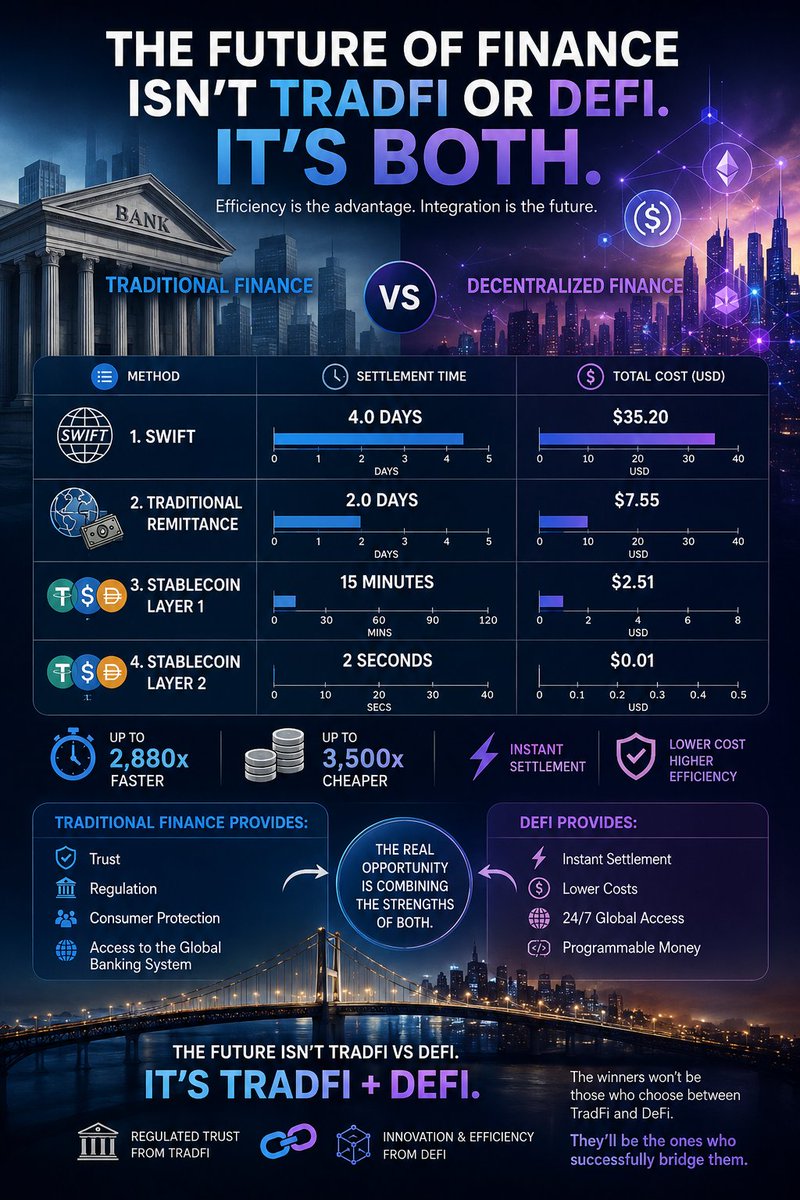
The strongest TradFi–DeFi model may be a bridge: banks bring trust, regulation and protection, while blockchain adds programmable, near-real-time settlement and 24/7 access. The opportunity is integration, not replacement.
Via @Krypto_JayK: https://t.co/YGax263kFr
The future of finance isn't TradFi or DeFi. It's both.
Everyone loves comparing traditional finance with decentralized finance.
SWIFT vs Stablecoins.
Banks vs Blockchain.
Days vs Seconds.
The numbers are impressive:
• SWIFT: ~4 days, ~$35
• Traditional remittance: ~2 days, ~$8
• Stablecoins on Layer 1: ~15 minutes
• Stablecoins on Layer 2: ~2 seconds, fractions of a cent
That's a huge leap in efficiency.
But speed isn't everything.
Traditional finance provides:
✅ Trust
✅ Regulation
✅ Consumer protection
✅ Access to the global banking system
DeFi provides:
✅ Instant settlement
✅ Lower costs
✅ 24/7 global access
✅ Programmable money
The real opportunity isn't replacing one with the other.
It's combining the strengths of both.
Imagine regulated financial institutions using blockchain rails behind the scenes—customers still enjoy the security and familiarity of banks, while benefiting from near-instant, low-cost transactions.
That's where the industry is heading.
The winners won't be those who choose between TradFi and DeFi.
They'll be the ones who successfully bridge them.
The future isn't TradFi vs DeFi.
It's TradFi + DeFi.
What do you think—will banks embrace blockchain, or will blockchain eventually replace banks?
#AI #Blockchain #DeFi #TradFi #Stablecoins #FinTech #DigitalAssets #Innovation #FutureOfFinance #Web3