Erin Brockovich's latest project is a website to report and track data center construction across the country:
"The race to build AI infrastructures is unfolding town by town across America... This map captures the real-world footprint of that race — revealing patterns of growth, conflict and uncertainty."
Brands cited in Google's AI Overviews get 120% more clicks per impression than brands that are not cited on the same search result.
AI Overview click-through rates just grew 85% in two months.
Is your website optimizing for AI Overviews?
If you're not, but want to, let's break down exactly what it takes to take advantage.
According to Seer Interactive's April 2026 analysis of 53 brands, 5.47 million queries, and 2.43 billion impressions, organic CTR on AI Overview queries rebounded from 1.3% in December 2025 to 2.4% in February 2026.
On informational queries where AI Overviews appear, brands that are cited earn approximately 20,700 organic clicks per million impressions.
Brands that are not cited earn approximately 9,400 clicks per million impressions on the same SERP.
That is 120% more clicks for the cited brand.
And that is what SEO Stuff (https://t.co/wKpf0EILTx) helps businesses build.
If you want to see where your site stands across Google and AI search, start here (it's free):
https://t.co/Pn764BHwyL)
As things stand, when a buyer searches a query that triggers an AI Overview, Google assembles an answer and cites sources within it.
The buyer sees those cited brands at the top of the page, inside the AI answer, before they ever scroll to the organic results below.
And as AI Overviews continue expanding across more queries and more categories, that gap compounds. Every query where your brand earns a citation is a query where you are pulling ahead of uncited competitors by a factor of two.
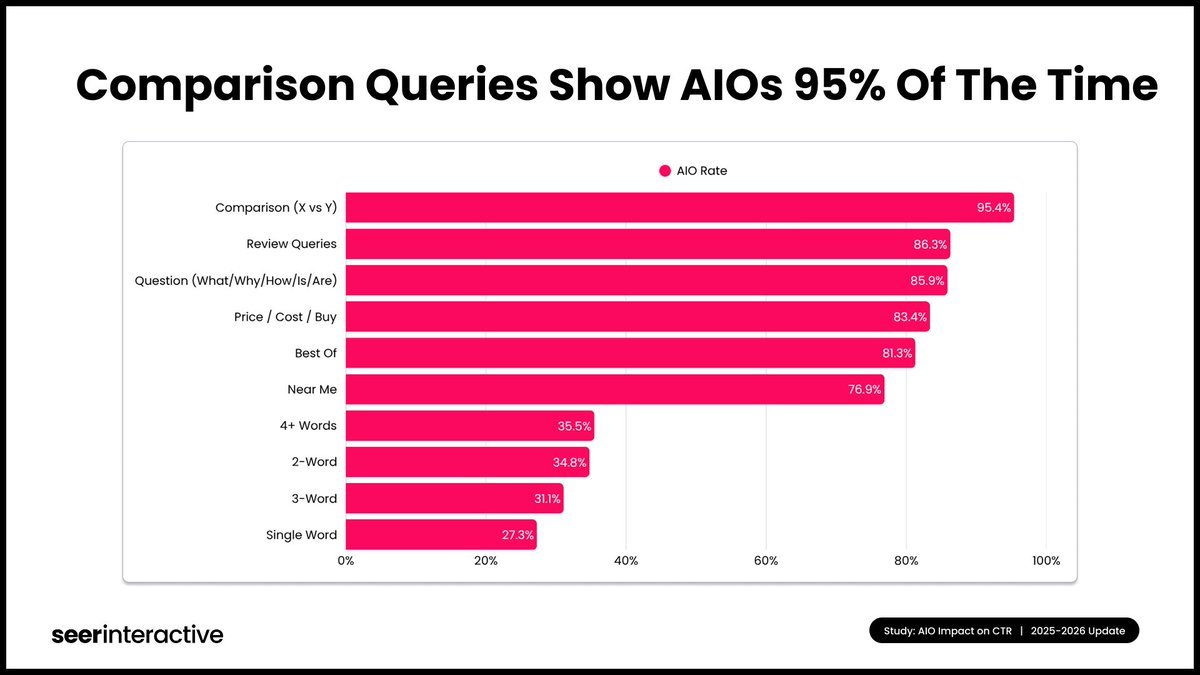
According to Seer's data, comparison queries trigger AI Overviews 95.4% of the time. Question queries trigger them 85.9% of the time.
These are the queries where buyers are actively evaluating options.
The brands capturing that click advantage share two things.
The first is content depth. AI Overviews break queries into sub-questions and pull sources for each one. The brands with comprehensive content covering the full question map in their category are the ones showing up in the AI's retrieval pool. Every sub-question your content answers is another opportunity to earn a citation.
The second is authority. The AI retrieves dozens of potential sources for every answer. The ones it actually cites are the ones with the strongest authority signals. Without that authority, your content might be in the retrieval pool but it is not getting selected for the citation.
Remember, if you want to see which queries in your category are triggering AI Overviews and whether your brand is earning the citation advantage on those queries, start here (it's free):
https://t.co/Pn764BHwyL
So what should you be doing?
Well build the content depth that earns AI Overview citations on the queries that matter in your category.
Invest in editorial authority that makes the AI choose your content for citation. The retrieval pool is crowded.
This is the system SEO Stuff (https://t.co/wKpf0EILTx) was built around.
The done-for-you package:
https://t.co/yEFyM0Ze7W
Expert-attributed content backed by DR50+ backlinks: the content depth and authority that earns AI Overview citations, capturing the 120% click advantage over uncited competitors on the same search results
The content package:
https://t.co/4CAnUt07PO
60 pages of expert-attributed content covering every question buyers ask in your category, so your brand appears in the AI's retrieval pool across the comparison and question queries that trigger AI Overviews 85% to 95% of the time
The authority-building package:
https://t.co/Z9m9D7TjES
Editorial authority from trusted publishers that makes the AI cite your content over every other source in the retrieval pool, giving you 120% more clicks than uncited competitors on the same queries
Brands cited in AI Overviews get 120% more clicks than uncited brands on the same search result.
AI Overview CTR just rebounded 85% in two months.
The brands earning citations are pulling away. The brands that are not cited are falling behind on the queries that matter most.
And remember, if you want to see which queries in your category are triggering AI Overviews and whether your brand is earning the citation advantage on those queries, start here (it's free):
https://t.co/Pn764BHwyL
Anthropic just paid millions to hire Andrej Karpathy.
He gave you the same knowledge for $0 the same week.
Co-founder of OpenAI. Former head of AI at Tesla. The man who coined vibe coding.
No recruitment fee. No exclusive access. Just a link and 29 minutes.
LLMs are ghosts not animals.
Vibe coding is dead.
Software 3.0 is here.
Watch it.
Then read this.
Because Karpathy tells you what Software 3.0 is.
This shows you how to build one - a software factory with Claude Code that ships features while you sleep.
The full build guide is below.
We’ve shipped a security-guidance plugin for Claude Code that helps identify and fix vulnerabilities as you’re writing code.
Available for all Claude Code users. Install from the plugin marketplace (/plugins).
Google recently filed a massive lawsuit.
In doing so they accidentally revealed how ChatGPT and all of AI search actually works.
They also quietly exposed how SEO Stuff (https://t.co/wKpf0EILTx) has been getting customers traffic and sales from Google and ChatGPT over the past 12 months.
Let's start at the beginning.
If you missed it, a few months ago Google sued SerpApi, accusing it of bypassing security controls to scrape and resell Google Search results at scale.
That alone is a big deal.
There have been a lot of credible reports suggesting that OpenAI used SerpApi pipelines to access Google Search results for real-time answers inside ChatGPT.
Google claims SerpApi utilizes automated systems to send hundreds of millions of requests (resulting in a 25,000% increase in scraping volume over two years) to sell real-time search data and power AI models.
This is all really important because it is a reminder that AI search systems didn’t magically replace search with some random thing.
[Want to know how your site is showing up in ChatGPT, Claude, Google AI, Perplexity and Grok?
Check here (it's free):
https://t.co/Pn764BHwyL]
Even the most advanced LLMs still need fresh information, approved sources, crawlable and extractable content and trusted third party validation.
Google’s index is still the strongest dataset on the internet.
If Google locks down access to that data, everything downstream changes, including how AI systems decide what to mention, what to cite and what to trust.
This lawsuit is essentially about control of the retrieval layer.
Your visibility inside ChatGPT, Gemini and AI Overviews still very much depends on a lot of classic SEO fundamentals.
And if scraped intermediaries become less reliable or legally risky, AI systems will lean even harder on first-party authoritative content, clean entity definitions, trusted domains and structured information they can clearly extract.
This is exactly why SEO Stuff (https://t.co/wKpf0EILTx) was built the way it was.
For example, the done-for-you package:
https://t.co/yEFyM0Ze7W
It focuses on:
Optimized content AI systems consistently cite and high-authority DR50+ PR backlinks from sites already appearing in AI search that reinforce trust signals
When AI systems need ranked, trusted sources, this is the content format they pull from.
Also, the content package:
https://t.co/4CAnUt07PO
It builds category-level coverage, deep topical authority, internal linking that maps your entire market and content that is structured in the way LLMs actually consume it.
Think of it as creating a private training dataset for your brand, without relying on scraped shortcuts.
And then the authority-building package:
https://t.co/Z9m9D7TjES
Because authority still matters.
Even AI systems need confidence.
Backlinks from real, trusted sites tell both Google and AI engines "this source isn’t disposable.”
In a world where Google is actively pushing back against scraping, that trust gap will only widen.
This lawsuit confirms something fairly important: AI search has made good SEO non-negotiable.
If AI can’t safely scrape its way to answers, it will default to structured content, known entities and trusted domains.
SEO Stuff (https://t.co/eh1auroJF7) is built for how search works heading into 2026.
For the layer of the web AI systems actually learn from.
Want to know how your site is showing up in ChatGPT, Claude, Google AI, Perplexity and Grok?
Check here (it's free):
https://t.co/Pn764BHwyL
More people need to know that ancient Roman engineering was so precise, their aqueducts still produce clear water to this very day - 2,000 years later.




![alexgroberman's tweet photo. Google recently filed a massive lawsuit.
In doing so they accidentally revealed how ChatGPT and all of AI search actually works.
They also quietly exposed how SEO Stuff (https://t.co/wKpf0EILTx) has been getting customers traffic and sales from Google and ChatGPT over the past 12 months.
Let's start at the beginning.
If you missed it, a few months ago Google sued SerpApi, accusing it of bypassing security controls to scrape and resell Google Search results at scale.
That alone is a big deal.
There have been a lot of credible reports suggesting that OpenAI used SerpApi pipelines to access Google Search results for real-time answers inside ChatGPT.
Google claims SerpApi utilizes automated systems to send hundreds of millions of requests (resulting in a 25,000% increase in scraping volume over two years) to sell real-time search data and power AI models.
This is all really important because it is a reminder that AI search systems didn’t magically replace search with some random thing.
[Want to know how your site is showing up in ChatGPT, Claude, Google AI, Perplexity and Grok?
Check here (it's free):
https://t.co/Pn764BHwyL]
Even the most advanced LLMs still need fresh information, approved sources, crawlable and extractable content and trusted third party validation.
Google’s index is still the strongest dataset on the internet.
If Google locks down access to that data, everything downstream changes, including how AI systems decide what to mention, what to cite and what to trust.
This lawsuit is essentially about control of the retrieval layer.
Your visibility inside ChatGPT, Gemini and AI Overviews still very much depends on a lot of classic SEO fundamentals.
And if scraped intermediaries become less reliable or legally risky, AI systems will lean even harder on first-party authoritative content, clean entity definitions, trusted domains and structured information they can clearly extract.
This is exactly why SEO Stuff (https://t.co/wKpf0EILTx) was built the way it was.
For example, the done-for-you package:
https://t.co/yEFyM0Ze7W
It focuses on:
Optimized content AI systems consistently cite and high-authority DR50+ PR backlinks from sites already appearing in AI search that reinforce trust signals
When AI systems need ranked, trusted sources, this is the content format they pull from.
Also, the content package:
https://t.co/4CAnUt07PO
It builds category-level coverage, deep topical authority, internal linking that maps your entire market and content that is structured in the way LLMs actually consume it.
Think of it as creating a private training dataset for your brand, without relying on scraped shortcuts.
And then the authority-building package:
https://t.co/Z9m9D7TjES
Because authority still matters.
Even AI systems need confidence.
Backlinks from real, trusted sites tell both Google and AI engines "this source isn’t disposable.”
In a world where Google is actively pushing back against scraping, that trust gap will only widen.
This lawsuit confirms something fairly important: AI search has made good SEO non-negotiable.
If AI can’t safely scrape its way to answers, it will default to structured content, known entities and trusted domains.
SEO Stuff (https://t.co/eh1auroJF7) is built for how search works heading into 2026.
For the layer of the web AI systems actually learn from.
Want to know how your site is showing up in ChatGPT, Claude, Google AI, Perplexity and Grok?
Check here (it's free):
https://t.co/Pn764BHwyL](https://pbs.twimg.com/media/HJQbqzIboAAaEkd.jpg)
![alexgroberman's tweet photo. Google recently filed a massive lawsuit.
In doing so they accidentally revealed how ChatGPT and all of AI search actually works.
They also quietly exposed how SEO Stuff (https://t.co/wKpf0EILTx) has been getting customers traffic and sales from Google and ChatGPT over the past 12 months.
Let's start at the beginning.
If you missed it, a few months ago Google sued SerpApi, accusing it of bypassing security controls to scrape and resell Google Search results at scale.
That alone is a big deal.
There have been a lot of credible reports suggesting that OpenAI used SerpApi pipelines to access Google Search results for real-time answers inside ChatGPT.
Google claims SerpApi utilizes automated systems to send hundreds of millions of requests (resulting in a 25,000% increase in scraping volume over two years) to sell real-time search data and power AI models.
This is all really important because it is a reminder that AI search systems didn’t magically replace search with some random thing.
[Want to know how your site is showing up in ChatGPT, Claude, Google AI, Perplexity and Grok?
Check here (it's free):
https://t.co/Pn764BHwyL]
Even the most advanced LLMs still need fresh information, approved sources, crawlable and extractable content and trusted third party validation.
Google’s index is still the strongest dataset on the internet.
If Google locks down access to that data, everything downstream changes, including how AI systems decide what to mention, what to cite and what to trust.
This lawsuit is essentially about control of the retrieval layer.
Your visibility inside ChatGPT, Gemini and AI Overviews still very much depends on a lot of classic SEO fundamentals.
And if scraped intermediaries become less reliable or legally risky, AI systems will lean even harder on first-party authoritative content, clean entity definitions, trusted domains and structured information they can clearly extract.
This is exactly why SEO Stuff (https://t.co/wKpf0EILTx) was built the way it was.
For example, the done-for-you package:
https://t.co/yEFyM0Ze7W
It focuses on:
Optimized content AI systems consistently cite and high-authority DR50+ PR backlinks from sites already appearing in AI search that reinforce trust signals
When AI systems need ranked, trusted sources, this is the content format they pull from.
Also, the content package:
https://t.co/4CAnUt07PO
It builds category-level coverage, deep topical authority, internal linking that maps your entire market and content that is structured in the way LLMs actually consume it.
Think of it as creating a private training dataset for your brand, without relying on scraped shortcuts.
And then the authority-building package:
https://t.co/Z9m9D7TjES
Because authority still matters.
Even AI systems need confidence.
Backlinks from real, trusted sites tell both Google and AI engines "this source isn’t disposable.”
In a world where Google is actively pushing back against scraping, that trust gap will only widen.
This lawsuit confirms something fairly important: AI search has made good SEO non-negotiable.
If AI can’t safely scrape its way to answers, it will default to structured content, known entities and trusted domains.
SEO Stuff (https://t.co/eh1auroJF7) is built for how search works heading into 2026.
For the layer of the web AI systems actually learn from.
Want to know how your site is showing up in ChatGPT, Claude, Google AI, Perplexity and Grok?
Check here (it's free):
https://t.co/Pn764BHwyL](https://pbs.twimg.com/media/HJQbnwbbsAAaQRl.jpg)
![alexgroberman's tweet photo. Google recently filed a massive lawsuit.
In doing so they accidentally revealed how ChatGPT and all of AI search actually works.
They also quietly exposed how SEO Stuff (https://t.co/wKpf0EILTx) has been getting customers traffic and sales from Google and ChatGPT over the past 12 months.
Let's start at the beginning.
If you missed it, a few months ago Google sued SerpApi, accusing it of bypassing security controls to scrape and resell Google Search results at scale.
That alone is a big deal.
There have been a lot of credible reports suggesting that OpenAI used SerpApi pipelines to access Google Search results for real-time answers inside ChatGPT.
Google claims SerpApi utilizes automated systems to send hundreds of millions of requests (resulting in a 25,000% increase in scraping volume over two years) to sell real-time search data and power AI models.
This is all really important because it is a reminder that AI search systems didn’t magically replace search with some random thing.
[Want to know how your site is showing up in ChatGPT, Claude, Google AI, Perplexity and Grok?
Check here (it's free):
https://t.co/Pn764BHwyL]
Even the most advanced LLMs still need fresh information, approved sources, crawlable and extractable content and trusted third party validation.
Google’s index is still the strongest dataset on the internet.
If Google locks down access to that data, everything downstream changes, including how AI systems decide what to mention, what to cite and what to trust.
This lawsuit is essentially about control of the retrieval layer.
Your visibility inside ChatGPT, Gemini and AI Overviews still very much depends on a lot of classic SEO fundamentals.
And if scraped intermediaries become less reliable or legally risky, AI systems will lean even harder on first-party authoritative content, clean entity definitions, trusted domains and structured information they can clearly extract.
This is exactly why SEO Stuff (https://t.co/wKpf0EILTx) was built the way it was.
For example, the done-for-you package:
https://t.co/yEFyM0Ze7W
It focuses on:
Optimized content AI systems consistently cite and high-authority DR50+ PR backlinks from sites already appearing in AI search that reinforce trust signals
When AI systems need ranked, trusted sources, this is the content format they pull from.
Also, the content package:
https://t.co/4CAnUt07PO
It builds category-level coverage, deep topical authority, internal linking that maps your entire market and content that is structured in the way LLMs actually consume it.
Think of it as creating a private training dataset for your brand, without relying on scraped shortcuts.
And then the authority-building package:
https://t.co/Z9m9D7TjES
Because authority still matters.
Even AI systems need confidence.
Backlinks from real, trusted sites tell both Google and AI engines "this source isn’t disposable.”
In a world where Google is actively pushing back against scraping, that trust gap will only widen.
This lawsuit confirms something fairly important: AI search has made good SEO non-negotiable.
If AI can’t safely scrape its way to answers, it will default to structured content, known entities and trusted domains.
SEO Stuff (https://t.co/eh1auroJF7) is built for how search works heading into 2026.
For the layer of the web AI systems actually learn from.
Want to know how your site is showing up in ChatGPT, Claude, Google AI, Perplexity and Grok?
Check here (it's free):
https://t.co/Pn764BHwyL](https://pbs.twimg.com/media/HJQbmkWaYAAyEY-.jpg)





![alexgroberman's tweet photo. Google recently filed a massive lawsuit.
In doing so they accidentally revealed how ChatGPT and all of AI search actually works.
They also quietly exposed how SEO Stuff (https://t.co/wKpf0EILTx) has been getting customers traffic and sales from Google and ChatGPT over the past 12 months.
Let's start at the beginning.
If you missed it, a few months ago Google sued SerpApi, accusing it of bypassing security controls to scrape and resell Google Search results at scale.
That alone is a big deal.
There have been a lot of credible reports suggesting that OpenAI used SerpApi pipelines to access Google Search results for real-time answers inside ChatGPT.
Google claims SerpApi utilizes automated systems to send hundreds of millions of requests (resulting in a 25,000% increase in scraping volume over two years) to sell real-time search data and power AI models.
This is all really important because it is a reminder that AI search systems didn’t magically replace search with some random thing.
[Want to know how your site is showing up in ChatGPT, Claude, Google AI, Perplexity and Grok?
Check here (it's free):
https://t.co/Pn764BHwyL]
Even the most advanced LLMs still need fresh information, approved sources, crawlable and extractable content and trusted third party validation.
Google’s index is still the strongest dataset on the internet.
If Google locks down access to that data, everything downstream changes, including how AI systems decide what to mention, what to cite and what to trust.
This lawsuit is essentially about control of the retrieval layer.
Your visibility inside ChatGPT, Gemini and AI Overviews still very much depends on a lot of classic SEO fundamentals.
And if scraped intermediaries become less reliable or legally risky, AI systems will lean even harder on first-party authoritative content, clean entity definitions, trusted domains and structured information they can clearly extract.
This is exactly why SEO Stuff (https://t.co/wKpf0EILTx) was built the way it was.
For example, the done-for-you package:
https://t.co/yEFyM0Ze7W
It focuses on:
Optimized content AI systems consistently cite and high-authority DR50+ PR backlinks from sites already appearing in AI search that reinforce trust signals
When AI systems need ranked, trusted sources, this is the content format they pull from.
Also, the content package:
https://t.co/4CAnUt07PO
It builds category-level coverage, deep topical authority, internal linking that maps your entire market and content that is structured in the way LLMs actually consume it.
Think of it as creating a private training dataset for your brand, without relying on scraped shortcuts.
And then the authority-building package:
https://t.co/Z9m9D7TjES
Because authority still matters.
Even AI systems need confidence.
Backlinks from real, trusted sites tell both Google and AI engines "this source isn’t disposable.”
In a world where Google is actively pushing back against scraping, that trust gap will only widen.
This lawsuit confirms something fairly important: AI search has made good SEO non-negotiable.
If AI can’t safely scrape its way to answers, it will default to structured content, known entities and trusted domains.
SEO Stuff (https://t.co/eh1auroJF7) is built for how search works heading into 2026.
For the layer of the web AI systems actually learn from.
Want to know how your site is showing up in ChatGPT, Claude, Google AI, Perplexity and Grok?
Check here (it's free):
https://t.co/Pn764BHwyL](https://pbs.twimg.com/media/HJQbsjrbEAAQi9M.jpg)


