Despite 100,000 containers being stranded.
R700 million in inventory stuck at sea.
Pepkor continued to grow sales during peak season.
How? Structure.
Pepkor’s supply chain was built to survive failure by planning for it.
This case study unpacks how they did it and what African supply chains must learn from it.
https://t.co/0yYGS6VUHr
One missing gearbox shipment shut down 5,000 cars per week.
That's the cost of lean manufacturing in 2024.
And Volvo learned it the hard way in Belgium.
January 2024. Houthi attacks closed the Red Sea.
Ships rerouted around Africa.
Added 14 days to every voyage.
Volvo's gearboxes got stuck at sea.
On January 15, the Ghent plant went silent.
7,000 workers sent home.
3 days. No production.
4,000 cars never built.
The math? $150 million potentially in lost revenue.
All because one part didn't arrive on time.
Here's what nobody tells you about just-in-time manufacturing.
It's brilliant when routes are stable.
It saves millions in inventory costs.
It keeps cash flowing.
But it is built on a dangerous assumption:
That parts always move smoothly.
They don't anymore.
Political conflict now sits inside supply chain planning.
Wars disrupt shipping lanes.
Trade disputes block borders.
Regional tensions add weeks to lead times.
The Red Sea normally carries 12% of global trade.
When it closed, 70% of Europe's auto parts got delayed.
Volvo wasn't alone. But they were exposed.
Premium vehicles need certified gearboxes.
You can't swap suppliers overnight.
Testing takes months. Approvals take longer.
So when that single shipment got delayed, the entire line stopped.
No gearbox. No car. No revenue.
Here's the part most automakers still ignore.
Just-in-time fails when routes cross political chokepoints.
=>The Suez Canal.
=>The Taiwan Strait.
=>The South China Sea.
These aren't just shipping lanes anymore.
They're geopolitical risk zones that can shut down at any moment.
Volvo recovered in 3 days because they had buffers and recovery plans.
Tesla's Berlin plant? Shut for 14 days during a different crisis.
The lesson?
Lean works until it doesn't.
For parts crossing conflict zones, holding extra stock isn't wasteful.
It's insurance against the next disruption you can't predict.
The other lesson most supply chains miss?
You're only seeing Tier 1 suppliers.
The gearbox maker might be fine.
But what about the gear supplier behind them?
Or the steel mill behind that?
Most disruptions start at Tier 3 or 4.
By the time you see the problem, it's already shut down your line.
Volvo's response shows what works:
→ Buffer parts that cross chokepoints
→ Map suppliers beyond Tier 1
→ Plan lead times assuming delays, not perfection
Nearshoring helps too.
Shorter routes mean less exposure.
Morocco and Turkey are closer than Shanghai.
Where's your supply chain one geopolitical event away from shutdown?
-----
Check out the full story here:
https://t.co/N9lKeLcQfR
Want more supply chain stories?
Check out our website:
https://t.co/SKROxWldLY
Subscribe here:
https://t.co/6HxkLXrVDl
Q1 2024: Nestlé Nigeria lost N142.7 billion.
Q1 2025: Same company reported a profit of N30.2 billion.
One supply chain decision changed everything.
Nigeria unified its currency in June 2023.
What followed was a currency collapse of seismic proportions.
At the time, Nestlé Nigeria was buying raw materials in dollars.
And selling finished goods in Naria.
The collapse meant the company was bleeding forex and watching the gap widen every single day.
By year-end, FX losses hit N195 billion.
That's $200 million gone from bad currency exposure.
But while other multinationals packed up and left Nigeria, Nestlé made a different call.
The company invested in local sourcing.
And the flagship move was Cassava starch.
Now, cassava grows everywhere in Nigeria.
But industrial-grade starch didn't exist at scale.
So Nestlé also had to build up the suppliers.
Here's how:
→ Gave suppliers letters of intent for guaranteed offtake
→ Provided technical support to meet food-grade standards
→ Conducted audits and testing until quality was bulletproof
→ Made advance payments to ease working capital
One supplier said Nestlé sampled their first batch and became their first customer immediately.
The result?
=>FX exposure dropped dramatically.
=>Domestic supply cut lead times from weeks to days.
=>By Q1 2025, they swung from a massive loss to a profit.
But here's what most companies miss when they try local sourcing.
They treat it like a vendor switch.
Find a local supplier. Sign a contract. Done.
Then quality varies.
Production fights with QC.
And they go back to imports.
Nestlé avoided that trap by keeping quality non-negotiable.
Suppliers had to pass audits.
Again and again.
No shortcuts.
They also spread risk across multiple suppliers and geographies.
No single point of failure.
The lesson for African supply chains facing forex pressure?
Local sourcing isn't a quick fix.
It's a build project.
You can't just swap suppliers and hope for the best.
You have to invest in their capability.
Lock in demand so they can scale.
And never compromise on quality.
-----
Check out the full story here:
https://t.co/3P6tNDzbur
Want more supply chain stories?
Check out our website:
https://t.co/SKROxWldLY
Subscribe here:
https://t.co/6HxkLXrVDl
While competitors ran from Nigeria's forex crisis, Nestlé stayed and captured market share.
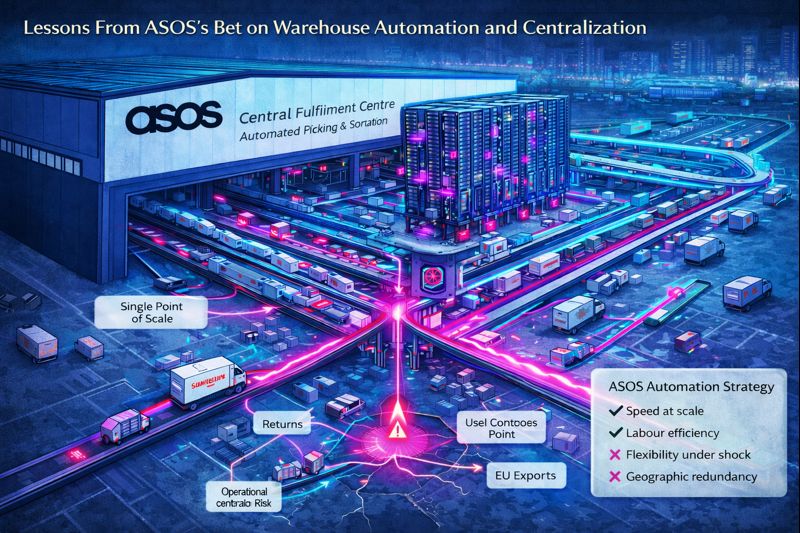
ASOS spent $100M to automate its warehouse.
Only to find out automation wasn't the problem.
Location was.
In 2021, ASOS opened a state-of-the-art fulfillment center in Atlanta.
=>Fully automated.
=>3 million items per week capacity.
=>2–3 day delivery to U.S. customers.
Four years later, they shut it down.
Not because the automation failed.
Because the network strategy did.
Here's what nobody tells you about warehouse automation:
Technology can't fix a bad footprint.
ASOS was holding duplicate inventory across the UK and the U.S.
=>Same products.
=>Two warehouses.
=>Double the markdowns when trends shift.
=>And double the working capital tied up in unsold inventory.
Fashion moves fast.
Items go out of style in a matter of weeks.
When you're holding the same SKU in two countries, one of them always becomes dead stock.
The Atlanta warehouse was processing volume.
But not enough to justify the duplication cost.
So ASOS made a brutal call.
=>Close Atlanta.
=>Centralize everything in the UK.
=>Ship to U.S. customers from one hub.
Now it wasn't without trade-offs.
For instance, delivery times jumped from 2–3 days to 5–8 days.
But here's what improved:
=>Better sell-through rates.
=>Less working capital is locked in stranded SKUs.
=>No more duplicate inventory sitting in the wrong location.
=>Full product catalog available to U.S. customers, rather than filtered local stock.
ASOS stopped pretending proximity was worth the duplication cost.
Express delivery is available for those who pay.
Returns still route locally through a Texas partner.
And the UK hub runs nearly nonstop with robotics handling peak loads.
The lesson is this:
Automation amplifies your strategy, but it doesn't replace it.
If your network design is flawed, automation just makes you inefficiently fast at the wrong thing.
Over to you, where's your network holding duplicate stock because you're afraid to let go of speed?
-----
Check out the full story here:
https://t.co/PucHZcpn31
Want more supply chain stories?
Check out our website:
https://t.co/SKROxWldLY
Subscribe here:
https://t.co/6HxkLXrVDl
In 2021, the UK economy lost 100,000 truck drivers.
To survive, Sainsbury's had to rewrite their entire supply chain playbook.
This is a story of what happens when control and resilience are built into your supply chain.
In 2021, Sainsbury's had a problem most supply chains never plan for.
Brexit, COVID, and an aging workforce collided at once.
=>Warehouses were stocked.
=>Trucks were fueled and ready.
=>But there was nobody to drive them.
Over 100,000 HGV drivers had vanished from UK roads.
So, goods weren't moving.
=>Milk sat in cooling plants.
=>Meat stayed in processing facilities.
=>And fresh produce was rotting in depots.
Meanwhile, the shelves were empty.
It was so bad that by October, 17% of British adults couldn't find essential items.
Major suppliers like Arla Foods admitted they couldn't reach a quarter of their delivery points.
Tesco, Asda, Sainsbury's—everyone was bleeding stock.
But Sainsbury's had one advantage that most didn't.
They owned their fleet.
While competitors scrambled for agency drivers and paid triple rates, Sainsbury's deployed their own trucks upstream.
Instead of waiting for suppliers to deliver.
They went and collected the goods themselves.
That entailed:
=>Milk from processing plants.
=>Meat from factories.
=>Direct pickup.
No middleman.
Now, it wasn't elegant.
In fact, it was expensive. But it worked.
CEO Simon Roberts said it plainly: "In-house logistics gave us assured capacity when outside hauliers failed."
They also made brutal choices.
=>High-volume stores got priority.
=>Seasonal items took a back seat.
=>If one brand didn't arrive, another filled the gap.
Availability dropped below expectations.
But stores stayed open.
And shelves stayed stocked.
Here's the brutal truth most supply chains ignore:
Built-in resilience and control give you a fighting chance when disruptions happen.
African supply chains are one fuel shortage or road closure away from the same crisis.
The question isn't if labor or any other factor will fail you.
It's whether you'll have control when it does.
Like this if you've underestimated labor risk.
Comment "CONTROL" if owning your logistics ever saved you.
Repost if your supply chain needs a Plan B.
-----
Check out the full story here:
https://t.co/l7kUpNhNZy
Want more supply chain stories?
Check out our website:
https://t.co/SKROxWldLY
Subscribe here:
https://t.co/6HxkLXrVDl
An 18-month listeriosis outbreak revealed that Tiger Brands' supply chain lacked an emergency system. Over 200 people died. And the company kept shipping.
Between 2017 and early 2018, over 1,000 people in South Africa fell ill from Listeria.
The source was a ready-to-eat processed meat from Tiger Brands' Polokwane factory.
But here's the part that stings:
Tiger Brands detected Listeria internally before the public announcement.
They had early warning signs, internal test results, and time to act.
But they sat on it. Waiting for confirmatory work.
And while they waited, contaminated polony continued to move through the supply chain.
Every pallet shipped was another vector of exposure.
By March 2018, when investigators publicly linked the outbreak to Enterprise Foods, the damage was done.
That was when Tiger Brands took action:
→ Recalled products nationwide.
→ Shut down two factories immediately
→ Destroyed 3,700 metric tons of inventory.
But the recall revealed another problem.
Formal retailers responded fast.
Small shops in informal channels didn't even get the message.
It was a terrible time for the company's supply chain.
Here is the lesson for every food supply chain:
→ Speed beats certainty when lives are at risk
→ Monitor the environment, not just the product
→ Build recall systems that reach every last distributor
→ Stop shipments at the first signal, ask questions later
Tiger Brands learned this the hardest way possible.
Does your supply chain have an emergency system that works under pressure?
Let us know in the comments section.
-------
Check out the full story here:
https://t.co/jkAMtjQhg6
Want more supply chain stories?
Check out our website:
https://t.co/SKROxWldLY
Subscribe here:
https://t.co/VMyFBFZFuJ
An 18-month listeriosis outbreak revealed that Tiger Brands' supply chain lacked an emergency system. Over 200 people died. And the company kept shipping.
Between 2017 and early 2018, over 1,000 people in South Africa fell ill from Listeria.
The source was a ready-to-eat processed meat from Tiger Brands' Polokwane factory.
But here's the part that stings:
Tiger Brands detected Listeria internally before the public announcement.
They had early warning signs, internal test results, and time to act.
But they sat on it. Waiting for confirmatory work.
And while they waited, contaminated polony continued to move through the supply chain.
Every pallet shipped was another vector of exposure.
By March 2018, when investigators publicly linked the outbreak to Enterprise Foods, the damage was done.
That was when Tiger Brands took action:
→ Recalled products nationwide.
→ Shut down two factories immediately
→ Destroyed 3,700 metric tons of inventory.
But the recall revealed another problem.
Formal retailers responded fast.
Small shops in informal channels didn't even get the message.
It was a terrible time for the company's supply chain.
Here is the lesson for every food supply chain:
→ Speed beats certainty when lives are at risk
→ Monitor the environment, not just the product
→ Build recall systems that reach every last distributor
→ Stop shipments at the first signal, ask questions later
Tiger Brands learned this the hardest way possible.
Does your supply chain have an emergency system that works under pressure?
Let us know in the comments section.
-------
Check out the full story here:
https://t.co/jkAMtjQhg6
Want more supply chain stories?
Check out our website:
https://t.co/SKROxWldLY
Subscribe here:
https://t.co/VMyFBFZFuJ
In 2025, China changed the export rules on rare earth metals.
Automakers' production lines were disrupted, but Daimler Truck had learnt from the 2021-2023 chip shortage. This time, they stockpiled the materials instead of relying on Just-in-Time.
Here's what the company saw coming:
Back in 2021, a $1 chip shortage stopped the production of $200,000 trucks.
Missing one tiny part idled entire factories.
Daimler's CEO, Karin Rådström, never forgot that pain.
So when rare earths faced the same threat, Daimler acted early.
They stockpiled magnets and microelectronics containing neodymium. They buffered semiconductors that had burned them before.
And the procurement stopped thinking in weeks and started thinking in months.
The trade-off was real:
More capital tied up.
Higher warehouse costs.
Additional carrying expenses.
But when China's delays hit, Daimler was already covered.
Automakers like Ford and Suzuki shut production lines.
But Daimler kept trucks moving.
Here's the shift:
→ Criticality beats cost
→ Past disruptions are your best planning tool
→ Strategic buffers aren't a waste when they prevent shutdowns
The lesson for every supply chain:
Just-in-time works until it doesn't.
And by then, it's too late to build the buffer.
What part could stop your entire operation if it disappeared tomorrow, and what are you doing about it?
Let us know in the comment section.
-------
Check out the full story here:
https://t.co/0Gxuv5Y98Y
Want more supply chain stories?
Check out our website:
https://t.co/SKROxWldLY
Subscribe here:
https://t.co/Gja5PMd5rY
In 2025, China changed the export rules on rare earth metals.
Automakers' production lines were disrupted, but Daimler Truck had learnt from the 2021-2023 chip shortage. This time, they stockpiled the materials instead of relying on Just-in-Time.
Here's what the company saw coming:
Back in 2021, a $1 chip shortage stopped the production of $200,000 trucks.
Missing one tiny part idled entire factories.
Daimler's CEO, Karin Rådström, never forgot that pain.
So when rare earths faced the same threat, Daimler acted early.
They stockpiled magnets and microelectronics containing neodymium. They buffered semiconductors that had burned them before.
And the procurement stopped thinking in weeks and started thinking in months.
The trade-off was real:
More capital tied up.
Higher warehouse costs.
Additional carrying expenses.
But when China's delays hit, Daimler was already covered.
Automakers like Ford and Suzuki shut production lines.
But Daimler kept trucks moving.
Here's the shift:
→ Criticality beats cost
→ Past disruptions are your best planning tool
→ Strategic buffers aren't a waste when they prevent shutdowns
The lesson for every supply chain:
Just-in-time works until it doesn't.
And by then, it's too late to build the buffer.
What part could stop your entire operation if it disappeared tomorrow, and what are you doing about it?
Let us know in the comment section.
-------
Check out the full story here:
https://t.co/0Gxuv5Y98Y
Want more supply chain stories?
Check out our website:
https://t.co/SKROxWldLY
Subscribe here:
https://t.co/Gja5PMd5rY
Pandemic demand fooled Peloton’s supply chain.
A straight-line growth blinded the company to reality.
And the result was a $1B meltdown.
At the height of COVID-19, Peloton couldn’t keep up with orders.
Bikes were sold out, and customers were forced to wait for months.
The company believed the demand was genuine and doubled down by acquiring factories, expanding production, and even planning a $400 million plant in Ohio.
But when gyms reopened, demand collapsed.
Warehouses turned into storage nightmares.
Ships sat offshore filled with unsold bikes.
At one point, Peloton lost $1B in a single quarter.
The problem wasn’t just the dip in sales.
It was a failure in forecasting.
Peloton had misinterpreted a temporary surge as permanent growth, thereby locking itself into assets that ultimately became liabilities.
The bullwhip effect did the rest: overproduction upstream created chaos downstream.
Here’s the lesson: supply chains must be built for flexibility, not just scale.
Here’s how you can do that:
– Share real-time data across suppliers.
– Balance control with flexible partnerships.
– Build demand scenarios, not just forecasts.
– Watch for early signals before they become crises.
The strongest chains aren’t the biggest. They’re the most adaptable.
-------
Check out the full story here:
https://t.co/9LK0mn8dvm
While competitors fought over metro customers, Flipkart spent millions on warehouses in smaller towns. Here's why that gamble paid off.
India's e-commerce war was heating up in the big cities.
But Flipkart saw something different.
New buyers weren't coming from Mumbai or Delhi anymore.
They were coming from Unnao, Sonipat, and hundreds of Tier-2 towns.
The problem?
Flipkart's warehouses were still parked in metro hubs.
That meant:
→ 800 km delivery routes for a grocery order.
→ Delays that turned promises into apologies.
→ Customers who ordered once, then never returned.
So Flipkart made a bet that looked crazy to competitors.
They built mega fulfillment centers in smaller towns.
Unnao got a 130,000 sq ft grocery hub processing 4,000 orders daily.
Sonipat got a center pushing 23,000 orders per day.
Then came the big move—a 140-acre campus in Manesar with 3 million square feet.
Critics called it overkill.
But the math told a different story.
=> Shorter distances meant faster delivery.
=> Regional hubs meant lower costs per order.
=> Category-specific centers meant fewer picking errors.
The results?
→ Coverage expanded to 10,000 PIN codes
→ Peak sales stopped breaking the network
→ Grocery delivery became predictable, not lucky
→ 2,000+ jobs created in towns competitors ignored
Here's the lesson:
Don't build capacity when your network screams.
Build it before demand hits the ceiling.
Regional distribution isn't optional at scale—it's survival.
Are you expanding where the growth is, or where it used to be?
-------
Check out the full story here:
https://t.co/ipZ7kaTcXz
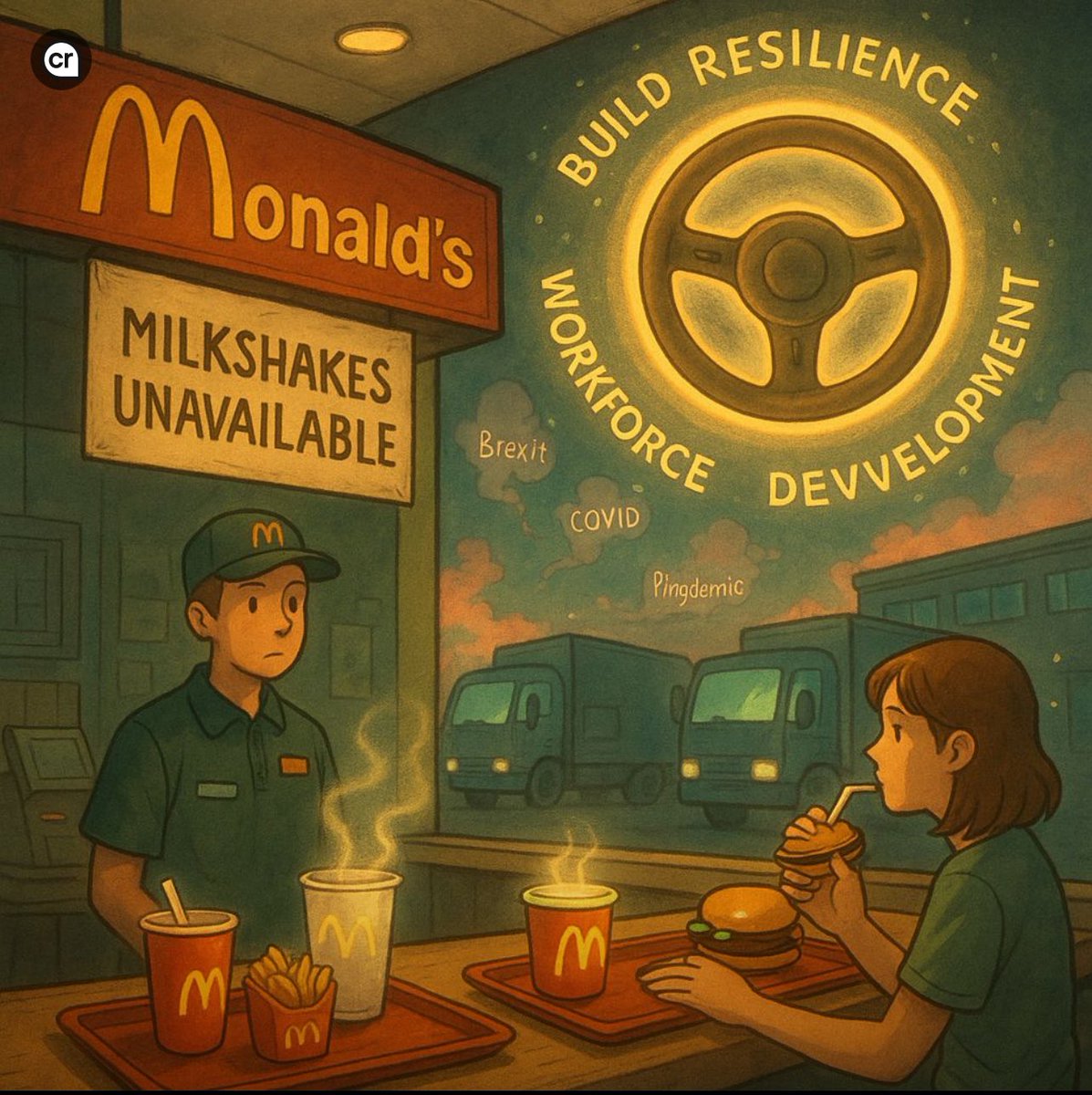
2021: Brexit + COVID = McDonald’s milkshake shortage.
The incident proved that efficiency without resilience collapses under pressure.
In August 2021, McDonald’s restaurants across the UK ran out of milkshakes.
Not because milk or syrup was missing, but because there weren’t enough truck drivers to deliver them.
Brexit had pushed 30,000 EU drivers out.
COVID halted the training of the remaining drivers.
The “pingdemic” forced thousands more into isolation.
Result: the UK was short 100,000 HGV drivers.
Many supply chains were also affected.
In McDonald’s case, the supply chain had to make a call.
It reallocated drivers to keep popular meals, such as burgers and fries, flowing. But shakes and bottled drinks were paused.
It was a tough choice, but it kept outlets open.
The crisis teaches us something about external factors in the supply chain. People are just as important as the goods and services.
Here’s how you can avoid McDonald's crisis:
Build resilience, not just efficiency.
Invest in workforce development.
Prepare “priority product” scenarios for crisis mode.
Because when drivers vanish, so do your deliveries.
--
-------
Check out the full story here:
https://t.co/c2fxqOWsKQ
Domino’s tested driverless pizza delivery with Nuro in 2021. The idea sounded bold, but the pilot stalled fast. But the real story isn’t the robot.
It’s what the trial revealed about scale, timing, cost, and the gap between hype and real delivery work. Here’s what supply chain leaders can learn from Domino’s autonomous delivery failure:
https://t.co/FkBaONGkAU
When the Houthi attacks turned the Red Sea into a warzone, IKEA didn’t panic—it pivoted.
This breakdown shows how the global furniture giant protected stock, shielded customers, and kept shipments moving without raising prices.
But the real value? African supply chains can use the same playbook—on any budget.
=> Route flexibility
=> Pre-season buffers
=> Crisis communication
=> Safety-first routing
=> Supplier partnerships that hold
Read the full story—and apply the lessons before your next chokepoint breaks.
https://t.co/AURg4kU3Zb
Nestlé's Maggi noodles went from 75% market share to almost zero due to supplier oversight and inadequate responses.
The crisis rewrote Nestlé’s entire supply chain playbook.
Maggi noodles was India's comfort food and it dominated shelves across the country.
Nestlé promised the quick meal had zero Lead or MSG.
But in 2015, a state lab test found excess lead, and the misleading “No added MSG” label was called into question.
And Nestlé reacted poorly.
The company's first mistake was weak supplier oversight.
The second was silence.
Instead of acting fast, Nestlé delayed, defended, and watched the crisis spiral out of control.
As a result, 38,000 tonnes of Maggi noodles were recalled.
-Sales collapsed
-Market share fell to almost zero.
-And trust—the hardest currency was gone.
Recovery meant more than just relaunching campaigns.
Nestlé had to rebuild its entire supply chain, including stricter supplier audits, ingredient testing, and more transparency.
The incident is proof that supply chain resilience isn’t just about cost or speed. It’s about trust.
Here’s how you can apply it:
-Exceed local safety standards.
-Build a crisis plan before you need it.
-Communicate openly, not defensively.
Because in food supply chains, trust is as vital as taste.
-------
Check out the full story here:
https://t.co/bWfl9jxLHs
46,000 GM workers went on strike in 2019
It was a $3B event that broke suppliers.
Here is what happened:
GM's just-in-time system held only two weeks of "parts" inventory.
When assembly lines stopped, suppliers quickly ran out of storage space and cash flow.
That was when the dominoes started falling fast.
And the ripple effect was crazy.
75,000 supplier employees were idled or laid off, in addition to GM's strikers.
Small Tier-2 and Tier-3 suppliers which were operating on razor-thin margins with no buffer were nearly destroyed during the 40-day shutdown.
But the damage wasn't just in the U.S. It spread across three countries.
Canadian plants laid off half their workforce when U.S. parts stopped flowing.
And Mexico's Silao facility furloughed 6,000 workers.
Steel companies also felt the hit since GM represents 5% of U.S. steel demand.
All the while this was happening, GM scrambled with desperate measures.
Salaried managers staffed parts warehouses, which are normally run by union workers.
Third-party suppliers got pressed into emergency service.
Dealer inventory buffers bought precious time, but couldn't last forever.
The lesson was brutal but clear.
Lean supply chains break fastest where resilience is weakest.
Every striking worker effectively idled multiple supplier employees and Just-In-Time efficiency became Just-In-Time fragility.
Here's how you can build strike-proof resilience:
-Diversify sourcing to avoid single points of failure.
-Map your suppliers down to Tier-3 level to spot chokepoints.
-Build selective buffers for critical components and high-risk items.
Remember, labor relations aren't just HR issues - they're supply chain strategy.
Check out the full story here:
https://t.co/rZHpCvbQJ7