🚨 Alarming Study on 911 Response Times 🚨
• Median time to transfer 911 calls between centers: 41 sec
• 90th percentile transfer time: 86 sec (almost 1.5 min!)
• Some agencies seeing transfer times up to 117 sec at 90th percentile
#6min2live
Source: https://t.co/MobtFJiBEh
The difference between compliance and performance!
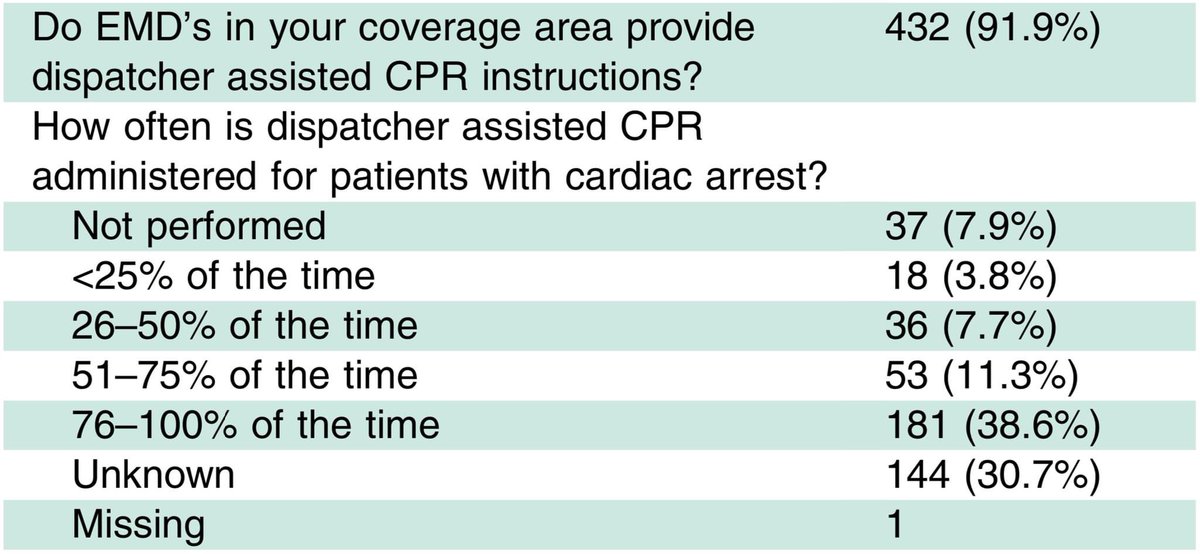
The vast majority of EMS systems (91.9%) provide T-CPR instructions. However, a minority (38.6%) get hands on the chest >75% cases.
#6min2live#measure#improve#survival
Study from @CARESRegistry.
https://t.co/SKfkPfmr6J
An excellent approach to mapping, understanding, and looking for opportunities to improve your cardiac arrest system performance across the patient journey #MeasureAndImprove#ItTakesASystemToSaveALife
Diagramming cardiac arrest calls is an illuminating way to better understand your system's actual performance.
We should measure things from the patient’s perspective whenever possible.
#6min2live#measure#improve#performance#survival#cardiacarrest
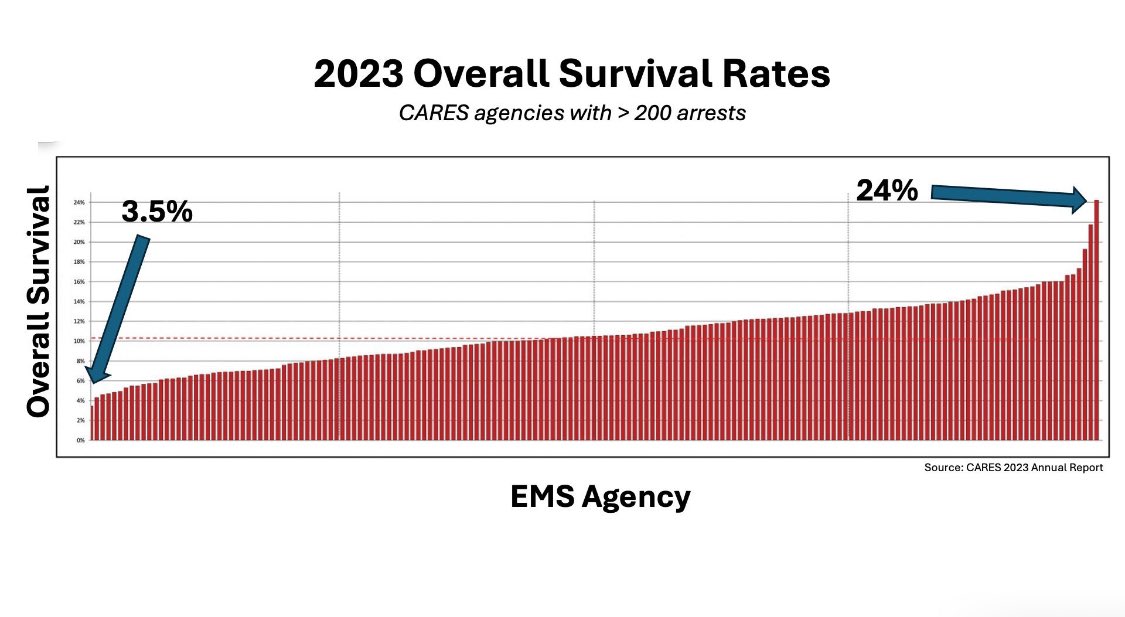
The graph below is from the @CARESRegistry 2023 Annual Report (with my annotations).
It shows that the highest performing EMS agency has an almost 700% increase in cardiac arrest survival compared to the lowest performing agency.
Would you want to know which cities these data represent?
I would.
@6Min2Live | @Gladwell
Data source: https://t.co/sl2sh0idEu
Our investigative journalist @BobDavis6M2L will be providing testimony at the hearing. @tbouthillet@gateshil#6min2live#CPR
Councilmember Pinto to hold oversight round table on 911 system failures https://t.co/qmzHQK4x2G
We are Six Minutes to Live, a movement to prevent needless deaths in sudden cardiac arrest. In 2003, @BobDavis6M2L in @usatoday wrote about disparities in SCA survival rates & these disparities remain. Join Bob, @tbouthillet & @gateshil to save more lives! https://t.co/LUk2xEt5j8
*** INCREDIBLE COMEBACK ALERT *** 🏈
#DamarHamlin scores first NFL interception, just 2 years after surviving sudden cardiac arrest on the field.
"CPR is a superpower and I just want everyone to be able to be afforded the same opportunity that I was.."
https://t.co/GTtilDdRrN
Transcutaneous pacing (TCP) with false capture! Thanks to @christifulli88 for having @joshkimbre, @JMedic2JDoc, and me on the @FOAMfrat podcast to discuss this hot topic! 👇
https://t.co/HOtcw7ukrG
Florida EMS Webinar today at 11 AM EST
Join us for an enlightening webinar presented by @joshkimbre and @JMedic2JDoc.
This session will delve into the findings from their latest paper, "False Electrical Capture in Prehospital Transcutaneous Pacing by Paramedics: A Case Series," published in Prehospital Emergency Care.
The study highlights critical insights into the challenges of achieving true electrical capture during transcutaneous pacing (TCP) in emergency settings, revealing significant implications for patient outcomes.
Zoom registration: https://t.co/PvtJLjskx8
BREAKING: The @CARESRegistry, the only national data collection tool that connects pre-hospital cardiac arrest data with hospital outcomes, will receive $23.85 million in grant funding over the next five years from the CDC. 🙌https://t.co/rRqesIypab
Last year, learned from @tbouthillet about efforts to increase cardiac arrest survival in Hilton Head Island and the creation of an airplane seating chart of survivors
We've taken his idea and added our first 7 "boarding passes" this #EMSWeek
.@christifulli88 had me on the @FOAMfrat podcast to discuss cardiac arrest ventilation. Heavy emphasis on expertly performed BLS and capnography. We touch on many topics including HP-CPR, BLS Continuous, and 30:2. Great conversation!
https://t.co/artN4dxlLT
I'd like to thank Spencer Oliver and Chris Pfingsten from EMS 20/20 and Rapid Sequence Information for having Bob Davis and me on the show to talk about sudden cardiac arrest! The episode just dropped and no stone is left unturned. https://t.co/UhBki3Nlnk
@BenjaminAbella@nflnetwork@NFL Step 1: Recognition. When an adult or child suddenly collapses it’s sudden cardiac arrest until proven otherwise. Think, “No, No, Go!” Is the patient awake? No. Is the patient breathing *normally*? No. Then Go! Call 9-1-1, start CPR, and get the AED.
In Episode 11 of #VoicesofCPR, Brandon Griffith, of Griffith Blue Heart explains the importance of closest-responder-dispatch protocols for sudden cardiac arrest– and that the nearest responders (often police officers) must be able to provide effective CPR.
#SystemsSaveLives