He says this as a communist, as though wanting affordable housing, cheap groceries, peace, prosperity, and opportunity constitutes an economic theory. Everyone wants good outcomes. The question is what policies actually produce them.
Communism’s entire sales pitch is to announce desirable ends, skip over incentives, production, prices, property rights, and economic calculation, then treat anyone questioning the means as morally opposed to the ends. And after a century of spectacularly bad results, perhaps “but this time our intentions are nicer” isn’t quite the rebuttal he thinks it is.
I don't label myself The Right, but here's a moral argument: it is immoral to pursue policies that don't work - that will make people poorer and their lives harder - just because they make you feel morally superior.
It is immoral to ignore the evidence you don't like.
It is immoral to pursue fashion over truth and ego over practicality. It is immoral to ruin people's lives (including the lives of the poorest) to satisfy your own moral narcissism.
It is immoral to steal. It is immoral to justify theft on the grounds that a consensus wants to steal.
It is immoral to be an MP and be this abjectly stupid.
A tax cut doesn't cost taxpayers money. Government spending does. Calling money people keep a "cost" assumes it belonged to the government in the first place.
You don't "pay for" letting people keep more of what they earned. You pay for the promises politicians make with other people's money.
I put the general framework below, and I'm glad to go into far more granular detail on any phase, the actual statutory repeals, the transition math, the sequencing. That part is solvable. Smart people have drafted versions of it for decades.
But here's the real obstacle, and it isn't economic. It's moral. None of this gets enacted in a culture that believes your neighbor's need is a claim on your life. As long as altruism is the accepted moral standard, that self-sacrifice is the good and self-interest is the sin, every free-market reform will be felt as cruelty, no matter how well it works. People will look at a policy that makes care cheaper and more abundant for everyone and still reject it, because it doesn't route through sacrifice, and sacrifice is what they've been taught virtue requires.
That's why Bernie wins the emotional argument even when he loses the factual one. He's speaking the language the culture already accepts: that need is a right, that the producer owes the needy, and that the compassionate thing is to make people provide, by force if necessary. He doesn't have to prove his plan works. He only has to invoke the moral code everyone already holds.
So the mechanics are the easy half. The hard half, the necessary half, is challenging the morality underneath. Making the case that a man's life belongs to him. That producing wealth is a virtue, not a debt. That leaving people free is not abandonment, and that the freest societies have always been the ones that lifted the poor the most, precisely because they unleashed production instead of rationing sacrifice.
You don't win this by out-detailing Bernie on policy. You win it by contesting the premise he's counting on you to concede: that caring for people means seizing from them. Until the moral argument is made and won, the policy argument can't land, because people will always choose the plan that lets them feel virtuous over the plan that actually works.
Fix the morality, and the mechanics follow. Skip it, and the best plan on earth dies on the floor.
Now the general framework.
You're right that specifics matter, so here's the honest answer to the subsidy question first, then the path out.
Understand how people got on subsidies: the ACA didn't rescue people from unaffordable care, it made care unaffordable, then sold the subsidy as the cure for its own disease. Look at the young. A healthy 30-year-old's cheapest plan jumped 260% from 2013 to 2014. In 44 of 51 states, the lowest-priced plans rose triple digits.
The cause: the 3:1 age-rating rule forbids charging the oldest more than three times the youngest, when real costs differ five to one. That gap gets loaded onto the young by law. Then the shell game: the subsidy rises dollar-for-dollar with the inflated premium, so the taxpayer eats a price the ACA manufactured. And those enhanced subsidies just expired end of 2025, exposing the true cost. That's the crisis Bernie points at, the predictable fruit of the intervention itself.
The path out, phased, lowering cost before removing any crutch:
Repeal the mandates and the age- and community-rating price controls. Let insurers price by real risk.
Let insurers sell across state lines and offer any plan buyers want, catastrophic, high-deductible, short-term. Let an 18-year-old buy cheap coverage sized to his needs.
Break supply chokeholds: repeal Certificate of Need laws, end residency caps, loosen licensing, speed FDA approval and accept drugs cleared abroad. More supply, lower prices.
End the tax distortion tying insurance to jobs, uncap HSAs. When patients see prices, providers compete, as in Lasik and cosmetic surgery, the fields government barely touches, where prices fall.
On current recipients: don't cut anyone off day one. Keep subsidies during transition. As prices fall, a $600 plan becomes $150, and the subsidy shrinks on its own, dissolving beneath people onto real affordable coverage. Lower cost first, let the subsidy fade.
Every crisis Bernie names traces to a government intervention. The cure isn't a bigger patch. It's removing the blade.
Trump's Housing Bill and the Man Who Has No Principles
Congress has passed the 21st Century ROAD to Housing Act, the largest housing package in a generation, and it now sits on the President's desk. In a fitting twist, Trump has refused to sign it, not over any principle in the bill itself, but because he is holding it hostage to an unrelated election bill he wants moved first. Remember that detail. We will return to it, because it tells you everything about the man.
First, let us be honest about the bill, because honesty is what separates analysis from cheerleading, and cheerleading is what you are about to get from nearly every commentator on the right.
What is actually good in it
Most of this bill is deregulation, and deregulation is good. It cuts the federal environmental reviews that strangle small housing developments. It streamlines permitting. It attacks the zoning and land-use barriers that local governments use to choke supply. Most notably, it eliminates the absurd five-decade-old federal rule requiring manufactured homes to be built on a permanent steel chassis, a mandate that added thousands of dollars to the cheapest housing in America for no reason but inertia. Homebuilders report that regulation accounts for roughly a quarter of the cost of a new home, sometimes nearly $100,000 before a shovel breaks ground. To the degree this bill removes government obstacles that government itself created, it is not a gift. It is the partial undoing of a wrong.
An Objectivist does not oppose this. Repealing a regulation that violated the builder's right to build is not socialism. It is restitution.
So if the bill merely removed barriers, I would say: good, now remove a thousand more. But it does not merely remove barriers. Buried in its fifty-odd provisions is a single clause that reveals the rot, and it is the clause every Trump loyalist will celebrate the loudest.
The provision that violates rights
The bill bans large institutional investors, those owning 350 or more single-family homes, from buying any more. This came directly from Trump, who signed a January executive order to "stop Wall Street from competing with main street homebuyers" and bragged about it in his State of the Union.
Strip away the populist packaging and look at what this actually is. It is the government telling a private buyer he may not purchase a piece of property from a willing seller, at a freely agreed price, because of who he is. Not because he committed fraud. Not because he violated anyone's rights. Simply because he already owns too much, by a number a politician picked.
This is a direct assault on two foundational rights. The right of the seller to sell his property to whomever he chooses, at the best price he can get, and the right of the buyer to acquire property through voluntary trade. A homeowner wanting to sell now has fewer bidders by law, which means a lower price for the most valuable thing most Americans own. The government has reached into a private transaction between two consenting parties and forbidden it, to score a point against a villain.
And note the populist lie underneath it. These institutional investors own between 1% and 3% of single-family rentals nationally. They are not the cause of the housing shortage, which is a supply problem created by, yes, government regulation. Even the bill's own supporters concede investors aren't the source of the constraint. Worse, these are often the very firms that buy distressed homes, renovate them, and return them to the market. Banning them can reduce supply, the exact opposite of the bill's stated goal. So the provision fails even on its own pragmatic terms. It exists not because it works, but because it feels good to punish a disfavored group. That is the essence of the anti-capitalist mentality: identify a productive minority, declare it the enemy, and aim the state at it.
The deeper point: Trump is not a capitalist, and has no principles
Here is what this bill exposes, and why it matters more than any single provision.
A man of principle, confronting a housing crisis, would reason from a fixed idea: the cause is government interference, so the cure is its removal, consistently, everywhere, even where removing it helps people I am supposed to hate. He would cut the regulations and he would leave the investors free, because the same principle that frees the builder frees the buyer. Property rights do not have exceptions for people you find unsympathetic.
Trump does not reason this way, because Trump does not reason from principle at all. He has a loose bag of impulses he mistakes for a philosophy. Cut red tape here, because it polls well. Ban the investor there, because Wall Street is an easy villain. Lower a cost by decree, as though the government had any business setting the price of anything. These impulses contradict each other, the deregulation pulling toward freedom and the investor ban pulling toward control, and he does not notice, because noticing would require a standard, and he has none.
This is the same man we have watched all year: bomb Iran on Tuesday, deal with it on Thursday, call the regime evil one week and say he would be "honored" to meet its leader the next. The housing bill is that same incoherence in domestic form. There is no through-line, no fixed conception of rights, only the mood of the moment and the applause it draws.
And observe the final proof, the thing he is doing right now. He will not even sign this bill on its merits. He is holding a major piece of housing legislation hostage to an unrelated election bill, using it as a chip. A man who believed in what the bill does, or objected to what it does, would act on that belief. Trump treats it as leverage, because to him it was never about principle. It was about the deal. It is always about the deal.
Watch the whitewash
Now watch what happens. The same Fox commentators who, a few years ago, would have denounced a federal ban on private home purchases as exactly the kind of government overreach conservatives oppose, will line up to praise it. Jesse Watters, Laura Ingraham, and Sean Hannity will clap, because their man signed it, and loyalty to the man has replaced loyalty to the principle. They will frame a government price-control scheme as Trump "fighting for the little guy" and "lowering costs," as though it were the federal government's job to lower the price of housing, which it is not, and never was. The government's only proper role here is to stop violating rights, not to engineer outcomes.
If anyone on that network analyzes this honestly, it will likely be Brit Hume, who retains the older habit of judging a policy by something other than whose name is on it. If he does, he deserves credit for it, and I will give it to him.
And on X, the faithful will do their part. Every loyalist account will recast a rights-violating purchase ban as a populist triumph, will bury the deregulation under the demagoguery, and will attack anyone who points out that telling a man he may not buy property is not capitalism. They will call it "America First." It is not. It is the oldest economic error in history wearing a red hat: the belief that prosperity comes from the government commanding outcomes rather than protecting freedom.
The standard
Judge the bill correctly. Praise the deregulation, because it restores freedom that should never have been taken. Condemn the investor ban, because it violates the rights of buyer and seller alike and fails even on its own terms. And see clearly the man behind it: not a capitalist, not a man of principle, but a dealmaker with a bag of contradictory impulses, signing or withholding his signature based on leverage and mood, while a chorus paid to admire him calls the chaos a philosophy.
A free market in housing does not need a president to lower prices. It needs a government that protects the right to build, to buy, and to sell, and then gets out of the way. That is the principle. Trump does not hold it, because he holds no principle at all.
For fifty years the economic establishment has told you that deflation is a disease. Falling prices, they warn, freeze spending, crush wages, spiral the economy into a tomb. Then there's Switzerland, which has spent decades doing the forbidden thing and somehow refuses to die.
The Swiss franc bought you roughly 0.23 dollars in 1970. Today it buys you about 1.20. The currency appreciated against the dollar by a factor of five while Swiss living standards rose to among the highest on earth. Consumer prices in Switzerland have repeatedly turned negative: 2015, 2016, 2020. Each time the Keynesian commentariat predicted catastrophe. Each time the Swiss kept buying watches, building tunnels through the Alps, and running a current account surplus that would envy any German.
Here's what a strong currency actually does to you. Your savings grow without you lifting a finger. The chocolate bar that cost five francs holds its value or gets cheaper as Lindt's productivity improves. You are not robbed in your sleep by a central bank printing your purchasing power into the pockets of the politically connected. A Swiss worker who stuffs francs under the mattress is rewarded for thrift, the oldest bourgeois virtue, the one Washington and Frankfurt have spent a century punishing.
Free market thinkers explained this generations ago. Prices fall because production rises. When a factory makes more shoes per hour, shoes get cheaper. This is not a malfunction. This is the entire point of an economy. The "deflationary spiral" the IMF dreads requires people to indefinitely postpone eating, heating, and clothing themselves in anticipation of a 0.8 percent price drop. Humans don't do this. The Swiss certainly don't.
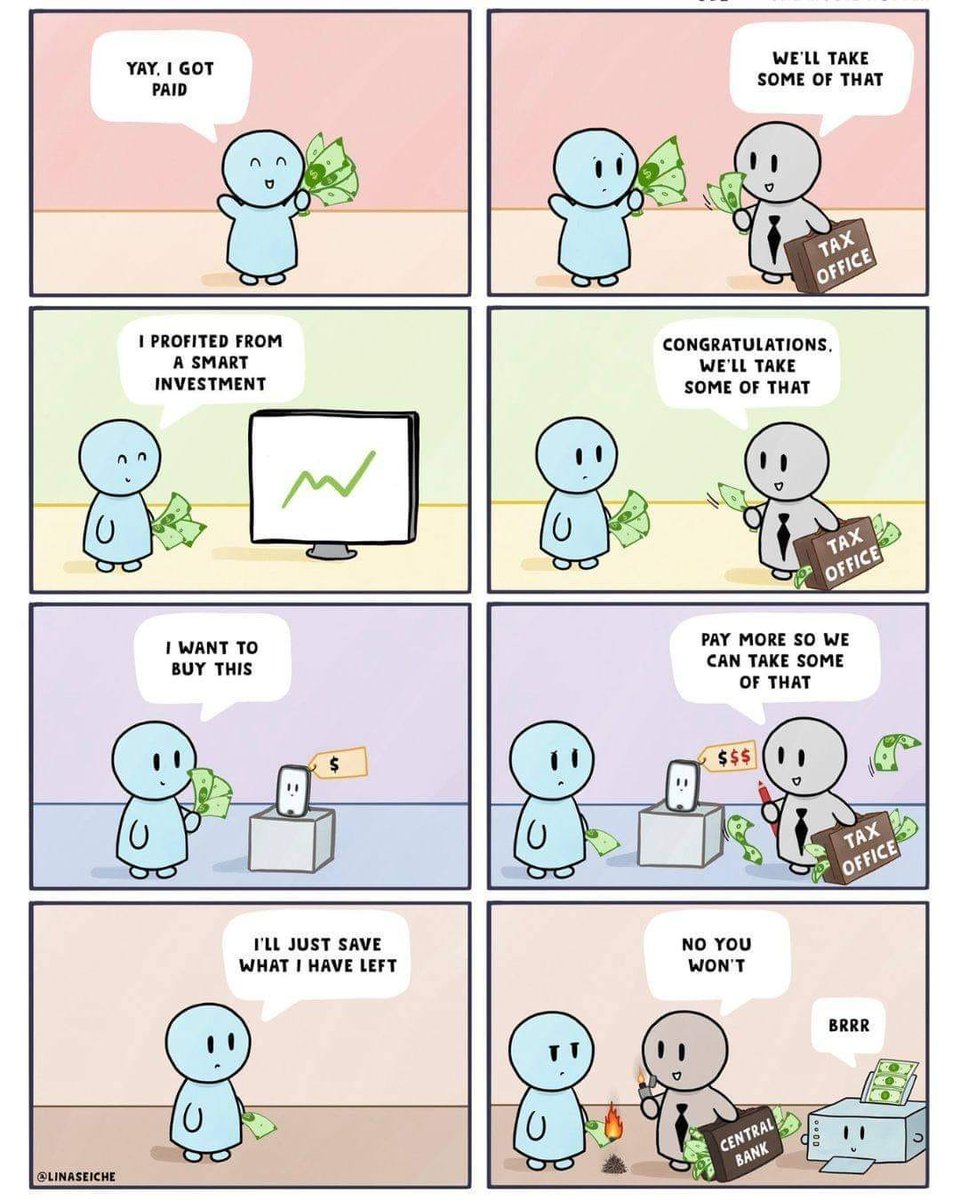
So when the European Central Bank tells you it must hit two percent inflation forever to keep you employed, understand what it is confessing. It needs your money to lose value because its entire model depends on debtors outrunning savers, on stimulus over thrift, on the quiet transfer running underneath the floorboards. The Swiss declined the offer. Their reward sits in every vault in Zurich, getting heavier while everyone else's gets lighter.
This is the framing of a collectivist. The honest framing is the opposite: never in human history has so much wealth been produced and held by so many. The poorest American today commands comforts no king could buy a century ago. That is the achievement Sanders calls a crisis.
And notice the word he smuggles in beside wealth: "power." There is no power over men in a fortune. The men he names cannot tax you, jail you, or force you to do anything. Their only power is to offer you a product and try to persuade you to buy it. You are free to say no.
Real power over other men is the power to compel, and that lives in exactly one place: the government office Sanders has occupied for decades. He is describing the producer's freedom and calling it tyranny, while holding the one weapon that is actual force.
The inequality he hates is not wealth seized but wealth created. He resents that some men make more because they produce more. That is not the issue of our time. It is the oldest envy, walking around in an angry senator's suit.
Elon could literally solve homelessness tomorrow.
All he needs to do is sell his stake in the companies he created from the ground up, crashing the price and evaporating his wealth as well as the savings and pensions of workers globally.. handing the control of these companies over to short term profit interests and preventing any long term vision from being enacted..
THEN take whatever money that remains which will be nowhere near 1tn and give it to homeless charities who have never solved homelessness anywhere on earth because they’re financially incentivised to do the opposite.
Bam - homelessness solved.
The reason he doesn’t do any of this is because he’s evil.
This clip of Charles Payne during Obama's second term is really incredible. Well done Charles.
In 2010 Obama put the federal government directly in charge of lending money to students. Eliminating private lending made the loans much easier to get, but they were not less expensive.
Before Obama took office, outstanding student debt was less than $100 billion. By 2015, outstanding student debt was approximately $800 billion and almost a third of the borrowers were in default. Of course the price of college continued to soar the entire time.
This is the best part. Payne predicted that someday the politicians would be promising to forgive student debt as a way to buy votes. He was spot on.
There are people like Ro Khanna on this site right now arguing that Elon Musk should be paying down the student debt when it's a problem that politicians created.
No, this is the reality of an economy increasingly distorted by government intervention, monetary manipulation, regulation, subsidies, zoning restrictions, healthcare cartels, and endless deficit spending, all while people keep calling the result “capitalism.”
Housing costs explode after decades of zoning laws, permitting restrictions, and central bank inflation.
Healthcare costs explode after decades of government intervention disconnecting consumers from prices and competition.
Food prices rise after inflationary spending, regulatory burdens, and supply distortions.
Then socialists point at the damage caused by mixed economies and political control and say: “See? This proves we need even more control.”
Many anti capitalist movements praise entrepreneurship in the abstract, but turn hostile once entrepreneurship actually succeeds.
They like the image of the small shop owner, the independent maker, the local founder, the underdog with an idea. But if that same person scales the business, hires thousands, attracts investors, builds logistics, gains market share, and becomes extremely wealthy, suddenly the language changes.
Now it’s “exploitation.” Now it’s “hoarding.” Now it’s “too much power.” Now the same productive process they romanticized becomes morally suspicious.
That reveals the deeper issue. They don’t really object to failure, stagnation, or dependency. They object to unequal success.
They want entrepreneurship without billionaires, innovation without massive rewards, jobs without owners, investment without investors, scale without capital accumulation, and abundance without the people who built the machinery of abundance becoming rich.
But successful entrepreneurship doesn’t stay cute and local forever. If it solves a real problem at scale, it creates inequality because it creates massive value. Trying to punish that outcome is how you turn ambition into fear and production into political risk.
Capital gains tax represents one of the most egregious examples of double taxation in the federal code, yet politicians treat it as if they're taxing "unearned" income for the first time.
You earn $100,000, pay income tax on it, and save $70,000 after Uncle Sam takes his cut. You invest that already-taxed money in stocks, real estate, or bonds. Ten years later, you sell for $140,000. The government swoops in again, demanding capital gains tax on your $70,000 profit. They're taxing the same economic activity twice: your initial productive work that generated the savings, then the delayed consumption that made investment possible.
Capital gains represent nothing more than the time value of money plus compensation for risk. When you save instead of consume immediately, you defer gratification to provide capital for productive investment. That $70,000 you invested didn't sit idle; it funded business expansion, job creation, and economic growth. The return you earned reflects both the productive use of that capital and inflation's erosion of purchasing power over time.
The double taxation becomes even more perverse when you consider inflation. If your $70,000 investment becomes $140,000 over ten years, but inflation averaged 3% annually, your real purchasing power increased by roughly $18,000, not $70,000. Yet the IRS taxes the entire nominal gain, including the portion that merely kept pace with their own monetary debasement.
Every dollar collected through capital gains tax is a dollar stolen twice; once from your labor, again from your thrift.
The Affordable Care Act created the most sophisticated corporate welfare scheme in American history, funneling hundreds of billions in taxpayer dollars directly into insurance company coffers while masquerading as healthcare reform.
The mechanics work beautifully for insurers. Government subsidies flow to individuals who must purchase private insurance on government-controlled exchanges. The state mandates coverage, eliminates genuine price competition through regulations, then pays insurance companies the difference when customers can't afford the artificially inflated premiums. Insurance executives get guaranteed revenue streams backed by federal tax collectors.
Between 2014 and 2023, federal premium subsidies alone totaled over $700 billion. Add cost-sharing reductions, risk corridor payments, and reinsurance programs, and you're looking at nearly $1 trillion in direct transfers to private insurers. UnitedHealth's revenue grew from $122 billion in 2013 to $324 billion in 2022. Anthem, Aetna, Humana, every major player doubled or tripled their revenue during the Obamacare decade.
Any free market perspective cuts through this charade immediately. Markets work through voluntary exchange and price signals. Obamacare destroyed both. Voluntary exchange disappeared when government mandated coverage. Price signals vanished when subsidies divorced consumers from actual costs. What remained was textbook fascism; private ownership with state control, funded by taxpayers who never consented to subsidizing Cigna's profit margins.
You cannot fix healthcare by eliminating markets then wondering why prices spiral upward. Insurance companies understood this from day one, which explains why they supported Obamacare after initially opposing it.
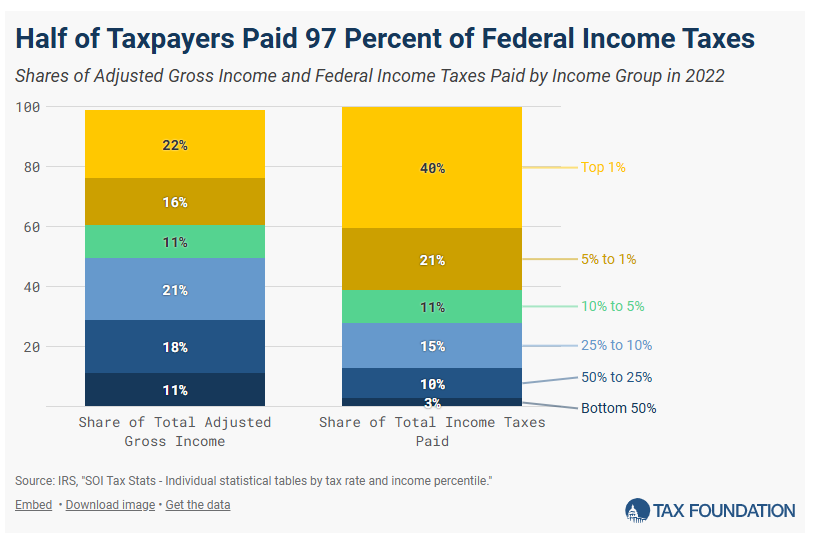
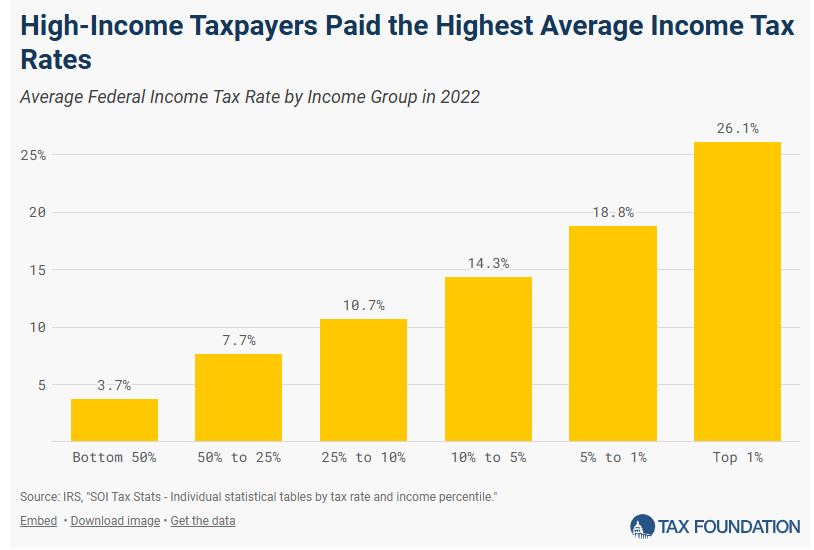
Higher earners pay higher rates and the most in income #taxes. There's just no satisfying Warren and company and their misleading complaints about "fairness" https://t.co/6PnDW3TegJ
It’s an inversion of terms to hide what’s actually being argued.
Under Marxism, needing to earn is labeled “slavery,” but the alternative they propose is access to what others have earned without their consent.
So the standard becomes this: if you have to produce to live, you’re oppressed. If others are required to produce for you, that’s justice.
But real slavery isn’t working for a wage you agreed to. It’s being forced to work without consent and without ownership of your own output.
A voluntary job is a trade. You exchange your labor for pay you accept. You can leave, negotiate, or refuse.
Slavery removes all of that.
So the argument collapses into this contradiction:
If no one is obligated to sustain you, you call yourself a slave.
If someone is obligated to sustain you, you call that freedom.
Instead of a defense of workers. It’s a demand to be carried by them.