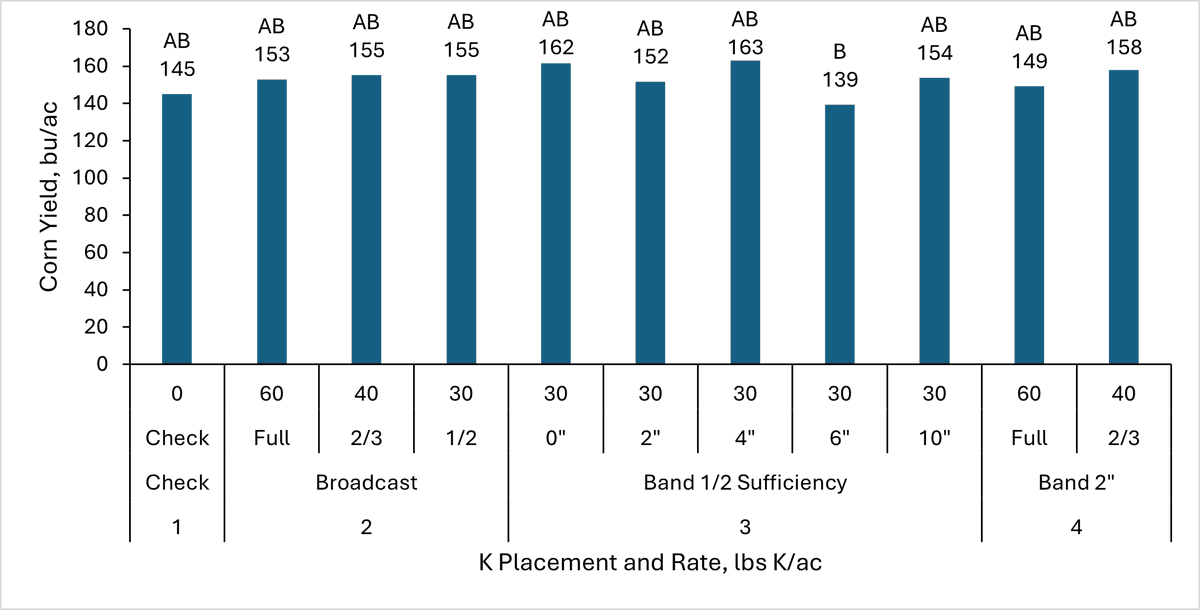
Beresford, SD Research Farm results (K test of 174 ppm). Banding K fertilizer at different distances from the corn row (0, 2, 4, 6, or 10”) vs. broadcasting did not affect corn yield response to K fertilization.
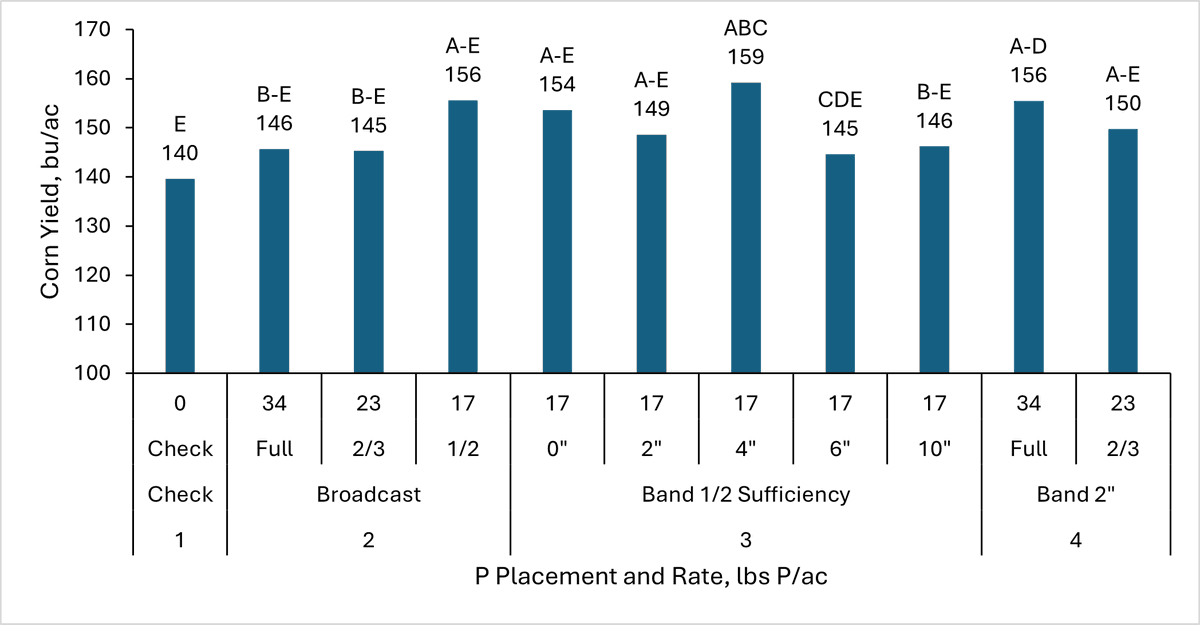
Beresford, SD Research Farm results (Olsen P: 11 ppm). Banding P fertilizer at different distances from the corn row (0, 2, 4, 6, or 10”) vs. broadcasting did not affect corn yield response to P fertilization.
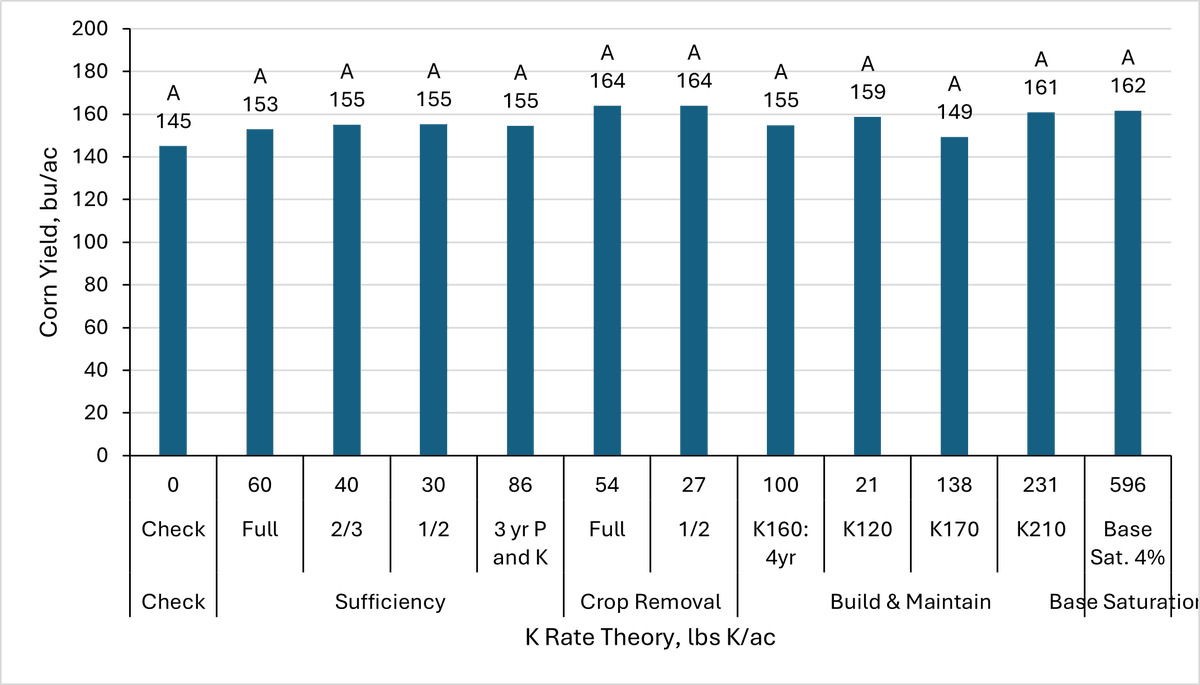
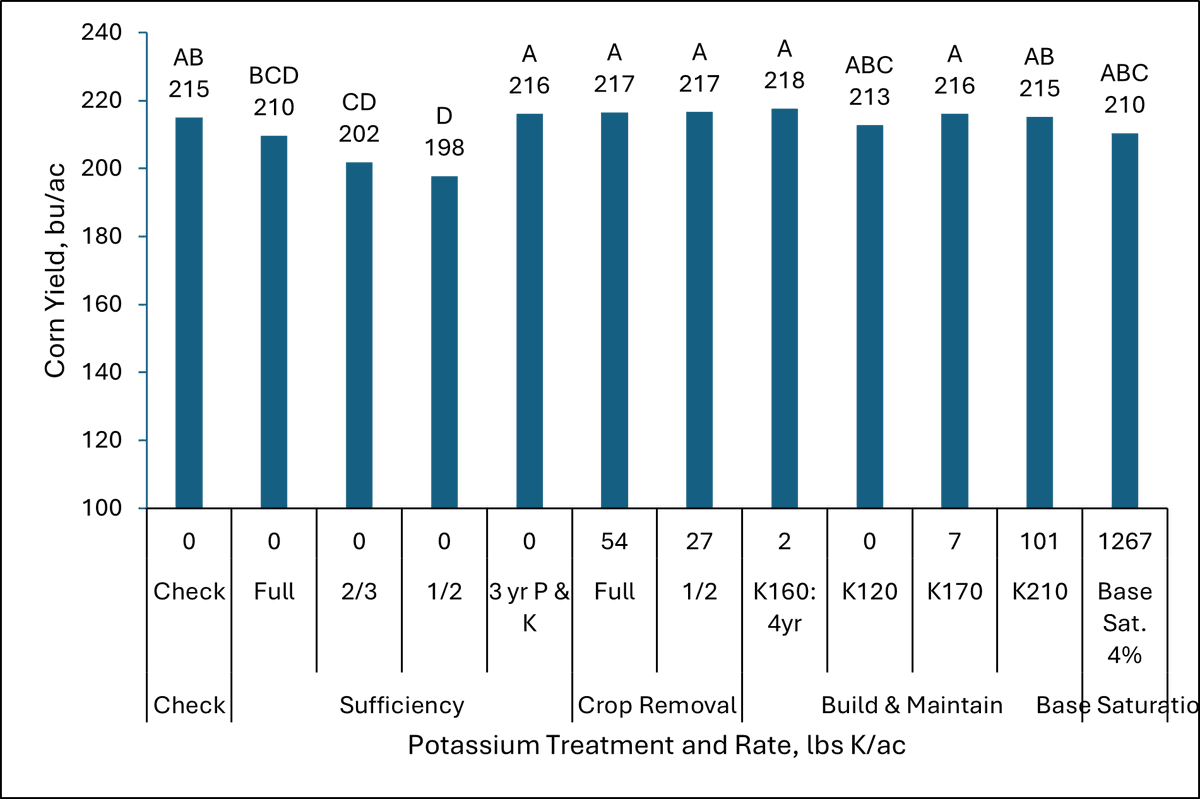
Beresford, SD Research Farm results (K test of 174 ppm). The rate theory used (Sufficiency, Crop Removal, or Build and Maintain) did not make a difference as corn yield for the check (0K) was 145 bu/ac and once K fertilizer was applied all yields were still similar.
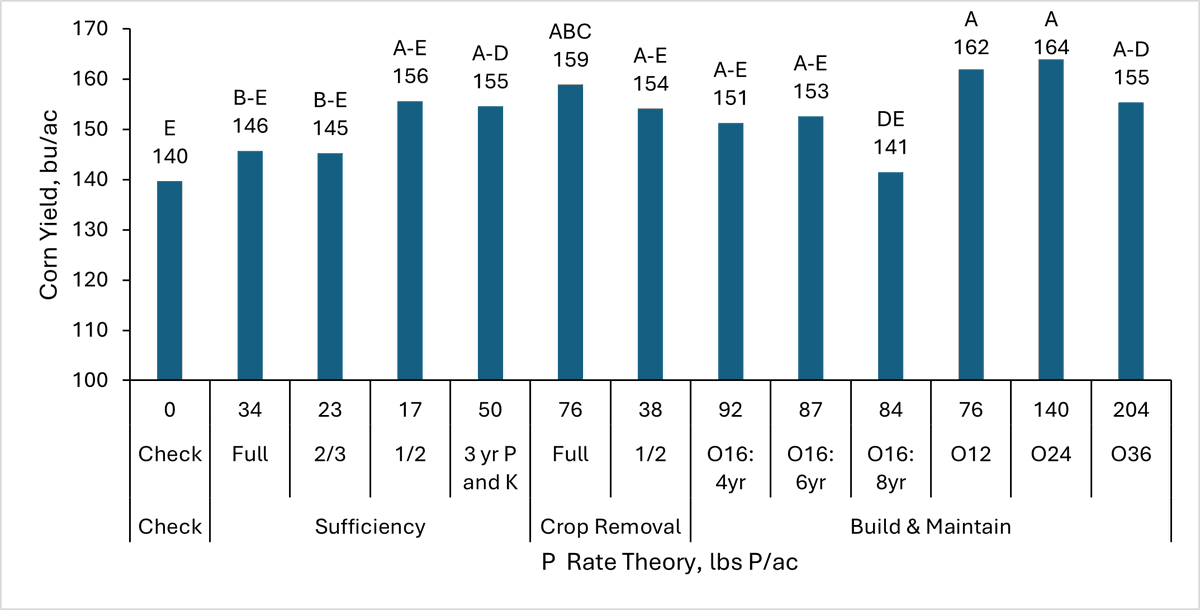
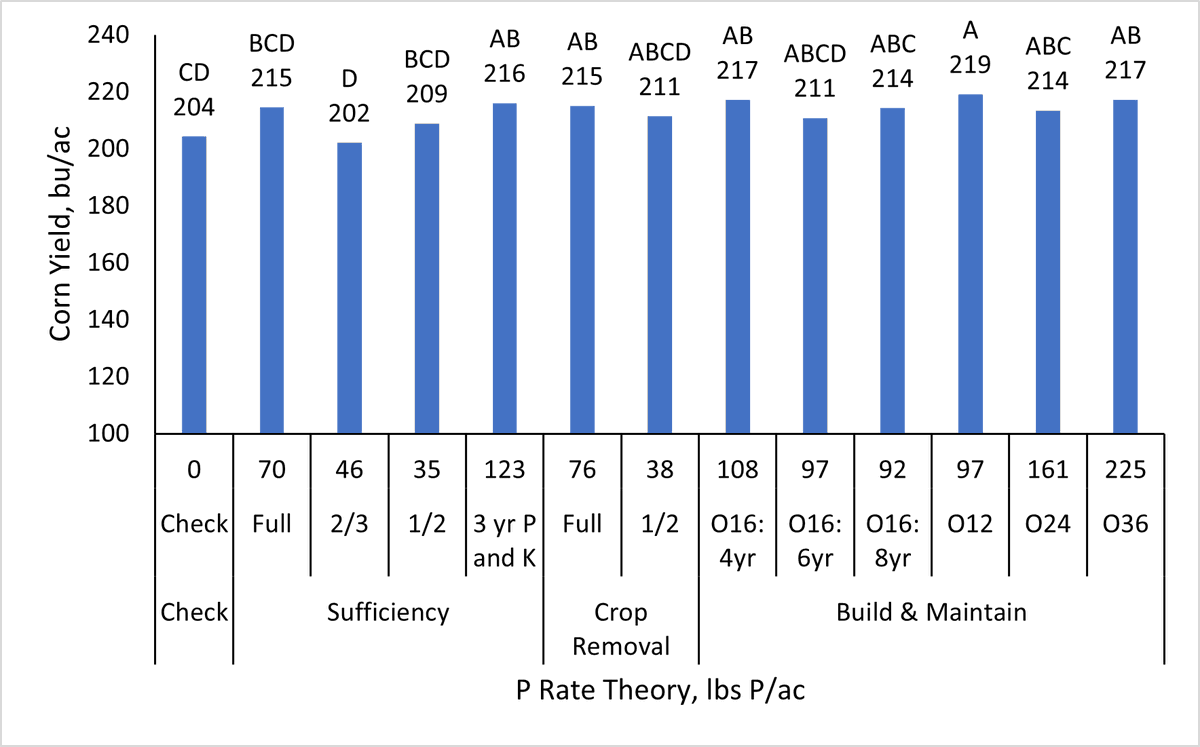
Beresford, SD Research Farm results (Olsen P: 11 ppm). Application of P increased yield. The rate theory used (Sufficiency, Crop Removal, or Build and Maintain) did not make a difference as long as 17 lbs P/ac was applied. This 1st year of a long-term study
It’s Soil and Fertilizers week with SDSU Ext. Crop Hour! (10-11, T, W, R). Topics include: New oat N recs, biological N fixation and N management in western SD. https://t.co/T72cWI3Z5b
Southshore, SD Research Farm Results: With a soil test K at 216 ppm (above the 160 ppm threshold for applying K), the addition of K regardless of the rate theory used did not increase corn yield.
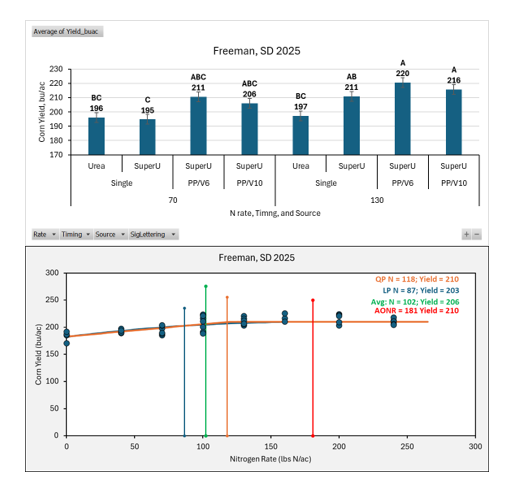
Want to know the right N fertilizer rate, source, and timing to use on your corn fields like the results in these images. The soil fertility extension program is looking for farmer fields to complete this kind of research. To learn more: e-mail: [email protected]
It’s Precision Ag week with SDSU Ext. Crop Hour! (10-11, T, W, R). Topics include: Precision N management, using crop as a biosensor, drone-driven precision ag. https://t.co/T72cWI4wUJ
It’s Markets, Economics and climate week with SDSU Ext. Crop Hour! (10-11, T, W, R). Topics include: Crop insurance and marketing, land values, climate change adaptation, ag policy outlook, and 2026 growing season outlook. https://t.co/T72cWI4wUJ
Southshore, SD Research: (Olsen soil test 8 ppm; Med) In comparing P fertilizer strategies (Sufficiency, Build & Maintain, & Crop Removal minimal difference was found between results with these methods. Economically, the SDSU recommended sufficiency approach profited the most.
Southshore, SD Research Station Results: Single applying N fertilizer or splitting it with 40 lbs N/ac at planting and the rest at 2, 4, 6, 7, 8, 9, 10, or 11 weeks after planting all yielded similarly, indicating a single or split application in this past year could be used.
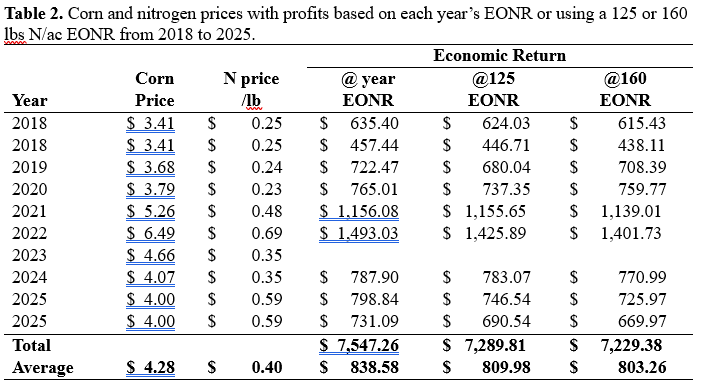
Research from Southshore, SD Research station. Applying N fertilizer at 125 lbs N/ac instead of 160 lbs N/ac over the past six years increased profit by $60/ac.
It’s Insect Pest Management week with SDSU Ext. Crop Hour! (10-11, T, W, R). Topics include: Soybean gall midge and Dectes stem borer, red sunflower and alfalfa weevil, and corn rootworm. https://t.co/T72cWI4wUJ
It’s Soil and Water week with SDSU Ext. Crop Hour! (10-11, T, W, R). Topics include: Cover crops and soil health, tile drainage systems, and P variability. https://t.co/T72cWI4wUJ
Crop Hour has begun! Have you signed up for our largest virtual event of the year? Visit https://t.co/SvTPxRWBR7 to sign up at no cost! Interested in CCA credits? We offer a total of 24 credits throughout the series- $30 per week (3 CEUs) or $200 for the entire series.
We will have our plain urea vs urea with urease and nitrification inhibitors this year again on research fields and several farmer fields. Last year with the really dry then really wet spring the urea with inhibitors improved yield and ROI. We will see this years results are
Working on setting up the nitrogen rate and timing trial on a hybrid rye field and the Southeast Research Farm. This will help us develop nitrogen fertilizer recommendations for this emerging crop.