Great interview on #SEO and #AI synergy with @SEOdub. Be sure to also check the #EXCLUSIVE series on the nationally syndicated https://t.co/IRTDhJuQ6S! More at #pobinsider. Questions on #articles? Email [email protected]. https://t.co/E8ZKJBXsJb
Google's @JohnMu has confirmed that AI Mode reporting will indeed come to Search Console - exactly what that means is not clear but the data will be in Search Console's performance reports soon - more details at https://t.co/PcOAXNCXJ4
This is 100% accurate and aligned with a human-first approach. Business-aligned, marketing aligned. The days of SEO strategies based solely on keywords are dead.
.
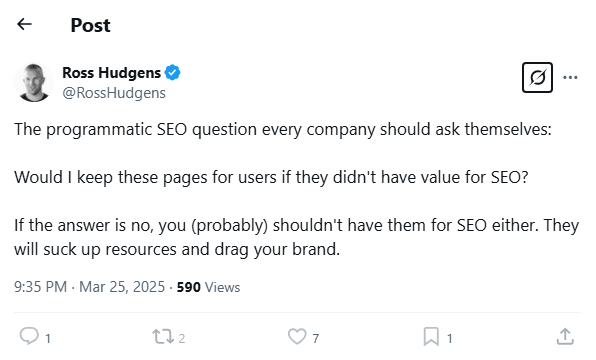
🔥 :: THIS is the question! :: 🔥
Well - almost the right one...
It has Nothing to do with "programmatic".
It's not about "dragging your brand".
It's about User Satisfaction!
It's about Business!
@JohnMu used to ask a question akin to the one below (in the Google Webmaster Forums, back in 2008+):
"If it wasn't for Google, would you do that?"
If you have pages/content,
that do nothing for Users - then they are candidates for being cut.
If they have some SEO value,
(such as inbound links, topic+intent boosting etc.),
then they may be candidates for merging or rewriting.
It's why I advise against :
* Churning out content because of "topical maps"
* Producing content based on "search volume"
You should not have pages/content solely for :
* SEO Purposes
* SEO gain
Every page and piece of content you produce,
on-site or off-site, should :
1) Contribute to a Business Goal
2) Serve a User Need
It's that simple!
#SEO #DigitalMarketing #Business
https://t.co/7JOLw2Qb5r
1/?
☠️🎯:: Is Google coming ::🎯☠️
☠️🎯:: for YOUR BUSINESS ? ::🎯☠️
Unless there's some massive legal shifts,
the whole AIO (content and traffic theft) is here to stay.
But that's not the same as Google actively coming for your business!
And with AIO - that may well be what @Google are looking to do.
An apparent leak (discovered by @tomcritchlow)
showed a large list of potential AIO Aspects,
including what appears functions/project names, and a few seem quite clear on their purpose.
Here's an alpha-sorted list:
AI List
AI Topics
AI Topics Layer 10
AIM Guided Narration (Fig)
About This Image
Air
Airport AIO
Allium
Automat
Bizmatch
Clarifying Questions
Create
Explore
Fact-checker
Fantasy Sports Researcher
Fig Slideshow
Getting Things Done
Golden Compass
Health
Highlight
Home Energy Assistant
Incentives Explorer
Info Sleuth
Learn About X
Limelight
Lsi
MedExplainer
Memora
Motorcycles
Neon
Neural Chef
Nitroboost:Create
Opt-in
Outfit Dreamer
QTalk
Shopping
Smart Kitchen
Spark
Stargaze
Stateful Journey
Supercat Prototype
Topic Map
Visit Guide
Web Guide
Weekend Hub
web_guide_flagship
Found via @lilyraynyc
>>>
#SEO #Business #AI
It’s the SEO tool culture that has driven the way SEO is done now. Most pros out there learned with tools, instead of applying SEO data and techniques to a marketing strategy. In the end if the tools continue to focus on SEO tactics, agencies and marketers will need to fill in the gaps. The future is human-first SEO, brand-aligned, business and audience driven marketing that uses SEO as the application.
@darth_na For sure. It’s different but not really new or revolutionary. Seems to spark interest and resonate with people, especially in the age of AI and automation. You definitely seem to buck the system, but great insights. Dig your stuff. Might have to recycle this convo into a post ;)
@darth_na Funny how all this stuff gets recycled as new, we recently re-positioned our company as “human-first”. SEO, Content, Paid. Same kinda thing ;)
This has been step one in SEO for ages, even before your website, appearing for your brand is the first requirement. Sometimes this can be quite challenging, but if you’re an SEO manager or an agency and can’t show strong visibility for the brand, you probably don’t have a long future in your position.
Google's AI Overviews = theft 🚨
And Google just got smacked with a lawsuit by Chegg -- and it's utterly fantastic ⚖️
I'm a former commercial litigator turned online travel publisher -- here are my notes from reading the complaint (link in next tweet) 👇
(warning, this summary is long & took me all morning to put together -- if you're a publisher please take 10 minutes to actually read it & share it with others)
1) Chegg is represented by the Susman Godfrey firm -- which means they are not messing around. Susman has quite the reputation as savvy, hard-charging litigators
2) Importantly, the compliant is grounded in antitrust law (NOT copyright, as I initially expected). And, goodness, it's a real banger ....
3) The complaint says the "exchange of access for traffic is the fundamental bargain that has long supported the production of content for the open commercial Web." 🎯
4) It continues: "But in recent years, Google has begun to tie its participation in this bargain to another transaction to which Chegg and other publishers do not willingly consent. As a condition of indexing publisher content for search, Google now requires publishers to also supply that content for other uses that cannibalize or preempt search referrals."
5) Chegg talks not just about AI Overviews, but also references featured snippets
6) 🫶this part -- "Google’s foray into digital publishing is designed to make Google a destination, rather than a search origination point to other websites."
7) Even if Google provided a separate opt-out for AI Overviews, it wouldn't work - because Google's monopoly power creates a collective action problem
8) A lot of fantastic points about how Google unfairly leverages its monopoly power to bend the open web to Google's will
9) Paragraph 13 is chef's kiss 🫰... "Google’s conduct is already eroding incentives for Chegg and other publishers to produce such valuable and useful content. If not abated, this trajectory threatens to leave the public with an increasingly unrecognizable Internet experience, in which users never leave Google’s walled garden and receive only synthetic, error-ridden answers in response to their queries—a
once robust but now hollowed-out information ecosystem of little use and unworthy of trust."
10) Search engines are supposed to be intermediaries between users and web publishers. The complaint quotes old-school Google saying "We may be the only people in the world who can say our goal is to have people leave our website as quickly as possible."
11) Search is a uniquely important channel for publishers. Other channels of traffic like social media can never replace search, because that traffic is not intentional
12) "Put simply, Google’s search monopoly gives it control over online distribution for digital publishers. Google uses that power to force digital publishers to give up their content. Google then itself acts as a publisher, either by republishing portions of other digital publishers’ content or by using GAI to summarize the content. The end result is that users increasingly consume other web publishers’ content on Google’s SERP, either in abridged or derivative form, which starves those publishers of traffic and revenue."
13) Chegg calls Google's strategy for publishers "embrace, absorb, extinguish"
14) Next is an entire fantastic section recounting the history of "Google’s Transformation from a Search Engine to Web Publisher"
15) Google appropriated publisher's content in 2 phases. Phase I it calls the 'republishing phase.' The complaint talks about featured like featured snippets & People Also Ask
16) Hilariously, paragraph 63 includes a screenshot of Sundar Pichai's mug inside a SERP for "who is google's ceo"
16) "Google refers to Featured Snippets, Top Stories, and People Also Ask as “search features.” But they are separate and distinct products from search results. This is Google acting as an answer engine—not a search engine."
17) Republishing is not automatically bad, but the problem is that Google forces it on publishers as a condition for appearing in Search (of which it has a monopoly)
18) "The decision to opt out of republishing by disallowing snippets or withholding Search Index Data is a Hobson’s choice. "
19) Phase II of Google's strategy to dominate online publishing centers around AI Overviews ("GAI")
20) Complaint notes that the non-monopolists like OpenAI and Perplexity have been forced to do licensing deals with many publishers, whereas Google has largely avoided this cost thanks to its search monopoly
21) Complaint walks through the differences between LLM pre-training and RAG (a point I've been trying to educate publishers on for months and months)
22) Next is a recap of Google's LLM product history: Bard, SGE, Gemini & AI Overviews
23) @rustybrick commentary is cited quite a bit (see footnotes on pages 40, 41)
24) The transition to AI Overviews "all but completes Google’s evolution from a “search engine” to an “answer engine” that publishes answers to user’s queries. Its formerly symbiotic and complementary relationship with publishers has now become overwhelmingly parasitic and competitive."
25) Google's own marketing language directly admits that the purpose of featured snippets & AI Overviews is to prevent users from clicking throughs to publishers
26) Next section talks about how Google's unauthorized use of publisher content for AI training
27) "Google has been intentionally vague in identifying the precise data sets used to train the LLMs underlying Gemini and AI Overviews"
28) "Google’s Terms of Service indicate that it uses all the information that it collects for search indexing to train its LLMs, including Chegg’s data. "
29) Google announced Google-Extended in Sept 2023, but blocking it doesn't change that Google trained on your content or that Google uses it for RAG
30) Next section: Google poses a "fundamental threat" to online publishing 👏👏
31) Lots of discussion on how AI Overviews directly compete with and seek to replace online publishers
32) Oh WOW - in paragraph 121, Sussman dug up a pretty damning admission in a 2023 Google DeepMind presentation: Google admits Generative AI in search would "reduce referrals to content providers hurting their ability to monetize"
33) Lots of outside observers recognize the risk AI Overviews present to publishers. Footnotes cite @timsoulo among others
34) AI Overviews increase "zero click" searches
35) AI Overviews will cause a downward spiral in publishing quality - as the incentive to create gets less, quality degrades, and the whole web suffers
36) Google has put publishers in an awful position - by publishing content, they feed the very AI beast that is consuming publishers alive
27) Next, the complaint walks through the actual legal claims -- which, IMHO, are quite strong
28) First - "reciprocal dealing," an antitrust concept which "occurs when a firm with market power refuses to sell product X to a customer unless that customer agrees to sell (or give) product Y to it. In this case, the product Google is selling to (and threatening to withhold from) digital publishers is Search Referral Traffic."
29) Second - "monopoly maintenance." Basically argues that Google's use of AI constitutes a form of "rent extraction" on publishers.
30) Google is using AI to illegally entrench its search monopoly
31) Third - "Unjust enrichment" - which basically means Google has unfairly benefited at the expense of publishers via wrongful conduct.
32) "The value of Google’s models and AI products is directly related to the quality of the works that it acquires to train them and ground their outputs."
33) Finally - a recital of the counts:
I - Reciprocal Dealing in Violation of Section 1 of the Sherman Act
II - Reciprocal Dealing in Violation of Section 2 of the Sherman Act
III - Tortious Conduct in Violation of Section 2 of the Sherman Act
IV - Unlawful Monopoly Leveraging in Violation of Section 2 of the Sherman Act
V - Unlawful Monopolization in Violation of Section 2 of the Sherman Act
VI - Unlawful Attempted Monopolization in Violation of Section 2 of the Sherman Act
VII - Common Law Unjust Enrichment
34) Lastly, Chegg's request for relief is of course damages and attorney fees, but also for a permanent injunction preventing Google from engaging in unlawful conduct
35) Chegg demands a jury trial
***link to complaint in next tweet***
My overall takeaway?
This is a truly fantastic complaint.
The only thing I think it missed is Google's admission in a blog post in summer 2023 that robots(.)txt is not a sufficient consent mechanism in the AI age. But, other than that, they really did their homework and hammered a ton of points I've been railing about for years.
If you are a publisher - please share so others see! 👏👏👏
I think this needs to happen. Google doesn’t invest in or own publisher content, and is using it to enrich themselves at the expense of publishers. They have to pay, or provide value in some form if they want to profit from 3rd party content. We are seeing this play out in real time, Google will either find a way to reciprocate to publishers, or they will find themselves in a very tough position one way or another.
Agreed, it really should be obvious and I think everything is coming full circle. I think we are where we’re at because of the shift to tool based SEO. I think we’ve had generations of folks who learnedSEO by learning SEO tools, instead of figuring out SEO from a marketing perspective.
@MordyOberstein 100% We have coined our approach “Human-first SEO”. We create business centric strategies for our clients, using SEO as a channel to make key human connections.
That makes a lot of sense, so they are fighting the proliferation of low quality, thin, unoriginal, content. We have definitely noticed how much more difficult indexing has become over the years. Maybe the guidance needs to be, yes, you need a blog, but will only get the value if you can share original content that does not already exist out there.