@Nikhil_Dwivedi A big thank you for producing a child #Bandar who would create a history in the world of cinema. We at Men Welfare Trust part of Save Indian Family Movement (@WeAreSIF ) congratulate you big time and wish you stupendous success for #Bandar.
The Silent Crisis: Why the Rise in Male Suicides Demands National Attention
The case of Twisha Sharma has reignited discussions around gender-based violence and suicides in India. As expected, much of the public discourse and media coverage has focused on allegations against the husband and his family. However, amid the sensationalism and trial by media, a larger and far more disturbing reality of growing epidemic of male suicides in India remains largely ignored.
Every day, 4.5 mts men take their own lives or become victims of violence in intimate relationships. Yet these incidents rarely evoke the same level of public outrage, media attention, or societal introspection as cases involving female victims. The result is a dangerous blind spot in our understanding of gender, victimhood, and mental health.
In 2024, India recorded approximately 1,70,694 suicides. Of these, 1,25,449—or 73.5%—were men.
Report by the National Crime Records Bureau (NCRB) since 1967 reveals an alarming trend. For more than three decades, from 1967 to 1999, the Male Suicide Index (MSI)—the ratio of male to female suicides—remained relatively stable at around 1.4. In other words, male suicides were about 40% higher than female suicides.
However, beginning in the late 1990s, a structural shift occurred. The ratio started rising steadily and has now reached an unprecedented 2.77. Today, nearly three men die by suicide for every woman (Refer graph :“Tracking the Male Suicide Index”).
The situation becomes even more concerning when marital status is considered. Data indicate that married men face a higher risk of suicide than unmarried men, and their suicide risk is significantly higher than that of married women. (Refer graph: “Male Suicide Risk by Marital Status”)
What Changed After the 1990s?
The timing of this shift raises important questions.
India's economic liberalization in 1991 transformed not only the economy but also the social fabric of the country. Globalization, rapid urbanization, changing family structures, evolving gender norms, and the growth of women institutions have all reshaped interpersonal relationships and social expectations.
Whether these developments directly contributed to the surge in male suicides remains a matter for rigorous research. However, one fact stands out: female suicides have remained broadly stable at around 45,000 annually since the late 1990s, while male suicides have continued to rise sharply, suggesting that the widening gap is driven primarily by increasing male vulnerability.
Men in Their Most Productive Years Are the Most Vulnerable
The burden of suicide falls disproportionately on men in the age group of 30–60 years—the very years during which men are expected to shoulder the responsibilities of earning, supporting families, caring for children and aging parents, and meeting societal expectations of success.
Approximately 65% of all male suicides occur within this age bracket.
The Male Suicide Index in this group is 3.91, meaning nearly four men die by suicide for every woman.
The disparity is even greater in the 45–60 age group, where the MSI reaches 4.53.
These figures should deeply concern policymakers, mental health professionals, and society at large. (Refer graph: “The Middle Age Crisis”)
Family Problems: The Largest Driver of Male Suicides
According to NCRB data, the single largest recorded cause of suicide is "Family Problems," accounting for 33% of all suicides.
Prior to 1995, NCRB separately recorded causes such as "Quarrel with Spouse" and "Quarrel with In-Laws." After 1995, these categories were merged into the broader category of "Family Problems." As a result, a substantial portion of marital conflict-related suicides is now embedded within the family problems category. This dispels the notion that marital conflict related suicides is captured under “Marriage related issues” (this captures issues directly related to event of marriage or divorce, non-settlement of marriage, dowry dispute etc).
The Male Suicide Index for suicides attributed to family problems was 0.92 in 1995. By 2024, it had risen to 2.59.
Even more strikingly, of the approximately 73,000 additional male suicides recorded annually since 1995, nearly 47% can be attributed to the increase in suicides linked to family problems.
This suggests that relationship and family-related stress is a major contributor to the rise in male suicides. (Refer graph: “Impact of Family Problems on Male Suicides”)
Need for National Commission for Men
The steady rise in male suicides is not merely a men's issue—it is a national public health concern. With men accounting for nearly three-fourths of all suicide deaths, the scale of the crisis demands focused attention and policy intervention.
A National Commission for Men could provide an institutional framework to study the causes of male distress, identify policy gaps, and recommend measures to address issues such as mental health, family-related stress, and suicide prevention.
The existence of the problem is no longer in question. The data is clear. What remains to be seen is how long society can afford to ignore it.
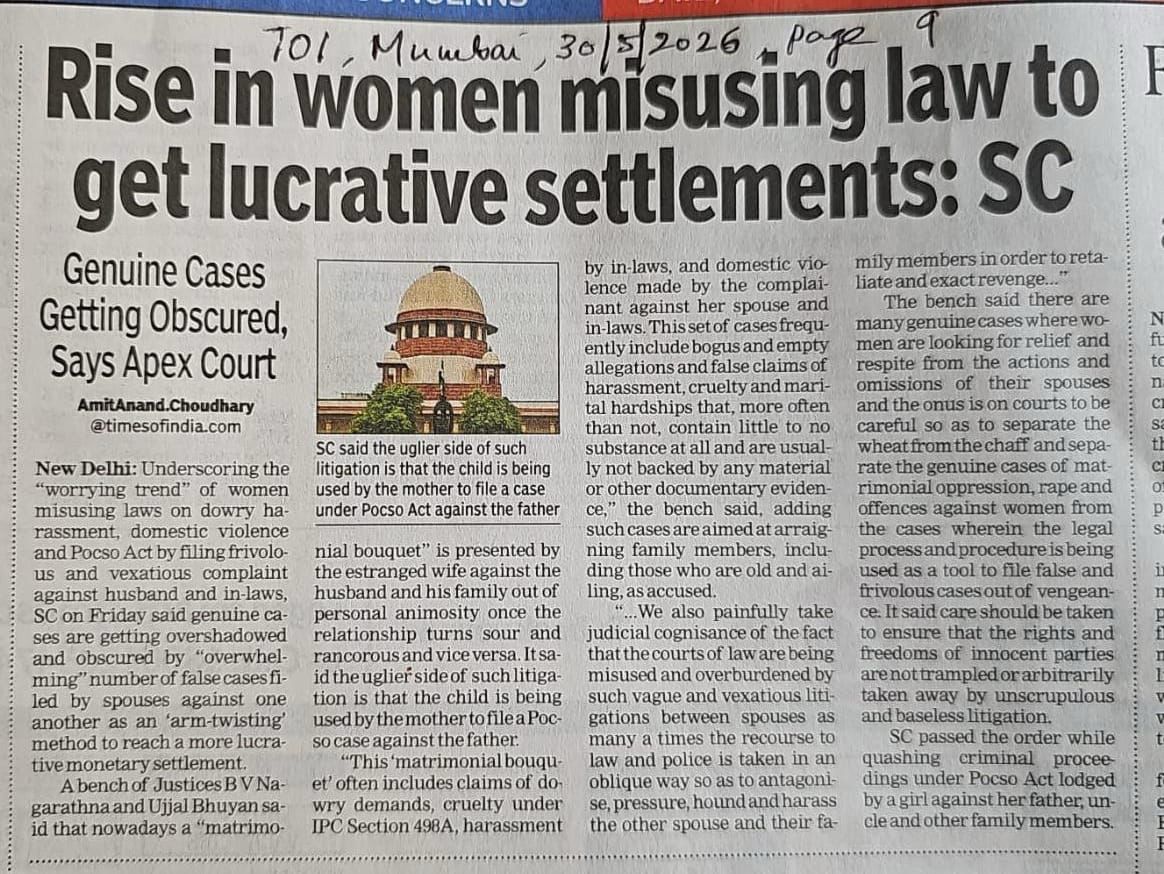
Supreme Court flags false cases used as tools by women to persecute men. Men face discrimination in laws and courts. Change is needed — for fairness & to get #HumanRights4Men#MensRights#LegalReforms
One of the most significant legal developments affecting the use of IPC 498A was the amendment to Section 41A of the CrPC in 2010. While the amendment itself did not immediately alter the ground reality, the landmark judgement in Arnesh Kumar vs State of Bihar, which mandated strict implementation of the amended provisions, had a far-reaching impact.
More than a decade has passed since the judgement, and its effects are now clearly visible in the data (refer graphs). During the ten-year period preceding the judgement (2005–2014), arrests per 498A case declined by about 16%, which may be considered a normative or gradual decline. However, in the ten-year period following the judgement (2015–2024), arrests per case declined by approximately 54%, a far more substantial shift.
Even after accounting for the earlier normative decline of 16%, nearly 40% (38% to be precise) of the reduction can reasonably be attributed to the impact of the Arnesh Kumar judgement and the safeguards introduced through stricter compliance with Section 41A CrPC. The objective of IPC 498A was largely immediate arrests. Following the Arnesh Kumar vs State of Bihar judgement, arrests declined sharply. Consequently, the growth trajectory of 498A cases flattened significantly in the post-Arnesh period. In the pre-judgement decade (2005–2014), registered 498A cases more than doubled, rising from 58,319 to 120,877. In contrast, during the post-judgement decade (2015–2024), the number of cases has largely stagnated around the 120,000 mark.
This does not imply that marital discord has reduced. However, it does suggest that the intimidatory value associated with automatic arrests under 498A may have diminished over time.
A similar trend has also been observed within the men’s rights movement. Earlier, a large number of individuals approached support groups like Save Indian Family Movement (SIFM) primarily due to fear of arrest under 498A, often in recurring waves. In recent years, that pattern appears to have significantly reduced, and this change can largely be linked to the impact of the aforesaid judgement.
This does not mean that underlying challenges faced by men in matrimonial disputes have reduced and may, in some respects, have intensified. In fact, the nature of legal pressure has shifted from the fear of immediate arrest under 498A toward concerns relating to allegations under sexual offence provisions involving relatives, as well as awarding of dispropotionate amount of maintenance and alimony against the husband. This is why feminists are pushing for removal of exceptions from IPC 375 (now BNS 63), to unleash the extortion tool that is lost in earlier draconian IPC 498A.
Importantly, the Indian Men’s Rights Movement now needs to evolve beyond false cases—though that transition has already begun in many ways. The emerging challenges of the future are likely to center around domestic violence against men, rising male suicides, mental health and emotional well-being, parental alienation, and the growing social and economic pressures imposed by existing patriarchal expectations on men.
आज NCR में Men Welfare Trust की प्रेस कॉन्फ्रेंस #ForcedSuicide और #Justice4Aman के लिए
मुख्य मांगें:
1. राष्ट्रीय पुरुष आयोग का तत्काल गठन
2. जेंडर-न्यूट्रल कानून
3. @PMOIndia से पुरुषों हेतु समर्पित सहायता
4. न्यायिक और प्रशासनिक जवाबदेही
Men Welfare Trust's Press Conference today in NCR on the #ForcedSuicide & for #Justice4Aman
Key Demands
1. Immediate establishment of a National Commission for Men
2. Gender-Neutral Laws
3. Dedicated Support for Men from @PMOIndia
4. Judicial and Administrative Accountability
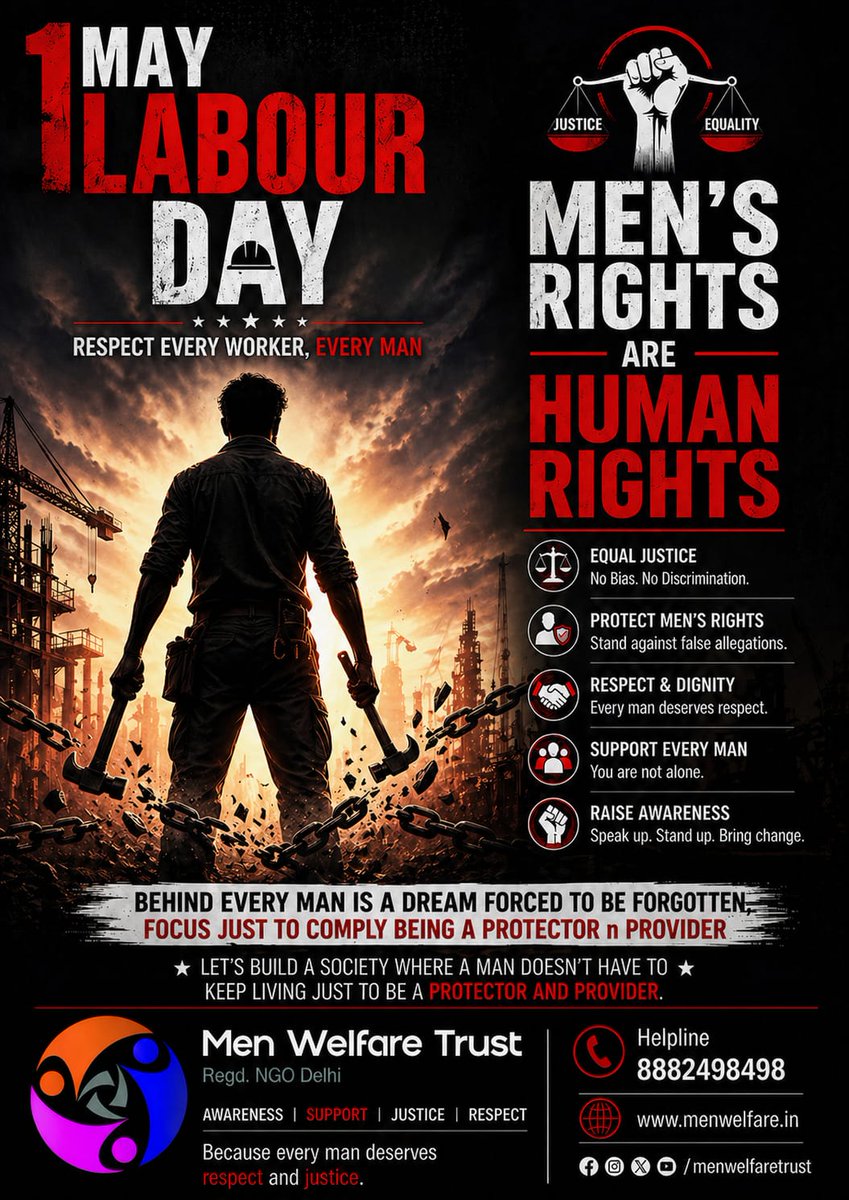
#LaborDay#1May, we salute every man as they has been a building block themselves for the world as we know.
Salute to the sacrifices which are often expected, just based on the gender.
Without questioning the discrimination, men continue to contribute to family, society, world
1) SC questions the withdrawal of consent of wife from divorce on mere fact that imaginary demand not part of settlement agreement was not fulfilled by husband.
2) SC makes it clear that any settlement agreement in mediation cell under jurisdiction of court and later confirmed by court should be abided by as long as intention and subsequent steps are taken by parties to fulfil the terms and conditions of agreement.
3) Withdrawal of consent should not be to pressurise the other party to give-in to demands not covered under the settlement agreement or modify the T&Cs of settlement agreement.
4) Anybody resiling from settlement without any rhyme and reason must be dealt with heavy cost.
5) Withdrawal of consent can be if a party genuinely wants to continue to live with other party or let’s say if consent was taken by coercion or threat.
#Extortion #Demand
Spouse Cannot Withdraw Consent For Mutual Divorce After Agreeing For It In Settlement Of Claims : Supreme Court
https://t.co/jf8QMKGa2Y
1) A husband, Party-in-Person, reaches SC to argue that a separate FIR be registered against wife and family for making a complaint of dowry being given on demand per Dowry Prohibition Act, 1961.
2) Hats off to husband to take the case to SC though he lost the case but we are sure he would win the fight.
3) An FIR is already registered against husband and family for allegedly taking dowry and cruelty.
3) Husband relies on a judgement of Delhi High Court - Neera Singh vs. State (Govt. of NCT of Delhi), 2007 - that FIR can be registered against those who claim to have given dowry.
4) SC criticises the above mentioned judgement of Delhi High Court as it did not take note of section 7(3) of DP Act.
5) Section 7(3) saves the aggrieved person who makes complaint. In this case per SC, wife and her family would be saved as she made complaint of dowry being taken by husband and family first.
6) SC adds an interesting twist that if husband instead of solely relying on complaint and statement of wife in FIR lodged against husband and family would have provided independent evidence of dowry being given by wife and family then an independent FIR can be registered.
7) We wonder if husband dares to do that he would be digging his own grave and that can be used against him and family for taking dowry.
8) We recommend husbands should not try to have FIR registered against wife and family counter to FIR lodged by wife. That has always been our recommendation.
9) Though Hats off to husband for taking the fight to SC
10) One aspect which is still open what if husband and family complain first about wife and family giving dowry in that case there is a possibility they may be saved from rigour of DP Act owing to 7(3) but not from BNS 85/86 aka IPC 498a.
#extortion #498a #BNS
https://t.co/SkYMAF2yIu
> This judgment is not a precedent so nothing to worry about.
> This doesn’t delve into the facts whether loan payments started before marriage or after marriage before cases started/while cases were ongoing.
> We think EMIs of loans taken before marriage or during marriage much before cases started must be given due weightage while considering maintenance.
> In a Bhushan Kumar Meen (supra) link of which given below 👇 SC duly considers the Home Loan EMI paid by husband to reduce the maintenance.
> It is right of any individual to acquire a home for living especially the first home.
> Hence, argue on merit show facts to courts and we strongly believe husband would the reprieve.
#Maintenance #Extortion
https://t.co/cthh64slJH
Duty To Maintain Spouse Primary; Loan Repayments For Asset Creation No Ground To Reduce Maintenance Liability: Supreme Court
> Man and woman were in relationship.
> Marriage takes place on March 2, 2016 as woman claims she is pregnant with the child of man.
> Child is born on April 1, 2016.
> Domestic Violence case filed against man and his family on July 14, 2016.
> Reply is filed by man along with application of DNA test.
> Court orders DNA test which reveals that man is not the father of child. DNA test is never challenged.
> HC and SC deny the relief of maintenance to child . Relief of maintenance was denied to woman as well by Magistrate and District & Sessions courts but matter, as far as maintenance of woman is concerned, is remanded back to Magistrate by HC and SC.
> In a separate case man has asked for annulment of marriage owing to fraud on him.
> I hope judges would start applying principle - once a lair always a lair in such cases and no reliefs are granted.
> Hats off to man for filing an application of DNA test which most men would not file knowing that in all possibility it would be denied because of rebuttable presumption under section 112 of Indian Evidence Act. But this is called out of box thinking.
> Rebuttable presumption in section 112 applies only when there is no DNA test. Once there is a DNA test . Applicability of section 112 has no meaning.
Link to SC and HC judgements are 👇
#Fraud #Paternity #Falsecases #Domestic #Violence
https://t.co/WcSmuGS4bk