The dominant model of opinion dynamics has long assumed that people average all views, outliers included.
In a new paper in PNAS, SFI Complexity Postdoctoral Fellow Kaleda Denton (@KaledaDenton) and colleagues test a different conformity model, based on the most popular opinion, not the average, against real-world data and find it consistently beats DeGroot averaging.
https://t.co/gJqYQu0d3G
In the 1970s, Thomas Nagel famously asked "what is it like to be a bat?" Today, large language models clamor to give an answer. Researchers optimistically argue that AI will allow humans to speak to whales, monkeys, even bats within a handful of years. However, interspecies communications experts have raised important questions about such bold claims.
To explore what interspecies communication actually requires, historically, philosophically, and empirically, SFI co-organized the working group "Interspecies: Decoding, Translation, and Interpretation" this May in collaboration with the Interspecies Internet.
https://t.co/KJckQGdZ1Z
SFI External Professor Nicholas de Monchaux has been named the new dean of UC Berkeley’s College of Environmental Design (CED), with a term commencing July 1, 2027.
De Monchaux, an acclaimed architect, urbanist, and scholar, has led MIT’s Department of Architecture since 2020 and is returning to UC Berkeley, where he was a professor from 2006 to 2019. He has been a frequent visitor to SFI since 2001, participating in research collaborations with SFI faculty, and joined SFI’s external faculty in 2025.
https://t.co/g7sUtXP3nI
SFI Science Board Fellow Simon Levin (Princeton University) has been named a Fellow of the Royal Society.
Since the 1970s, his work has been rooted in mathematical theories and models to better understand a range of environmental issues. He has been involved with SFI for more than three decades, joining the SFI Science Board in 1994 and serving as its chair from 2007 to 2010.
https://t.co/CgTobIMe5x
Reserve your free tickets for SFI’s Community Lecture with Thalia Wheatley on June 23, 7:30 pm at the Lensic Performing Arts Center.
For more than a century, neuroscience has viewed intelligence as a property of individual brains. But brains did not evolve in isolation. Humans are an intensely social species whose minds are continuously shaped by other minds. Increasingly, evidence suggests that our most sophisticated cognitive abilities emerge not from solitary brains, but from networks of interacting people.
In this lecture, Wheatley will explore conversation as a powerful mechanism for coupling minds — aligning attention, beliefs, emotions, and behavior across individuals. Drawing on research from neuroscience, psychology, and network science, she will show how everyday features of human interaction are precision tools that synchronize brains, strengthen social connection, and shape mental health.
When: June 23, 2026 | 7:30 pm
Where: Lensic Performing Arts Center, Santa Fe, NM.
Free tickets: https://t.co/TiZg8D5gbJ
Presented free to the public thanks to generous sponsorship by the McKinnon Family Foundation, with support from The Lensic Performing Arts Center and the Santa Fe Reporter.
In this SFI Seminar, Eric Goles of the University of Adolfo Ibáñez explores fungal automata, a cellular automaton model in which information flows only horizontally or vertically. He shows that despite these directional constraints, fungal sandpile automata can simulate arbitrary Boolean circuits and are computationally universal.
Watch Goles’s SFI seminar: https://t.co/4gKoMBJJHt
SFI External Professor Brian Enquist has received the Ecological Society of America’s Robert H. MacArthur Award, one of the field’s highest honors for mid-career ecologists.
The award recognizes Enquist’s work linking functional traits in organisms to the structure and functioning of communities and ecosystems, including research with SFI collaborators that helped advance Metabolic Scaling Theory and predictive, trait-based ecology.
https://t.co/KBmRyL0yjq
SFI External Professor Han van der Maas has been named the next director of the University of Amsterdam’s Institute for Advanced Study (IAS).
Van der Maas, a professor of psychological methods at the University of Amsterdam, has been involved with the IAS since its founding in 2016, previously serving as a principal investigator and a member of the management team.
https://t.co/xszE1emfT0
SFI Complexity Postdoctoral Fellow Marina Dubova (@dubova_marina) has received a 2026 Glushko Dissertation Prize from the Cognitive Science Society and the Glushko-Samuelson Foundation.
The prize recognizes recent Ph.D. dissertations for groundbreaking work in cognitive science. Dubova’s dissertation from Indiana University focused on the cognitive mechanisms of discovery, research she is continuing at SFI.
https://t.co/f3Ae4SUZfE
Interest in artificial intelligence is driving a proliferation of research into the nature of intelligence. Researchers at SFI are using it as an occasion to revisit classic problems and to make progress on some frontier questions around complex-adaptive systems.
An SFI working group met March 19–20 to explore these questions. It was the first in-person meeting of leaders in an ongoing project, “Building Diverse Intelligences Through Compositionality and Mechanism Design,” funded by the Templeton World Charity Foundation.
The group plans to synthesize their work in position papers outlining formal frameworks for compositionality and mechanism design, offering researchers tools to apply to new systems.
https://t.co/NdK8PVx6EW
In March, SFI External Professor Aaron Clauset (University of Colorado Boulder) received two notable honors: he was elected a 2025 Fellow of the American Association for the Advancement of Science and named 2026 Distinguished Alumni by the University of New Mexico School of Engineering.
Both honors recognize Clauset’s foundational contributions to network science and computational social science, including his work on the structure and dynamics of complex systems.
https://t.co/38lnt0k2Au
SFI External Professor Laurent Hébert-Dufresne has received the 2026 Erdős-Rényi Prize, the top honor for early-career researchers in network science.
“This recognition reflects the deeply collaborative nature of complex systems research,” says Hébert-Dufresne. “The most exciting questions in network science happen at the intersections — between disciplines, between theory and application, and between people with very different perspectives.”
https://t.co/lXo4wrtPrN
Is the scientific enterprise too risk-averse?
SFI Professor C. Brandon Ogbunu joined an Open to Debate event at Johns Hopkins University, alongside other scientists and scholars, to discuss whether today’s incentive structures reward safe, incremental work over bold scientific thinking.
Watch the debate: https://t.co/g6zicMy0X2
In this SFI Seminar, Gianfranco Bertone (@gfbertone) of the University of Amsterdam traces the search for dark matter, beginning with the observations and arguments that made it central to cosmology, to the experiments shaping the next decade of inquiry. He also discusses a growing new direction: using gravitational waves to probe dark matter.
Watch Bertone’s SFI seminar: https://t.co/haUHNAM8a3
All of biology is transient. Over time, a population of identical cells can change so that some subgroups exhibit different behaviors — such as different size, protein expression, or metabolism. Cell biologists have long assumed that these population-scale behaviors are determined by individual-level mechanisms, and that observations of these subgroups can reveal what happens at the single-cell level.
Mathematical biologist and SFI Postdoctoral Fellow James Holehouse challenges that assumption in a recent paper, describing real-world counterexamples in which population-level cellular patterns don’t correspond to individual behaviors.
https://t.co/6g3puSIpiB
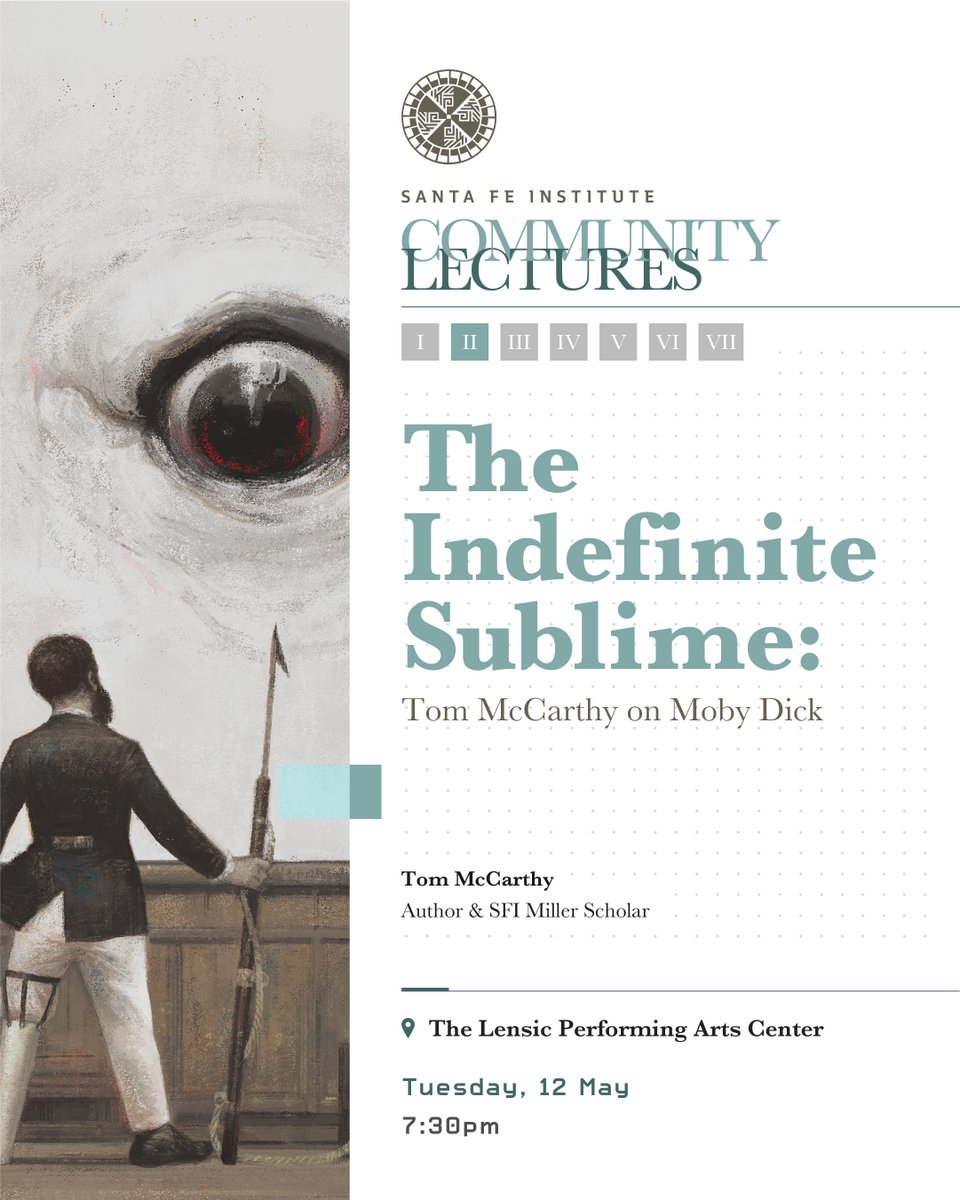
Join us tomorrow at the Lensic Performing Arts Center for SFI’s Community Lecture with Tom McCarthy.
In this exclusive event, McCarthy will trace Moby-Dick’s tides and meridians to unpack the ways in which Melville overhauls the language of the Enlightenment and breaks open the horizons of modernity.
Tomorrow | May 12 | 7:30 pm MT
Free tickets: https://t.co/ai2leCWAhy or watch the live stream on SFI’s YouTube.
In this SFI Seminar, Amos Golan (American University, SFI) discusses how to make decisions when available information is insufficient to identify a unique solution.
He presents an information-theoretic approach and compares it to other decision criteria using simulations and empirical examples.
Watch Golan’s SFI seminar: https://t.co/RknN9irZ71
In 1989, the opening of the inner-German border marked a democratic turning point lived not only in institutions, but in everyday life. A recent SFI working group led by Katrin Schmelz and Sam Bowles examined the conditions under which liberal democracy may be sustainable in the long run, with a focus on the role of economic institutions.
Schmelz explains: "how we interact in our daily life — in our jobs, for example — shapes who we become as citizens, and how a democratic culture may thrive or be degraded.” Bowles adds: “As long as Americans feel left out of the major decisions that are altering their lives, democracy will be in danger in this country."
Lessons from the working group will inform a new research agenda that Schmelz and Bowles will develop over the next decade.
https://t.co/53ywXKzLsg
Reserve your free tickets for SFI’s Community Lecture with Tom McCarthy on May 12, 7:30 pm at @TheLensic.
McCarthy will trace Moby-Dick’s tides and meridians to unpack the ways in which Melville overhauls the language of the Enlightenment and breaks open the horizons of modernity.
Drawing on twentieth-century visual art as well as classical and eighteenth-century philosophy, he will reveal a “grammar of the indefinite” at work in Melville’s prose.
When: May 12, 2026 | 7:30pm
Where: Lensic Performing Arts Center, Santa Fe, NM.
Free tickets: https://t.co/ai2leCX876
Presented free to the public thanks to generous sponsorship by the McKinnon Family Foundation, with support from The Lensic Performing Arts Center and the Santa Fe Reporter.