Applications for the 2027 Complexity Postdoctoral Fellowships are open through September 30.
Marina Dubova just completed SFI's Complexity Postdoctoral Fellowship, and she reflects on what the experience meant to her. A cognitive scientist, Dubova shares what she found at SFI, and how the freedom to follow several big questions at once shaped her time here.
Deadline: September 30, 2026
Requirements & application: https://t.co/mMzUxKNgak
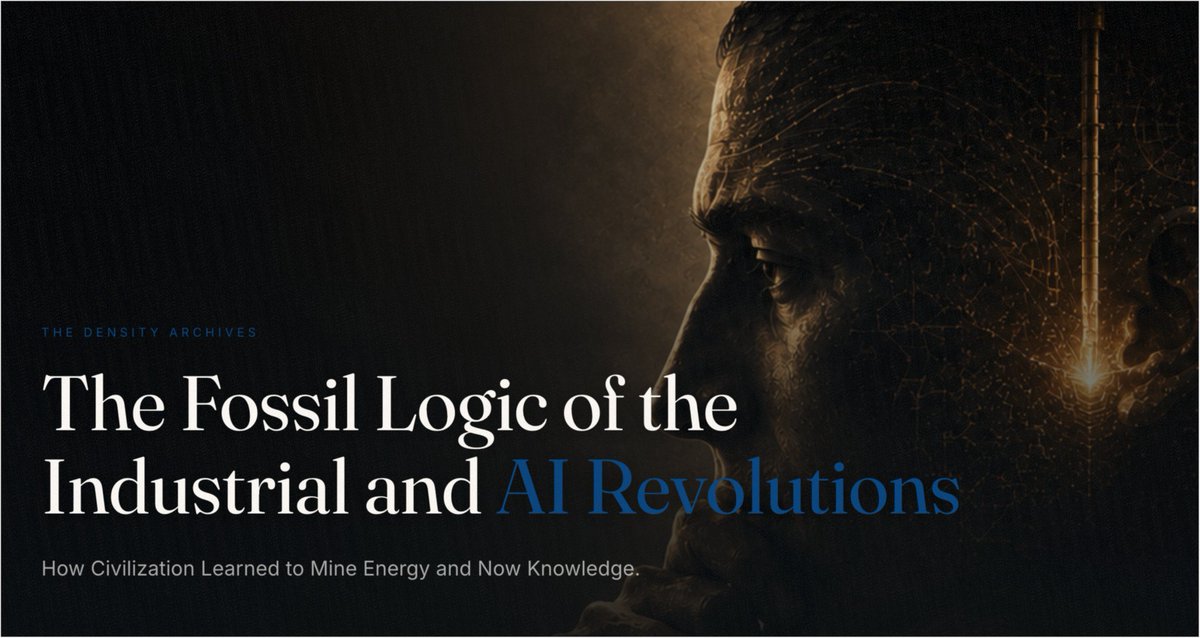
Blue Continuum, a new magazine from Nautilus founder John Steele, launched this week. Among its first stories is an essay from SFI President David Krakauer, “The Fossil Logic of the Industrial and AI Revolutions.”
In the essay, Krakauer looks at the parallels between our use of fossil fuels and the way AI draws from accumulated human knowledge.
Read the essay: https://t.co/xFr3YsSLpW
Direct your own research. Forge lifelong transdisciplinary connections. Apply for the 2027 Santa Fe Institute Complexity Postdoctoral Fellowships.
Complexity Fellows contribute to SFI’s research and collaborate with leading researchers worldwide. If you recently completed your Ph.D. in any scientific discipline and are interested in transdisciplinary research, consider applying. SFI offers independent research opportunities and support to explore big questions across disciplines.
Deadline: September 30, 2026
Requirements & application: https://t.co/mMzUxKNgak
Ten years ago, David C. Krakauer, President at @sfiscience , warned Nautilus that the world's greatest problem was stupidity: applying outdated rules to new realities. Now he's expanded that idea in a remarkable new essay, What Makes Humans Stupid. https://t.co/qLkdTcagiQ
Catch up on our most recent Community Lecture: "Why Your Brain Hates Losing" with Colin Camerer, on loss aversion and how different regions of the brain encode gains and losses.
Watch here: https://t.co/1Rq9FuXy3Y
This was SFI's fourth Community Lecture for 2026. You can watch lectures from this and previous years on SFI's YouTube channel.
The Santa Fe Institute is now accepting applications for the 2027 Complexity Postdoctoral Fellowships!
SFI is looking for recent Ph.D. graduates with strong quantitative and computational skills interested in theoretical, collaborative research. The fellowship offers unparalleled intellectual freedom and the opportunity for early-career scholars to become leaders in transdisciplinary science.
Deadline: September 30, 2026
Requirements & application: https://t.co/mMzUxKNgak
Reserve your free tickets for SFI’s Community Lecture with Thalia Wheatley on June 23, 7:30 pm at the Lensic Performing Arts Center.
For more than a century, neuroscience has viewed intelligence as a property of individual brains. But brains did not evolve in isolation. Humans are an intensely social species whose minds are continuously shaped by other minds. Increasingly, evidence suggests that our most sophisticated cognitive abilities emerge not from solitary brains, but from networks of interacting people.
In this lecture, Wheatley will explore conversation as a powerful mechanism for coupling minds — aligning attention, beliefs, emotions, and behavior across individuals. Drawing on research from neuroscience, psychology, and network science, she will show how everyday features of human interaction are precision tools that synchronize brains, strengthen social connection, and shape mental health.
When: June 23, 2026 | 7:30 pm
Where: Lensic Performing Arts Center, Santa Fe, NM.
Free tickets: https://t.co/TiZg8D5gbJ
Presented free to the public thanks to generous sponsorship by the McKinnon Family Foundation, with support from The Lensic Performing Arts Center and the Santa Fe Reporter.
Reserve your free tickets for SFI’s Community Lecture with Tom McCarthy on May 12, 7:30 pm at @TheLensic.
McCarthy will trace Moby-Dick’s tides and meridians to unpack the ways in which Melville overhauls the language of the Enlightenment and breaks open the horizons of modernity.
Drawing on twentieth-century visual art as well as classical and eighteenth-century philosophy, he will reveal a “grammar of the indefinite” at work in Melville’s prose.
When: May 12, 2026 | 7:30pm
Where: Lensic Performing Arts Center, Santa Fe, NM.
Free tickets: https://t.co/ai2leCX876
Presented free to the public thanks to generous sponsorship by the McKinnon Family Foundation, with support from The Lensic Performing Arts Center and the Santa Fe Reporter.
📢 Calling all NetLogo users for the inaugural NetLogo conference in Chicago, June 29–July 1!
🎤 Keynotes: Uri Wilensky, Josh Epstein & Moira Zellner
🛠️Workshops on ABM + AI, GIS & more.
👉Register by May 1 for early bird pricing: https://t.co/TxxsXBQtD5
Beyond Borders, the quarterly column by SFI President David Krakauer, is available on Substack!
In “The Biophysics of Paradigm Change,” Krakauer moves from evolved accelerometers to cultural knowledge, paradigm change, and adaptive technology.
Read the full column here: https://t.co/H5d6XvZXGh
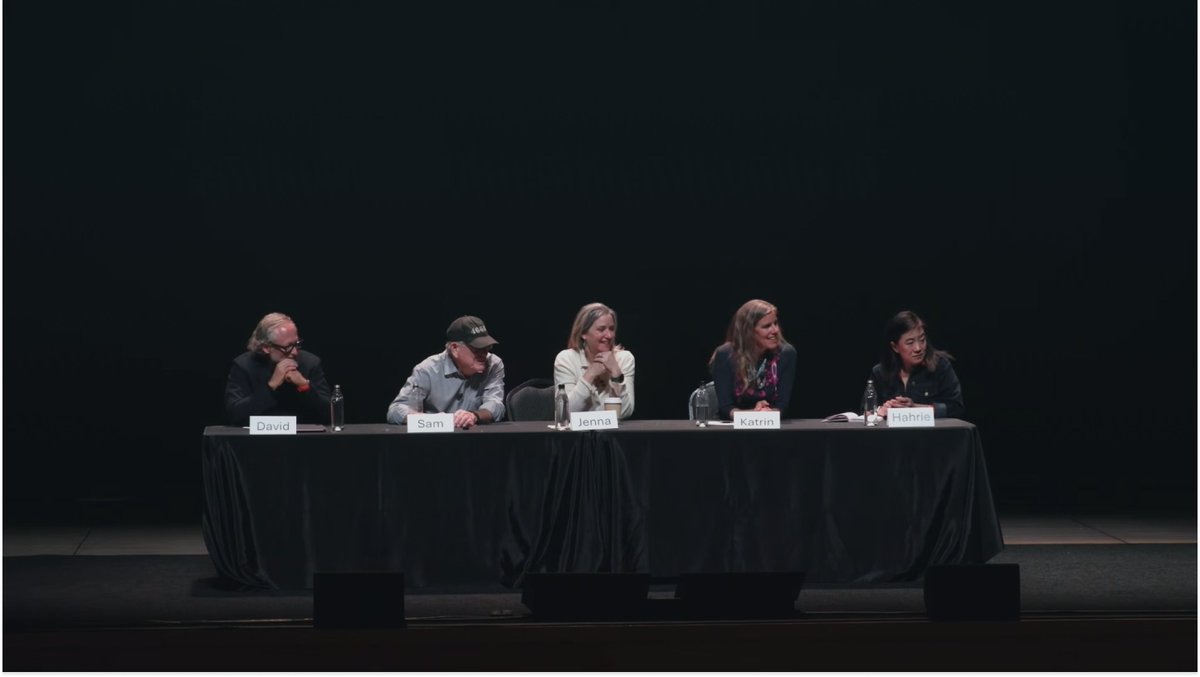
Catch up on SFI’s first Community Lecture for 2026, Crossroads Democracy Panel.
The panel featured Jenna Bednar, Samuel Bowles, Hahrie Han, Katrin Schmelz, and David Krakauer as moderator, and explored what science has to say about the history, economics, psychology, and politics of democracy, the citizens’ values that it both requires and may promote, and how a renewed expansion and deepening of democracy may be the best way to save it.
Watch on SFI’s YouTube channel: https://t.co/x086u4aQI0
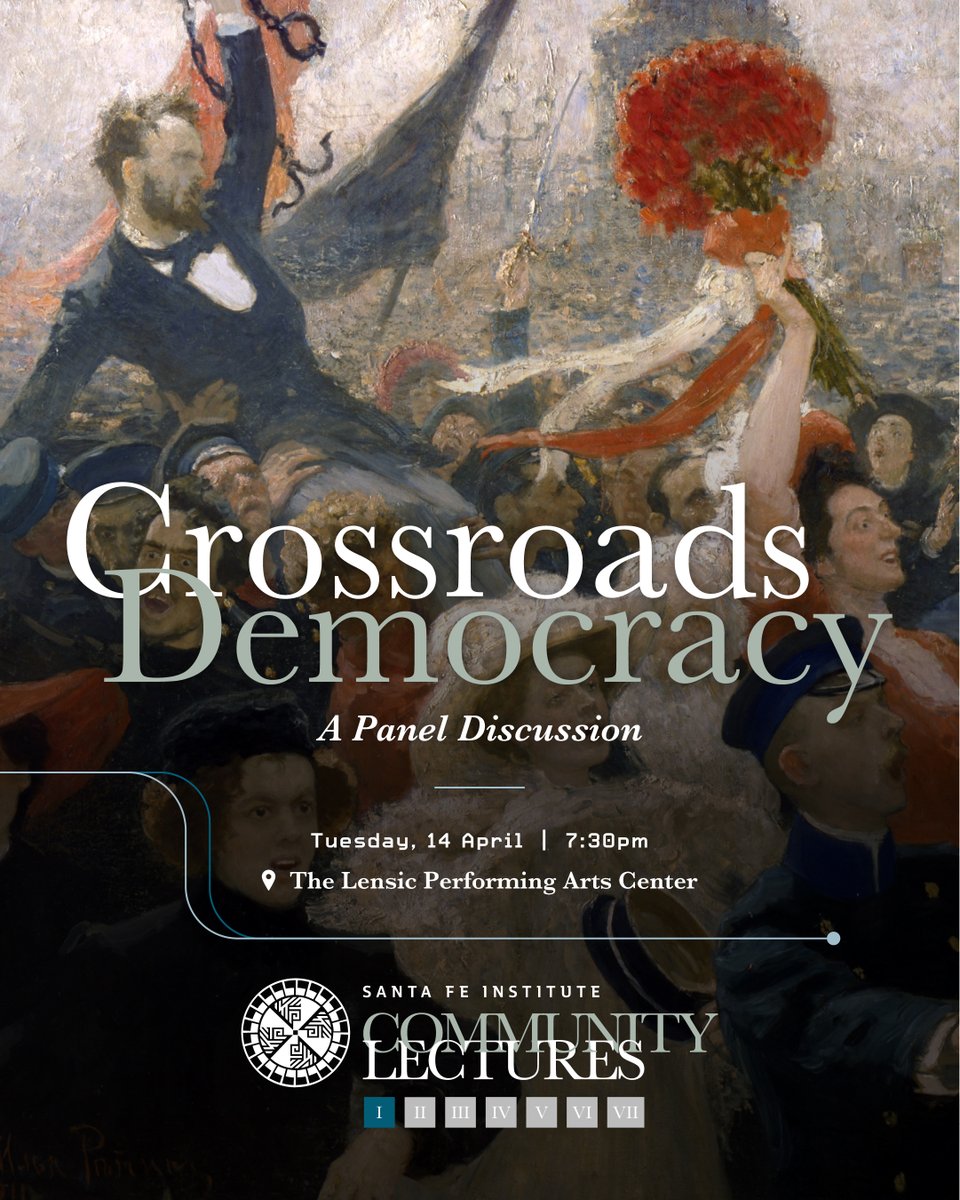
Reserve your free tickets for SFI’s first 2026 Community Lecture event, Crossroads Democracy Panel, on April 14 at the Lensic Performing Arts Center.
Hosted by the Santa Fe Institute, this panel brings together scholars from political science, economics, psychology, and behavioral science to explore what research can tell us about the history of democracy, the values it requires and may promote, and whether a renewed expansion and deepening of democracy may be the best way to save it.
Speakers:
- Jenna Bednar, political scientist at University of Michigan, SFI External Faculty.
- Samuel Bowles, economist at the Santa Fe Institute.
- Hahrie Han, political scientist at Johns Hopkins University.
- Katrin Schmelz, behavioral economist and psychologist at the Santa Fe Institute.
- David Krakauer, President of the Santa Fe Institute and moderator of the open discussion.
When: April 14, 2026 | 7:30 pm
Where: Lensic Performing Arts Center, Santa Fe, NM.
Free tickets: https://t.co/LZW0UW4LAK
More info: https://t.co/jOzz8q0exG
Presented free to the public thanks to generous sponsorship by the McKinnon Family Foundation, with support from The Lensic Performing Arts Center and the Santa Fe Reporter.
The brain has evolved a voracious appetite for energy, consuming about 20% of our daily total. So what makes that cost worth it?
At a recent SFI working group, researchers from across disciplines examined how the high energetic cost of intelligence is balanced against its evolutionary advantages, and began charting a mathematical foundation for understanding that tradeoff.
https://t.co/bXwaOHoGuS
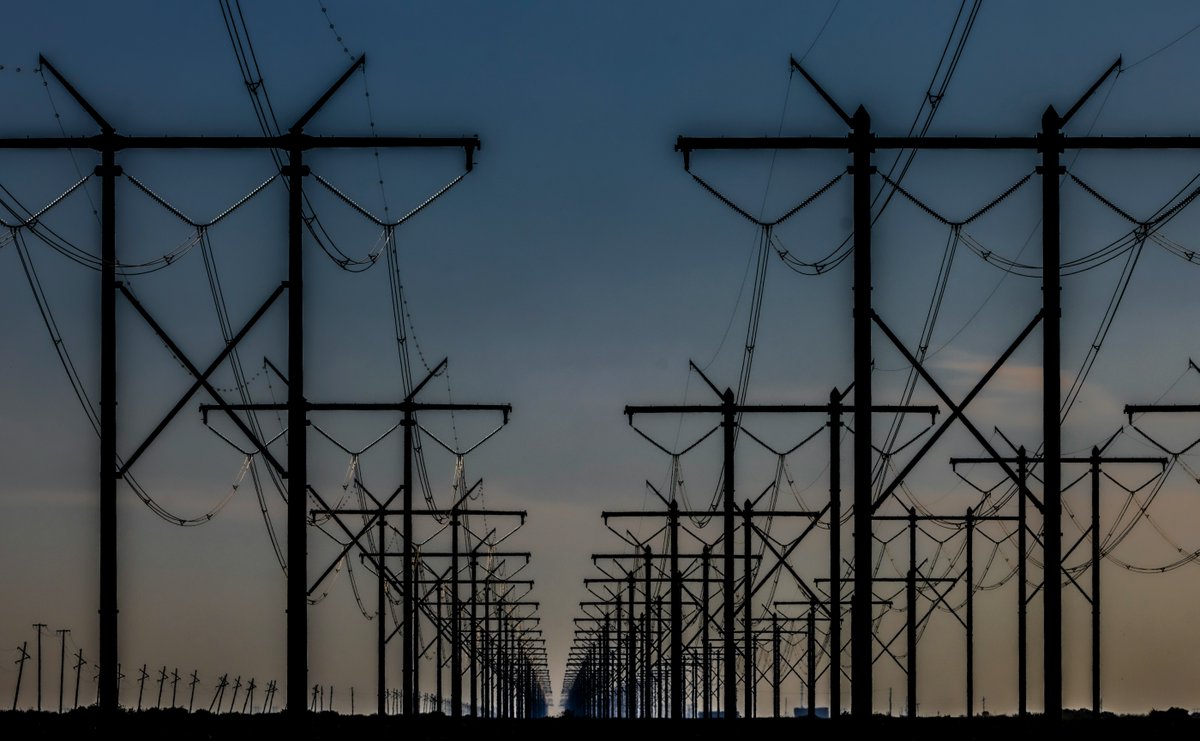
The grid is in crisis. A century-old system for generating, distributing, and regulating electricity is struggling to cope with electrification, decarbonization, rising demand from data centers, and rapid technological change.
At a recent SFI working group, researchers and practitioners explored how a complex adaptive systems approach could help build a more resilient, adaptive grid. “Piecemeal solutions aren’t enough,” says SFI External Professor Seth Blumsack. “How is the grid system organized as a whole? How can we address whole-systems problems?”
https://t.co/L3LiORQ2Ux
Final week to apply for SFI’s 2026 summer programs. Applications close soon for three of our immersive, residential experiences in complexity science:
– Complex Systems Summer School (CSSS) – For graduate students, postdocs, and professionals interested in transdisciplinary research.
– Graduate Workshop in Computational Social Science (GWCSS) – For early-career researchers exploring computational approaches to the social sciences.
– CSSS Journalism Fellowship – For experienced journalists reporting on science and complexity.
Application deadline: February 4, 2026
Apply for CSSS and GWCSS here: https://t.co/hZH9IoFpAY
Apply for the Journalism Fellowship here: https://t.co/TDZHUa36fI
Are you a scholar of the social sciences looking to include computational approaches in your research?
SFI’s Graduate Workshop in Computational Social Science (GWCSS) is designed for advanced Ph.D. students pursuing thesis research in computational social science. Participants work closely with peers and faculty to advance their own research and take part in collaborative modeling and complexity-based problem solving.
Deadline: February 4, 2026
Apply here: https://t.co/yJnlBaqJee