Between 1985--2023, MIT's faculty grew 9%. Administrative staff grew 189%. 📈 Why? In new @PNASNews paper, we use dynamical system model to show administrative bloat can emerge without empire-building--just from well-intentioned problem-solving gone awry https://t.co/MZgGkxilZ2
A mystery novel, a history book, and a fantasy epic may have little in common in plot or style. But count the words inside them and a strange regularity appears: many new words show up early, then fewer and fewer as the author reuses what has already been introduced. That pattern, known as Heaps’ law, turns out not to belong to books alone.
A new study in PNAS, led by SFI and MIT researchers, finds that the same rule also describes how complex systems grow, from living cells and corporations to universities and government agencies. As these systems get bigger, they add new functions more and more slowly. While systems vary in how much they invest in creating new functions, once those exist, their subsequent growth slows, following a remarkably universal pattern known as sublinear growth.
https://t.co/qmebd8nYg1
Through modeling the growth process and empirically estimating key parameters, we find that while systems differ in how they add new functions, once a function is introduced, its growth follows a common sublinear preferential attachment process.
New paper in PNAS: We find Heaps' law, empirical regularity first identified in how diversity of vocabulary scales in books, also describes function diversity in cells and many human organizations (with cities being a notable exception). w/ @sfiscience
https://t.co/oSGdHTeSsI
PhD applications at @MITSloan are live! 🎓 Deadline is Dec 1. If you’re excited about social system modeling research and want to work with me or our other fantastic faculty, we’d love to see your application to the system dynamics group! https://t.co/hGMah4bLHq
Collaborate with researchers from around the world. Chart your own transdisciplinary path. Applications for the 2026 Santa Fe Institute Complexity Postdoctoral Fellowships are open!
With competitive salary, collaborative and discretionary funds, a generous benefits package including paid leave, the SFI Complexity Postdoctoral Fellowship offers early-career scholars the opportunity to become leaders in the field of transdisciplinary research.
Deadline: October 1, 2025
Requirements & application: https://t.co/mMzUxKNgak
Mastering a skill can take decades, but the learning process unfolds across multiple timescales, from mere moments to days. A new paper by three former SFI postdoctoral fellows presents a theoretical model of nested timescales of learning, offering a unified, multi-scale account of skill acquisition.
The study grew from a conversation between co-authors @mingzhen_lu, @VickyCYang, and @TylerMarghetis during SFI's 2020 Postdocs in Complexity conference.
https://t.co/D3bw7llBx2
Excited to share our new paper in @Nature_NPJ Complexity! We propose a unified, multiscale model of skill acquisition—linking moments to decades. Ideated at the @sfiscience -@JSMF conference research jam, and years (many revisions) later, it’s finally out. https://t.co/sS5ZJnMjXW
The Santa Fe Institute is hiring full-time resident faculty!
We’re looking for applicants with outstanding academic accomplishments in their own field who also engage other disciplines in deep ways. Our faculty are broad, creative, and catalytic thinkers who are willing to take risks. They excel at communication and collaboration and are looking to break new ground in addressing some of science and society’s most challenging problems.
Apply by Friday, March 28, 2025. https://t.co/EShgp5ai0s
Microsoft's Computational Social Science group may have the opportunity to hire one researcher
Senior: 0-3 yrs post PhD
https://t.co/ZqZOfnQtcC
Principal: 3+ yrs post PhD
https://t.co/ig32EJHSQS
Please note: our ability to hire this season is not certain
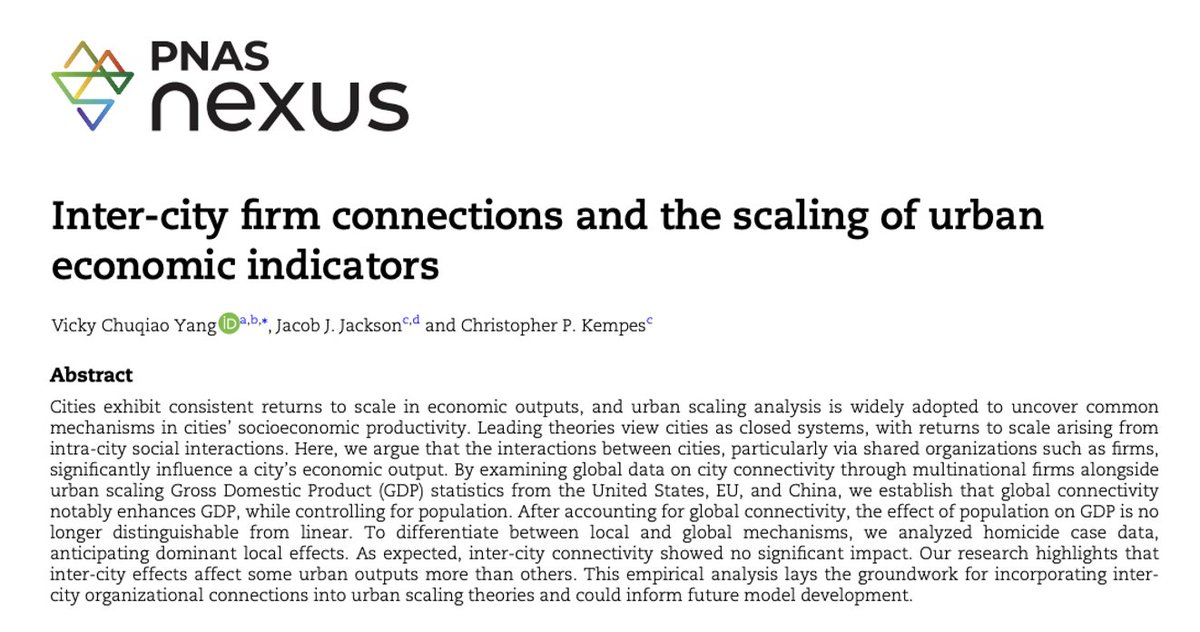
A significant body of research has investigated why, as city populations grow, so do violent crime, contagious diseases — and per-capita GDP. A new paper now finds that cities with strong interconnectivity show a marked economic benefit, even beyond normal scaling.
https://t.co/3s3nA2htEH
We hope this motivates rethinking of urban scaling models to integrate global & local effects. Paper (w/ @JakeJJacksonRI & Chris Kempes) at @PNASNexus: https://t.co/RWhngOFT47
New paper on urban scaling & global connections. We show global connectivity (through multinational firms), plays a significant role in GDP. After accounting for global connectivity, effect of population is no longer distinguishable from linear.
PhD student opening at MIT Sloan System Dynamics! Seeking aspiring social system modelers (esp. dynamical system), wanting to take the social sciences seriously. Generous fellowship funding, free to work with me or any of our talented SD faculty. https://t.co/hRE8lNGwKj
The structure at Sloan is different from the lab structure at most engineering schools---students are not tied to/funded by any particular faculty. So students have unparalleled freedom to choose who they want to work with and bring in their own project ideas.
PhD student opening at MIT Sloan System Dynamics! Seeking aspiring social system modelers (esp. dynamical system), wanting to take the social sciences seriously. Generous fellowship funding, free to work with me or any of our talented SD faculty. https://t.co/hRE8lNGwKj
Interested students should apply directly on the Sloan link included in the 1st post (please select system dynamics). Deadline is Dec 1. Individual faculty (like myself) is not able to evaluate applications on our own.