Experienced Chief Economist with a demonstrated history of working both at sell and buy side, covering the Brazilian and G10 economies.
Working at EQI Asset.
O Teorema de Mencken | VEJA
Paul Krugman popularizou a expressão “ideias zumbis”: aquelas que são repetidamente refutadas, enterradas e, apesar disso, insistem em voltar à vida. Uma delas é mudar a meta de inflação.
Leia mais em: https://t.co/sPUtV5qt8z https://t.co/sPUtV5qt8z
@EdwardKonings Interessante q o Fed usa essa abordagem há meses mas de maneira "informal", postando os relatórios mas sem mencionar na comunicação oficial.
Live: O Labirinto das Decisões
Como nossa mente influencia riscos, ganhos e perdas
Hoje, dia 14 de janeiro, as 18:15hs
Vamos falar dos viéses de decisão e como eles afetam nossa vida, inclusive financeira.
https://t.co/qIpFDUzze8
When we look at the Brazilian economy and wonder why growth has been so low for so long, an uncomfortable part of the answer lies in the private sect itself. Brazil is a notorious breeding ground for zombie companies. These are firms that cannot generate enough profit even to pay the interest on their own debt, but remain in existence because the financial system allows for the constant rollover of this liability. They do not innovate, they do not grow, they do not increase productivity.
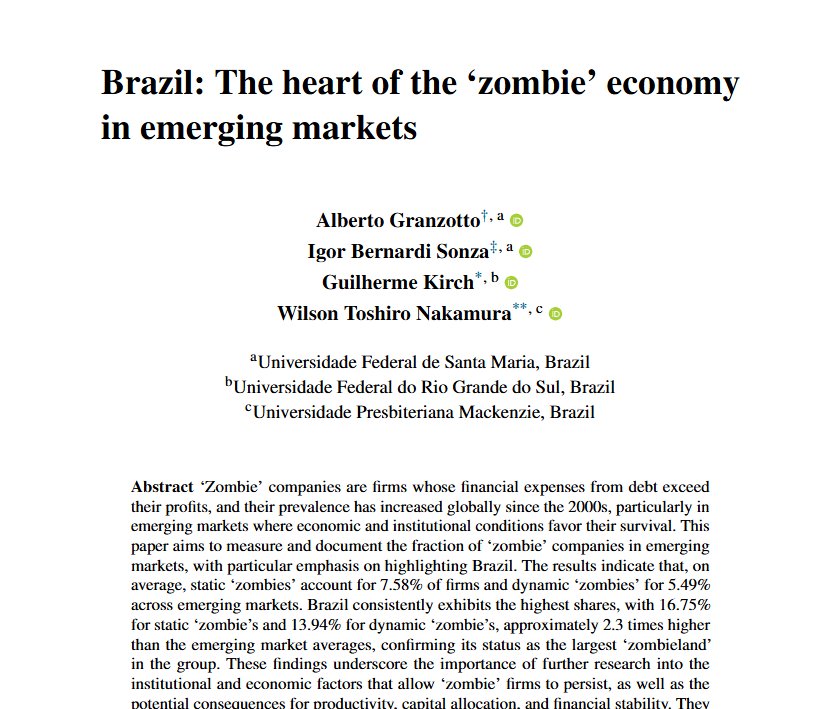
According to an article by Granzotto et al. (2025) in the Brazilian Review of Finance, which compares companies in various emerging markets, on average 7.6% of firms are "static zombies" (firms with EBITDA/Financial Expenses < 1) and 5.5% are "dynamic zombies" (EBITDA/Financial Expenses >/= 1) in these markets.
In the Brazilian case, 16.75% of companies are classified as static zombies and 13.94% as dynamic zombies! In other words, more than double the average for emerging markets. The authors themselves bluntly state that Brazil is the "heart of the zombie economy" among emerging markets, about 2.3 times above the international standard.
To clarify what this means: we are talking about companies that cannot generate enough profit to cover their financial costs, meaning that investors will have to wait longer to recover their principal, and that workers will be employed in firms without the capacity to invest in new technologies and processes that could improve their human capital and productivity.
The article shows that this mass of zombie companies distorts capital allocation, reduces aggregate productivity, and weakens investment dynamics. Credit, labor, and resources are trapped in financially fragile firms, while more productive companies face a hostile financing environment. And this, of course, has a cost in terms of potential economic growth.
As long as the Brazilian government does not address the problem of reforming the business environment and its capital markets, these types of inefficiencies will continue to persist and condemn workers and investors to remain trapped in firms that should be defunct.
SOURCE: https://t.co/a8MPL6y7xz
#Economía #econtwitter #Economics #Finance #Brazil
@mariatad Disagree on this one. Lula and PT have always been against this deal. They followed through on a proposal from the previous govt that was ready to be signed. Would probably be a relief for Lula if this goes sour.
Minhas 5 sugestões de leituras
meu objetivo é trazer os livros que me trouxeram mais conhecimento ao longo de 2025, ideias novas e provocações sobre novos temas.
https://t.co/dTrAFeZILF