SF Commercial & Residential Real Estate
Off-market deals • Luxury • Market intel
Sotheby’s International Realty | DRE 018896394
DM for private opportunities
Proud of my production record over the last 15 years. Some very special transactions include:
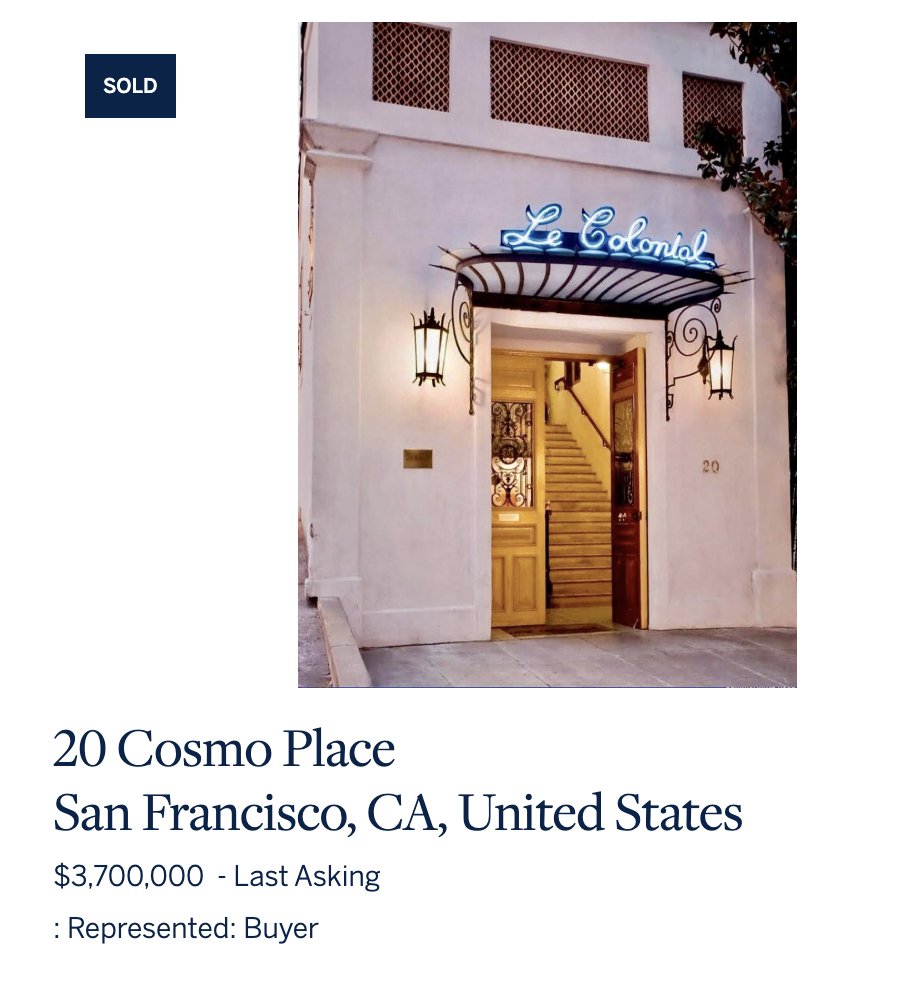
-Negotiating the purchase of 40 Cosmo Place in San Francisco—the iconic commercial building that housed the legendary Le Colonial.
-The record-breaking sale of 667 Howard, a commercial property across from SFMOMA.
-The hard-fought sale of 570-580 Bush, a Union Square multi-unit building over retail, secured after a grueling, multi-round campaign that tested every strategy.
-Acquiring the Presidio Heights mansion at 3878 Jackson for $500K below asking.
-Closing the 10-day sale of a San Francisco single-family home at 40 Dorchester Way above asking.
-Outmaneuvering an all-cash offer with a financed bid to secure the coveted property at 1479 Oak Rim Drive in Hillsborough.
Thank you to my clients, many of whom have become lifelong friends, for entrusting me with your commercial and residential projects.
Follow and reach out. I’m here to help.
#SFRealEstate #BayAreaDeals #LuxuryHomes #commercialrealestate
Two new S.F. listings pitched as development plays: 2083 Ellis St. ($2.499M) comes with plans for a 7-story, 9-condo building near Divisadero, and Potrero Hill's 1107 Rhode Island St. ($1.225M) sells together with its neighbor on a 5,800 SF parcel.
Union Square trade: Thor Equities paid $50.55M (about $370/SF) for 55 Stockton St., an eight-story, 136,714 SF office and retail building at Stockton and O'Farrell. It's Thor's second Union Square buy in four months. This is the former Crate and Barrel store. Link in comments.
Strada plans 300+rentals, an eigh story bulding on Lake street with 262 rentals and 45 for sale homes at West Pacific Ave and the Presidio. Link in comments.
S.F. Planning accepted Tidewater Capital's formal application for a 390-foot, 36-story mixed-use tower at 1301 Van Ness Ave., using SB 330 and the Housing Choice San Francisco program. Plans call for 443 units (105 studios, 209 one-bedrooms, 84 two-bedrooms, 45 three-bedrooms), 4,520 SF of retail and 108 parking spaces on the 0.46-acre site at Sutter, home to the 1911–12 Goodyear building, which is considered a historic resource. Construction is estimated at about $175M, with a possible January 2028 to April 2030 timeline. Link in comments.
Explainer of the day:
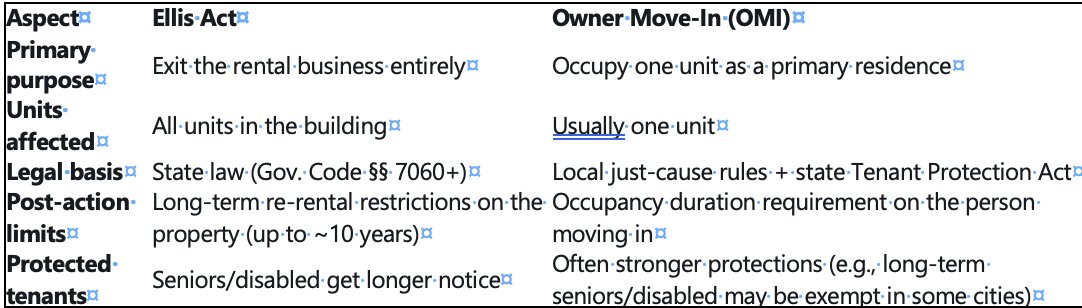
The Ellis Act and owner move-in (OMI) are distinct no-fault eviction mechanisms in California (especially in rent-controlled cities like San Francisco, Los Angeles, Oakland, and Berkeley). They serve different purposes and have different scopes, requirements, and long-term effects.
Ellis Act
This is a California state law (Government Code §§ 7060 et seq., enacted in 1985) that gives property owners the right to withdraw all residential rental units in a building from the rental market to “go out of the rental business.” Local governments cannot force an owner to continue offering units for rent.Wikipedia
Scope: Entire building (or all units on the parcel in many cases). You cannot use it for just one or a few units.
Typical uses: Leaving the rental business entirely, converting to condos/TICs, demolition/redevelopment, or selling vacant to an owner-user.
Notice: Generally 120 days; extends to 1 year for tenants who are 62+ or disabled and have lived in the unit at least 1 year.
Relocation: Required; amounts are set locally and are often substantial (higher than many OMI amounts in places like San Francisco).
Afterward: Significant restrictions that run with the property (often up to 10 years). If units return to the rental market, there are usually controlled rents for the first several years, a right of first refusal for displaced tenants, and potential damages for early re-rental. These constraints bind future owners once recorded.
Owner Move-In (OMI)
This is a recognized “just cause” ground for eviction under local rent-control ordinances and California’s statewide Tenant Protection Act (Civil Code § 1946.2, as amended by SB 567). It allows an owner (or certain close relatives) to recover one specific unit for use as a primary residence.
Scope: Typically limited to one unit per building. Other units stay on the rental market. Ownership thresholds often apply (e.g., a natural person with a minimum recorded interest such as 25%).
Who can move in: The owner or close relatives (definitions vary by locality and state law; commonly spouse/domestic partner, children, parents, grandparents, and sometimes siblings).
Notice: Often 60 days under state rules (longer in some local ordinances or for certain tenancies).
Relocation: At least one month’s rent under state law; local ordinances frequently require substantially more.
Afterward: The person moving in must generally do so within 90 days and occupy the unit as a primary residence for a minimum period (12 months under state law; longer under many local rules, such as 36 months in San Francisco). Failure can trigger a right of return for the tenant, damages (including treble damages in some cases), and other penalties. Good-faith intent is required; bad-faith use (e.g., to clear a low-rent tenant and re-rent at market rates) is restricted and punishable.
Practical notes: Rules and dollar amounts vary significantly by city and change over time. Both require strict procedural compliance (filings with the local rent board/housing agency in controlled cities, proper notices, etc.). Misuse can lead to liability. Selling a building with tenants in place is sometimes an alternative that avoids relocation costs and restrictions, though it typically yields a lower sale price.
This office building is relatively easier to convert to residetial.
Preliminary Permits Invoke HC-SF For 2536 California Street, San Francisco.
Link in comments.
Why San Francisco Still Isn’t Building Offices: Kilroy Pegs Replacement Cost at Up to $1,700 Per SQFT. Link in comments, Basically rents have to go up 20-40% before new towers pencil out.
Bay Area homeowners will be required to replace broken natural gas furnaces with heat-pump heating and cooling systems starting in 2029, under a rule from the Bay Area Air District. This is the district’s second major natural-gas appliance ban aimed at cutting nitrogen oxide (NOx) emissions for health and environmental reasons.
Key cost details from the air district’s new analysis:
A standard gas furnace replacement currently costs about $8,000.
A heat-pump HVAC system has a median cost of about $21,000 for a single-family home — an extra ~$12,500–$13,000.
This follows the earlier water-heater rule: starting in 2028, roughly half of homeowners must replace broken gas water heaters with heat-pump models (extra cost ~$3,500 on average); the other half can use exemptions. Many households will therefore end up with two heat pumps.
The air district projects the combined water-heater and furnace rules will prevent 37 to 85 premature deaths per year and avoid hundreds of millions of dollars in health-care costs.