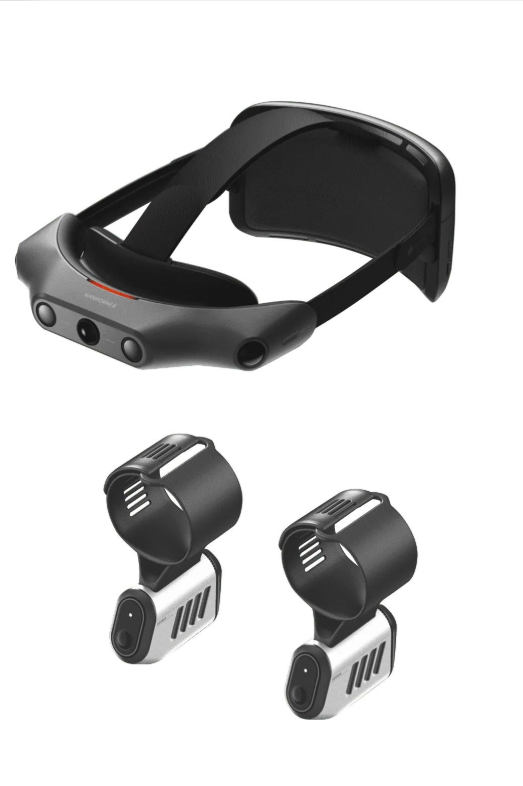
We're heading into a new era of sports analytics, where any cricket enthusiast or aspiring athlete can analyze their own personal videos and start building an AI-powered personal coach.
I spent about 10 minutes fetching clips, extracting bowling form with the @vlmrun gateway and comparing bowling traces from @Jaspritbumrah93, @malinga_ninety9 and others.
Embodied AI data collection in China has entered the era of mass crowdsourcing.
Just look at these screenshots. Ordinary people can now get paid to record everyday physical tasks: sorting packages, scanning barcodes, packing boxes, and more.
The price has dropped to just RMB 14 (~$2) per hour of valid video footage.
And here's the catch: "valid" means footage accepted by the buyer, not the total time spent recording.
Typically, only around 70% of recorded footage counts.
That brings the effective pay down to roughly RMB 9.8 (~$1.40) per hour of recording, even before accounting for setup and other work.
That's approaching the income level of China's lowest-paid workers.
The race to scale embodied AI data is no longer just about robots and GPUs.
It's also about how cheaply human physical labor can be turned into training data.
The platform is operated by Mifeng Technology (Maniformer), backed by AgiBot (Zhiyuan Robotics).
By the way, how much are they paying for data collection where your country ?
i was talking 4 days with Claude for this song
Berlin rave meets opera.
Human-made Slopcore.
Unpromptable.
55,000 lines of code
282 clips generated.
99 chosen.
Music? Art? A cultural movement?
We wil find out eventually...
I'M YOUR SLOP (I'M YOUR ART) 🎨
btw, thanks for all the messages. im not use have notifications. bit overwhelmed 💀
MolmoB0t really challenged my perception of the role of simulation in today's robotics scaling paradigm.
You don't really need photorealism or careful tuning for simulation to be useful -- just domain randomize your way to generalist policies!
https://t.co/0IDSK6YN1z
Introducing Agora-2, our next-generation multi-agent world model.
Agora-2 supports up to 20 humans and agents interacting inside a shared environment, all simulated in real time.
Our multiplayer research preview is available to try right now!
@EMostaque It’s an interesting question - do we have enough measurements to infer all of the laws of the universe given the right analysis aka “maths”. My hunch is probably No - but that’s the empiricist in me :)
If you had a choice between instantly receiving £50,000 or a 50% chance to win £1m, which would you pick?
£50,000: 73%
50/50 chance of winning £1m: 21%
🧵Late last year, I got to work with @osc_london on a very interesting project. I was called on to create a highly detailed digital twin of a North Korean oil tanker, called the Yu Son, Here's how I did it...
Just like the oil futures markets but now for compute - it may not seem like a big deal, but this type of financial instrument makes a lot of things possible.
Today, we launched GPU compute forward curves derived from our prediction market prices. Forward curves are now available on Nvidia B200. H200, and A100 chips.
Forward curves track implied future prices. They are how mature commodity markets form expectations, allocate capital, and manage risk. Energy, interest rates/SOFR, FX, metals, and agricultural markets all rely on market-implied forward prices.
Despite becoming one of the key inputs in the global economy, compute has lacked that market-derived infrastructure. Compute right now is where oil was before NYMEX — traded only via OTC deals, just like oil used to trade OTC between producers and refiners. As compute becomes as fundamental to the economy as energy, the industry will need a similar derivative market to promote efficient price discovery.
Prediction markets are uniquely suited to this problem. Compute is not one uniform commodity and spans many chips, grades, tenors, locations, and contract structures. A live prediction market can aggregate those dispersed views into transparent prices that reflect market expectations for different maturities.
The opportunity is big. Hyperscalers are spending over $700B on compute this year and the market is expected to grow to $7-10T by 2030. If this market behaves like traditional commodity markets, a liquid derivative market could be 10-20x bigger than the underlying spot market.
Compute is still not uniform enough, but this is a step towards standardization as forward curves will help us see the rise and fall of different model prices and how they correlate.
The forward curve is a first step. Up next: futures and perps.
This may be a glimpse of the next air war.
CNN reports that the pilot of a U.S. Air Force F-15E Strike Eagle, shot down over Iran in April, described a sight that immediately triggered debate inside the U.S. Intelligence Community: multiple Iranian drones in the air, apparently interconnected or coordinated, moving as one. One source described larger drones with smaller drones beneath them, “like legs.” Another described it as a “minefield of drones” in the sky.
That image matters because it points to something much larger than one strange encounter.
As I have written several times before, drones change everything.
The drones we see today are still primitive compared with what is coming. They are like the first aircraft that had to be pushed or run into the air by manpower from a field. Crude, limited, almost awkward. But the development curve is completely different now. Aviation took decades to mature. Drone warfare is moving in years, sometimes months.
The key point is not simply that drones can fly. It is that we now have the ingredients for autonomous drone clusters: cheap airframes, sensors, networking, edge computing and AI systems capable of coordinating movement, target recognition and swarm behaviour.
That turns airspace into something new.
Airspace used to be controlled by aircraft, missiles and radar. In the next phase, it can be “mined” in real time.
A drone swarm does not need to destroy a fighter jet directly to change the battle. It can block its path. It can force evasive movement. It can overload sensors. It can create false targets. It can make a pilot choose between flying into a dense field of small autonomous objects or breaking formation. It can sit between a tanker and the aircraft that need refuelling. It can hover around a suspected rescue corridor. It can rise from trucks, ships, containers or concealed launch sites and fill a sector of sky in seconds.
Imagine a few scenarios.
A fighter package enters contested airspace. Instead of meeting one missile system, it meets a moving aerial obstacle field. Hundreds of drones climb into layered altitude bands, some acting as decoys, some carrying explosives, some simply forcing manoeuvres.
A rescue helicopter approaches a downed pilot. The enemy does not need to shoot it down immediately. It seeds the air around the rescue zone with small autonomous drones, forcing the rescue force to slow down, reroute or expose itself.
An aerial refuelling tanker operates far behind the front line. A long-range drone cluster does not attack the tanker directly. It occupies the airspace between the tanker and incoming fighters, breaking the rhythm of refuelling and extending the stress on the entire operation.
A naval task force moves through a narrow corridor. Drone swarms launched from shore, small boats or merchant vessels create a temporary aerial minefield over the water. Every radar screen fills with movement. Every defensive system has to decide what matters and what does not.
This is why the “jellyfish” description is so striking. Whether the pilot saw a tightly coordinated formation, a linked drone structure or simply a dense cluster behaving as one system, the military implication is the same: the future is not just the drone as a weapon. It is the drone as terrain.
A minefield once meant something placed on land or under the sea before the enemy arrived. Now the minefield can move, think, reposition and appear in the air at the moment it is needed.
That is the revolution.
The question is no longer whether drones can destroy expensive military platforms. We already know they can. The deeper question is whether they can make entire zones of airspace too confusing, too costly or too dangerous to enter.
And if they can, then the age of uncontested air superiority may be ending much faster than many Western planners want to admit.
What happens when the sky itself becomes a programmable obstacle? And what happens to traditional air power when cheap autonomous systems can turn a flight path into a trap within seconds?
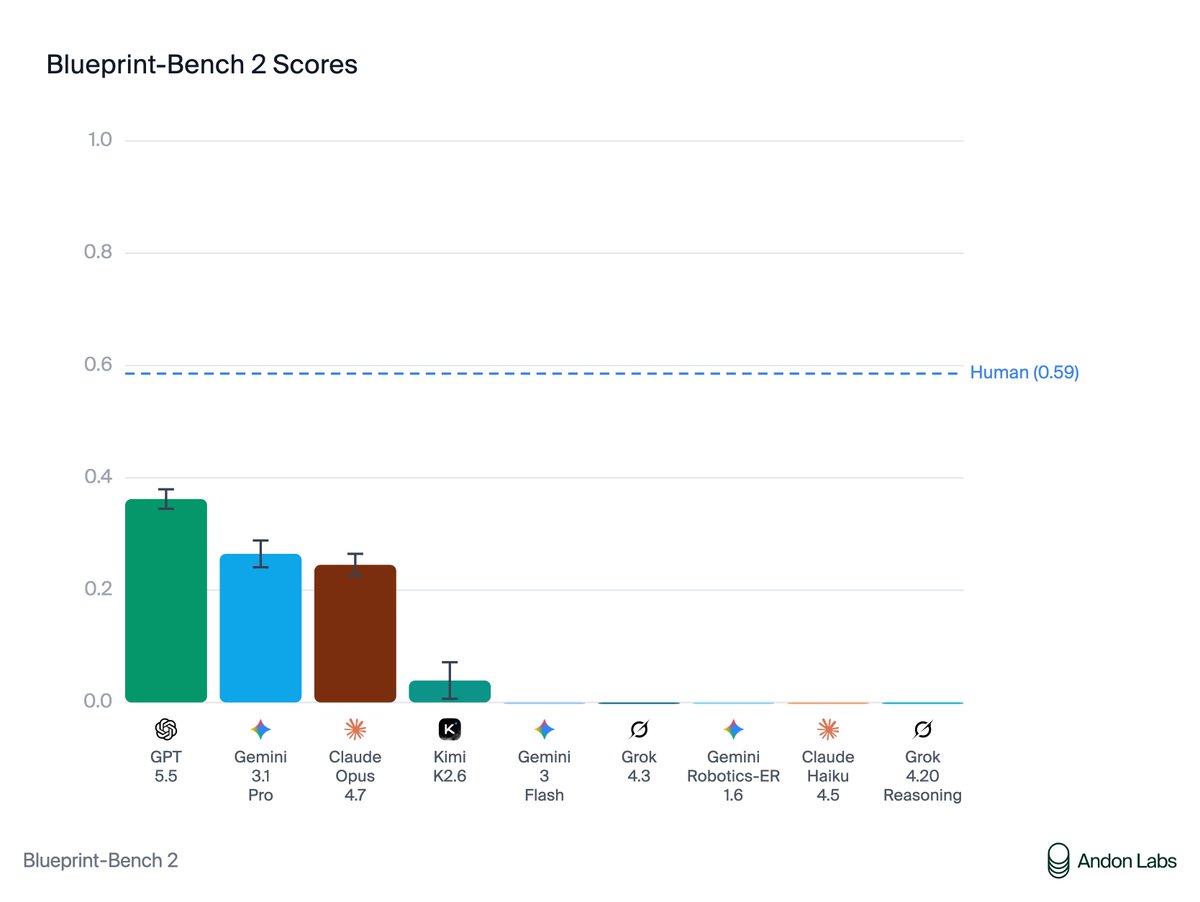
New benchmark for spatial intelligence. This reflects what a lot of people using the models for robotics work are seeing in practice. They just aren’t very good at spatial intelligence….yet.
Introducing Blueprint-Bench 2.
3D spatial intelligence is not something AI models are trained for. We built the original Blueprint-Bench to track when it would emerge. At the time, no models showed any sign of such intelligence.
Seven months later, the first signs are here.
There’s a lot of talk about super shoes in marathons. But fueling strategy is contributing a similar impact on record times. The science is evolving fast - take a read here to see Kejelcha’s strategy and why a missed bottle at 35k may have cost him a place in history.
A little more for the marathon nerds: Yomif Kejelcha ran 1:59:41 to become the second man under two hours in a legal race and he was on Sabastian Sawe's shoulder until 41K. Took a bit different of a fueling approach.
The Santamadre team, an emerging Spanish company, shared his fueling plan with the targeted amounts at each station. A few things stood out to me, if I'm reading this correctly. Kejelcha planned to take roughly 60ml of fluid at most stations, which is estimated at less than half of Sawe's intake (though it's worth noting runners often toss bottles quickly and don't hit their targets exactly). He skipped 5K entirely and took nothing at 40K.
🗣️Santamadre co-founder Alfonso Beltrá López: “We took advantage of the pre-race window to reduce digestive load as much as possible. We knew exactly how much fluid the athlete loses and how much energy his body consumes, as we had monitored him 24/7 over the previous three months: body temperature, breathing rate, heart rate and oxygen saturation. We also controlled his caloric load in detail. The strategy was to provide 287.4 g of carbohydrates between the pre-race and in-race fueling, in addition to the 580 g of glycogen we had built up during the two-day carb-loading phase before the race.”
I didn't know as much about their products beforehand but the Unusual Fuel (taken by him at 15K, 25K, 35K) is a high-carb drink mix: 100g of carbs and 500mg of sodium per 500ml. Unusual Gel 45 is a 45g carb gel in a 1:1 glucose-to-fructose ratio, available with or without caffeine. He used the caffeinated version pre-race and at 20K.
Then there's Reset Gel (10K, 30K), which is an interesting one. It's billed as a CNS fatigue blocker with 300mg of tart cherry polyphenols. It also has 30g of carbs. It kicks in quick and his two doses overlapped to cover most of the second half.
🗣️ López: “We used RESET Gel at 10K and 20K, a gel designed to help control muscle damage and reset fatigue. It was one of the key parts of our strategy, exactly as we had seen in the specific training sessions.”
Finally, the Prototype he sipped for 75 minutes pre-race is a new product in the works. Santamadre says more is coming on that in the months ahead.
🗣️López: “It was a real shame he couldn’t grab the last bottle at 35K. We believe everything could have changed. At 41K, he ran empty; those extra three minutes could have been covered by the 12.4 g of carbohydrates planned for that point.”