A leveraged position doesn't lose money because the asset goes the wrong way. It can lose money even when the asset ends up exactly where it started.
Move an asset up 20 percent then down 20 percent and it lands down 4 percent, not flat. Run 2x leverage through that same round trip and the loss is worse. That gap has a name, volatility drag, and it is pure math, not bad luck. Add financing drag, the actual cost of the capital behind the exposure, and most leveraged products only work as short-term trades. Hold them long enough and the two drags eat the position from underneath, regardless of direction.
2factor's structure splits an asset's volatility instead of just leveraging its price. One tranche is senior, capital protected, and paid a premium. The other is junior, leveraged, with no liquidation risk and no counterparty shorting against it, funded by that same premium instead of by borrowing costs. Where an asset's own long-run drift outpaces both drags, that split creates a band of leverage that compounds for the holder instead of against them, and the right multiple depends entirely on the asset. Near Bitcoin's volatility the band closes early, so the junior targets about 1.33x. Equities, at a fraction of that volatility, stretch the band well past 3x, the research runs roughly 2.35x for gold and 2.1x for the S&P 500. Bitcoin is the hard case for this mechanism, not the easy one, which is exactly why it's the one live on testnet right now.
Tokenization already solved getting assets onchain. It never solved what happens to them once they're there. Tokenized equities are the fastest growing corner of onchain RWAs, and they inherited market hours without inheriting market makers or any capital structure around the exposure. That's the gap this closes.
I joined the @2FactorFinance Points Program to track this as it goes live. Marks come only from verified actions, never from a purchase, a deposit, or holding anything, and they carry no cash value and cannot be transferred, they're a leaderboard score, not a token. When Season 1 ends at launch, the leaderboard freezes and the top 10 accounts split 1 BTC in cbBTC on a fixed curve, from 18.2 percent at rank 1 down to 1.8 percent at rank 10.
Referral link if you want in: https://t.co/NqkwBOHxmB
If you had to weigh your own portfolio's long-run drift against its volatility, would leverage be working for you right now or against you?
one detail from @vangrid_io I actually like
buyers don’t just get your raw capture video 😂
they see a watermarked preview first
once accepted, Vangrid turns the capture into the 3D data they actually need
less “give me all your footage”
more “give the machine the useful part”
We’re entering a world where the physical environment itself can become a source of machine-readable data.
But there’s a huge difference between collecting information and turning it into something machines can actually understand.
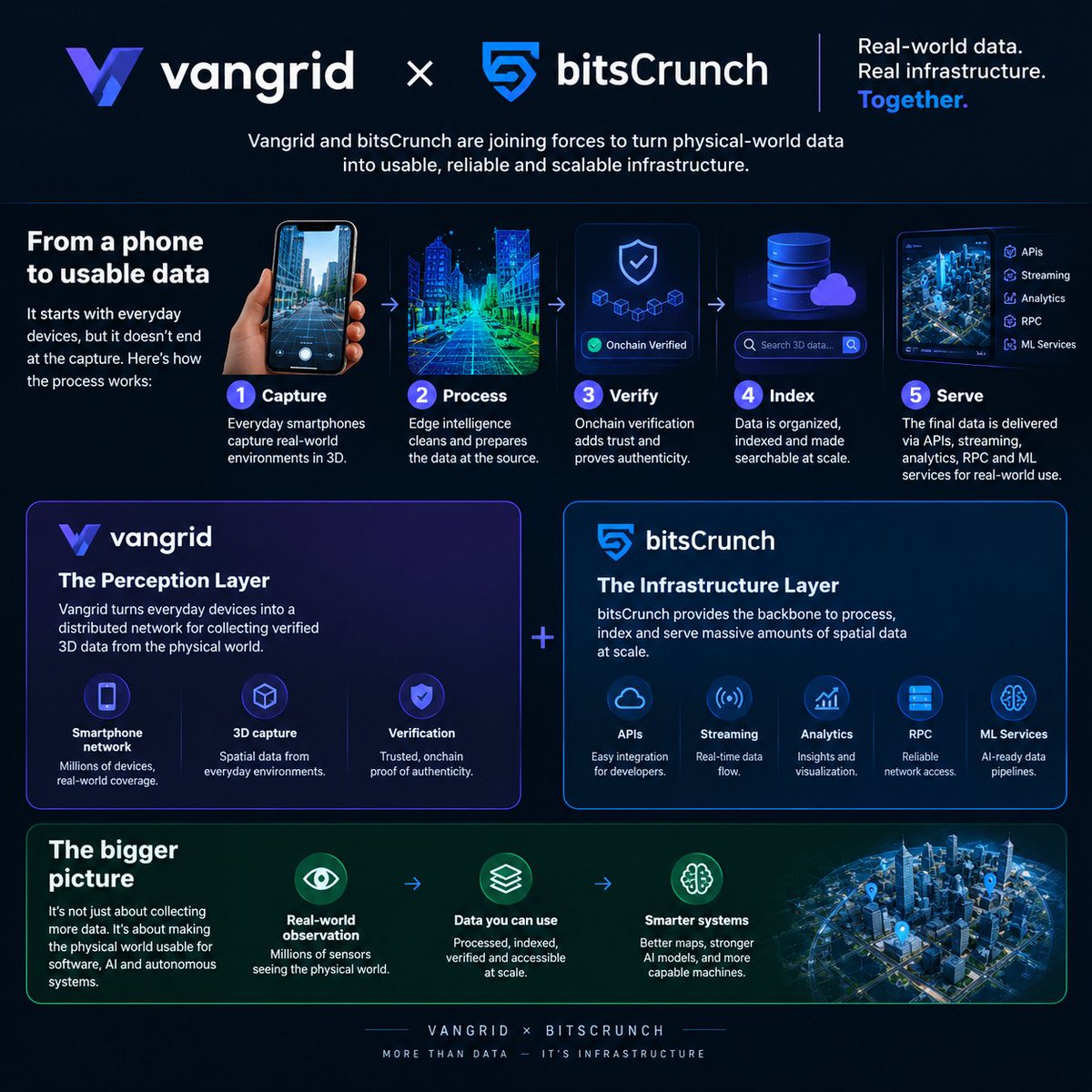
That’s what makes the @vangrid_io × bitsCrunch collaboration worth watching.
Vangrid is creating a distributed network where ordinary smartphones can observe real-world spaces and generate 3D representations of them.
The bigger challenge comes after the capture.
How do you handle enormous amounts of spatial information?
How do you organize it?
How do you analyze it?
And how do you make it accessible without losing the trust behind the data?
That’s where bitsCrunch becomes an important part of the picture, bringing infrastructure designed around data processing, analytics, APIs and machine-learning workloads.
Put the pieces together and you get a pretty interesting pipeline:
Phones provide the eyes.
Vangrid coordinates the observations.
Verification adds confidence.
bitsCrunch helps turn the resulting data into usable infrastructure.
The end goal isn’t simply to create a bigger map.
It’s to make the physical world increasingly readable by software, AI and autonomous systems.
Your @injective USDC can be used to pay for day-to-day expenses.
@bitrefill offers over 8,000 products across more than 180 countries, including gift cards, eSIMs, payment cards, and mobile top-ups.
@lifiprotocol routes your USDC from Injective to the asset Bitrefill accepts.
All the bridging happens in the middle of the payment process.
Process takes just a few clicks:
• Select a gift card from Bitrefill
• Choose LI․FI Pay for the payment method
• Select USDC from Injective in your wallet
Injective already connects to 60+ chains through LI․FI, and this launch turns that reach into DoorDash and Amazon purchases.
gBeldex beldesian
@BeldexCoin caught my attention again with the way the latest updates connect the everyday side of the ecosystem with the work happening underneath
The new explorer makes it easier to look through the blockchain and understand what is happening, while the V7.0.4 update goes deeper into the network itself
- Wallet and RPC improvements
- Better validation and security checks
- PoS updates
- P2P and Flash Sync changes
- Improvements around transaction handling
There is also a different side of Beldex getting more interesting lately, with discussions around AI agents, identity and how privacy could work as these systems become more connected
For me, seeing @BeldexCoin improve the tools people actually use while continuing to work on the core network makes the whole project more interesting to follow
Still plenty to watch as the next updates come out
$ELONPUNK died so my next bag could live.
@HexZypher held it with me the whole way down. We called it a dip, then a consolidation, then we stopped mentioning it, the way you stop mentioning an ex.
@prophetthedog's Graveyard is the first place that treated it like it deserved a funeral. Card is attached, tombstone included, no refunds.
The only thing still counting down is the Prophet timer. $ELONPUNK already finished.
Which coin took you and your friend down together? Bury it at https://t.co/1w17XHsSY2 and tag whoever held it with you.
𝗕𝗲𝗵𝗶𝗻𝗱 𝘁𝗵𝗲 𝗧𝗲𝗰𝗵: 𝗪𝗵𝗮𝘁 𝗠𝗮𝗸𝗲𝘀 𝗙𝗮𝘀𝘁𝗫𝗡𝗲𝘁𝘄𝗼𝗿𝗸 𝗠𝗶𝗻𝗶𝗻𝗴 𝗗𝗶𝗳𝗳𝗲𝗿𝗲𝗻𝘁
Mining is often associated with simply running hardware and receiving token rewards.
FastXNetwork takes a different approach by connecting mining to the AI infrastructure that powers its ecosystem.
At the center of the system are GPU computing nodes. These nodes provide the physical compute needed for AI workloads across the network. According to FastXNetwork, node operators contribute GPU compute to the AI layer, with mining rewards based on factors such as uptime and computing power.
This creates a more direct relationship between the infrastructure and the token economy:
𝗚𝗣𝗨 𝗡𝗼𝗱𝗲𝘀 → 𝗔𝗜 𝗖𝗼𝗺𝗽𝘂𝘁𝗲 → 𝗔𝗜 𝗔𝗽𝗽𝘀 → 𝗙𝗫𝗡𝗪 𝗘𝗰𝗼𝘀𝘆𝘀𝘁𝗲𝗺
FastX allocates 40% of the 1 billion FXNW total supply to mining over 10 years, specifically for miners and node holders contributing GPU compute and maintaining the decentralized infrastructure.
But the mining layer is only one part of the bigger architecture.
FastX has four connected layers:
𝗩𝗲𝗰𝘁𝗼𝗿 𝗗𝗮𝘁𝗮𝗯𝗮𝘀𝗲
Processes Web3 information such as on-chain events, news and social signals into data that AI systems can retrieve.
𝗔𝗜 𝗟𝗮𝘆𝗲𝗿
Provides the physical GPU infrastructure, isolated agent environments and custom AI algorithms.
𝗥𝗼𝘂𝘁𝗶𝗻𝗴 𝗟𝗮𝘆𝗲𝗿
Connects different AI platforms and intelligently routes workloads to improve how compute and models are used.
𝗔𝗽𝗽𝗹𝗶𝗰𝗮𝘁𝗶𝗼𝗻 𝗟𝗮𝘆𝗲𝗿
Turns those underlying resources into things users can actually interact with, including AI agents, dashboards and Web3 applications.
That is what makes the mining model interesting to look at from an infrastructure perspective.
The GPU isn't simply part of a mining setup. 𝗜𝘁 𝗯𝗲𝗰𝗼𝗺𝗲𝘀 𝗽𝗮𝗿𝘁 𝗼𝗳 𝘁𝗵𝗲 𝗰𝗼𝗺𝗽𝘂𝘁𝗲 𝗯𝗮𝗰𝗸𝗯𝗼𝗻𝗲 𝗯𝗲𝗵𝗶𝗻𝗱 𝗙𝗮𝘀𝘁𝗫𝗡𝗲𝘁𝘄𝗼𝗿𝗸’𝘀 𝗔𝗜 𝘀𝗲𝗿𝘃𝗶𝗰𝗲𝘀.
FastX's own value-flow model puts it simply:
𝗚𝗣𝗨 𝗻𝗼𝗱𝗲𝘀 𝗺𝗶𝗻𝗲 → 𝗔𝗜 𝗰𝗼𝗺𝗽𝘂𝘁𝗲 𝗶𝘀 𝗴𝗲𝗻𝗲𝗿𝗮𝘁𝗲𝗱 → 𝗮𝗽𝗽𝘀 𝗰𝗼𝗻𝘀𝘂𝗺𝗲 𝗔𝗜 → 𝗙𝗫𝗡𝗪 𝘃𝗮𝗹𝘂𝗲 𝗳𝗹𝗼𝘄
That gives mining a role inside the larger ecosystem rather than treating it as an isolated feature.
And as more AI applications require continuous compute, having infrastructure that can provide that compute becomes an important part of the equation.
𝗧𝗵𝗲 𝗶𝗱𝗲𝗮 𝗶𝘀 𝗻𝗼𝘁 𝗷𝘂𝘀𝘁 𝘁𝗼 𝗺𝗶𝗻𝗲 𝗮 𝘁𝗼𝗸𝗲𝗻. 𝗜𝘁’𝘀 𝘁𝗼 𝗰𝗼𝗻𝘁𝗿𝗶𝗯𝘂𝘁𝗲 𝗰𝗼𝗺𝗽𝘂𝘁𝗲 𝘁𝗼 𝗮 𝗱𝗲𝗰𝗲𝗻𝘁𝗿𝗮𝗹𝗶𝘇𝗲𝗱 𝗔𝗜 𝗶𝗻𝗳𝗿𝗮𝘀𝘁𝗿𝘂𝗰𝘁𝘂𝗿𝗲.
That is the bigger picture behind FastXNetwork mining.
@FastXNetwork
BIG NEWS: @verona_dev just launched verUSD, a stablecoin built for AI agents.
$100M+ in institutional commitments
$60M+ in signed revenue already set to flow
Live across Ethereum, Solana, Arbitrum, Polygon + more
Most stablecoins launch first and search for adoption later.
Verona launched with real usage already lined up.
AI agents are moving from making decisions to moving real money.
And every agent economy needs a payment rail.
Verona just put one on-chain.
Pay attention to verUSD.
Achieving $170k requires an absolute market cap increase comparable to the entire previous bull cycle, but now this volume is being covered not only by retail, but by spot ETFs and sovereign funds.
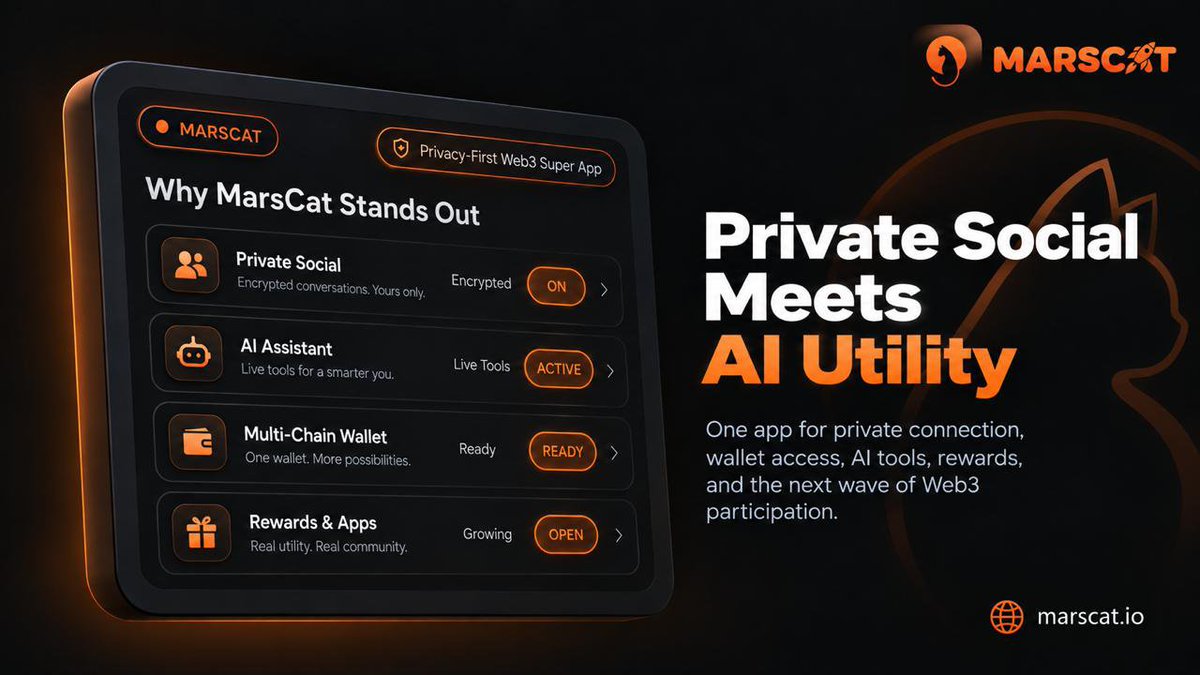
While most “private” instant messengers are centralized systems disguised as privacy apps
the apps use encryption, but metadata, server, and social graph data remain centralized.
unlike all of the aforementioned applications, @MarsCat_Global is not a centralized application;
rather, it is built atop of RelayX, which is peer-to-peer technology
the unique feature of the app: privacy is not an add-on, but a layered solution consisting of...
→ identity: No real information is needed to join the network
→ data: Blowfish encryption for text, special Shredder Protocol for files
→ social graph: each friendship relationship is identified using unique crypto identity
MarsApp offers an alternative for developers looking to launch apps directly via the P2P network, with built-in resilience to DDoS attacks.
good to keep an eye on if the future of private social networking interests you
🌐 https://t.co/3Rke1KMlsd
➡️ https://t.co/b7jnYIoNv2
🖇 https://t.co/5KHJWIzqbd
#Web3 #MarsCat #Ai
𝗪𝗵𝗮𝘁 𝗺𝗮𝗸𝗲𝘀 𝗙𝗮𝘀𝘁𝗫 𝗺𝗶𝗻𝗶𝗻𝗴 𝗱𝗶𝗳𝗳𝗲𝗿𝗲𝗻𝘁?
It’s the connection between 𝗺𝗶𝗻𝗶𝗻𝗴 𝗮𝗻𝗱 𝗔𝗜 𝗶𝗻𝗳𝗿𝗮𝘀𝘁𝗿𝘂𝗰𝘁𝘂𝗿𝗲.
FastX nodes contribute GPU compute to the network, helping provide the resources needed for AI workloads while participating in the FXNW mining system.
So the idea goes beyond simply earning tokens:
𝗚𝗣𝗨 𝗰𝗼𝗺𝗽𝘂𝘁𝗲 → 𝗔𝗜 𝗶𝗻𝗳𝗿𝗮𝘀𝘁𝗿𝘂𝗰𝘁𝘂𝗿𝗲 → 𝗻𝗲𝘁𝘄𝗼𝗿𝗸 𝘂𝘁𝗶𝗹𝗶𝘁𝘆.
That’s the bigger picture behind @FastXNetwork mining.
Good night to everyone!
Web3 needs more than just rankings; it needs a clear view of the people behind them. @NucleusCodes
Web3 sees almost everyone, yet it doesn't necessarily see each individual clearly. At low resolution, vastly different people look identical: a wallet with a certain transaction volume, a creator with a specific number of interactions, a member who completed a task, or someone who referred twenty users.
But zoom in, and the picture changes completely. Consider two wallets with similar volumes: one belongs to a user who patiently seizes the right opportunities and stays through market volatility, while the other chases the highest incentives.
Look at two creators with equal impressions: one has an audience deeply connected to the project's narrative, while the other reaches a broad but largely irrelevant crowd.
Compare two people who each referred twenty users: for one, most disappear after the campaign ends; for the other, many remain and make genuine contributions.
The problem is that projects often select people based on a few simple metrics: wallet balance, follower count, volume, or leaderboard position. These indicators are useful but insufficient; relying on them alone reduces individuals to mere numbers.
Adding layers of data such as on-chain activity, social context, depth of contribution, network quality, and behavioral consistency increases the resolution of a user profile.
Users don't become "more valuable"; they are simply understood more accurately. This ensures that individuals who lack massive wallet balances but offer sustainable contributions are still recognized. @NucleusCodes
This also shifts incentives: when a single number no longer suffices, "metric optimization" becomes ineffective, encouraging people to build profiles of genuine substance. The goal is not endless surveillance, but rather gathering enough relevant context to make better decisions.
Web3 needs more than just better ways to rank people. It requires a perspective clear enough to take into account the genuine differences of each individual.
When people hear MarsChain, most people immediately think about MARS.
But MARS is only one part of the bigger picture.
After looking deeper into the ecosystem, there are three major components that help explain the foundation of MarsChain:
1. Proof of Contribution (PoC)
PoC is one of the core ideas behind MarsChain’s mining model.
The basic concept is connecting contribution to hashpower through the burning of MARS.
In simple terms:
Burn MARS → Receive Hashpower → Participate in Mining
This means the token isn’t simply sitting in a wallet; under the stated model, contribution is connected directly to participation in the network.
2. Mining & Hashpower
The second major component is the relationship between hashpower and mining.
MarsChain’s model connects contributed MARS with hashpower, which then represents participation in its mining and reward mechanism.
This is where mechanisms such as dynamic calibration become important, because the network can change as more participants and hashpower enter the ecosystem.
The idea is to create a mining model that responds to network conditions rather than treating everything as permanently static.
3. MARS Tokenomics & Deflation
The third major component is the economic design around MARS.
MarsChain states a 200 billion maximum supply, while burning permanently removes MARS from circulation and the stated 448-day halving cycle reduces mining output over time.
This creates the deflationary side of the ecosystem.
But deflation should be understood as a protocol mechanism, not a guarantee that the token price will increase.
⸻
These are only the three major components I use to introduce the MarsChain architecture.
In the full video, I go much deeper and explain the other mechanisms that connect to them, including:
Burning.
Hashpower.
Dynamic Calibration.
Mining.
Deflation.
NFT Access.
Referral Contribution.
Christmas & Oracle Protocols.
I also explain how the 188-day calibration model differs from the 448-day halving cycle, and why understanding that difference matters.
When you put everything together, the broader concept looks like:
Contribution → Burn → Hashpower → Mining → Rewards → Deflation → Network Growth
So this isn’t just about looking at MARS as a token.
It’s about understanding the system behind it.
If you’ve been hearing about MarsChain and want to understand what is happening underneath the surface, watch the full video.
No unnecessary hype.
Just a clear breakdown of the mechanisms, how they connect, and what MarsChain is trying to build.
Don’t just look at MARS. Understand MarsChain.
@MarsChainDAO #MARS #Web3
A lot of people look at $MNTD mainly as a token.
But the design published by @PlayOnMint shows another layer.
$MNTD is designed as a utility token for ecosystem participation and MINT Status.
The basic concept:
Stake $MNTD → build Status → unlock rewards/perks
Official MINT materials mention benefits associated with Status such as rakeback, daily rewards, raffles, airdrops, weekly lossback and staking rewards.
This puts the token inside a progression system rather than treating it as a standalone asset.
What remains interesting to watch is how each Status level actually works after TGE.
The official page also states that levels, requirements, benefits and certain numbers may change before launch.
So the interesting question is not simply:
“How much will $MNTD be worth?”
It is how effectively the utility token translates into real user progression.
Two weeks ago, Prosper was a list of Curators and a thesis.
Now it's a competition.
At launch, all you had to go on were strategy descriptions and a lot of guessing. Everything was narrative.
Now the p{VAULT} Trading Challenge is live until Oct 1, the DeBot integration puts p{VAULT}s in front of traders in tools they already use, and a live leaderboard shows where volume and conviction are actually concentrating. A few p{VAULT}s have already graduated.
My original thesis hasn't changed. Robinhood brings assets onchain. Arc-style launchpads financialize memes. Prosper financializes strategy performance and conviction.
The difference is that you can actually check it now. → https://t.co/bnQayDGMZn
@ProsperTicker
Arc Terminal Is About Reading the Market as a System
Price is only one part of what moves a trade. Liquidity, positioning, narratives and timing can all change the picture. @TheARCTERMINAL is interesting because it brings more of that surrounding context into the trading environment, making the market easier to view as one connected system
Quip Gives Computation a Bigger Role
@quipnetwork is exploring what happens when blockchain computation is not treated purely as a cost of maintaining consensus. Its Proof of Useful Work model gives that compute another purpose, while its quantum and post-quantum focus adds a security layer for a very different computing landscape
Nucleus Codes Makes Reputation About Patterns
One contribution can get attention, but repeated contribution tells a much bigger story. @NucleusCodes focuses on those patterns over time, turning reputation into something that reflects sustained participation rather than just whatever happens to be visible today
🚀 $2.39 MILLION USDC
2,472 Participants
The biggest @echodotxyz Sonar sale of 2026 officially belongs to @axisrobotics
🤯 If you aren't paying attention to the Physical AI revolution yet, this is your wake up call
But this massive milestone isn't just about a successful raise it's proof of community conviction
Building true Physical AI requires massive, highly diverse datasets. You can't build the future of robotics in a closed lab
Axis is building a decentralized global data engine, crowdsourcing at scale, and relying on everyday contributors to shape the future of AI 🤖
For everyone who participated in the Community Sale, here is what’s next:
✅ Allocations are pro rata and will be recorded on chain soon
✅ Unaccepted USDC will be automatically refunded within 48 hours🔥 PLUS... the team is cooking up "special surprises" for participants! (In this ecosystem, loyal contributions are always generously rewarded 👀)
Didn't get into the sale?
You are not too late to the party
You can actively help train the next generation of AI and get rewarded for your data right now.
Join the data collection platform, complete tasks, and make sure to SIGN your Trajectories on chain to make your contributions count⛓️
Let’s build the largest Web3 AI data engine together. Start contributing here 👇
🔗https://t.co/TrYfKiFIKH
Most people learn a job the hard way.
You burn time. You mess up. Somebody more experienced stands next to you and shows the same movement again. That is how skill actually transfers. Slow, expensive, human.
I was reading the new @axisrobotics writeup and that part stuck with me more than the jargon.
They are not just piling up more robot tasks. They are trying to turn one learned movement into something you can reuse and stack. Teach pick up once, use it in a lot of different jobs later. Their tests even show a policy getting better from the data it creates after it is deployed. 22% to 52% on the real robot. And the specialist models are cheap enough that one task is in the $5–$10 compute range.
That number is small. The idea is not.
If machines can keep a library of skills instead of starting from zero every time, fewer people have to stand there repeating the same dangerous or boring motion just to train the next system.
I do not care about “scaling paradigm” language. I care if physical work gets a little less wasteful for the humans still doing it.
$AXIS is sitting under that bet.
Join : https://t.co/OrzRiPGWjj
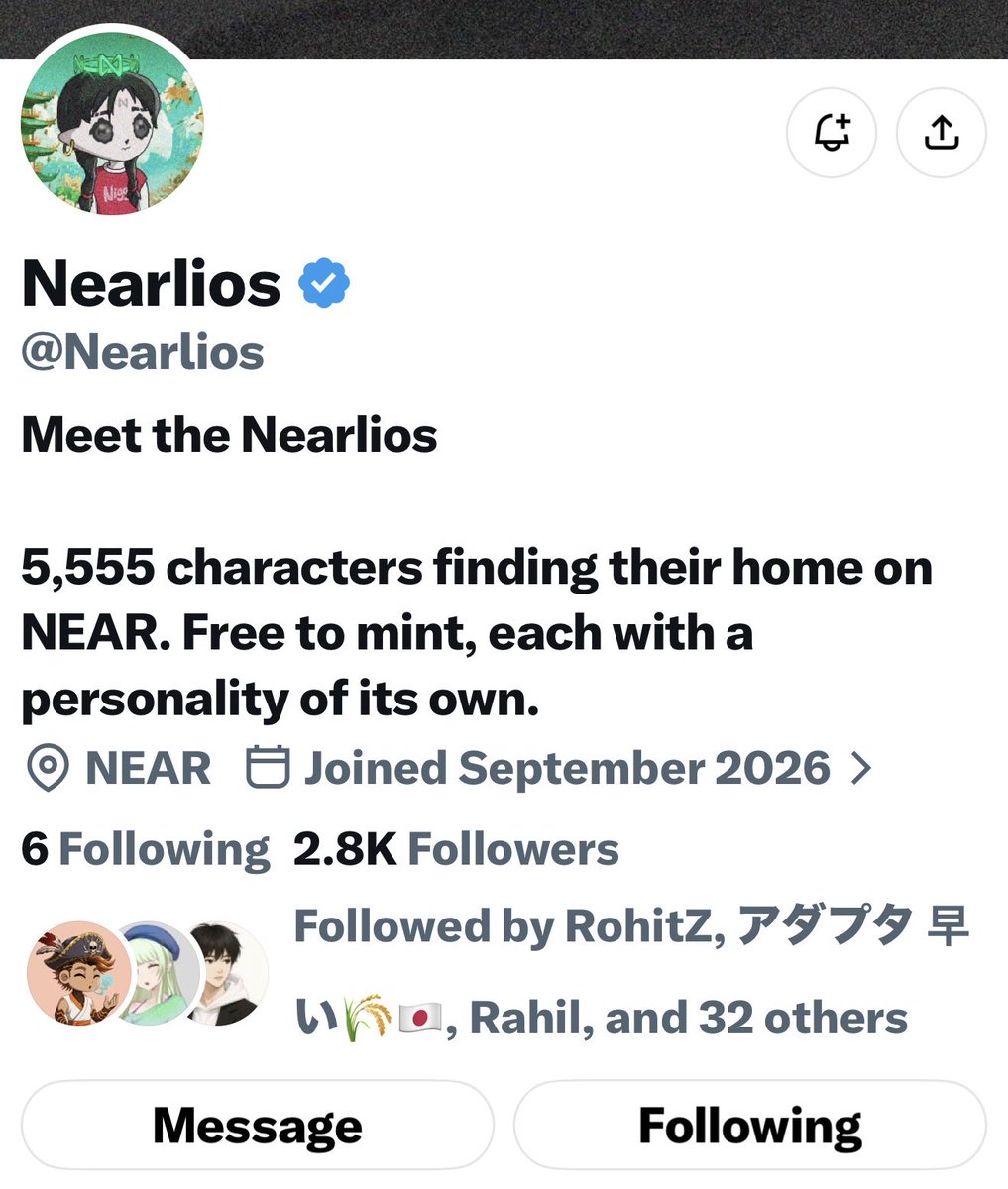
EARLY ALPHA: NEARLIOS NFT
Something interesting is happening in the NEAR ecosystem!
5,555 unique characters Free mint Every NFT has its own personality Built around NEAR
@Nearlios has opened free mint registration, with only 1,000 spots available.
Register here: https://t.co/hcETTwaZWx
Still early, but definitely worth checking out.
DYOR and don’t miss the registration!