Very proud of our work understanding the effect of chloride concentration in silver oxidation in the context of SOERS/SERS substrate generation. Wonderful collaboration with @TschulikGroup, @acolinaubu and @HerasAranzazu https://t.co/XjUmMmmkwK
NiFe2O4 can be activated during oxygen evolution cycling - wonder why and what is the active species? More interestingly, we found similar active species also formed on P-doped NiFe2O4 - check out our recent paper for details😃
https://t.co/FWN5yUCY5l
🌿Exciting times at the Mülheim Chemistry Campus🌿
Over 50 talented young scientists from all over the world have joined us to dive deep into the world of spectroscopy and electronic structure of transition metal complexes during our Summer School.
#ScienceExchange
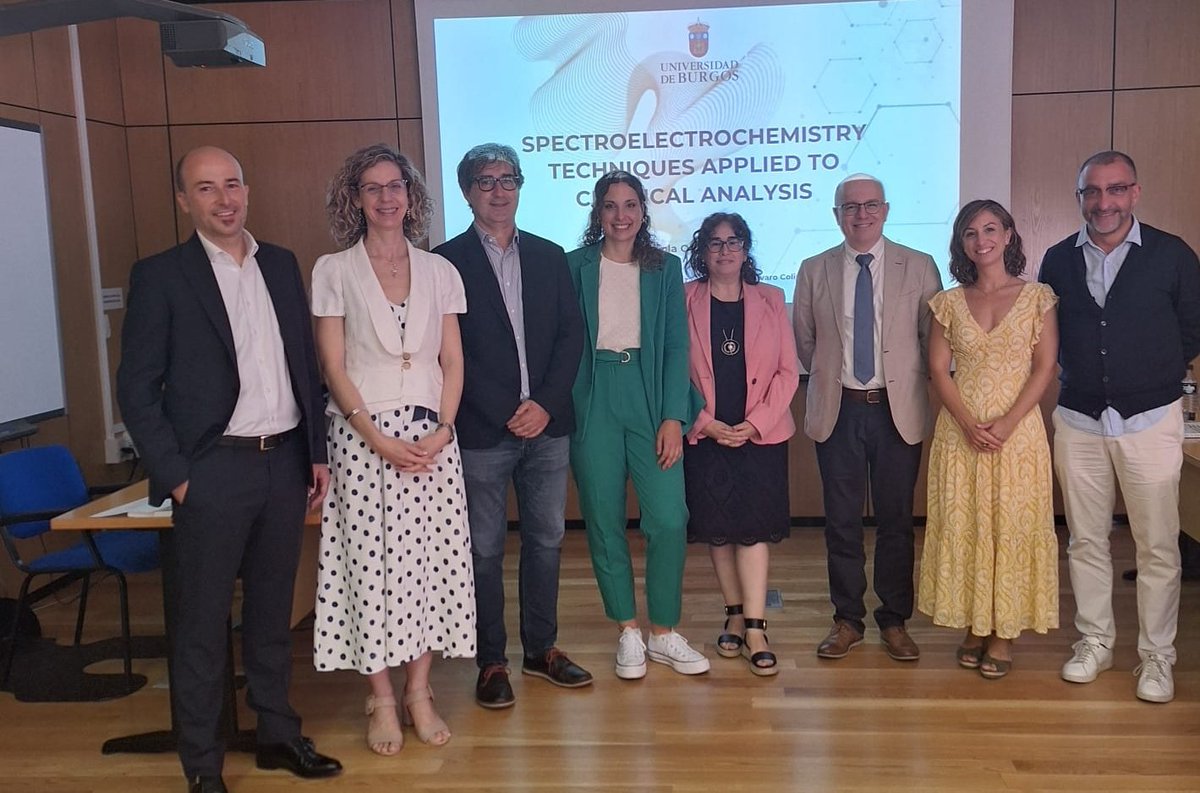
We have a new doctor in our group. @FabiolaOlmo has demonstrated the capabilities of #spectroelectrochemistry in quantitative analysis. Congratulations!!!!
We have the pleasure of being on the fearured cover of
@an_chem with our most recent work showing our new bidimensional #spectroelectrochemistry cell with tunable thin-layer thickness https://t.co/jsNGb8EqrK
Our new bidimensional #spectroelectrochemistry cell with piezoelectric control of the thin-layer thickness is published in @an_chem. The roughening of a gold electrode to generate AuNPs is studied, explaining all the processes observed in the voltammogram.
https://t.co/jsNGb8EYhi
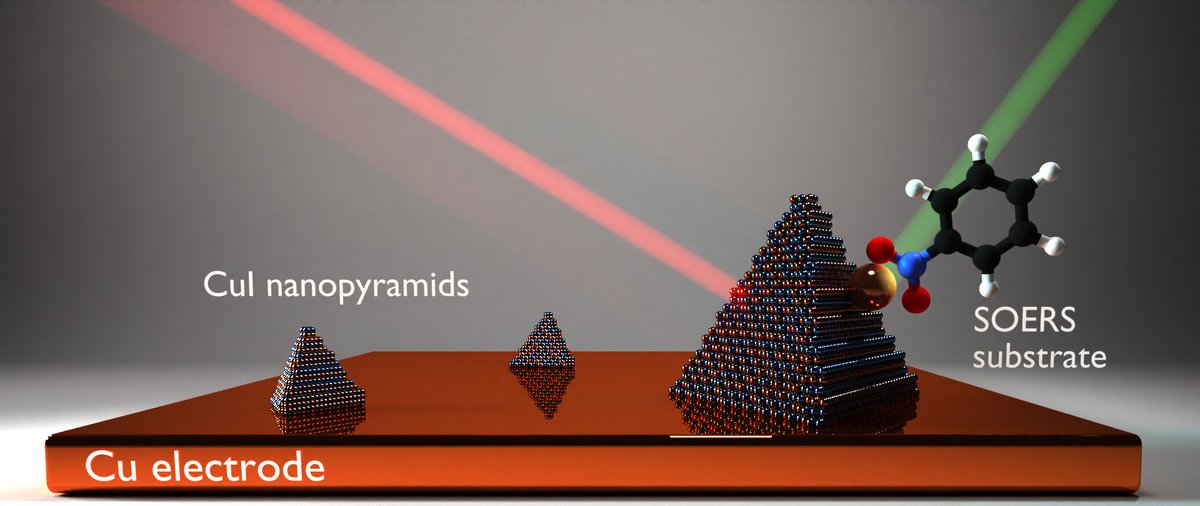
Happy to announce my first paper as corresponding author! A beautiful applied surface science @ELSchemistry where we explore the use of CuI and CuSCN nanomaterials as SERS substrates
Thanks to @acolinaubu and @HerasAranzazu for their support.
https://t.co/Qoo0xDdN3l
Our last work about new EC-SOERS substrates based on Cu is published in Applied Surface Science, providing an overview of the use of Cu electrodes for EC-SOERS and opening new gates for furture applications. First corresponding author for @El_e_perdido. https://t.co/vKIjadSvU7
We have the pleasure of being on the cover of
@an_chem with our most recent work that explain the origin of SOERS as a new and useful strategy to enhance the Raman signal. Check the work out in the link... https://t.co/gAeZiu4c5b
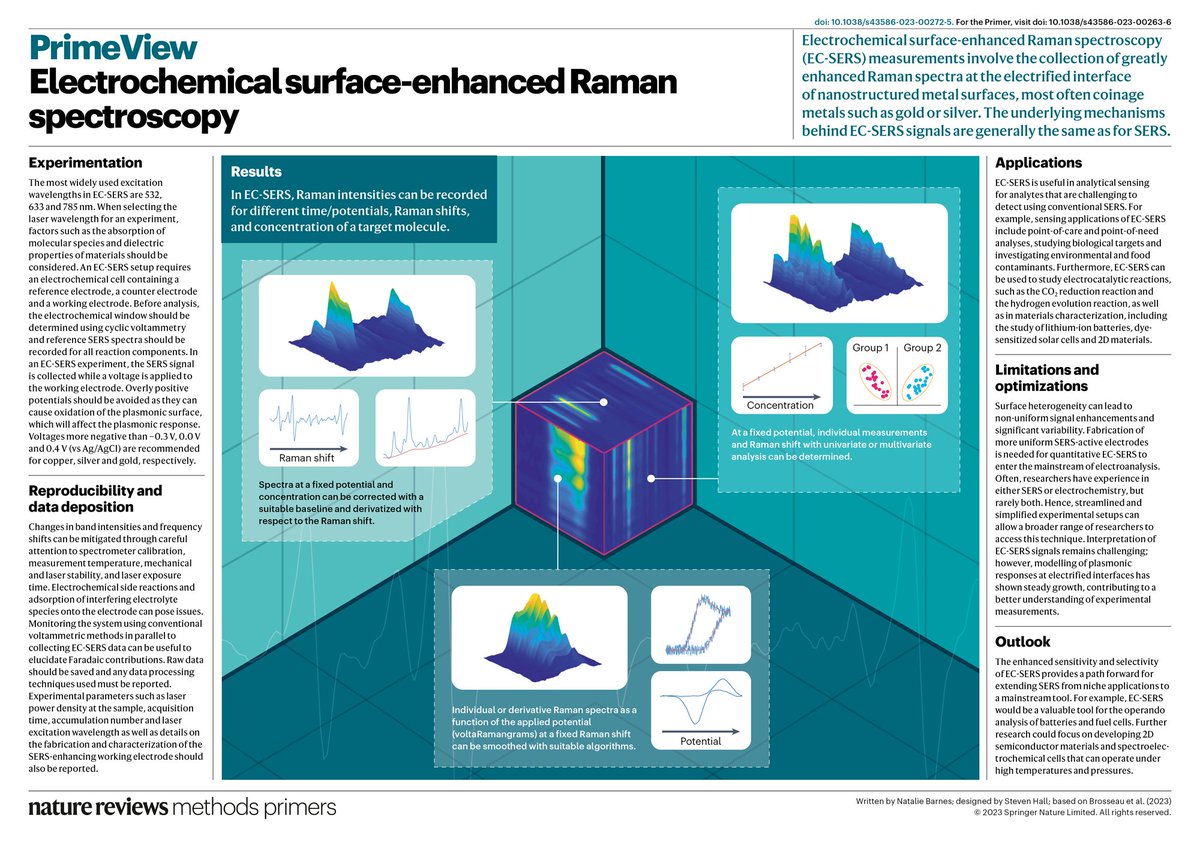
This weeks PrimeView highlights the type of data that can be obtained from an electrochemical surface-enhanced Raman spectroscopy (EC-SERS) experiment.
Free to download for a week 👇https://t.co/Fh5dgBd0bJ
I am deeply happy to share our review on EC-SERS published in @MethodsPrimers, developed in collaboration with highly recognized researchers in the field. Many thanks @ChristaBrosseau, @AJWilsonLab, Bin Ren, Xiang Wang and @acolinaubu for your great work.
https://t.co/T045Zt0VRG
Very happy to publish this review on EC-SERS in @MethodsPrimers in collaboration with some of the best researchers in this field. Thank you very much @ChristaBrosseau, @AJWilsonLab, Bin Ren, Xiang Wang and collaborators for your extraordinary work.
https://t.co/5UCHmzXv4m
I am delighted to share our last work that explain the origin of SOERS as a new strategy to enhance the Raman signal. An interesting work that shows the potential of spectroelectrochemistry in the study of complex systems... Check the work out in the link https://t.co/gAeZiu4c5b
Finally, EC-SOERS is explained as a semiconductor/dielectric #SERS substrate activated by metal cations. Read our last paper in @an_chem https://t.co/qbpXa25BaF
We are on summer holidays, Electrochimica Acta is not. Our last work on the best EC-SOERS substrate based on silver hexacyanoferrate is available now. https://t.co/yaxmwMM47U
We've launched a new YouTube channel dedicated to to the 'Basics of #EIS'!🤓🍦 Join us on this electrochemical journey, as we support the Electrochemical #Impedance Spectroscopy lectures at the @ruhrunibochum in Germany.(1/8)
📺 Check out our first video: https://t.co/nv5jSW2TVs
We have the pleasure of being on the cover of @an_chem with our most recent work related to combining SECM with UV/Vis spectroelectrochemistry. Check the work out in the link... https://t.co/9WPrWAjtJ5
#spectroelectrochemistry#SECM
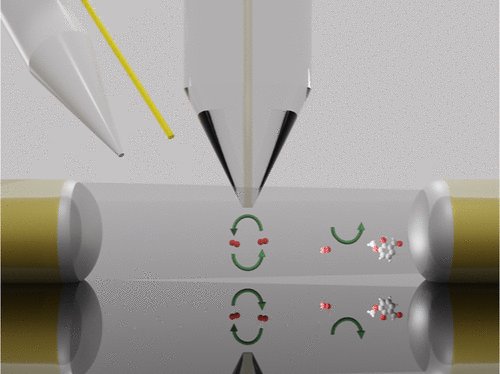
The combination of Ultraviolet/Visible absorption spectroelectrochemistry in parallel configuration with Scanning Electrochemical Microscopy is a powerful technique to study the electrode process. @acolinaubu
https://t.co/b7IRtLcCwC
We are delighted to share our last work in the combination of SECM with UV-Vis absorption spectroelectrochemistry to sudy electrochemical interface, published in @an_chem. https://t.co/9WPrWAjtJ5