I try to answer three questions investors constantly face:
• Is the market valuation attractive or expensive ?
• What global and domestic factors can impact returns?
• Where are the opportunities emerging across sectors and stocks?
I share my research, investing thoughts and frameworks to make sense of market noise.
Created https://t.co/qmPnjpy8tw : A data-driven framework to understand market valuations and find opportunities
Why own dividend stocks when growth stocks can generate much higher returns?
Because investing isn't just about maximizing returns.
It's about making it easier to stay invested.
Think about it.
If your salary covers your monthly expenses and your portfolio generates a steady stream of dividends, you're far less likely to panic when markets fall.
You don't feel the need to: → Sell good businesses at the wrong time → Chase every market rally → Take unnecessary risks just to generate income
Growth stocks are still where long-term wealth is created.
But dividend stocks can give you something more valuable:
Patience and emotional control
Exactly.
A steady income gives investors the luxury of patience.
Add a portfolio of quality dividend stocks, and you create a small cash-flow engine that reduces the pressure to chase every market move.
The best decisions often come when you don't need the market to pay you today.
@Dutta_Souravd Possible, but "without a doubt" is where markets usually surprise investors.
Small caps can create exceptional returns, but valuations, earnings growth and liquidity still decide the outcome.
Confidence is useful, certainty is dangerous.
@KapoorShitij I'd add one more: exceptional traders have a repeatable process.
Resilience without an edge just means surviving losses longer.
Process + discipline is what compounds over time.
@trading_bn Crude may decide the macro direction, but earnings and valuations will likely decide how far Nifty moves.
A breakout is more meaningful if it's backed by improving fundamentals.
@darshitpatel84 This is why I rely on market breadth alongside index levels.
If 70–80% of stocks are correcting while the index is relatively stable, the index is telling only part of the story.
@stockifiabhijit True.
But psychology alone isn't enough.
You also need a process that tells you when fear or optimism is actually justified.
Otherwise, emotions just become another opinion.
For most retail equity investors, there doesn't seem to be any major change to capital gains taxation.
The interesting part is that the measures are aimed at attracting foreign investment and supporting sectors like electronics manufacturing.
However, these changes can have meaningful impact on capital flows over the next few years.
Many investors track USD/INR.
Very few track USDX (DXY).
That's a mistake.
USD/INR ≠ USDX
- USD/INR tells you how many rupees one US dollar can buy.
- USDX (DXY) tells you how strong the US dollar is against the world's major currencies.
If your goal is to understand global capital flows, USDX is usually the more important indicator.
Why?
A rising USDX often means: • Global money is moving towards US assets. • Financial conditions are tightening. • Emerging markets can see lower capital inflows.
Meanwhile, USD/INR is influenced by many India-specific factors like RBI intervention, crude oil prices, trade balance, and domestic demand for dollars.
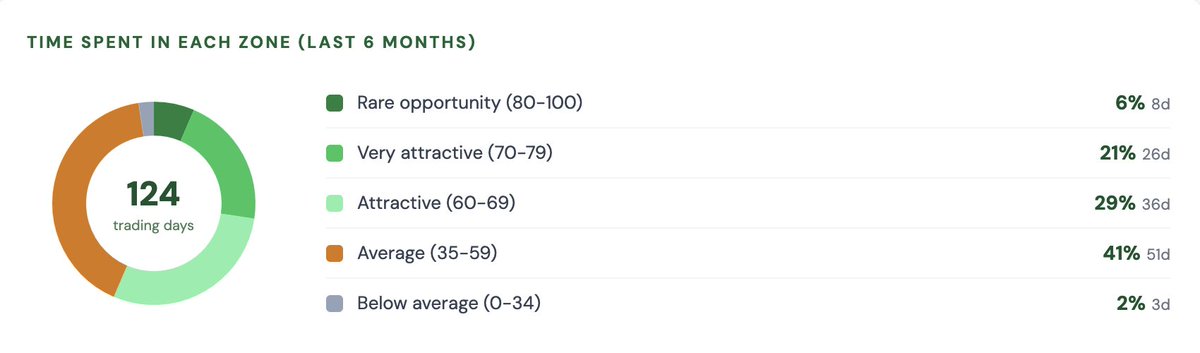
How often does market gives you good buying opportunities? Here's the last 6 months.
The reality is that markets spend most of their time in the "average" zone.
Truly attractive opportunities come and go much faster than most investors realize.
See how much time market spent in which zones in last 90 days.
Top two zones are ideally best buying opportunities.
@Vivek_Investor Exactly !
Every individual , his priorities, risk appetite, financial needs and many other factors are different.
Same rules can’t fit everyone.
@ChanderBhatia01 90% investors should ideally follow this. Don’t rely on tips, news , temporary sentiments.
If not long term at least be the medium term investor.
@stockifiabhijit People underestimate the power of saving. Earning and investment are also very important but saving is the core.
Earn -> Save -> Invest -> Repeat