Social Justice: Theory & Practice in the Vincentian Tradition ll #SJUinAction l @StJohnsU undergrad minor l #NYC responses to liberating news "from the edges."
"Before the crucified people,
asking myself what I have done to crucify them,
what am I doing to take them down from the cross,
What ought I to do in order to raise them up?"
-Ignacio Ellacuría, S.J.
* icon by Sadao Watanabe *
Live-tweets by Jeremy V. Cruz. The thread broke a couple times--sorry about that!
Any necessary corrections, clarifications, or full quote context can be obtained from the forthcoming event recording.
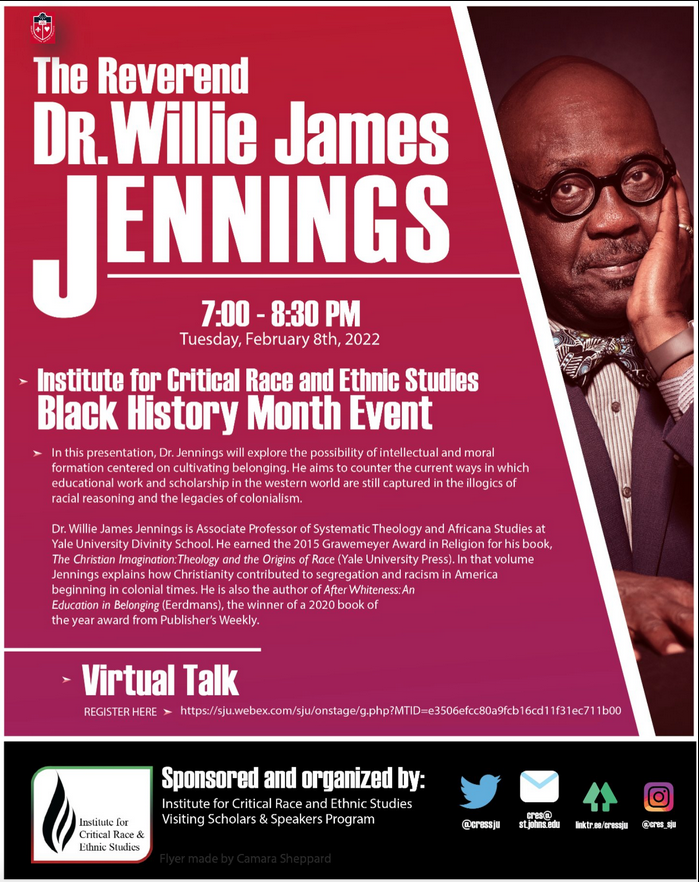
The Institute for Critical Race and Ethnic Studies invites you to:
"To Educate Toward Belonging: Race, Faith, and the Problem of the Finished Man" by Rev. Dr. Willie James Jennings
Tuesday, February 8 at 7 p.m. (EST)
Register: https://t.co/Lh0fI6XOMb
All are welcome
"We are within designs that we did not create. What does it mean to create learning experiences, curriculum, courses that enable us to pay attention? We have to rethink 'design'.
What does it mean to cultivate the ability to pay attention?"
Jennings is calling us to a "collaboration that is not just episodic", but rather is creation that is part of a new way of life. Creating "crowd" even amid our important disagreements.
"Here's what academic institutions don't do well. We need to be asking:
What forms of injustice and violence ought we to be thinking about resisting together?
Belonging and resisting injustice must be understood as ONE project, not alternative options or tasks."
"For many, Jesus and 'the self-sufficient man' are indistinguishable."
"Jesus with the crowd is not simply dispensing knowledge. He's creating belonging."
Jennings points out that our narratives of "survival through education" (for oppressed and marginalized ppl) can often cultivate rugged individualism, a turning inward, a brutal self-assessment, in pursuit of the self-sufficient white supremacist masculinist "man in control".
Jennings contrasts "plantation pedagogy" with "Jesus and the crowd". The latter signifies possibilities of new life emerging among a mass of humanity, including enemies. The crowd is chaos, lacks control, and cannot be educated (as colonial subjects) into self possession.
Jennings, as theologian, points to the gospels' images of Jesus as educator/formator for an alternative image:
*bringing the masses (not Christians) TOGETHER, across different backgrounds and aspirations
*cultivating dreams and action toward BELONGING (not mastery)