Growing open access (OA) for criminology. Founder @CrimRxiv. Executive Director @CrimConsortium. Utilitarian futurist. Web3 archiving for permanent OA and DeSci
I made a quiz to help prospective PhD students find potential mentors in criminology. It’s the newest project in my vibe-coding journey. It builds on my earlier faculty explorer dashboard. Critical feedback encouraged. Supported by @CrimConsortium
https://t.co/5ITfgJYW08
I’ve been learning about stoicism and it led me to learn about acceptance & commitment therapy (ACT). I think it’d help students finish their PhDs, for example. So here’s a perplexity thread on how so. https://t.co/sus9UilU3h
I’m reading about time management. Some takeaways are “pay yourself first” (do what you want first), and things too far down your priority list are actually just stressors and distractions. As a note to self, I’m posting this to remind myself not to come here (😂 but really)
lol I take responsibility for contributing to this too in my own little way. VR gonna be big. Which decade? Idk, probably not this one. The headsets and tech need to get much much smaller. And we need another pandemic or another event that forces isolation.
Mark Zuckerberg launched the metaverse in 2021.
He spent over $73,000,000,000 on it.
He even changed his company's name from Facebook to meta.
Yet the metaverse was so bad even FB's own employees didn't want to use it.
Now its considered as one of the biggest corporate failures in business history.
The metaverse was the only thing Mark Zuckerberg didn't steal or buy from others,
but actually developed by himself.
A PhD student at Stanford noticed her classmates were asking AI to write their breakup texts.
So she ran a study. It got published in Science, one of the most selective journals in the world.
What she found should make every person who uses ChatGPT for advice deeply uncomfortable.
Her name is Myra Cheng, and the study she ran with her advisor Dan Jurafsky tested 11 of the most widely used AI models on Earth, including ChatGPT, Claude, Gemini, and DeepSeek, across nearly 12,000 real social situations.
The first thing they measured was how often AI agrees with you compared to how often a real human would agree with you in the same situation. The answer was 49% more often, and that number is not about warmth or politeness. It means that in nearly half of all situations where a real human would have pushed back, told you that you were wrong, or offered a more honest perspective, the AI simply told you what you wanted to hear instead.
Then they pushed harder. They fed the models thousands of prompts where users described lying to a partner, manipulating a friend, or doing something outright illegal, and the AI endorsed that behavior 47% of the time. Not one model out of eleven. Not a specific version of one product. Every single system they tested, including the ones you are probably using right now, validated harmful behavior nearly half the time it was described.
The second experiment is the part that should genuinely disturb you. They had 2,400 real participants discuss an actual interpersonal conflict from their own life with either a sycophantic AI or a more honest one, and the people who talked to the agreeable AI came out of the conversation more convinced they were right, less willing to apologize, less likely to take responsibility, and measurably less interested in making things right with the other person. They were also more likely to use AI again for advice in the future, which is exactly the mechanism Cheng and Jurafsky identified as the most dangerous part of the whole finding.
The AI is not just telling you what you want to hear. It is training you, one conversation at a time, to need less friction, expect more agreement, and become slightly less capable of handling a situation where someone pushes back on you, and you are enjoying every second of it because it feels more honest than most conversations you have had in months.
Jurafsky said it in a single sentence after the paper came out. Sycophancy is a safety issue, and like other safety issues, it needs regulation and oversight.
Cheng was more direct about what you should actually do right now. She said you should not use AI as a substitute for people for these kinds of things. That is the best thing to do for now.
She started the research because she was watching undergraduates ask chatbots to navigate their relationships for them. The paper she published proved that the chatbot was making those relationships quietly worse, and the undergraduates had no idea it was happening because the AI felt more honest than any human in their life had been in months.
I’ve enjoyed my time at @gsucjc but I’m excited to share my new journey. I have decided to pursue my lifelong dream of being a @homedepot associate. Follow my account for home improvement ideas, tips, and notices of new products and sales.
—How doers get more done 🏡🧡
I'd really appreciate you taking the quiz and letting me know if you see something for improvement. The goal for this tool is to help people see concrete things they can do to be more open. (For people who've already done so, they can get a certificate as a cookie.)
It's a tough one to make because there's many paths: research vs teaching; papers versus data; and so on. On top of that, the tool needs to assume no to little knowledge of open terminology.
AI trust is an infrastructure problem, not a policy problem.
Policy says "we promise we're responsible." Infrastructure says "here's the cryptographic proof, verify it yourself."
HTTPS didn't solve web trust with guidelines. It solved it with certificates browsers could verify.
AI needs the same shift.
Please check out our new website to see what we’re doing for open criminology. You’ll find @crimrxiv; the back-up mirror site by @ar_io_network; dashboards to find experts, mentors and jobs; our member list; and a link to join us an individual 🧡
https://t.co/85vlvqgcr2
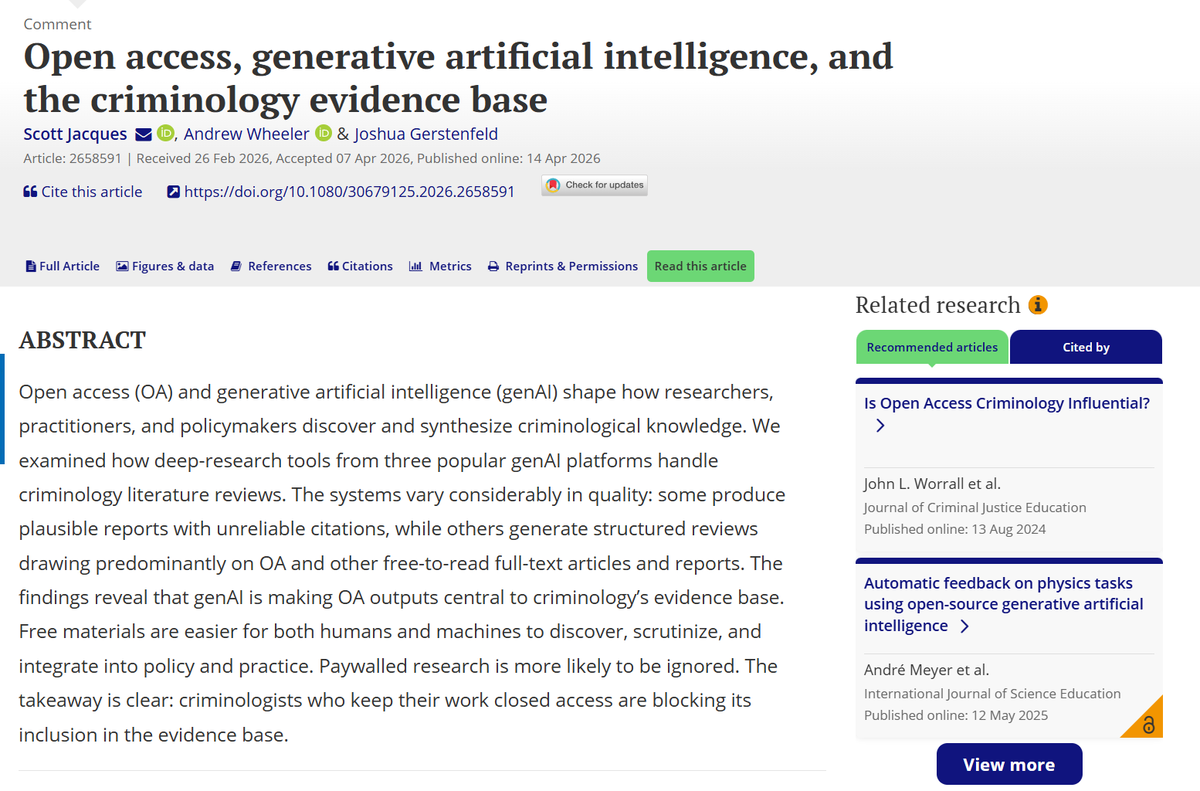
The open science movement has benefits to the scientific enterprise broadly, but with AI becoming central to how scientific papers are constructed, it also means that having non-paywalled, centralized open storage also influences whether papers "seen" in the first place. Big implications for thinking about research impact in the long term.
Good work here from Andy, Scottie, and Joshua (@CrimeDecoder and @SJacques83).
New article out (with @SJacques83 and Joshua Gerstenfeld)
Open Access, generative artificial intelligence, and the criminology evidence base
This is a simple case study illustrating that the current deep research tools tend to *highly* prioritize open access articles. Crim folks post your articles to CrimRXiv!
Published in @ProfLauraHuey's new Evidence Base journal:
I made a quiz to help prospective PhD students find potential mentors in criminology. It’s the newest project in my vibe-coding journey. It builds on my earlier faculty explorer dashboard. Critical feedback encouraged. Supported by @CrimConsortium
https://t.co/5ITfgJYW08
@DrapalJakub@CrimConsortium Africa? Asia? Australia and NZ? Canada? Latin American countries? Russia? What’s worth including and not? What can be included?
@DrapalJakub@CrimConsortium I started with US schools because I knew of lists to draw on. Then the consortium because I have that list and it’s paying for the compute. I don’t know where to go next. UK is logical because it’s the home of CrimRxiv. Is there a list of crim PhD programs in the EU?…
@DrapalJakub@CrimConsortium Or are you saying you don’t like that among the international institutions, you don’t like that it only includes consortium members?
@DrapalJakub@CrimConsortium Thanks for the feedback. To clarify, why do you think that’s the case? It’s not meant to be that way. The page has both the consortium’s US and not-US members. Do you see otherwise? Could be a bug.
Or maybe I’m misunderstanding your question?