In relation to Australian Human Rights Commission’s Racism@Uni report recommendations that stress Institutional accountability, I decided to share my thoughts in a series of articles. Here is the first exploring cognitive burden! https://t.co/FYNBfkW6UL
A nice collaborative work on a new topic for us. The groups of @garriearumugam and & @GATCLab publish their work on how TEs shape gene regulatory networks upon intermittent fasting. https://t.co/EQGrFISZke
Ahead of Indian PM’s Melbourne visit, our AISRF project “Designer crops: engineering thermotolerance” wrapped its first in-person meet @NIPGRsocial in New Delhi. Incredible to sync with @alokksinha & colleagues. Thanks Australia’s DISR & India’s @DBTIndia for the vital funding.
Please repost!
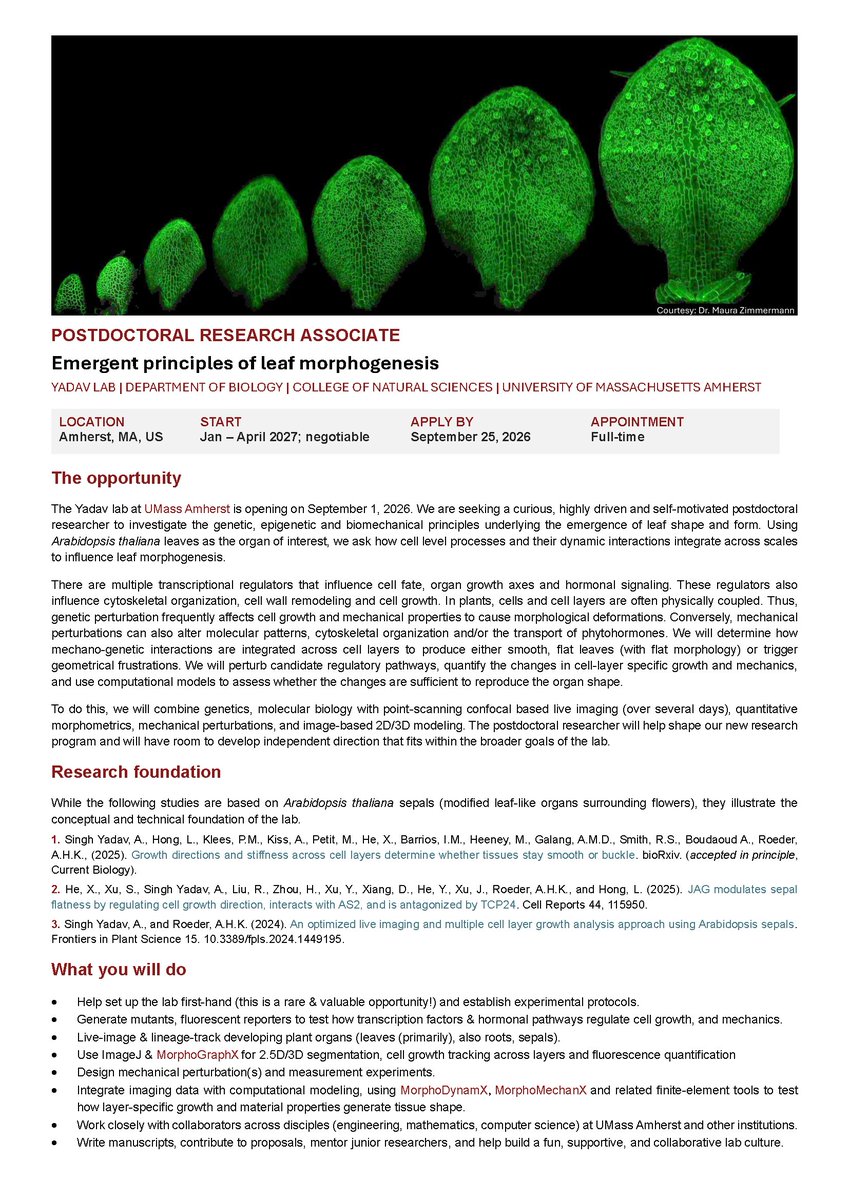
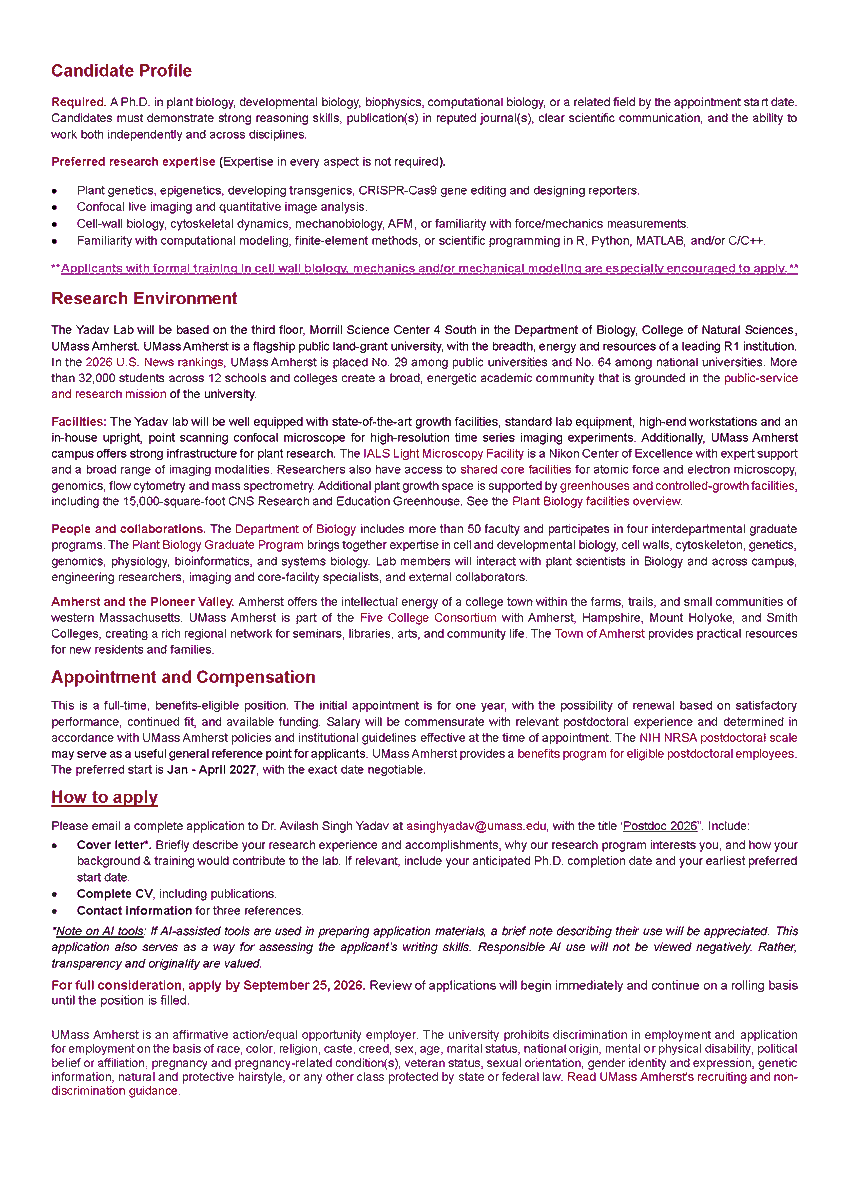
🌿 Postdoctoral position available in the Yadav Lab at UMass Amherst! 🌿
Apply by September 25, 2026. Please see the advertisement below. https://t.co/WAfLIVN7at
We are seeking a #postdoc to investigate the genetic, epigenetic and biomechanical principles underlying the leaf morphogenesis.
Applicants with formal training in cell wall biology, mechanics and/or mechanical modeling are especially encouraged to apply.
#PlantScience #DevelopmentalBiology #Morphogenesis #Mechanobiology #Biomechanics #ComputationalBiology #QuantitativeBiology #LiveImaging #Microscopy #Arabidopsis #AcademicJobs #ResearchJobs #UMassAmherst #NewPI #ScienceJobs #Biophysics #SystemsBiology
Pleased to share that I will be starting as a tenure-track Assistant Professor in the Department of Biology at the University of Massachusetts, Amherst @UMassAmherst in Fall 2026!
My lab will study how genetics and tissue mechanics influence one another over space and time to drive the leaf morphogenesis.
Interested in mechanobiology? Let’s get in touch! email: [email protected].
In back-to-back papers, our lab and the Casal lab tackle the question: How does temperature reshape auxin-driven growth?
Together, we reveal that temperature directly rewires ARF behavior.
https://t.co/WfqsQPihF6
A new mechanism for “RNA memory”! 😱
Thrilled to share another crazy paper from the lab (can’t believe we posted 2 in 2 days!), summarizing >10 years of research:
Work on transgenerational inheritance of small RNAs in the powerful model organism C. elegans changed how we think about what’s possible in inheritance and evolution, because it allows the most heretical thing: inheritance of parental responses to the environment! However, it’s still unclear whether RNAs are inherited across generations in other animals, largely because the RNA-dependent RNA polymerases that amplify heritable small RNAs and prevent their dilution in C. elegans are not conserved in mammals.
In this new work, an amazing collaboration with the Rink and Wurtzel labs, we show that planarians establish long-lasting and heritable small RNA–based gene regulatory states despite lacking canonical RNA-dependent RNA polymerases and nuclear RNAi machinery (that are required in C. elegans).
You might say “they are both worms…” BUT planarians are evolutionarily very distant from C. elegans (flatworms vs. roundworms, diverged more than 500 million years ago), making this particularly surprising. These are totally different animals.
We find that ingestion of double-stranded RNA induces sequence-specific silencing that persists for months and survives repeated cycles of whole-body regeneration. Even more strikingly, RNAi can be transferred between animals, echoing James V. McConnell’s controversial “RNA memory” experiments from the 1970s (his lab was targeted by the Unabomber terrorist Ted Kaczynski, who sent McConnell a bomb. This and other controversies ended this line of experiments…)
Mechanistically, we find that the response transitions from a transient systemic dsRNA-triggered phase to a stable, cell-autonomous post-transcriptional “memory phase” maintained by antisense small RNAs. Using a new luminescence reporter (transgenesis is currently impossible in planarians), we show that silencing spreads along the targeted gene and identify a weird type of planarian small RNAs with untemplated polyA tails.
RNAi inheritance without canonical RdRPs establishes planarians as a powerful system for studying RNA-based regulatory inheritance beyond C. elegans and raises the possibility that RNA-mediated inheritance may be more broadly conserved in animals, potentially even in mammals.
Here’s a video of a planarian that is treated by RNAi against β-catenin and develops multiple heads instead of just one. This is one of the phenotypes that is inherited. Another phenotype is “loss of eyes” (which we show is not only inherited across multiple regeneration cycles, but can also be transmitted between animals in transplantation experiments).
Amazing work led by first authors Prakash Cherian and Idit Aviram (co-supervised by Omri and me).
Please read the preprint, the link is in the next tweet, and share!
Newly published in Advanced Science | We established a simple protocol for reliable, high-throughput infection with R. solani in the field. This helps us identify maize malate dehydrogenase as a new resistance gene by enhancing mtROS accumulation. https://t.co/lJEsyIGEFg
Today in @Nature we report a new prime editing strategy that can rescue a common cause of many genetic diseases in a disease-agnostic manner. This approach converts a redundant endogenous tRNA into an optimized suppressor tRNA, enabling a single prime edit to rescue premature stop codons across different diseases.
(1/15)
https://t.co/zs0qu5bhXx
Excited to share my first paper as a co–first author, published in Nature Communications!
From my Master’s thesis at Monash University under the guidance of Prof. Sureshkumar Balasubramanian — uncovering how genetic variants shape mRNA splicing.
🔗 https://t.co/lt2IKNeqeo