We are less than a month into 2025 and China has already scored two massive wins that no one, especially the US government, saw coming 👇
The first was how the ban of TikTok exposed the truth about China. When the US government violated the first amendment and banned TikTok in the United States, millions of Americans essentially gave a middle finger to their government and downloaded Xiao Hong Shu 小红书 called Red Note in English.
Overnight millions of Americans realized the US government had lied to them about China and that life in China is actually completely different than the dystopian society Western media often portrays China to be. The US government spent billions on anti-China propaganda and all of these efforts were erased overnight.
Then two weeks later, China released Deepseek R1 which has completely changed the entire future of AI. We were told AI tools like ChatGPT needed billions of dollars of investment and the most advanced GPUs available. In reality, China built an open source version in less than two months with a budget of less than $6 million dollars.
These are the two biggest stories coming out of China right now and both of them will rewrite the future of the world as we know it. The US government can't promote anti-China propaganda anymore because the truth has now been exposed and with China's latest invention, the world has realized China will not only have a seat at the table, but will be a major influence for the future of our world.
🇭🇰🥇🤺
Vivian Kong secures Hong Kong's first gold medal of the Paris Olympics!
Kong defeated local favourite Auriane Mallo-Breton 13-12 in the women’s epee final.
One of the Four Greatest Inventions of China, the ancient method of papermaking. "Fire paper", which took a year to create using ancient methods, has been replaced by technology because it took too long to survive. #Chinese Intangible Cultural Heritage #Traditional Craft #CulturalHeritage #legacy
As I find myself in the heart of China for the second time, this time on a more permanent basis. The initial excitement inside me brewed with a mix of anxiety and curiosity. The China I had read about from afar was a land shrouded in mystery and misconceptions, often depicted in the Western media with a veil of scepticism and caution. Yet, what I encountered upon my arrival was a reality so dynamically different that it felt like stepping into an alternate dimension and this is a feeling that continues to this day.
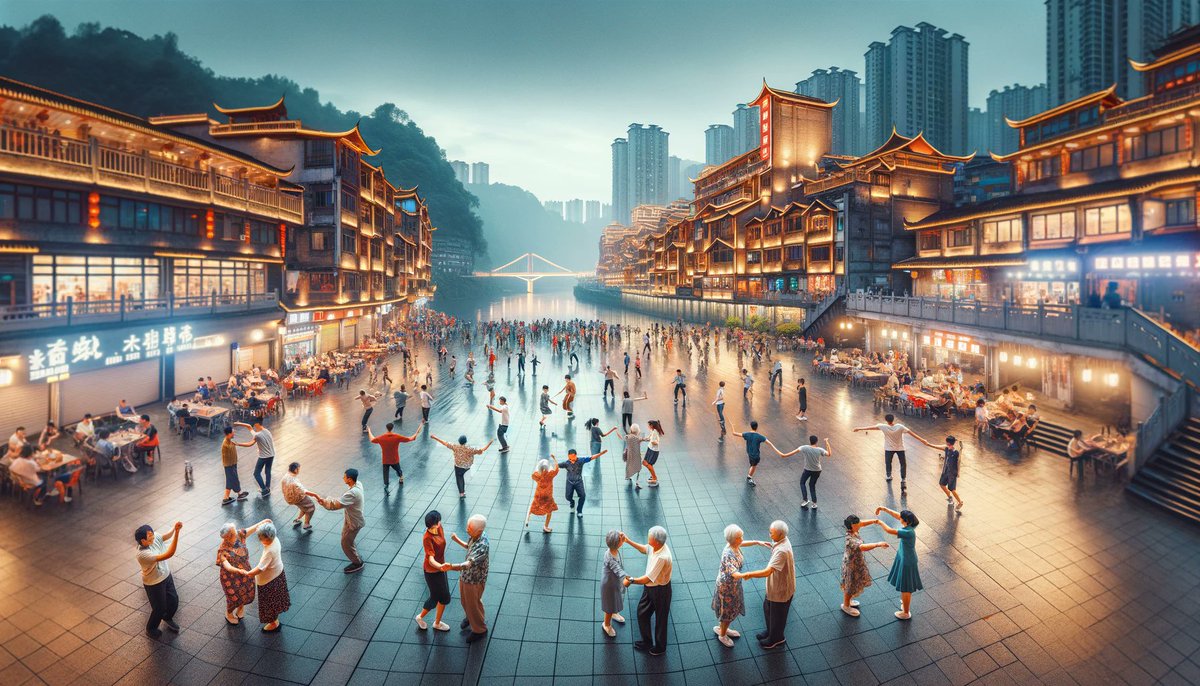
The first and perhaps the most profound realisation was the sense of freedom and safety that touched everyday life. Contrary to the image of a tightly restricted society, I observed people enjoying a breadth of personal freedoms, perhaps in ways more pronounced than in the West. Streets bustled with life late into the night, with families and friends gathering without a hint of apprehension. Elderly folks danced in public squares, young couples strolled leisurely along the riverbanks and groups of friends laughed over street food, unconcerned by who might be watching. In China, dancing in the streets isn’t just a rare sight, it’s a commonplace joy, a vibrant testament to the community and cultural openness.
One of the most striking aspects of my time here is the near absence of crime. Night or day, I can walk through various cities feeling completely secure, a stark contrast to my experiences in parts of Australia where youth crime and a general sense of caution can often pervade the night air. Here, the respect for community and elders is remarkable. The youth, often misrepresented or misunderstood in Western narratives, displayed a level of respect and decency that was both refreshing and enlightening. It’s not just about manners, it’s about a societal structure that fosters mutual respect across generations.
Education in China is a realm where ambition and focus intersect with incredible results. The children, often perceived as overburdened by their educational commitments, indeed face immense pressures. However, recent government regulations aim to balance these demands, protecting the well-being of the young learners. The commitment to education isn’t just about achieving high marks but fostering a well-rounded societal contribution. From a young age, children are not only immersed in academics but are also taught to be bilingual, wiring their brains in ways that enhance cognitive abilities and cultural understanding. This isn’t a myth, it’s a scientifically supported fact that being multilingual sets a foundation for more effective thinking and problem-solving.
In these encounters and observations, my preconceived notions about China were not just challenged, but dismantled. The vibrancy of its culture, the warmth of its people and the efficacy of its societal structures painted a picture of a nation that, while not without its flaws, is making strides in directions that could only be appreciated through first-hand experience.
While no country can claim perfection, my journey into China illuminated the complexities and the advancements of a nation often misunderstood by those looking in from the outside. This journey was a vivid lesson in the beauty of setting aside biases and embracing a world with open eyes and an open heart.
#LifeInChina #CulturalDiversity #SafeStreets #CommunityJoy #EducationFocus #BilingualKids #UrbanNights #RespectElders #China #RealChina
I like to talk about my understanding why China has territorial disputes with many neighbors. There are total different reasons for land dispute and marine dispute, today I will only focus on the land part.
The reason is actually very simple, China barely had border treaties with its neighbors before RPC. Let me explain here.
The territory of RPC is inherited from the ROC, which is inherited from the Qing Dynasty, which is mainly inherited from the Ming Dynasty.......it can be traced back to 3000-4000 years ago.
In ancient China, there was actually no concept of territory, which is a legal term from the west. At that time, Chinese emperor believed that "all lands under heaven belongs to me". In practice, the Chinese emperor basically believed that all the place Chinese lived was the territory of my empire.
there were many countries or tribes established by ethnic minorities on the outskirts of the Chinese Empire, but there were no clear boundaries. The border between China and them is more like a buff zone instead of a clear line.
The famous Great Wall is the practical border between the Chinese Empire and ethnic minorities from the north, but the Great Wall is just a military concept and not a legal border.
In 18th century, Qing Dynasty signed some treaties with Russia. That's the first time, from my perspective, for China empire has a relatively clear border with someone, but only for a few part, most of its border was still relatively unclear.
Later on, China fell into a century of humiliation, with continuous civil wars and foreign invasions, so neither the late Qing Dynasty nor the ROC were able to effectively manage their borders, nor did they sign any treaties to define more borders, so most part of China's border in 1949 still had many buff zones, just like ancient China.
PRC is something new. It not just claimed the territory as ROC and Late Qing claimed, but also had the ability to send troops to all its claimed borders, which resulted in many disputes with locals and neighbors. There are three main types of disputes:
1. The local people are in a state of autonomy for ethnic minorities, such as Tibet and Mongolia. The PRC has defeated the local forces in Tibet, realizing effective management there. However, due to Stalin's pressure and the stupid treaty signed between the ROC and the Soviet Union, the restoration of sovereignty over Outer Mongolia was ultimately abandoned.
2. On the border between China and Vietnam, as well as on the border between China and Myanmar, where local residents mix or intermarry between Chinese and foreigners, and there are both Vietnamese and Chinese residents in a village, or it is difficult to determine which country certain residents are from, negotiations are needed to define such boundaries.
3. The China India border, as well as the borders between China and Central Asian countries, are actually desolate mountains and deserts, with only people passing by but no one actually living there. Chinese came here and claim in our document that this is Chinese territory, but people from other countries may also come here and claim in their document that this is their territory. Such boundaries also require negotiation.
Since 1949, PRC has resolved the land disputes with all of its land neighbors, except with India and Bhutan (controlled by india). They are Vietnam, Myanmar, Nepal, Kazakhstan, Kyrgyzstan, Laos, Mongolia, North Korea, Pakistan, Tajikistan, and Russia. The principle is simple, "I have some and you have some."
Unfortunatly, the principle doesn't work with India, who believed india must have 100% dispute lands. Zhou Enlai in 1961 proposed to India that China keeps Aksaiqin and India keeps southern Tibet as the basis for the border, but India refused. In the 1990s, Deng also proposed twice, but India refused too.
Basically, PRC is the first gov in China history to clarify those relatively unclear borders in the past few thousand years. Of course, there are many disputes. Long enough for a post. Let me do the marine part later.
@Jingjing_Li He is right. As an American married to a Filipina from Mindanao, I also would like to see all our bases removed and the using of the puppet regimes come to an end. So much potential for Filipinos, but it does not lay with the west. Your roots are with your Asian neighbors.
As a Chinese, I often come across strange stereotypes about Chinese people on Western social media. The following are the three most common misconceptions that I see.
𝐌𝐢𝐬𝐜𝐨𝐧𝐜𝐞𝐩𝐭𝐢𝐨𝐧 𝐧𝐮𝐦𝐛𝐞𝐫 𝐨𝐧𝐞: China is a socialist nation, and the people are heavily brainwashed. We have a collective beehive mindset, know little about the outside world, and cannot discuss politics or geopolitics.
All Chinese must complete nine years of compulsory education, during which time we learn much about the world and other countries. Most Chinese people are familiar with the Mayflower Compact and the events of the Industrial Revolution. However, suppose you ask an ordinary American about China's history. In that case, from my personal experience, most of them know nothing or only learn about the Cultural Revolution or the Great Leap, and they assume that the Chinese are not permitted to understand such things.
The notion that the Chinese cannot discuss politics or geopolitics is even more absurd. If you look at Chinese social media platforms like Weibo, you can see people engaging in political and social discussions, criticizing their government for things they don't like.
If you take a taxi in Beijing, you'll see how interested the drivers are in geopolitics. They would spend half an hour debating US sanctions and Palestinian-Israeli tensions and even sharing their views and theories with you.
So, yeah, we do know more than you realize.
𝐌𝐢𝐬𝐜𝐨𝐧𝐜𝐞𝐩𝐭𝐢𝐨𝐧 𝐧𝐮𝐦𝐛𝐞𝐫 𝐭𝐰𝐨: stereotypes about Chinese appearances. I've been questioned several times if I'm Chinese, just because they believe Chinese people do not have big eyes. That is both rude and ignorant.
China is a large country with many different ethnic groups; the Chinese people's appearance is quite diverse. My Uyghur friends and I may not look alike, but we are all Chinese.
I believe the misperception may stem from Hollywood movies, in which Asians usually appear the same. The guys are either nerds or Kongfu masters, while the girls always have coloured hair in purple or pink. I don't doubt that some Chinese people look like that, but I don't feel represented at all. It is the image that the West has held of the Chinese for decades, which is completely outdated.
The same thing happens to Africans and Latinos; our image is established by Hollywood films that cater to the tastes of Western consumers.
𝐌𝐢𝐬𝐜𝐨𝐧𝐜𝐞𝐩𝐭𝐢𝐨𝐧 𝐧𝐮𝐦𝐛𝐞𝐫 𝐭𝐡𝐫𝐞𝐞: the Chinese steal technology and we are unable to develop our own.
True, in the past, we were copycats, just as Germany copied British products. Countries in the early stages of industrial development learn from and copy others. True, the West remains the leader in many technology, but China is also making advances.
There are several areas where China is now leading, and how can we steal innovations from countries that do not even have them or are lagging behind? China has taken the lead in electric vehicles and sustainable energy, and many argue that we have stolen the technologies. If this is true, how come China can lead while the countries that allegedly invented the technologies trail so far behind?
I am not suggesting China is perfect, and we still have a long way to go in terms of promoting intellectual property protection for both Chinese and foreign enterprises.
I believe that visiting China and seeing my country for yourself is the best approach to dispel falsehoods and misconceptions. You'll probably see that we're not all that different, and the Chinese are really friendly.
Last Friday a family of 5 from 🇬🇧 arrived in Guangzhou, 🇨🇳, in the early hours of the morning. On their way to find the hotel they booked, they were deeply surprised that 🇨🇳's society was so safe & that they could take their kids freely on the streets in the middle of the night.
We’ve all heard the story that’s been on repeat: China is the big, bad wolf.
It feels like every time you turn on the news or scroll through your feed, there’s something new and negative about China. But let’s take a step back and really think about this. Have you, or anyone you know, actually been to China? If not, it’s kinda hard to say you’ve got the full picture.
China isn’t just some country that popped up out of nowhere. With thousands of years of history, culture and wisdom, it's remarkable. It’s like trying to summarise your entire life story in a single tweet. It just doesn’t do it justice. Everything we hear about China is through the media, which, let’s be honest here, is always trying to sell us a particular story for a particular agenda. It makes you wonder, if all our info is coming from these sources, do we really know China? The answer is probably not.
I’ve noticed something funny. People who’ve never been to China are sometimes the first to throw insults against those saying anything positive about the country. It’s like, how can you be so sure if you’ve never been there yourself? Then they result in dealing the same old card: “Wumao is paid by the CCP to write this”. They’ve bought into this narrative hook, line and sinker, without stopping to question where it’s coming from.
Then, there’s the flip side. Some folks go to China, maybe they have a tough time because it’s pretty different from what they’re used to, or they go there with the wrong attitude, end up leaving and being bitter about it. But here’s a thought: just because something’s different, doesn’t mean it’s bad and if they went there with the wrong attitude, then that’s on them. Maybe it just wasn’t their cup of tea and that’s okay. But it doesn’t mean the entire country’s got it wrong.
China’s uniqueness is actually pretty cool when you think about it. Sure, it’s got its own set of issues, but who doesn’t? It’s unfair and way too simple to slap a label on it without really trying to understand what’s going on.
Before we jump to conclusions or take sides, let’s take a moment to think, if all our info on China is second hand, are we really in a position to judge? It’s about being open to learning more and realizing that maybe, just maybe, there’s a lot more to the story than what we’re being fed.
So, next time you’re about to form an opinion on China, ask yourself, am I seeing this through my own eyes, or through someone else’s agenda? Getting to know the real China (or any place, for that matter) is about diving deeper, asking questions and being ready for some surprises along the way. Let’s not let someone else’s narrative dictate our understanding. After all, isn’t discovering the world for ourselves what makes life interesting?
#China #DiscoverChina #RealChina #Medialies #FakeNews
It is a prevalent misconception that people in China cannot criticize the government or its policies if they disagree. When people ask me questions like these, I often tell them to sign up for Weibo to see how the Chinese netizens monitor and critique their government. Rather than relying on biased reports, you can use Weibo's translation tool to see the truth for yourself.
China isn't flawless, I assure you. Just like every other nation, it has its fair share of issues that require fixing. However, it is simply untrue to claim that Chinese people are unable to criticize their nation.
As always, I'll use facts and figures to demonstrate how Chinese people "discuss the negative" without being "punished" but instead get their problems fixed.
To begin with, in China, we have accessible internet channels for ordinary Chinese residents to raise grievances against their local government and gain official responses. Advice and criticism of the government are standard fare on Chinese social media.
For instance, in China, most local governments are obligated to respond to complaints made on "领导留言板" (Message board for Leaders), an online platform where any Chinese citizen can complain about their local governments. Ministers, members of the State Council, and national institutions, including the People's Bank of China, are also accessible to the public, and they will respond to suggestions and critiques from the general public.
https://t.co/m2npg4nwRV
So far, in 2023, 4,213,433 complaints have been addressed through this channel. And here's one example (Picture 1):
A college student from JingGu County, Yunnan Province, filed a formal complaint with the local government office on November 8, claiming that he had not yet received his government scholarship and the local educational authorities had provided him with an unclear response. He wanted to know when he might expect to receive the money because he is a student from a poor household, and it would mean a lot to him.
The local authorities responded to the handling result on November 29 and said they investigated the complaint immediately upon receipt. Although the local authorities ran into financial difficulties, which caused a delay in paying the scholarship to the student, they have now sent the money to him and others like him. The local government also committed to doing more to ensure students receive their scholarships on schedule in the future.
You can even rate the performance and response of the government.
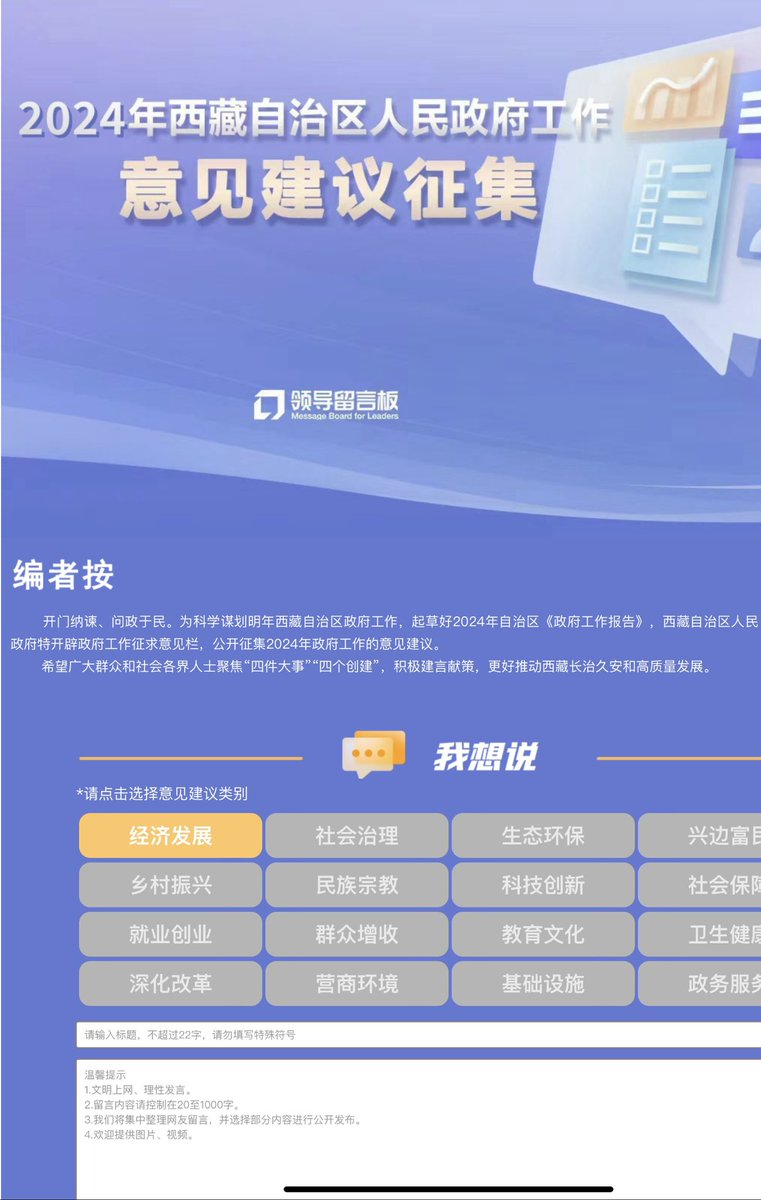
The second image is a link to a survey asking locals in Xizang how they would want to see the region's government operate in 2024. Local citizens are encouraged to submit their suggestions, and the categories include "deepening reform," "education and culture," "environmental protection," "religion," and "increase people's income."
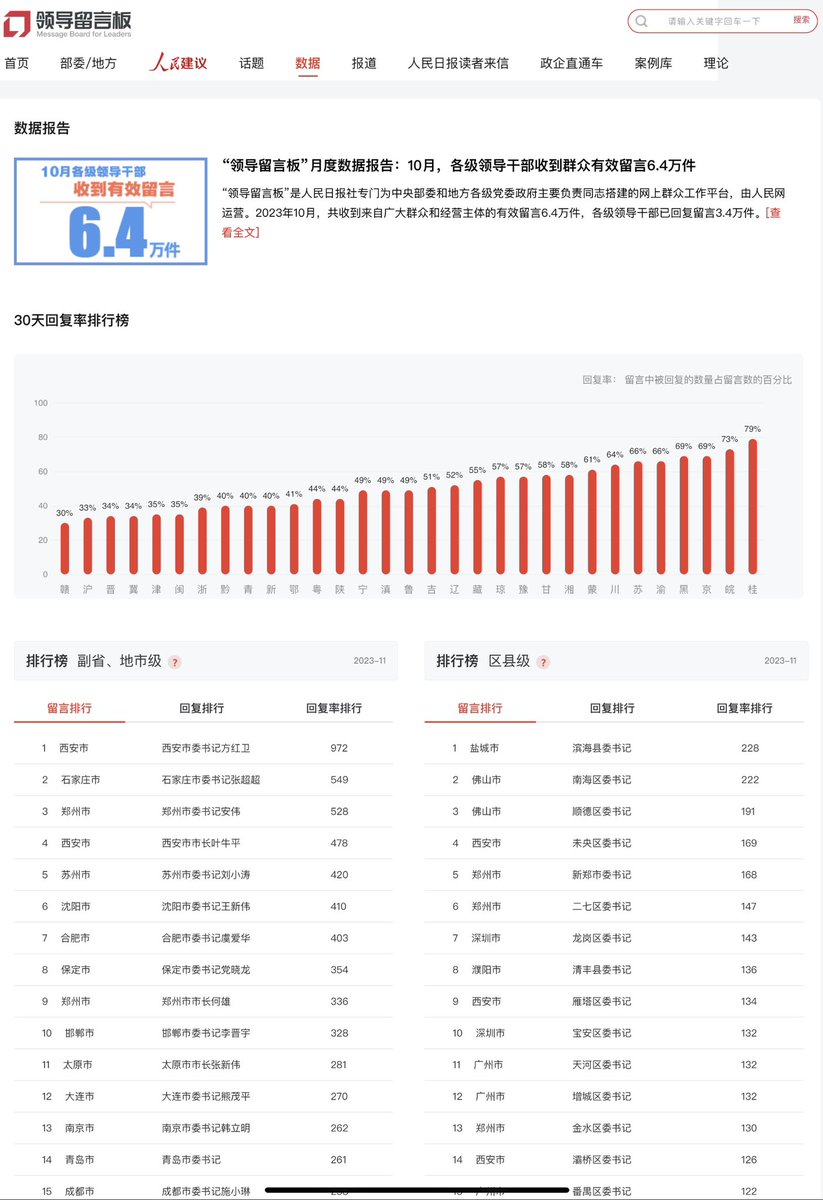
The third image is a real-time chart of complaints filed by ordinary Chinese via the Message Board for Leaders. The website displays a ranking of the government response rates across the country, with Guangxi Zhuang Autonomous Region having the highest rate at 79% and Jiangxi Province having the lowest at 30% in October.
The public can see which official is the most responsive based on another ranking, and anyone can view the complaints that the official dealt with.
Official statistics show that all of China's autonomous regions and provinces have registered on the Message Board for Leaders, where public members can communicate with the relevant officials.
Even more so, this is only one of numerous internet forums where citizens may voice their ideas on the government and have a say in how the country is run.
There is a reason why the Chinese government has one of the best approval ratings in the world. While "freedom of speech" in the West often refers to the ability to criticize government authorities, in China, it means the ability to voice one's wants and have those needs met.
Israel wants to eradicate extremists in Palestine, but how does it do so without causing the world's largest humanitarian crisis?
Let's take a look at how China solved extreme terrorism in Xinjiang as an example. @RnaudBertrand shares China eradicated Islamic terrorism:
1. Without any killings
2. With the unanimous support of the entire Muslim world (even the Talibans!)
3. Without any refugee crisis
4. Without forbidding Islam
5. Making Xinjiang a wealthy province of China with a GDP per capita higher than most countries in the region.
If you've never heard the truth about Xinjiang, two German scholars just wrote a groundbreaking report on Xinjiang and Muslims in China that expose the truth that Western media will NEVER tell you.
Full breakdown of what's really happening to Muslims in China 👇
https://t.co/zHeNAaDzuu
During the American colonial era, lobsters were considered "garbage meat" and were eaten by indentured servants, prisoners, and poor families that couldn't afford anything else. Even the indigenous tribes that lived near the coast would use lobsters as fertilizer or fish bait rather than consume them.
19th-century Kentucky politician, John Rowan, once said, "Lobster shells about a house are looked upon as signs of poverty and degradation." It was common for people to bury lobster shells in their backyard to prevent their neighbors from seeing them.
In one Massachusetts town, indentured servants even sued their owners because they were feeding them too much lobster. They won the lawsuit and got it in ink that they could only be fed lobster—at most—three times a week.
Lobsters had such a bad reputation because they were extremely plentiful. Early colonists could just walk up to the shoreline and collect them because they would wash up onto the shore in droves. The lobster also had a reputation for being a bottom feeder that would literally eat anything. It also didn't help that during this time, people ate lobster by grinding it up entirely and eating it as a paste or stew.
In the early 19th century, people paid 53 cents a pound for Boston baked beans and paid just 11 cents for a pound of lobster. It was quite common for lobster to be served to cats.
Towards the end of the 19th century, the opinion of the lobster began to change. As railroads began to expand across America, the railway companies decided to serve lobster because it was cheap, plentiful, and largely unknown to inland passengers who found it delicious and demanded more! It was during this time that lobster meat was also being canned and sold all across the country, which pushed demand even higher.
By the 1920s, there were fewer lobsters yet demand continued to increase. By the 1950s, the lobster had cemented its status as a delicacy and became something that was eaten by movie stars and the wealthy.