Couldn't agree with this more. It wasn't until I started my master's that I heard of grad assistantships. Imagine my shock when I learned PhD students get tuition waivers and stipends, factors that played big parts in my decision to pursue master's instead of doctorate then
Just told an undergrad about graduate assistantships, stipends, & tuition waivers. Her mind was blown. We need to do a better job educating students about #gradstudent opportunities - esp for rural, low-income, non-traditional students #highered
This new computer algorithm called ALPACA can predict which gene networks and signaling pathways are utilized by cancer cells so treatments can be customized based on the patient's conditions. #CornellCancerClass@CancerResource https://t.co/FfYy25GQkO
Did you know? Your wrist fitness monitors can track your daily activities AND your body's response to different cancer treatments at the same time! Great move towards personalized medicine using modern technology :) #CornellCancerClass@CancerResource https://t.co/usaDFh2c5F
Still in development, but this cool artificial mole might save your life via early diagnosis in the near future! #CornellCancerClass@CancerResource https://t.co/01aeGqBWki via @ETH_en
This new study identifying transition states of cancer cells as they become more metastasis-potent may lead to targeted treatments of higher risk cells to prevent metastasis #CornellCancerClass@CancerResource https://t.co/h51MyfIMp6
This new cancer drug maybe cutting-edge, but the diagnostic test to identify patients who can benefit from it isn't. We are likely to face similar challenges as cancer treatments get more targeted #CornellCancerClass@CancerResource
https://t.co/DsoWJ33oPt
Here's yet another link between our life style and cancer: calorie restriction reduces systemic oxidative stress in our body, reducing the risk of many diseases including diabetes and cancer #CornellCancerClass@CancerResource
https://t.co/3C5jDNE3T4
Related to last night's class, a study from Dana-Farber Cancer Institute shows a new approach to turn "immunosuppressive" environment into "immunostimulatory" one by implanting a drug-releasing hydrogel at the tumor site #CornellCancerClass@CancerResource
https://t.co/DlDr4kCN8d
If you'd been a heavy smoker in the past and your room decor has stayed the same since you quit smoking, this Spring maybe a good time to refurnish your house. #ThirdhandSmoking#CornellCancerClass@CancerResource
https://t.co/NVmQ5KIhix via @BerkeleyLab
Placebo for your brain - messages of "hope" will motivate you towards taking positive actions for your health more than the messages of "fear" according to this recent study from Penn State. #cornellcancerclass@CancerResource
https://t.co/j6hkTFol4w
It seems that not only microbes in our gut but also microbes on our skin matter when it comes to preventing cancerous growth in our body based on this new study @CancerResource#CornellCancerClass
Human skin bacteria have cancer-fighting powers https://t.co/q6nqDmGBXt
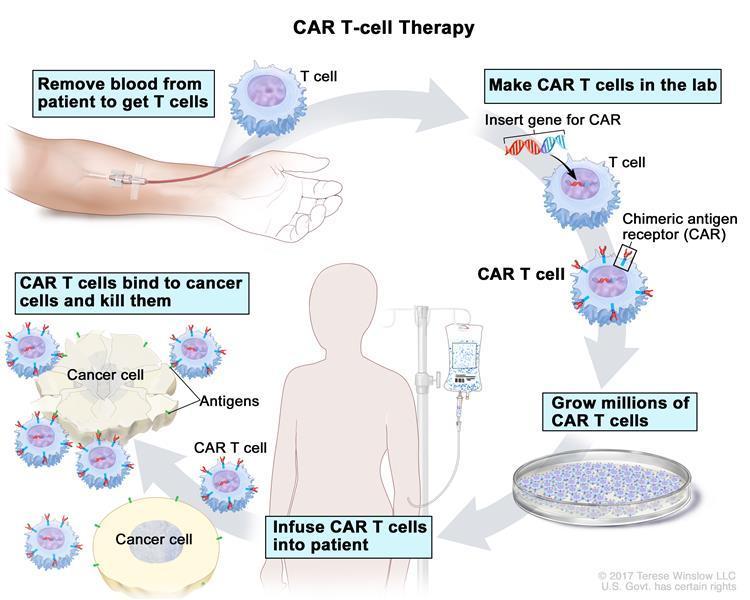
And more detailed information can be found in NCI website here:
CAR T Cells: Engineering Immune Cells to Treat Cancer https://t.co/4CvRVwD9qN
@CancerResource#CornellCancerClass https://t.co/Tft1eh2O2a
This article is a great example of utilizing big data for cancer research and how valuable each contribution to the big data is. Without them, this discovery would not have been possible. #CornellCanerClass@CancerResource
https://t.co/twmgfmq10x
A helping hand for your immune system - an injection of T-cell boosting agents into tumors has been shown to eliminate them completely in this study. Currently undergoing clinical trials #CornellCancerClass@cancerresource
https://t.co/NHkptYi00y
Very disheartening but continued endocrine therapy beyond initial 5 years seems to hold a key in lessening this risk #CornellCancerClass@cancerresource 20-Year Risks of Breast-Cancer Recurrence after Stopping Endocrine Therapy at 5 Years | NEJM https://t.co/AqfJ7clRNA