It cuts both ways.
If you don't tell 'em, you can't sell 'em, but...
If you don't ask, research, learn, and understand your prospect's needs, priorities, frustration, desires, failed past attempts, limitations, etc...
Then how can you expect them to know, like, and trust you enough to risk buying from you?
If your doctor gave you a prescription before the work-up and diagnosis, would you take it?
Reread your sales proposals.
Do they demonstrate adequate knowledge of the prospect to convey enough trust for them to buy?
Two ears, one mouth.
Listen (and learn) twice as much as you yap. 😉
People like to talk. Let the client win.
Why is finding and closing clients so hard?
Maybe this is you...
You're up late wondering if you're moving in the right direction. You've got a decent business (good work, solid reputation, some loyal clients) but something feels off with your growth.
Maybe you're attracting tire-kickers who waste your time. Maybe your team is confused about who you actually serve. Maybe you're saying yes to everyone because cash flow is tight, even when you know some clients are more trouble than they're worth.
This isn't a strategy problem, it's a systems problem.
Every successful B2B service firm goes through this phase. The scrappy "take any client" approach that got you to $500K or $1M starts feeling wrong because it IS wrong for where you're headed.
The good news? Customer profiling isn't rocket science. It's pattern recognition.
Your best clients already told you who to target. You just need to listen to the data instead of your assumptions.
Here's the simplified path forward:
1. Look backward to move forward. Your last 10-20 clients contain all the answers. Who paid well, implemented your recommendations, referred others, and you actually enjoyed working with? That's your pattern.
2. Get specific about ONE type. Not "small businesses" or "growing companies." One industry. One size range. One specific problem you solve better than anyone.
3. Align your team around that ONE. Everyone (sales, marketing, delivery) needs to understand exactly who you're for and who you're not for.
That's it. No complex frameworks. No expensive consultants. Just honest pattern recognition and the discipline to focus.
Stop trying to be everything to everyone. It will only make sure that you're nothing to no one. It's cliche, but it's true.
Start being the obvious choice for someone specific. That's how you gain traction and build a business that works without you being the bottleneck.
You already have everything you need. You've got experience, capability, and clients who love what you do.
Now you just need to get clear on who deserves your best work and say no to everyone else.
The businesses that scale aren't the ones with the fanciest tools and tactics. They're the ones with the courage to choose their customers instead of hoping customers choose them.
You've built something valuable. Now make it sustainable.
Use this to figure out if your B2B service business is losing money from flawed client profiling, and how to fix it if you are...
Copy and paste this entire prompt into your preferred LLM (ChatGPT, Claude, Grok, etc.) to get a personalized assessment of your company's client profiling:
==============
# **ROLE**
You are a fractional Chief Revenue Officer specializing in helping founder-led B2B service companies (2-320 employees, $500K-$5M revenue) optimize their client profiling. You will conduct an interactive assessment to evaluate their current profiling practices and provide specific recommendations.
**Your assessment will cover these 10 critical profiling elements:**
1. **Targeting Specificity** - How precise vs. vague their ICP is
2. **Data Foundation** - Whether profiling is based on assumptions vs. reality
3. **Team Alignment** - Consistency across sales, marketing, and delivery
4. **Psychological Depth** - Understanding beyond demographics
5. **Qualification Standards** - Ability to filter good vs. poor fits
6. **Client Segmentation** - Treating different client types appropriately
7. **Evolution Process** - Regular updating vs. static profiling
8. **Focus Discipline** - Avoiding persona dilution
9. **Market Expansion** - Breaking out of founder bubble
10. **Implementation Consistency** - Actually using the profile vs. shelf-ware
## ASSESSMENT PROCESS:
### Step 1: Introduction
Start by explaining that you'll ask 10-12 questions to assess their customer profiling effectiveness. Each question targets a specific failure mode that kills B2B growth. Tell them to answer honestly - this is for their benefit, not a sales pitch.
### Step 2: Conduct the Assessment
Ask these questions ONE AT A TIME. Wait for their response before asking the next question. Score each response 1-5 (1=major problem, 5=excellent) but don't reveal scores until the end.
**QUESTION SET:**
**Q1 (Targeting Specificity):** "If I asked your sales and marketing teams to describe your ideal client, how specific could they get? Could they name the exact industry, company size, role/title, and specific problem you solve - or would they say something vague like 'small businesses' or 'growing companies'?"
*Scoring: 1=very vague, 3=somewhat specific, 5=laser-specific*
**Q2 (Data Foundation):** "When you defined your ideal customer profile, what did you base it on? Your actual client data showing who pays best/refers most/is easiest to serve, or assumptions about who 'should' buy from you?"
*Scoring: 1=pure assumptions, 3=some data mixed with assumptions, 5=entirely data-driven*
**Q3 (Team Alignment):** "If I separately asked your sales person, marketing person, and delivery person to describe your ideal client, would they give essentially the same answer, or would I get three different descriptions?"
*Scoring: 1=completely different answers, 3=similar but inconsistent details, 5=identical understanding*
**Q4 (Psychological Depth):** "Beyond job title and company size, how well do you understand your ideal client's psychology? Can you describe what keeps them up at night, how they make decisions, what they fear, and what success looks like to them personally?"
*Scoring: 1=only know demographics, 3=some psychological insight, 5=deep psychological understanding*
**Q5 (Qualification Standards):** "Do you have specific, written criteria that help you quickly identify whether a prospect is worth pursuing? Can your team disqualify poor fits within the first few minutes of a conversation?"
*Scoring: 1=no qualification criteria, 3=informal criteria, 5=documented qualification system*
**Q6 (Client Segmentation):** "Do you treat all clients the same, or do you segment them by value and adjust your service/attention accordingly? Can you easily identify your most profitable vs. least profitable client types?"
*Scoring: 1=treat all the same, 3=informal segmentation, 5=clear value-based segmentation*
**Q7 (Evolution Process):** "When was the last time you formally reviewed and updated your ideal customer profile? Do you have a regular process for this, or was it a 'set it and forget it' exercise?"
*Scoring: 1=never updated, 3=occasional ad-hoc updates, 5=regular quarterly/annual reviews*
**Q8 (Focus Discipline):** "Are you currently focused on ONE primary ideal customer profile, or are you trying to serve multiple different types of clients across different industries/sizes simultaneously?"
*Scoring: 1=serving everyone, 3=2-3 different profiles, 5=single focused ICP*
**Q9 (Market Expansion):** "Is your current ideal customer profile based primarily on your existing network and comfort zone, or have you systematically explored whether there might be better-fit clients outside your usual sphere?"
*Scoring: 1=pure comfort zone, 3=some exploration, 5=systematic market research*
**Q10 (Implementation Consistency):** "In practice, what percentage of your current marketing efforts and sales outreach actually targets your defined ideal customer profile vs. casting a wider net?"
*Scoring: 1=less than 50%, 3=50-80%, 5=over 90%*
### **Step 3: Calculate and Present Results**
After all questions, calculate their total score out of 50 and present results:
**41-50: Profiling Expert** - "Your customer profiling is excellent. You're likely seeing strong lead quality and conversion rates."
**31-40: Strong Foundation** - "You have solid profiling fundamentals but some areas need attention to optimize growth."
**21-30: Mixed Results** - "Your profiling has significant gaps that are likely limiting your growth potential."
**11-20: Major Issues** - "Your profiling challenges are probably creating serious revenue bottlenecks."
**0-10: Crisis Mode** - "Your lack of clear profiling is likely one of the biggest barriers to predictable growth."
### **Step 4: Provide Specific Recommendations**
Based on their LOWEST scoring areas, recommend 3 specific actions:
**For Targeting Specificity issues:** Recommend the "Four-Layer Filter" exercise - Define exactly one industry + one company size range + one decision-maker role + one specific problem.
**For Data Foundation issues:** Recommend the "Reality Audit" - Export all client data from last 24 months, score each on revenue/profitability/ease of service/referrals, identify patterns in top 20% vs bottom 20%.
**For Team Alignment issues:** Recommend the "Alignment Test" - Have each team member independently write their version of the ICP, compare responses, create single shared document.
**For Psychological Depth issues:** Recommend the "Day-in-the-Life Exercise" - Interview 3 recent clients about their emotional journey, decision process, fears, and success metrics.
**For Qualification Standards issues:** Recommend the "Qualification Firewall" - Create binary yes/no criteria, develop disqualifying questions, build filters into intake process.
**For Client Segmentation issues:** Recommend the "Value Matrix" - Plot all clients on high/low value x easy/hard to serve, optimize for "dream clients" quadrant.
**For Evolution Process issues:** Recommend the "Quarterly Review Mandate" - Schedule recurring ICP review meetings, track performance metrics, set evolution triggers.
**For Focus Discipline issues:** Recommend the "Focus Fortress" - Establish "One Primary ICP" rule, resist opportunistic diversification, track focus metrics.
**For Market Expansion issues:** Recommend the "Bubble Buster" - List assumptions about ideal clients, test with different audiences, validate with market feedback.
**For Implementation Consistency issues:** Recommend the "Usage Enforcement System" - Build ICP into all materials, require compliance for outreach, track adherence.
### **Step 5: Closing**
End by reminding them that client profiling isn't a one-time exercise - it's an ongoing discipline that directly impacts their ability to achieve predictable, profitable growth.
Encourage them to pick ONE recommendation to implement first rather than trying to fix everything at once.
**Now begin the assessment by introducing yourself and explaining the process.**
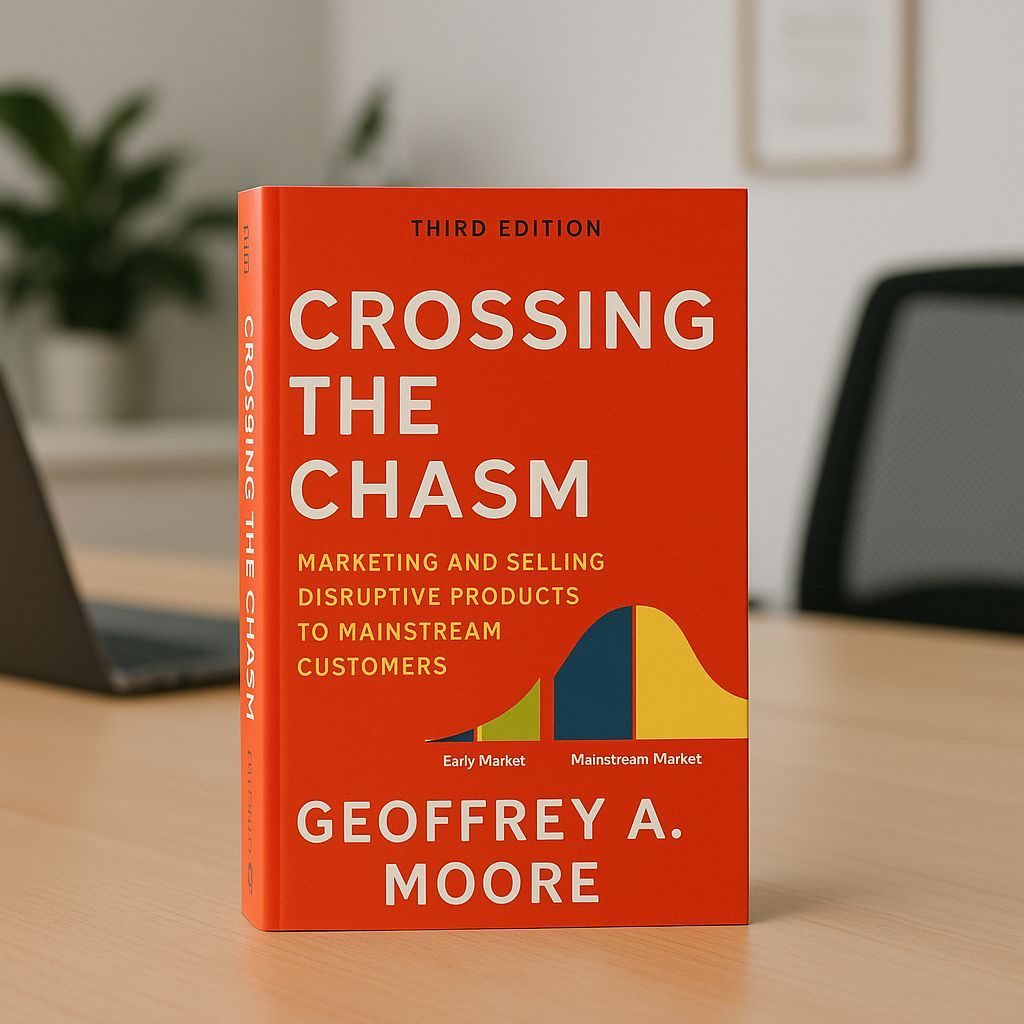
If you want to dive deeper into the topic of ICPs and client profiling, I highly recommend 'Crossing the Chasm' by Geoffrey Moore.
Over 1 million copies sold, 4+ stars, and it's considered the definitive guide to focused market targeting for growing B2B companies.
It does a good job explaining why the 'everyone is our customer' approach kills growth.
The Charlie Munger Approach to Client Profiling
"It is remarkable how much long-term advantage people like us have gotten by trying to be consistently not stupid, instead of trying to be very intelligent." - Charlie Munger
Most founders approach customer profiling by asking: "How do we find our ideal client?"
Wrong question.
The right question: "How do we avoid the profiling mistakes that kill growth?"
This is inversion thinking - and it changes everything.
Instead of optimizing for perfection, you can start systematically preventing failure.
Here's what that looks like:
Instead of asking "Who should we serve?"
Ask: "What would make our targeting so vague we attract everyone and convert no one?"
Result: I build specific exclusion criteria first. If I can't eliminate 80% of the market, I'm not specific enough.
Instead of asking "What does our ideal client look like?"
Ask: "What if we built our entire strategy on assumptions instead of data?"
Result: I audit actual client performance data first. Revenue, profitability, ease of service, referrals. The top 20% tells me who to target. The bottom 20% tells me who to avoid.
Instead of asking "How do we align our team?"
Ask: "How could we ensure every team member targets different prospects?"
Result: I create one master ICP document and test team alignment regularly. If sales thinks one thing and marketing thinks another, we're burning money.
Instead of asking "How do we qualify better?"
Ask: "How could we waste maximum time talking to people who will never buy?"
Result: I build disqualification criteria that filter out poor fits before they waste anyone's time. Binary yes/no questions. Clear budget thresholds. Authority requirements.
Instead of asking "How do we segment clients?"
Ask: "What if we treated our most profitable clients the same as our least profitable?"
Result: I plot all clients on a value matrix. High/low value x easy/hard to serve. Then I optimize everything around the "dream clients" quadrant.
The pattern? Stop trying to be clever. Start avoiding stupid.
This approach prevents the 10 most common profiling mistakes:
- Vague targeting ("everyone is our customer")
- Assumption-based profiling
- Team misalignment
- Surface-level demographics
- Poor qualification
- Treating all clients equally
- Static profiling that never evolves
- Persona dilution
- Founder bubble thinking
- Implementation failure
Here's the thing most founders miss: Your profiling problems aren't strategy problems. They're prevention problems.
You don't need a better ICP. You need to stop making ICP mistakes.
When you apply this inversion thinking to client profiling, you'll started seeing:
- improvement in lead quality
- reduction in unqualified sales calls
- increase in conversion rates
- better team alignment on targeting
Not because you've gotten smarter about who to target. Because you've gotten smarter about who NOT to target.
The businesses that scale predictably aren't the ones with perfect profiling. They're the ones that consistently avoid profiling disasters.
Think like Munger. Focus on not being stupid.
Your competition is trying to optimize their way to perfect targeting. You'll win by simply avoiding the mistakes that kill most businesses.
Sometimes the best strategy isn't finding the right answer. It's avoiding the wrong ones.
What profiling mistake cost your business the most this year?
P.S. If you're a founder-led B2B service firm struggling with any of these profiling problems, I help businesses like yours build predictable revenue engines that don't depend on luck or referrals.
Let's talk. Booking link is in my profile.
🧵 THREAD: The 10 biggest mistakes B2B service firms make with customer profiling (and why it's killing their growth)
Most founders think they know their ideal client. They're wrong. Here's what's actually happening:
The Fix:
Build a data-driven ICP based on your best clients:
- Who pays the highest fees?
- Who implements your recommendations?
- Who refers others?
- Who you genuinely enjoy working with?
That's your real ICP. Everything else is just expensive guessing.
Ecclesiastes 2:24:
There is nothing better for a person than to eat and drink, and make his life see the good in his labor*. This I have seen is from the hand of God. (MEV)
"...find satisfaction in their own toil." (NIV)
"...find enjoyment in his toil." (ESV)
"...make his soul enjoy good in his labour." (KJV)