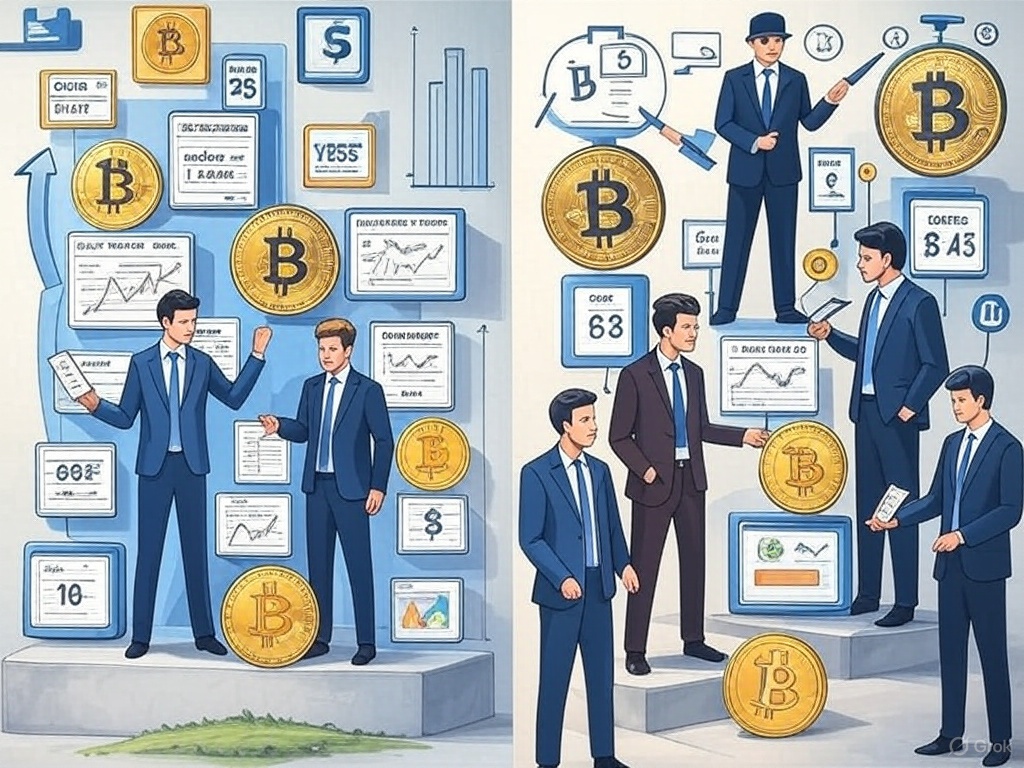
Bitcoin's journey... what a rollercoaster! 🎢 Let's talk Bitcoin Dominance ($BTC.D) – the measure of Bitcoin's weight in the entire crypto world. Its story IS the story of crypto itself!
Remember the early days (2009-2013)? $BTC was basically THE ONLY GAME in town. Dominance near 100% felt normal! A small club of pioneers dreaming big. Feels like ancient history now, right? 🤔
Then came the first challengers (2013-2016)! Litecoin ($LTC), Ripple ($XRP), and the game-changer: Ethereum ($ETH) with its smart contracts in 2015. Suddenly, $BTC wasn't alone. Dominance started to dip, showing crypto was more than just one coin. Innovation was brewing! 🔥
2017? Absolute madness! The ICO boom, fueled by Ethereum's ERC-20 standard. Money poured into everything! $BTC dominance PLUNGED below 40% for the first time. Wild speculation, crazy gains... a truly unforgettable, chaotic era! 🤯💥
But winter came (2018-2019) 🥶. The ICO bubble burst. Fear gripped the market. Where did everyone run? Back to the King! $BTC dominance surged back above 70% as people sought refuge in the most established name. A harsh lesson in market cycles.
Then, the REBIRTH (2020-2021)! DeFi Summer exploded, NFTs went mainstream. New blockchains like Solana ($SOL) and Avalanche ($AVAX) rose. Real innovation, real use cases (and yes, more meme coin madness! 🤪). $BTC dominance fell again, testing lows near 40%. The ecosystem was truly diversifying! 🌳
And now? The ETF Era! 🏦 Since 2022, we've seen macro pressures (inflation, rate hikes) and major crypto events (FTX collapse). But the US $BTC Spot ETF approval in early 2024 is HUGE! Big money is flowing directly into Bitcoin, pushing dominance up again. Bitcoin is solidifying its "digital gold" narrative.
What's next? The future is a thrilling mix! Will innovative Altcoins keep chipping away at $BTC's share? Or will institutional adoption via ETFs cement Bitcoin's top spot? Plus, Bitcoin's own Layer 2 solutions are evolving! It's a complex dance between tech, money, and market mood. 💃🕺
One thing's for sure: watching $BTC dominance is key to understanding crypto's pulse. It's been an epic saga, and the next chapter is just beginning! 👀
Follow for more insights into the macro x crypto intersection!
#Bitcoin #Crypto #BTCDominance #Investing #DigitalAssets
SPANISH:
¡El viaje de Bitcoin... qué montaña rusa! 🎢 Hablemos de la Dominancia de Bitcoin ($BTC.D) – la medida del peso de Bitcoin en todo el mundo cripto. ¡Su historia ES la historia de las criptomonedas!
¿Recuerdas los primeros días (2009-2013)? $BTC era básicamente EL ÚNICO jugador. ¡Una dominancia cercana al 100% parecía normal! Un pequeño club de pioneros soñando en grande. Parece historia antigua ahora, ¿verdad? 🤔
Luego llegaron los primeros retadores (2013-2016)! Litecoin ($LTC), Ripple ($XRP), y el que cambió el juego: Ethereum ($ETH) con sus contratos inteligentes en 2015. De repente, $BTC no estaba solo. La dominancia empezó a bajar, mostrando que las cripto eran más que una moneda. ¡La innovación estaba en marcha! 🔥
¿2017? ¡Locura absoluta! El boom de las ICOs, impulsado por el estándar ERC-20 de Ethereum. ¡El dinero fluía hacia todo! La dominancia de $BTC se DESPLOMÓ por debajo del 40% por primera vez. Especulación salvaje, ganancias locas... ¡una era caótica e inolvidable! 🤯💥
Pero llegó el invierno (2018-2019) 🥶. La burbuja de las ICOs estalló. El miedo se apoderó del mercado. ¿A dónde corrieron todos? ¡De vuelta al Rey! La dominancia de $BTC resurgió por encima del 70% mientras la gente buscaba refugio en el nombre más establecido. Una dura lección sobre los ciclos del mercado.
¡Luego, el RENACIMIENTO (2020-2021)! El Verano DeFi explotó, los NFTs se volvieron mainstream. Nuevas blockchains como Solana ($SOL) y Avalanche ($AVAX) surgieron. Innovación real, casos de uso reales (¡y sí, más locura de monedas meme! 🤪). La dominancia de $BTC cayó de nuevo, probando mínimos cerca del 40%. ¡El ecosistema se estaba diversificando de verdad! 🌳
¿Y ahora? ¡La Era de los ETF! 🏦 Desde 2022, hemos visto presiones macro (inflación, subidas de tasas) y eventos cripto importantes (colapso de FTX). ¡Pero la aprobación del ETF Spot de $BTC en EE.UU. a principios de 2024 es ENORME! Mucho dinero está fluyendo directamente a Bitcoin, impulsando la dominancia de nuevo. Bitcoin está solidificando su narrativa de "oro digital".
¿Qué sigue? ¡El futuro es una mezcla emocionante! ¿Seguirán las Altcoins innovadoras quitándole cuota a $BTC? ¿O la adopción institucional vía ETFs cimentará el primer lugar de Bitcoin? Además, ¡las soluciones de Capa 2 de Bitcoin están evolucionando! Es un baile complejo entre tecnología, dinero y el ánimo del mercado. 💃🕺
Una cosa es segura: observar la dominancia de $BTC es clave para entender el pulso de las cripto. ¡Ha sido una saga épica, y el próximo capítulo apenas comienza! 👀
¡Sígueme para más análisis sobre la intersección macro x cripto!
#Bitcoin #Criptomonedas #DominanciaBTC #Inversión #ActivosDigitales
JAPANESE:
ビットコインの旅路… まるでジェットコースター!🎢 ビットコイン・ドミナンス($BTC.D)について話しましょう – 暗号資産界全体におけるビットコインの重みを示す指標です。その物語こそ、暗号資産そのものの物語なのです!
初期の頃(2009~2013年)を覚えていますか?$BTCは基本的に市場で唯一の存在でした。ドミナンスが100%近くだったのが普通だったのです!少数のパイオニアたちが大きな夢を見ていました。今ではまるで古代史のようですね?🤔
その後、最初の挑戦者たちが現れました(2013~2016年)!ライトコイン($LTC)、リップル($XRP)、そしてゲームチェンジャー:2015年のスマートコントラクトを備えたイーサリアム($ETH)。突然、$BTCは一人ではなくなりました。ドミナンスは下がり始め、暗号資産が一つのコイン以上のものであることを示しました。イノベーションが醸成されていたのです!🔥
2017年は?まさに狂乱!イーサリアムのERC-20標準に煽られたICOブーム。資金があらゆるものに流れ込みました!$BTCドミナンスは初めて40%を割り込み急落。激しい投機、狂ったような利益…本当に忘れられない、混沌とした時代でした!🤯💥
しかし冬が来ました(2018~2019年)🥶。ICOバブルが弾けたのです。市場は恐怖に包まれました。誰もがどこへ逃げたでしょうか?王者の元へ!人々が最も確立された名前に避難を求めたため、$BTCドミナンスは70%以上に急上昇しました。市場サイクルの厳しい教訓でした。
そして、再生(2020~2021年)!DeFiサマーが爆発し、NFTが主流に。Solana($SOL)やAvalanche($AVAX)のような新しいブロックチェーンが登場。真のイノベーション、真のユースケース(そして、ええ、さらなるミームコインの狂乱も!🤪)。$BTCドミナンスは再び下落し、40%付近の安値を試しました。エコシステムは真に多様化していました!🌳
そして今?ETFの時代!🏦 2022年以降、マクロ経済的圧力(インフレ、利上げ)や主要な暗号資産イベント(FTX破綻)を見てきました。しかし、2024年初頭の米国$BTC現物ETFの承認は巨大です!大金が直接ビットコインに流れ込み、ドミナンスを再び押し上げています。ビットコインは「デジタルゴールド」の物語を固めつつあります。
次は何でしょう?未来はスリリングなミックスです!革新的なアルトコインが$BTCのシェアを削り続けるのでしょうか?それともETFを通じた機関投資家の採用がビットコインのトップの座を固めるのでしょうか?さらに、ビットコイン自身のレイヤー2ソリューションも進化しています!技術、資金、市場心理の間の複雑なダンスです。💃🕺
確かなことは一つ:$BTCドミナンスを観察することは、暗号資産の脈拍を理解する鍵であるということです。壮大な物語でした、そして次の章は始まったばかりです!👀
マクロ×暗号資産の交差点に関するさらなる洞察を得るためにフォローしてください!
#ビットコイン #暗号資産 #BTCドミナンス #投資 #デジタル資産
SIMPLIFIED CHINESE:
比特币的旅程……真是跌宕起伏!🎢 聊聊比特币占有率($BTC.D)——衡量比特币在整个加密世界分量的指标。它的故事本身就是加密货币的故事!
还记得早期(2009-2013年)吗?$BTC 基本上是镇上唯一的玩家 。接近100%的占有率感觉很正常!一小群先驱者怀揣着大梦想 。现在感觉像是远古历史了,对吧?🤔
然后来了第一批挑战者(2013-2016年)!莱特币($LTC)、瑞波币($XRP),以及改变游戏规则的:2015年带有智能合约的以太坊($ETH)。突然间,$BTC 不再孤单。占有率开始下降,表明加密货币不仅仅是一种币 。创新正在酝酿!🔥
2017年?绝对疯狂!由以太坊 ERC-20 标准助燃的 ICO 热潮 。资金涌入所有项目!$BTC 占有率首次暴跌至 40% 以下 。疯狂的投机,疯狂的收益……一个真正难忘、混乱的时代!🤯💥
但冬天来了(2018-2019年)🥶。ICO 泡沫破灭 。恐惧笼罩市场。大家跑哪儿去了?回到王者身边!随着人们在最老牌的名称中寻求避险,$BTC 占有率飙升回 70% 以上 。市场周期的一次严酷教训。
接着是重生(2020-2021年)!DeFi 之夏爆发,NFT 进入主流 。像 Solana($SOL)和 Avalanche($AVAX)这样的新区块链崛起 。真正的创新,真正的用例(当然,还有更多的 Meme 币狂热!🤪)。$BTC 占有率再次下跌,测试接近 40% 的低点 。生态系统真正多元化了!🌳
现在呢?ETF 时代!🏦 自 2022 年以来,我们看到了宏观压力(通胀、加息)和重大的加密事件(FTX 崩盘)。但 2024 年初美国 $BTC 现货 ETF 的批准是巨大的 !大笔资金直接流入比特币,再次推高占有率 。比特币正在巩固其“数字黄金”的叙事 。
接下来会怎样?未来是激动人心的混合体!创新的山寨币会继续蚕食 $BTC 的份额吗 ?还是通过 ETF 的机构采用会巩固比特币的头把交椅 ?此外,比特币自己的 Layer 2 解决方案也在发展 !这是技术、资金和市场情绪之间复杂的舞蹈。💃🕺
有一件事是肯定的:关注 $BTC 占有率是理解加密市场脉搏的关键。这是一部史诗般的传奇,而下一章才刚刚开始!👀
关注我,获取更多宏观 x 加密交叉领域的深度分析!
#比特币 #加密货币 #BTC占有率 #投资 #数字资产
ARABIC:
رحلة البيتكوين... يا لها من أفعوانية! 🎢 لنتحدث عن هيمنة البيتكوين ($BTC.D) – مقياس وزن البيتكوين في عالم الكريبتو بأكمله. قصتها هي قصة الكريبتو نفسها!
هل تتذكر الأيام الأولى (2009-2013)؟ كان $BTC هو اللاعب الوحيد تقريبًا في الساحة. هيمنة تقترب من 100% بدت طبيعية! نادٍ صغير من الرواد يحلمون أحلامًا كبيرة. يبدو وكأنه تاريخ قديم الآن، أليس كذلك؟ 🤔
ثم جاء المنافسون الأوائل (2013-2016)! لايتكوين ($LTC)، ريبل ($XRP)، والمُغيّر لقواعد اللعبة: إيثيريوم ($ETH) بعقوده الذكية في 2015. فجأة، لم يعد $BTC وحيدًا. بدأت الهيمنة في الانخفاض، مظهرةً أن الكريبتو أكثر من مجرد عملة واحدة. كان الابتكار يختمر! 🔥
2017؟ جنون مطبق! طفرة الطروحات الأولية للعملات (ICO)، مدفوعة بمعيار ERC-20 الخاص بإيثيريوم. تدفقت الأموال إلى كل شيء! انهارت هيمنة $BTC إلى ما دون 40% لأول مرة. مضاربة جامحة، مكاسب جنونية... حقبة فوضوية لا تُنسى حقًا! 🤯💥
لكن الشتاء أتى (2018-2019) 🥶. انفجرت فقاعة الـ ICO. سيطر الخوف على السوق. إلى أين هرب الجميع؟ عادوا إلى الملك! ارتفعت هيمنة $BTC مرة أخرى فوق 70% حيث بحث الناس عن ملاذ في الاسم الأكثر رسوخًا. درس قاسٍ في دورات السوق.
ثم، الولادة الجديدة (2020-2021)! انفجر صيف التمويل اللامركزي (DeFi)، وأصبحت الرموز غير القابلة للاستبدال (NFTs) سائدة. ظهرت بلوك تشينات جديدة مثل سولانا ($SOL) وأفالانش ($AVAX). ابتكار حقيقي، حالات استخدام حقيقية (ونعم، المزيد من جنون عملات الميم! 🤪). انخفضت هيمنة $BTC مرة أخرى، مختبرةً أدنى مستوياتها بالقرب من 40%. كان النظام البيئي يتنوع حقًا! 🌳
والآن؟ عصر صناديق الاستثمار المتداولة (ETF)! 🏦 منذ عام 2022، شهدنا ضغوطًا على الاقتصاد الكلي (التضخم، رفع أسعار الفائدة) وأحداث كريبتو كبرى (انهيار FTX). لكن الموافقة على صندوق $BTC المتداول الفوري في الولايات المتحدة في أوائل عام 2024 أمر ضخم! تتدفق أموال كبيرة مباشرة إلى البيتكوين، مما يدفع الهيمنة للارتفاع مرة أخرى. يعزز البيتكوين روايته كـ "ذهب رقمي".
ماذا بعد؟ المستقبل مزيج مثير! هل ستستمر العملات البديلة المبتكرة في اقتطاع حصة $BTC ؟ أم أن التبني المؤسسي عبر صناديق الاستثمار المتداولة سيعزز مكانة البيتكوين الأولى ؟ بالإضافة إلى ذلك، تتطور حلول الطبقة الثانية الخاصة بالبيتكوين أيضًا! إنها رقصة معقدة بين التكنولوجيا والمال ومزاج السوق. 💃🕺
هناك شيء واحد مؤكد: مراقبة هيمنة $BTC أمر أساسي لفهم نبض الكريبتو. لقد كانت ملحمة، والفصل التالي قد بدأ للتو! 👀
تابعني للمزيد من الرؤى حول تقاطع الاقتصاد الكلي والكريبتو!
#بيتكوين #كريبتو #هيمنة_بيتكوين #استثمار #أصول_رقمية
FTX’s liquidation screws Chinese investors—$470M claims flagged, $290M disputed over shady KYC!
@brian_armstrong
, lead a lawsuit & escrow these accounts! Coinbase wins trust, market share, & moral high ground as crypto’s ethical leader. #FTX #CryptoJusticeFTX’s $1.93B reserve cut risks Chinese investors’ rights Discriminatory flagging violates fairness Coinbase’s compliance cred can champion justice Leading lawsuit boosts Coinbase’s global reputation Escrow role secures future market loyalty Benefits to Coinbase By leading a collective lawsuit and acting as an escrow agent for FTX’s disputed accounts, Coinbase can: Enhance Reputation: Positioning as an ethical leader in crypto builds trust, especially among international investors. Gain Market Share: Supporting Chinese investors taps into a massive market, fostering loyalty when regulations ease. Strengthen Compliance Credibility: Leveraging its status as a compliant, publicly traded exchange sets Coinbase apart from competitors. Drive Industry Leadership: Championing fairness in the FTX case solidifies Coinbase’s influence in shaping crypto’s future.
FTX’s liquidation screws Chinese investors—$470M claims flagged, $290M disputed over shady KYC!
@brian_armstrong
, lead a lawsuit & escrow these accounts! Coinbase wins trust, market share, & moral high ground as crypto’s ethical leader. #FTX #CryptoJusticeFTX’s $1.93B reserve cut risks Chinese investors’ rights
Discriminatory flagging violates fairness
Coinbase’s compliance cred can champion justice
Leading lawsuit boosts Coinbase’s global reputation
Escrow role secures future market loyalty
Benefits to Coinbase
By leading a collective lawsuit and acting as an escrow agent for FTX’s disputed accounts, Coinbase can: Enhance Reputation: Positioning as an ethical leader in crypto builds trust, especially among international investors.
Gain Market Share: Supporting Chinese investors taps into a massive market, fostering loyalty when regulations ease.
Strengthen Compliance Credibility: Leveraging its status as a compliant, publicly traded exchange sets Coinbase apart from competitors.
Drive Industry Leadership: Championing fairness in the FTX case solidifies Coinbase’s influence in shaping crypto’s future.
FTX’s liquidation screws Chinese investors—$470M claims flagged, $290M disputed over shady KYC! @brian_armstrong
, lead a lawsuit & escrow these accounts! Coinbase wins trust, market share, & moral high ground as crypto’s ethical leader. #FTX #CryptoJusticeFTX’s $1.93B reserve cut risks Chinese investors’ rights
Discriminatory flagging violates fairness
Coinbase’s compliance cred can champion justice
Leading lawsuit boosts Coinbase’s global reputation
Escrow role secures future market loyalty
Benefits to Coinbase
By leading a collective lawsuit and acting as an escrow agent for FTX’s disputed accounts, Coinbase can: Enhance Reputation: Positioning as an ethical leader in crypto builds trust, especially among international investors.
Gain Market Share: Supporting Chinese investors taps into a massive market, fostering loyalty when regulations ease.
Strengthen Compliance Credibility: Leveraging its status as a compliant, publicly traded exchange sets Coinbase apart from competitors.
Drive Industry Leadership: Championing fairness in the FTX case solidifies Coinbase’s influence in shaping crypto’s future.
Here's the final chapter of our deep dive on wealth creation:
Chapter 6: Macro Environment Adaptability, Global Perspective & Systemic Risk Management – Navigating Firmly in an Uncertain World 🌍🛡️
Wealth accumulation and preservation are deeply embedded within a complex web of macroeconomic trends, societal structures, cultural norms, and global dynamics. Understanding and adapting to this macro environment, while proactively managing systemic risks, is key to ensuring your wealth journey is both sustainable and successful. This chapter explores comparative wealth paths (US-China as a case study), managing economic cycles & "black swan" events, and leveraging behavioral finance to overcome psychological hurdles, all to build a resilient wealth structure in an uncertain world.
Key Points: Here's what I'm seeing for this chapter:The journey to wealth isn't in a vacuum. Mastering your internal game (psychology, skills) is vital, but so is navigating the external landscape (macro trends, systemic risks) with wisdom and a global perspective.
6.1 US & China Wealth Paths: A Comparative Look for Global Insights & Localized Strategy 🇺🇸🇨🇳
As the world's two largest economies, the US and China offer fascinatingly different yet sometimes similar paths to wealth. Understanding these differences and commonalities – in institutional frameworks, cultural attitudes, and developmental stages – can help individuals, particularly those in evolving markets, draw lessons from mature economies while tailoring strategies to their unique local contexts.
6.1.1 Institutional Variances: Shaping the "Rules of the Game"The institutional environment is the "infrastructure" for wealth creation, influencing opportunities, risk profiles, and strategic choices.
Capital Market Maturity & Regulation:US: Developed, mature, multi-layered (registration-based IPOs, robust short-selling, rich derivatives market, established delisting, institutionally dominated, stringent regulation, relatively strong investor protection). Offers diverse direct investment channels; equity incentives are common; active VC scene.
China: Continuously evolving (gradual shift to registration-based IPOs, retail investor dominance but growing institutional presence, higher volatility, policy sensitivity, developing derivatives/shorting, stricter delisting, strengthening regulation/investor protection). Investment channels expanding; equity incentives rising in new-economy firms; public and private funds are key participation routes.
Tax System Complexity & Planning Scope:US: Extremely complex (federal, state, local taxes; progressive income tax, capital gains, dividends, estate/gift taxes are significant). Numerous tax-advantaged accounts (401k, IRA, HSA, 529), deductions, credits, and advanced planning tools (trusts, 1031 exchanges, QSBS). Tax planning is core to wealth management.
China: Relatively simpler but reforming (hybrid individual income tax, primarily corporate income tax, no unified property or inheritance/gift tax yet). Personal tax planning focuses on specific deductions, bonus calculations, some equity incentive benefits. Corporate-level tax planning is more common. Use of trusts for legacy planning is emerging.
Legal & Property Rights Protection:US: Common law based, strong tradition of private property rights, developed legal services, deep contract culture, relatively transparent/predictable enforcement, strong IP protection, mature use of trusts/wills.
China: Socialist legal system continually improving (property, contract, company, IP laws strengthening). Private property protection is increasing but maturity/enforcement detail still evolving. Important to track policy shifts and legal risks, especially in emerging sectors.
Entrepreneurial Ecosystem & Innovation:US: World-leading innovation hub (e.g., Silicon Valley), strong culture of risk-taking/failure tolerance, vast VC/PE market, tight academia-industry links, deep talent pool, clear exit paths. Entrepreneurship is a major path to explosive wealth growth.
China: Dynamic entrepreneurial scene (government support, leading firms in AI, digital economy, new energy). Huge domestic market and application scenarios are local advantages. Ecosystem influenced by policy, funding, and intense competition. How do you see the differences in capital market structures (e.g., US vs. your local market) impacting individual investment strategies?
6.1.2 Cultural Differences: Deep-Seated Influences on Financial BehaviorCultural norms, as informal institutions, subtly shape savings, risk appetite, consumption, and perceptions of wealth.
Savings Habits & Consumption:US: Traditionally lower savings rates, prevalent credit-based consumption, "live in the moment" ethos (though subcultures like FIRE exist).
China: Strong tradition of thrift, high savings rates, more cautious about debt, strong emphasis on saving for education/retirement.
Risk Appetite & Investment Behavior:US: Generally higher participation in financial investments and greater risk tolerance. Equities form a larger part of household assets. Higher acceptance of innovative, high-risk investments.
China: Traditionally favored low-risk, stable investments (savings, bank products). Real estate historically overweighted in household assets. Stock market has higher retail participation, leading to more speculative sentiment, though investor education and market maturity are improving this.
Perception of Equity & Entrepreneurship:US: Strong equity culture; equity seen as key to sharing success and wealth leaps. Entrepreneurship highly valued; higher tolerance for failure.
China: Rapidly growing appreciation for equity, but "iron rice bowl" (stable job) mentality persists for some. Entrepreneurship often viewed as high-risk/high-stress; tolerance for failure is improving.
Views on Wealth & Legacy:US: Beyond personal/family needs, wealth use often includes giving back (strong philanthropic culture). Legacy planning is often professionalized and long-term (trusts, foundations).
China: Traditional views emphasize family prosperity and honoring ancestors. Inheritance often direct property transfer. Modern legacy tools are gaining traction. Philanthropic awareness is growing, but strategic philanthropy and family foundations are nascent.
6.1.3 Universal Logic: Principles Driving Wealth Growth GloballyDespite differences, the fundamental logic of wealth creation is universal: sustained investment in Human Capital is the start; diversified Cash Flow generation and management are key; the long-term power of Compounding is the engine of exponential growth; Risk Management and asset preservation are a cornerstone; and Lifelong Learning & Adaptability are perpetual themes.
6.1.4 Lessons & Adjustments: Localized Wisdom from a Global ViewpointIndividuals, especially in markets like China, can benefit from understanding their local context while selectively adopting mature practices from developed markets, always localizing for their specific situation.Potentially Adaptable Insights: Mature asset allocation concepts (lifecycle, core-satellite, global diversification), widespread use of index funds/passive investing, emphasis on equity incentive value, sophisticated risk management tools/awareness, professional wealth planning (trusts, wills, insurance), strategic philanthropy/impact investing, importance of tax planning.
Key Local Considerations (Illustrative for China, but principles apply elsewhere): Deep understanding of unique policy environments (e.g., "policy-driven markets"), adapting to local stock market characteristics (investor structure, volatility, regulation), the role of real estate in household assets and its future trends, FX volatility and cross-border capital flow management, local evolution of legal/trust systems, cultural nuances in communication/execution (especially in family legacy planning).
6.2 Navigating Economic Cycles & "Black Swan" Events: Wisdom for Sailing Through Storms 🌪️🦢
The ocean of wealth is not always calm. Economic tides, market storms, and "black swan" events test every financial vessel. Understanding economic cycles and mastering coping strategies is crucial to stay on course, avoid capsizing, and even harness favorable winds.
6.2.1 Classic Cycle Theories (e.g., Merrill Lynch Investment Clock): Guidance & LimitationsThe Investment Clock divides the economic cycle (Recovery, Overheat, Stagflation, Recession) and suggests outperforming asset classes in each, driven by GDP growth and inflation (CPI) dynamics.Guidance: Cultivates cyclical thinking, provides a strategic asset allocation reference, helps avoid emotional chasing of returns.
Limitations & Modern Caveats: Idealized model; real economies are complex. Globalization, deep financialization, large-scale monetary interventions (like QE), and black swan impacts can distort or invalidate classic patterns. Data lags and interpretation challenges exist.
Strategy: Don't apply mechanically; use flexibly. Focus on long-term trends over short-term forecasts. Diversification is paramount.
6.2.2 The "All-Weather Portfolio" Concept & PracticePopularized by Ray Dalio, it aims to build a portfolio with relatively stable performance across various economic environments (growth/recession, rising/falling inflation) by diversifying assets that perform well in different scenarios, thereby balancing risks without predicting the future.Core Logic (Risk Parity across Four Quadrants): Divides economic environments (e.g., growth higher/lower than expected, inflation higher/lower than expected) and allocates roughly equal risk-weighted exposure to assets suited for each (e.g., equities, long/intermediate gov't bonds, TIPS, commodities, gold).
Practical Points: Drawdowns can still occur; potential returns might be more moderate. Sophisticated institutional versions may use leverage. Needs local adaptation. The key idea is a diversified mix of low-correlation assets for different macro regimes.
6.2.3 Maintaining Strategic Liquidity: "Ammunition" for Crises & "Black Swan" OpportunitiesBlack swans are rare, unpredictable, high-impact events. Strategic liquidity serves as:Safety Net: Buffers against market panic and liquidity freezes, avoiding forced selling at low prices.
Opportunity Seizer: When black swans cause irrational sell-offs of quality assets, liquidity allows for opportunistic buying.
Building It: This is beyond your standard emergency fund. Held in cash, money market funds, short-term high-grade government bonds/ETFs. Size depends on risk appetite, wealth, market judgment, and opportunity cost tolerance. Manage dynamically: increase when risks are high/markets frothy; deploy decisively when opportunities appear. "The art of waiting" requires patience and conviction.
6.2.4 Continuous Learning: Global Macro, Geopolitics & Emerging TrendsThe world is complex and dynamic. Lifelong learning, a global perspective, and attention to impactful macro variables are essential for adaptability and foresight.Focus Areas: Macroeconomic fundamentals (GDP, inflation, rates, FX, employment), monetary/fiscal policy, major economies' outlook, geopolitical risks (international relations, conflicts, trade, resources), tech/industrial trends (AI, biotech, new energy, Web3), social/demographic shifts (aging, emerging market middle class, sustainability).
Sources: Reputable financial media, research reports, quality books/documentaries, industry conferences, expert interviews. Always maintain critical thinking and build your own cognitive framework. What are your go-to sources for staying informed on global macro trends?
6.3 Psychological Fortitude & Behavioral Finance: Conquering Self for Rational Prosperity 🧘♂️🧠
Often, the biggest obstacles on the wealth journey are internal: greed, fear, and cognitive biases. Behavioral finance reveals the profound impact of psychology on investment decisions. Strengthening mental fortitude and actively mitigating common behavioral traps are intrinsic safeguards for long-term rational investing and sustainable wealth growth.
6.3.1 Overcoming Greed & Fear (Avoiding the "Retail Cycle" of Buy High, Sell Low)FOMO during bull runs (chasing highs) and panic selling during bear markets (locking in losses) are primary drivers of poor retail investor returns.Strategies: Develop and strictly adhere to an Investment Policy Statement (IPS). Anchor decisions in value and long-term perspective. Employ contrarian thinking. Automate investments (e.g., DCA). Diversify. Use stop-loss/take-profit orders dialectically and with discipline.
6.3.2 Cultivating Long-Termism: Seeing Through the Fog, Waiting for the Bloom ⏳🌸 Compounding, by its nature, demands a long horizon. Frequent trading rarely leads to sustained success and can interrupt compounding. Holding quality assets long-term is often the best strategy to capture intrinsic value growth.Developing Long-Termism: Focus on fundamentals, ignore short-term noise. Set distant financial goals. Learn from investment masters. Review periodically but avoid obsessive monitoring. "Slow and steady often wins the race."
6.3.3 Recognizing & Mitigating Common Investment Biases (A Deeper Dive): Understanding and actively countering these is key to rational investing:Overconfidence Bias: Overestimating abilities, leading to frequent trading, concentrated positions, underestimating risk. Antidote: Humility, objective review of past decisions, seek diverse opinions, diversify, admit "I don't know."
Confirmation Bias: Seeking info that supports existing views, ignoring contradictory data. Antidote: Actively seek counterarguments, engage with "uncomfortable" but true info, discuss with those holding different views.
Anchoring Bias: Over-relying on initial information (the "anchor"). Antidote: Use multiple valuation benchmarks, don't let purchase price or historical highs dictate future decisions.
Loss Aversion & Disposition Effect: Pain of loss felt more keenly than pleasure of equal gain, leading to "selling winners too early, holding losers too long." Antidote: Set clear sell disciplines, focus on opportunity costs not sunk costs, periodically ask "If I didn't own this, would I buy it today?"
Herding Behavior / Bandwagon Effect: Mimicking the actions/views of the majority. Antidote: Develop independent analysis, be wary of "hot stocks" or consensus views, stick to your strategy, think contrarian during extreme market sentiment.
Recency Bias & Availability Heuristic: Overweighting recent or easily recalled/vivid events in decision-making. Antidote: Seek longer-term, broader data. Be cautious of dramatic/emotional anecdotes. Use statistical thinking. Review historical parallels.
Narrative Fallacy: Imposing a coherent (often overly simplistic) story on random events to explain/predict. Antidote: Critically examine any "story" for data, logic, risks. Focus on quantifiable facts/financials. Distinguish correlation from causation.
Illusion of Control: Overestimating one's ability to control random or uncontrollable factors. Antidote: Acknowledge market complexity/uncertainty and your own limits. Focus on controllable factors (portfolio construction, costs, risk, learning, behavior).
Self-Serving Bias: Attributing successes to skill, failures to external factors. Antidote: Attribute outcomes objectively. Courageously admit and learn from mistakes. Keep a detailed investment journal for unbiased review.
By systematically studying behavioral finance, understanding how these biases work, and consciously applying "counter-strategies" in practice, individuals can significantly enhance their decision-making rationality, reduce psychologically driven investment errors, and navigate the path to wealth more steadily and successfully. Which behavioral bias do you find yourself battling most often in your financial decisions?
Overall Conclusion & Final Thoughts on the Wealth Leapfrogging Journey:
This deep dive has traversed the critical dimensions of achieving significant wealth from a starting point of limited financial capital. We began by redefining 'starting from scratch' to emphasize the primacy of intangible capitals (Skill, Cognitive, Social, Psychological).
We then explored the Three-Dimensional Capital framework – Human, Operating, and Financial – detailing their strategic accumulation and efficient inter-conversion as the bedrock of wealth growth.
The Six-Stage Strategic Roadmap provided a lifecycle guide, offering tailored objectives, mindsets, and actions from early career high-salary launches and foundational savings, through income diversification and equity ignition, to systemizing cash flow, accelerating compounding via sophisticated asset management, and finally, to wealth preservation, legacy planning, and value realization.
We distilled Five Core Iron Laws: moving beyond salary to leveraged income; pipelining all cash flow into productive assets; prioritizing strategic sector/equity choices over brute force; building antifragile wealth through cyclical thinking and risk management; and recognizing proactive tax/legal planning as a source of "alpha" and security.
Finally, we underscored the necessity of Dynamic Self-Diagnosis using the "Three Questions, Three Examinations" method, iterative strategic upgrades aligned with the roadmap, and the crucial role of Adapting to the Macro Environment, maintaining a global perspective, managing systemic risks, and cultivating psychological resilience through behavioral finance wisdom.
The journey to significant wealth is not a sprint, but a marathon demanding continuous learning, strategic thinking, disciplined execution, and profound self-awareness. It's about building robust systems – for earning, for saving, for investing, and for thinking.
What are your biggest takeaways from this entire discussion? Which chapter or concept resonated most with you, or sparked new ideas for your own wealth journey?
Thank you for joining this deep dive. I hope this framework provides lasting value.
Found this analysis helpful? A like ❤️ and retweet 🔁 helps it reach more people! Follow me @[YourHandle] for more deep dives into the macro x crypto intersection, investment strategies, and wealth creation insights. Questions about any part of this multi-chapter analysis? Drop them in the comments – I'm always happy to discuss ideas and explore these concepts further! 🤔
#WealthCreation #InvestingStrategy #FinancialFreedom #MacroEconomics #BehavioralFinance #AssetAllocation #HumanCapital #Entrepreneurship #GlobalFinance #RiskManagement
(End of Thread)
Alright, so we've covered a fair bit, haven't we? Hope some of it clicked or at least got you thinking.
My main point through all this? Making good, steady choices with your money and skills is really the best way to get ahead. It’s not about some secret Wall Street trick, but more about understanding the basics and sticking to a plan that makes sense for you.
I spend a lot of time digging into how all this money stuff works – from the big banks to those new digital coins – and how it all connects to a regular person trying to build something for themselves and their family. And honestly, some of it can get pretty complicated, but there are always some straightforward ideas that can help.
So, if you found any of that helpful, or just curious about what comes next, here’s the deal:
comment! follow! DM! RT!
Okay, here's the next chapter of our deep dive, focusing on dynamic self-diagnosis and iteration:
Chapter 5: Dynamic Self-Diagnosis & Iterative Upgrades for Wealth Leapfrogging – Calibrating Your Course, Continuous Evolution 🧭⚙️
The journey to wealth is dynamic and ever-evolving. Both the external environment and your individual circumstances change. Establishing an effective self-diagnosis mechanism and periodically reviewing and adjusting your wealth strategy are crucial to ensure you're always heading towards the right goal. This chapter introduces a "Three Questions, Three Examinations" deep diagnostic method, explains how to align it with the six-stage strategic map for course correction, and emphasizes the importance of a personal wealth dashboard.
Key Points: Here's what I'm seeing for this chapter:Wealth building isn't a "set it and forget it" game. Continuous self-assessment and strategic iteration are vital to navigate the journey successfully. This chapter is about building that crucial feedback loop.
5.1 The "Three Questions, Three Examinations" Deep Diagnostic Method & Its Dynamic Application – Pinpointing Position, Identifying Bottlenecks 🔍🎯
Periodically (e.g., annually or at major turning points), ask yourself these six core questions and answer them with deep honesty. This will clarify your true position on the wealth leapfrogging path, identify major bottlenecks, and highlight areas needing improvement.
5.1.1 Question 1: "In my total income this year, what percentage comes from non-salary sources (operating/business income, capital/investment income)?" 💰📊
Deep Analysis: Evaluates the diversity, leverage, and resilience of your income structure. Set ideal percentage targets for different stages (e.g., Stage 2 >20%, Stage 3 >40%, Stage 4 >60%). Checks if you're effectively reducing reliance on a single active income and building a diversified, growth-potential, and resilient income system.
Action Guide: If the percentage is too low, reflect: Is human capital not adequately converted into operating capital (via side hustles, entrepreneurship, equity)? Is financial capital deployed ineffectively (insufficient savings, overly conservative portfolio, too much idle cash)? Create specific action plans (e.g., launch a side business, optimize investment portfolio, negotiate for equity).
5.1.2 Question 2: "If I had no active income (salary, business operations), could my current passive income (investment returns, rent, etc.) cover 12 months, or even longer (e.g., 24-36 months), of my desired quality lifestyle costs?" 🛡️⏳
Deep Analysis: Measures the thickness of your financial safety net, the maturity of your passive income systems, and your true degree of financial freedom. Assesses if passive income alone (without depleting principal) can sustain your ideal lifestyle long-term. Evaluates stability, growth sustainability, management complexity, and stress-bearing capacity of passive income sources.
Action Guide: If not, strengthen savings discipline to accelerate principal accumulation. Optimize investment portfolio for better cash flow efficiency (increase "cash cow" assets). Or, re-evaluate lifestyle costs to reduce non-essential "quality" standards. Patience is key for building long-term passive income systems.
5.1.3 Question 3: "Can my current overall asset allocation withstand, recover from, and potentially even gain value from unforeseen systemic 'black swan' events like the 2000 dot-com bubble, the 2008 GFC, or the 2020 pandemic shock?" 🦢🌊📈
Deep Analysis: Tests the strategic resilience of your asset allocation, the effectiveness of your risk management, and your own psychological fortitude. Assesses diversification level, asset quality, liquidity arrangements. Reviews risk budget, stop-loss discipline, If-Then contingency plans, and use of hedging tools. Reflect on your actual reactions during past market volatility.
Action Guide: If the answer is unclear or no, you must re-examine asset diversification (geography, class, strategy – increase global allocation, consider alternatives). Enhance asset quality (cull high-risk "pseudo-assets"). Build multi-layered liquidity firewalls. Refine risk management plans. Strengthen psychological preparedness and behavioral discipline.
5.1.4 The Three New Examinations: Scrutinizing the Intangible Drivers of Wealth LeapfroggingBeyond the numbers, what internal forces are at play?
Examine Cognition: "What is the primary cognitive bottleneck for my current wealth stage?" (e.g., fixed mindset, information silos, lack of learning drive, risk misinterpretation). Cognition precedes action; breaking cognitive bottlenecks is key to advancing.Action: Embrace lifelong learning, practice deliberate self-reflection and critique, seek high-quality external feedback, adapt to change with an open mind.
Examine Capabilities: "Do I possess the core competencies needed for the next wealth stage?" (e.g., transitioning from specialist to manager, manager to investment decision-maker, creator to preserver/trustee). Capability gaps hinder opportunity seizure.Action: Assess skill gaps against the six-stage map. Create a development plan (deliberate learning, practical application, mentorship, challenging tasks). Learn by doing, and do while learning. Don't fear "stretching" your role.
Examine Network (Social Capital): "Does my network support my progression to higher wealth tiers?" (e.g., mentors, partners, professional advisors, peer role models, cross-industry resources). A high-quality, diverse network is a powerful lever.Action: Consciously cultivate your network (enhancing your own value is prerequisite). Engage in high-quality interactions. Build reciprocal relationships based on sincerity and mutual benefit. Regularly review and maintain connections. Seek connections with those at higher cognitive levels. Beware of "ineffective networking"; focus on quality.
Which of these "Three Questions or Three Examinations" feels most pressing for you to address right now? Share your thoughts! 👇
5.2 Dynamic Gap-Filling & Strategic Iteration Using the Six-Stage Map – Charting Your Personalized Advancement Roadmap 🗺️✏️
Combine the "Three Questions, Three Examinations" diagnostic results with the "Six-Stage Strategic Roadmap" (from Chapter 3) to dynamically fill gaps and iterate your strategy, creating a personalized and actionable advancement plan.
Pinpoint Your Current Stage: Based on your diagnostic results (income structure, passive income coverage, asset allocation resilience, cognitive/capability/network status), clearly identify which wealth stage you/your family are currently in. Be honest – no over or underestimation.
Identify Core Gaps: Compare your current status against the core objectives and key actions of your identified stage. Pinpoint the primary "gaps" or "bottlenecks" (usually 1-3) hindering progress to the next stage. Focus on the main constraints.
Develop a Catch-Up Plan: Design SMART (Specific, Measurable, Achievable, Relevant, Time-bound) action plans to address these gaps.
Preview the Next Stage: While addressing current gaps, proactively learn and plan for the knowledge, skills, and resources needed for the next wealth stage. This "pre-learning" and "pre-planning" ensures a smoother transition.
Embrace Non-Linear Progress: Understand that wealth leapfrogging can involve stage jumps, stagnation, or even short-term setbacks. Maintain strategic composure (long-term vision, don't abandon strategy due to short-term failures) and tactical flexibility (adjust specific tactics while keeping the main direction). Learn from setbacks, adapt quickly, and accept imperfection.
5.3 Establishing a Personal Wealth Dashboard – Quantifying Progress, Driving Action 📊 dashboards.Excel
To effectively self-diagnose, track progress, and adjust strategy promptly, create a personalized "Wealth Dashboard." This digitizes and visualizes key metrics, providing a clear view of your wealth engine's performance.
Key Performance Indicators (KPIs) Tracking:Core Financials: Net Worth, Total Income, Income Source Percentages, Savings Rate, Investment ROI, Debt-to-Asset Ratio, Passive Income Coverage Ratio, Emergency Fund Months.
Non-Financial (Relevant to Wealth Growth): Skill enhancement progress, network development milestones, health management metrics, personal brand influence.
Principle for KPIs: "Less is more." Focus on metrics most critical to your current stage's core objectives.
Regular Review & Adjustment Cadence (Monthly, Quarterly, Annually):Monthly Review (Focus: Tactical Execution & Cash Flow): Check budget adherence, track savings goals, update emergency fund/short-term investments, log financial decisions & learnings.
Quarterly Review (Focus: Mid-Term Progress & Minor Strategy Tweaks): Update net worth & portfolio performance. Assess income percentage trends. Check side-business/startup progress. Review if any If-Then rules were triggered. Make minor adjustments to short-term plans based on market/personal changes.
Annual Review (Focus: Strategic Assessment & Long-Term Planning): Conduct a full "Three Questions, Three Examinations" diagnosis. Re-evaluate current stage, identify new gaps. Review annual goals, summarize lessons. Update strategy and action plans for the next year. Revisit long-term financial goals. Review with your financial advisor (if you have one).
Utilizing Tools: Excel/Google Sheets, Professional Personal Finance Apps, Wealth Management Software.Excel/Google Sheets: Highly flexible for custom reports/dashboards, formulas, charts. Requires time to build/maintain; data entry can be manual.
Personal Finance Apps/Bookkeeping Software: User-friendly, automated transaction tracking, budgeting, spending analysis, account aggregation. Less customizable than Excel; advanced features may be paid. Prioritize data privacy.
Wealth Management Software/Platforms (for HNWIs): Offered by private banks or wealth managers. Integrate broader asset classes, complex portfolio analysis, risk management, and legacy planning tools.
A combination can be effective (e.g., app for daily tracking, spreadsheet for detailed net worth/portfolio management).
Bottom Line / TL;DR for Chapter 5:Wealth leapfrogging demands continuous self-awareness and adaptation. Use the "Three Questions, Three Examinations" method to honestly assess your income structure, financial security, and portfolio resilience, alongside your cognitive, capability, and network strengths. Align these findings with the Six-Stage Wealth Roadmap to identify and address gaps. A Personal Wealth Dashboard with relevant KPIs, reviewed regularly, will keep you on track, enabling you to iterate your strategy and navigate your wealth journey with precision and agility.
What's one KPI on your personal wealth dashboard that you find most crucial for keeping your financial goals on track? Let's share insights! 👇
(End of Chapter 5)
Chapter 4: The Five Core Iron Laws of Wealth Leapfrogging from Scratch: In-Depth Interpretation & Practical Application 📜🔩
This chapter unveils five unbreakable core laws that permeate the entire wealth accumulation journey. A thorough understanding and strict adherence to these will dramatically boost the efficiency and success rate of your wealth leap, helping you stay clear-headed and on the right course in complex environments.
Key Points: Here's what I'm seeing for this chapter:These five laws are fundamental principles. Mastering them is non-negotiable for anyone serious about achieving significant financial growth, especially if starting with limited capital.
🔥 Iron Law 1: Sole Reliance on Salary = Chronic Financial Anemia → Strategically Seek & Create Diversified, "Leveraged" Income.
Long-term dependency on salary growth alone is like "chronic financial anemia" – it rarely supports quantum leaps in wealth. It's crucial to consciously and strategically break free from over-reliance on a single wage, actively creating multiple income streams with "leverage."
Interpretation:Arithmetic Salary Growth vs. Geometric Asset Growth: Salaries typically grow linearly and have caps. Leveraged business income or asset growth potential is often exponential. This difference in scale is a chasm to cross.
Types of Leverage & Their Utility:Time Leverage: Using others' time (hiring, outsourcing, systems).
Capital Leverage: Using borrowed or others' funds (mortgages, business loans, VC).
Intellectual Leverage: Monetizing replicable knowledge/skills (courses, software, IP).
Platform Leverage: Using large existing platforms for reach (e.g., e-commerce, social media).
The Nature of Leveraged Income (Equity, Dividends, Rent, IP): These incomes aren't solely tied to your direct time input. Equity captures company growth; dividends share profits; rent is return on asset use; IP scales intellectual creations.
Application Strategies:Embed "Leverage Acquisition" in Early Career Planning: Target startups with equity potential (assess fundamentals & equity plans carefully) or professional firms with clear partnership tracks (sharing in overall firm success).
Create Scalable "Passive Income" Projects: Think online courses/digital products (create once, sell many times), software/SaaS, royalties (books, music, designs), membership communities/paid subscriptions, affiliate marketing. Key: automated marketing & delivery.
Invest in Assets Generating Sustainable Cash Flow: Dividend-paying stocks/ETFs, bonds/bond funds, rental properties/REITs, cautiously P2P lending, equity in operating businesses (non-controlling stakes).
Analytical Note: We've seen tech entrepreneurs succeed through equity leverage, knowledge influencers through intellectual/platform leverage, and savvy real estate investors through time/capital leverage. Conversely, chasing equity in doomed ventures, failing to operationalize knowledge products, or over-leveraging in speculative property often leads to setbacks. Smart selection, rigorous risk control, and continuous learning are paramount when applying leverage. Which type of leverage are you most focused on building right now? 🤔
🌊 Iron Law 2: Cash Flow ≠ Assets → Efficiently "Pipeline" Every Active Income Stream into Productive Assets.
High cash income doesn't automatically translate to increased wealth. It's vital to understand the difference between "cash flow" and "assets," and to efficiently convert net cash flow into assets that continuously generate more value – creating an "asset pipeline."
Interpretation:Cash Loses Purchasing Power to Inflation (Time Value): Cash itself doesn't grow; inflation erodes it. Holding large sums of low-yield cash means your wealth is shrinking in real terms.
"Sleeping" Cash in Current Accounts = High Opportunity Cost: This is the return you're forfeiting that could have been generated by investing that capital.
The Essence of "Pipelining": Establishing automated mechanisms to consistently and disciplinedly convert net cash flow into assets that produce future cash flow or appreciate (stocks, bonds, funds, quality real estate – your "reservoirs").
Application Strategies:Automated Savings & Investment Systems: E.g., "Payday auto-transfer" to ETFs, index funds, or even high-yield savings. "Save/invest first, spend later." Technology helps overcome human inertia.
Regular Cash Flow Review & Allocation: Monthly/quarterly, assess surplus cash and deploy it into your pre-defined investment portfolio. Apply this to irregular large income sums too. Consider a "cash holding cap" and an "opportunity fund" account.
Prioritize Repaying High-Cost Debt: (Credit cards, high-interest consumer loans). This is effectively a "risk-free, high-return" investment, as high-interest debt severely erodes cash flow. Methods like "debt snowball" or "debt avalanche" can be useful.
Use FinTech Tools: Robo-advisors, automated bookkeeping software, budgeting apps can enhance pipelining efficiency and investment management convenience.
Behavioral Finance Lens: Overcoming inertia & irrationality in saving/investing:Use defaults (make auto-save/invest the default), commitment devices, mental accounting (specific accounts for specific goals), frame inaction as a loss (loss aversion), visualize future gains ("endowment effect"), leverage social norms (learn from peers, join communities), and use immediate small rewards to reinforce behavior. What behavioral trick helps you stay disciplined with your finances?
🚀 Iron Law 3: Sector Selection (Industry β) + Quality Equity (γ) > Blind Brute Force → Synergistic Amplification of Human & Financial Capital.
"Choice is more important than effort." Strategically selecting high-growth "sectors" (capturing industry systemic tailwinds – Beta) and securing "equity-like" outsized returns (Gamma) in quality "vehicles" (high-potential companies) has a far greater wealth-amplifying effect than relying purely on individual "brute force."
Interpretation:Industry β (Beta): Systemic tailwind from an industry's overall growth potential and profitability. High-beta industries are like sailing with a strong wind; participants benefit from a "rising tide."
Equity γ (Gamma): The potential for outsized returns (above industry average) through equity in specific superior companies ("champion horses" within the sector). Higher risk, but often exponential reward potential.
Diminishing Marginal Returns of Personal Effort vs. Exponential Potential of Good Choices: Personal effort has limits. A great sector (high β) provides ample room, and equity in a leading company (high γ) links your wealth to its exponential growth.
"Rising Tide Lifts All Boats" & "Choosing the Right Boat": Industry β is the "tide." The company is the "boat." You need a high β tide AND a high γ "champion boat" to maximize returns.
Application Strategies:Early Career: Invest Heavily in Industry Research & Company Selection: Apply this law to your human capital. Continuously learn. Analyze industry fundamentals (lifecycle, Porter's Five Forces, PESTEL). Conduct due diligence on companies (management, product, business model, financials, culture).
Investing: Prioritize Leaders in High-Growth Sectors or Disruptive Innovators: Apply this law to your financial capital. Focus on quality names in high-β sectors. Avoid sunset industries or stagnant companies. Aim for long-term holding of quality equity.
Understand "Circle of Competence" & "Economic Moats": Your circle of competence (areas you truly understand) guides your career and investment choices. Economic moats (structural factors protecting long-term competitive advantage – intangible assets, cost advantages, network effects, switching costs, efficient scale) guide selection of durably competitive businesses.
Analytical Note: Success stories often involve engineers joining high-growth tech firms early (equity payoff) or investors backing emerging consumer brands. Failures often stem from staying in declining industries or blindly chasing "pseudo-hype" projects. Strategic "choice" is decisive.
🛡️ Iron Law 4: Cyclical Thinking + Risk Budgeting + Contingency Planning → Building an Antifragile Wealth Structure.
Wealth accumulation is not linear; it's fraught with uncertainty and cyclical fluctuations. A cognitive framework based on cyclical thinking, a clear risk budget, and robust contingency plans are essential for building an "antifragile" wealth structure that can withstand shocks and even benefit from volatility.
Interpretation:Objective Existence of Cycles (Economic, Credit, Market Sentiment): Economic cycles (expansion, boom, recession, recovery) affect asset performance. Credit cycles (expansion/contraction) impact funding costs/liquidity. Market sentiment cycles (greed/fear) cause short-term price deviations from value. Understanding these helps long-term decision-making.
Risk Budgeting: Setting maximum tolerable drawdowns/loss limits for asset classes and the overall portfolio. Quantify risk tolerance and make it a hard constraint.
If-Then Strategy (Contingency Planning): Formulate clear responses for predefined risk events (market crash, property vacancy, job loss, illness): "If X happens, I will do Y." This aids calm, rational responses when risks materialize.
Antifragility: The ability to benefit from, or at least not be harmed by, volatility and uncertainty. Strategies: redundancy/margin of safety, optionality, "barbell strategy" (most assets ultra-safe, a small portion in high-risk/high-reward), learning from errors, embracing small controlled volatilities.
Application Strategies:Incorporate Cyclical Considerations in Asset Allocation: Referencing models like the Merrill Lynch Investment Clock, strategically adjust asset weights during different economic phases (recovery, overheat, stagflation, recession). Don't apply mechanically; use judgment, focus on long-term trends. Diversification is fundamental.
Document & Discipline If-Then Rules: For portfolio management, real estate, personal finances, health, etc. Write them down and stick to them.
Regular Portfolio Stress Testing & Scenario Analysis: Simulate performance under extreme adverse conditions. Analyze potential outcomes in various future scenarios to identify vulnerabilities.
Maintain Strategic Liquidity Reserves: To manage uncertainty and seize opportunities during crises ("Black Swan" hunting). Liquidity is a safety net, buffer, and opportunity fund. This is beyond your regular emergency fund. "The art of waiting" requires patience.
Tools & Methods:Investment Diary: Record decision rationale, thoughts, market conditions, emotions, outcomes, reflections. Aids review, reduces emotional bias, tracks strategy effectiveness.
Decision Trees: Visual aid to analyze choices, potential outcomes, probabilities, and payoffs.
Stop-Loss/Take-Profit (Use Judiciously): Stop-losses limit single-trade losses (but can get "whipsawed"). Take-profits lock in gains (but may miss further upside). Use based on strategy and risk appetite, with disciplined execution. How do you approach risk budgeting for your own portfolio? Do you have "if-then" plans for major market events?
🏛️ Iron Law 5: Tax & Legal Planning First → Compliance Creates "Alpha Returns" & a Wealth Safety Net.
Taxation and legal frameworks are unavoidable and critical dimensions of wealth accumulation and preservation. Tax and legal planning must be at the forefront of wealth management. Compliant, professional planning can create "additional alpha" (outperformance) and build a crucial safety net for your wealth.
Interpretation:Taxes Directly Reduce Investment Returns: Efficient tax planning equals higher effective after-tax returns. This is not about evasion, but legally utilizing tax code provisions (deductions, credits, deferrals, entity structuring) to minimize liabilities.
Legal Tools (Trusts, Insurance, Corporate Structures, Wills, POAs): These are vital shields for asset protection, orderly inheritance, and risk mitigation (personal debt, marital issues, incapacity, lawsuits). Trusts offer asset segregation; insurance provides risk coverage & tax-efficient transfer; corporate structures can limit liability.
"Tax Minimization/Planning" vs. "Tax Evasion/Aggressive Avoidance": Legal compliance is absolute. Legitimate tax planning uses existing laws. Evasion is illegal. Aggressive avoidance (exploiting loopholes solely for tax reduction) risks challenge. This law refers only to legal, compliant "tax planning."
Application Strategies (Principles are universal, specific tools vary by jurisdiction - consult local professionals!):
Common Tools/Strategies (Conceptual - U.S. examples often cited, but principles apply more broadly):Tax-Advantaged Accounts: (e.g., 401(k)s, IRAs, HSAs in the US; similar pension/savings vehicles elsewhere).
Capital Gains Tax Planning: Long-term holding periods, tax-loss harvesting, specific business stock exemptions (like QSBS in US), opportunity zone investments.
Real Estate Tax Benefits: Depreciation, 1031 exchanges (US-specific, but concept of deferral exists elsewhere), deductions for property investors.
Estate & Gift Tax Planning: Annual gift exemptions, lifetime exclusions, marital deductions, charitable deductions, various trust structures (e.g., ILITs, GRATs).
For China (Illustrative Concepts - requires expert local advice):Personal Income Tax Optimization: Special deductions, bonus tax choices, stock incentive tax benefits, pension tax deferrals.
Business Structure Choices: Impact of sole proprietorship, partnership, LLC on tax liability.
Family Trusts & Insurance Trusts: Growing use for asset isolation, directed inheritance, risk prevention.
Cross-Border Asset Compliance: CRS reporting, FX management, dual residency tax treaties, overseas inheritance.
Universal Principles: Seek tax/legal counsel before major financial decisions. Utilize different legal entity structures appropriately. Maintain meticulous records for compliance.
Quantitative Impact ("Tax Alpha"): Efficient tax planning demonstrably boosts long-term compound returns. By reducing effective tax rates, it increases both after-tax returns and the principal available for reinvestment. Even small annual improvements in after-tax returns (e.g., 0.5%-1%) compound into significant wealth differences over decades. Top-tier planning can yield even greater "tax alpha," but demands deep expertise, ongoing attention, and scrupulous compliance.
Bottom Line / TL;DR for Chapter 4:These five iron laws are your compass: 1. Diversify beyond salary into leveraged income. 2. Convert all cash flow into productive assets. 3. Prioritize strategic sector and quality equity choices over sheer effort. 4. Think in cycles, budget for risk, and plan for contingencies to build antifragility. 5. Make tax and legal planning a proactive part of your strategy for "alpha" and security. Adhering to these non-negotiable principles is foundational for achieving and sustaining significant wealth.
Which of these Iron Laws do you find most challenging to implement consistently, and why? Share your experiences! 👇
Here's the continuation of our deep dive:
Chapter 3: The Six-Stage Strategic Roadmap for Wealth Leapfrogging – Detailed Map & Action Guide 🗺️
This chapter maps out a strategic journey through an individual's primary career and wealth accumulation cycle, segmented into six distinct stages. Each stage has unique core goals, mindsets, actions, metrics, challenges, and psychological adjustments. Understanding this map helps anyone, especially those "starting from scratch," make informed decisions and progress systematically towards financial freedom.
Key Points: Here's what I'm seeing for this chapter:
This roadmap provides a structured approach to long-term wealth building, adapting strategies as your career, capital, and life circumstances evolve. It's about playing the long game with intention.
Stage 1 (Ages 20-30): High-Salary Launch Pad, Forced Savings & Financial Literacy Foundation – Building the Wealth Engine's Base 🚀💰📚
This is the rapid growth phase for Human Capital and a critical window for shaping financial habits and initial accumulation.
Core Objective: Maximize cash flow from human capital, achieve a high savings rate (e.g., >40%), and build foundational financial knowledge with initial practical application.
Core Mindset: Be a learning sponge 🧽, practice delayed gratification, embrace active trial-and-error.
Key Actions:Career: Target high-growth industries, ideally at leading or rapidly expanding companies for a strong salary start and quick progression. Deeply research industry prospects. Evaluate company platforms (training, pay, exposure vs. promotion speed, scope, equity potential). Choose core business roles, seek learning opportunities & mentorship.
Savings: Set clear goals (e.g., >40% of income). Use automated savings tools. Build a "save first, spend later" habit. Track expenses, budget (e.g., flexible 50/30/20 rule, aiming to boost the savings portion), control consumer desires (needs vs. wants, delay purchases, avoid lifestyle creep, wary of consumer debt). What's one savings hack that worked wonders for you in your 20s?
Learning: Systematically learn personal finance & investment basics (classic books, quality courses, reputable financial news). Cover: core financial concepts, personal financial planning, investment 101 (index funds, value investing, asset allocation, basic financial statement understanding, behavioral finance).
Investing: Start Dollar-Cost Averaging (DCA) into low-cost broad-market index ETFs. Crucially, establish an emergency fund (covering 6-12 months of living expenses) first, held in highly liquid, low-risk instruments. For ETFs (e.g., S&P 500, FTSE All-World), start small, be consistent, and ignore short-term market noise.
Networking: Actively build your early professional network (alumni, colleagues, industry events, professional/interest groups). Seek mentors and valuable connections based on sincerity, mutual value, and genuine connection. Don't underestimate "weak ties."
Key Metrics: Annual income growth rate, savings rate, emergency fund coverage (months), ETF investment amount & consistency.
Common Challenges: Paycheck-to-paycheck habits, lingering student mindset, career uncertainty, misjudging risk, impatience.
Psychological Adjustments: Cultivate a long-term perspective over short-term temptations, develop a growth mindset, build positive wealth beliefs, gain a sense of achievement from small wins, practice patience & self-discipline.
Stage 2 (Ages 25-35): Equity Ignition, Income Diversification & Capability Expansion – Accelerating the Engine, Building Multiple Pillars 🔥💵🌍
Your primary career is gaining traction, professional skills maturing. The focus shifts to "igniting" equity-linked returns, diversifying income, and expanding your capabilities.
Core Objective: Launch "non-salary" income streams, secure early-stage equity/options, significantly broaden revenue sources, and begin establishing a personal brand.
Core Mindset: Value creator, proactive, embracing calculated uncertainty.
Key Actions:Main Career: Strive for senior roles, aiming for company stock options, equity incentives, or becoming a key team member/partner. Continuously increase your value in core positions. Actively pursue performance-linked incentives (options, RSUs, profit sharing). Understand partnership criteria and work towards them. Prudently evaluate and manage any equity received.
Side Hustles/Entrepreneurship: Actively develop high-value side ventures (knowledge/skill-intensive, high hourly return, sustainable & scalable). Explore asset-light startup or partnership models. Use MVP (Minimum Viable Product) strategies to test business ideas, always prioritizing cash flow management. If partnering, choose wisely, define roles/rewards clearly, and build trust.
Investing: With risk well-managed, consider small allocations to angel/seed investments if you have deep domain expertise and access. Increase exposure to higher risk/reward assets tentatively. Angel investing is extremely high risk – focus on your industry, co-invest with reputable groups, or ensure extreme diversification. Other areas: specific sector ETFs, a small, well-researched position in digital assets, always with strict risk controls.
Capabilities & Personal Brand: Enhance your personal brand value and industry influence. Build professional moats through deep/scarce expertise, unique experiences, a strong network, and continuous innovation. Develop your brand via precise positioning, consistent value output (articles, videos, speaking), and active engagement.
Learning: Deepen knowledge in business operations, marketing, team management, financial analysis. Modules: business models/strategy, sales/marketing, product/service management, operations, finance from an operator's view, team building/leadership, legal basics. Learn via courses, reading, mentorship, and "learning by doing."
Key Metrics: % of non-salary income, cash flow from side ventures, nominal value & potential of equity/options, personal brand influence (e.g., engagement, reach).
Common Challenges: Balancing main job & side ventures, equity valuation uncertainty & illiquidity, partnership risks, high failure rate of startups, difficulty in upskilling, time management pressures.
Psychological Adjustments: Cultivate an entrepreneurial spirit, learn from failures & iterate quickly, build strong mental resilience, learn to delegate & collaborate, maintain respect for the market & risk awareness.
Stage 3 (Ages 30-40): Cash Flow Multiplication, Asset Structure Optimization & Passive Income Construction – Solidifying the Financial Fortress, Driving Automatic Growth 🏰💸🔄
Often a career peak, income at new highs, family responsibilities growing. The core strategy shifts from "actively creating cash flow" to "systematically multiplying cash flow" and optimizing assets to lay the foundation for passive income.
Core Objective: Build a stable, sustainably growing portfolio of diverse cash flow sources. Significantly optimize personal/family balance sheets. Passive income begins to emerge and grow as a percentage of total income.
Core Mindset: Systems builder, focused on efficiency & sustainability.
Key Actions:Operations/Business: Systematize successful side ventures (productize/service-ize), creating replicable profit systems. Or, leverage primary career expertise into a scalable business (e.g., consultancy, specialized services). Focus on process standardization, tech enablement, automation. For replicable systems, consider team building, IP protection, brand building.
Real Estate: Prudently consider first or additional real estate investments (e.g., well-located rental apartments for short/long-term lease, small commercial properties) aiming for positive cash flow and long-term appreciation. Key factors: location, cash flow potential, appreciation prospects, risk diversification (REITs can be an option here too). Requires diligent management and careful use of leverage, plus an eye on macro policy and market cycles.
Asset Allocation Optimization: Comprehensively review and strategically optimize existing assets. Improve overall ROA/ROE. Sell underperforming assets. Conduct regular "financial check-ups," define strategic roles for each asset, and assess their efficiency.
Tax Planning: Begin systematically learning and applying tax planning principles related to income and investments. Understand strategic tax planning, core tax types (income, capital gains, property, etc.). Initial areas: maximizing personal tax allowances, legitimate income structuring, tax implications of investment income, real estate tax planning. Seek professional help for complexity. Is tax efficiency a key part of your current financial strategy?
Debt Optimization: Restructure debt to reduce "bad debt" (high-interest consumer debt) and sensibly use low-cost "good debt." Prioritize paying off high-interest bad debt. Manage good debt (mortgages, business loans) effectively. Avoid new bad debt. Maintain a good credit score. Monitor debt-to-asset ratios.
Key Metrics: Passive income as % of total income, total net monthly cash flow increase, debt-to-asset ratio, annualized portfolio return, profitability of operating assets.
Common Challenges: Cash flow vulnerability to external shocks, real estate timing & management difficulties, asset allocation/rebalancing execution, tax complexity & compliance, new debt traps, family financial pressures, mid-life crisis anxieties.
Psychological Adjustments: Shift from "active earning" to "money working for me." Cultivate systems thinking & long-range planning. Enhance risk awareness & coping ability. Maintain an open learning mindset. Balance family & finances. Stay patient & confident.
Stage 4 (Ages 35-50): Systematic Asset Pool Amplification & Compound Curve Acceleration – Riding the Wealth Snowball to Exponential Growth ❄️📈🌍
Human and operating capital are likely at high levels; financial capital starts demonstrating the power of compounding. Core strategy: dramatically expand total asset base through highly disciplined, systematic investment and forward-looking diversification, accelerating the compounding effect for a quantum leap in wealth.
Core Objective: Systematically grow the total asset base, fully leverage and accelerate compounding, achieving a significant uplift in wealth.
Core Mindset: Strategic investor, long-term focus, navigating cycles.
Key Actions:Automated Investing: Automate the disciplined investment of monthly/quarterly investable cash flow into a pre-set asset portfolio (growth-oriented equity funds, index funds, bond funds). Establish a clear Strategic Asset Allocation (SAA) and automated fund transfer/investment mechanisms. Discipline trumps market timing.
Diversified Allocation: Systematically allocate across assets with different risk/return profiles: rental property portfolios, quality Private Equity (PE), Real Estate Investment Trusts (REITs), global diversification. For property, consider scaling to a "portfolio" approach with professional management. PE/VC requires due diligence, understanding long lock-ups, J-curve effect, and extreme diversification (often for accredited investors). REITs offer liquidity. Global allocation (via global/regional ETFs, QDII, overseas accounts) diversifies country risk and captures global opportunities, minding FX, geopolitical, and tax differences.
Portfolio Management: Construct a dynamic balance of "cash cow" assets (stable cash flow: high-grade bonds, high-dividend stocks, prime rental properties) and "growth engine" assets (high appreciation potential: growth stocks/funds, PE/VC, high-potential real estate). Adjust ratio based on life stage/goals. Use cash cows to feed growth engines. Review and adjust periodically.
Macroeconomic Awareness: Deepen understanding of economic cycles (e.g., Merrill Lynch Investment Clock), market sentiment, and asset rotation. Understand key macro indicators (GDP, inflation, interest rates, employment, FX, PMI). Study cycle theories. Understand market sentiment & behavioral finance. Remain humble; use macro insights for long-term strategy, not short-term trades.
Basic Risk Hedging (Use with Caution): Consider simple hedging tools like gold or inverse ETFs for specific risk management – with extreme caution. Gold for safe haven/inflation hedge. Inverse ETFs for short-term market downturns (beware daily reset & decay, not for long holds). Options (e.g., buying puts) are more complex and costly. Alternatively, increase cash/high-credit bonds or assets with low/negative correlation to economic cycles. Principles: clear objective, cost-benefit, moderation, dynamic adjustment.
Key Metrics: Total asset growth rate (annualized), portfolio Sharpe/Sortino Ratios, Financial Freedom Score (Annual Passive Income / Annual Total Expenses), net asset composition & quality analysis.
Common Challenges: Psychological pressure & poor decisions during market corrections, portfolio complexity, "wealth anxiety" at higher net worth, misjudging macro/market cycles, investment fraud/bad advice risk, increasing tax planning complexity.
Psychological Adjustments: Cultivate unwavering long-termism. Establish and adhere to investment discipline & decision processes. Simplify and focus. Seek high-quality professional (financial, legal, tax) support. Stay open to learning but wary of "new shiny object" syndrome. Foster a healthy view of wealth and lifestyle.
Stage 5 (Ages 45-55): Prudent Growth, Wealth Preservation & Legacy Planning Initiation – Building the Wealth Fortress, Planning for Generations 🛡️🕊️🌳
Wealth accumulation is significant. Career may be at its peak or maturing. Strategic focus shifts from all-out offense to a balanced offense-defense, emphasizing wealth preservation, comprehensive risk management, and long-term (especially legacy) planning.
Core Objective: Maintain reasonable growth while prioritizing wealth preservation and comprehensive risk management. Ensure quality of life and financial security. Begin initial wealth transfer planning.
Core Mindset: Wealth guardian, risk manager, family planner.
Key Actions:Asset Allocation Shift: Gradually reduce allocation to high-risk, high-volatility assets. Increase holdings in quality fixed income, blue-chip dividend stocks, absolute return strategy funds. Shift from "aggressive" to "balanced" or "conservative." For real estate, consider reducing leverage or shifting to prime rental properties/REITs. Increase cash holdings moderately. Stricter rebalancing.
Risk Management (Insurance): Systematically plan insurance coverage (high-value life insurance, critical illness, long-term care, property & casualty). Insurance becomes a foundational protection layer. Diversify counterparty risk across multiple large financial institutions.
Tax & Estate Planning: Engage professionals for comprehensive tax planning (income, capital gains, estate/gift taxes) to minimize tax burdens and maximize wealth transfer efficiency. This gets complex quickly. Key areas: ongoing income tax optimization, capital gains strategies, cross-border asset compliance, estate/gift tax planning (using exemptions, trusts, insurance, charitable giving). Principles: legality, early planning, dynamic adjustment, professional consultation.
Legal Tools: Consider establishing family trusts, wills, durable powers of attorney, etc., for wealth protection, directed inheritance, and tax optimization. Trusts can offer asset isolation, specific inheritance, flexible distribution, probate avoidance, and tax benefits. Wills are fundamental. Powers of attorney/living wills address incapacity. Essential to use qualified legal professionals.
Health Management: Treat health as the most important asset. Invest time/energy in health management and preventative care. "1 (health) and 0s (wealth)" theory applies. Regular check-ups, healthy diet, consistent sleep, exercise, stress management, mental well-being. This is the highest ROI investment.
Career Semi-Exit/Transition: If primary career pressure is excessive, health requires it, or personal desires change, consider a gradual exit or transition to roles like consultant, investor, mentor. Paths: non-executive director, advisor, lecturer, professional investor, pursuing passions, philanthropy. Requires financial, psychological, and health preparation.
Key Metrics: Portfolio volatility, risk-adjusted returns, insurance coverage adequacy, completeness of estate plan, health indicators, quality of life/stress indices.
Common Challenges: Becoming overly conservative and letting inflation erode assets, starting legacy planning too late or poorly, difficulty adjusting to aging/health issues, "empty nest" or post-retirement blues, reduced openness to new tech/ideas, peer comparison pressures.
Psychological Adjustments: Accept slowing wealth growth; shift from "faster, higher" to "steadier, longer." Enjoy existing achievements and quality of life; learn to "slow down." Focus on non-material satisfaction. Proactively plan retirement life, cultivate new interests, expand social circles. Strengthen communication with children, fostering intergenerational understanding.
Stage 6 (Ages 55+): Wealth Stewardship, Impact Expansion & Life Value Realization – From Financial Freedom to Lasting Value ✨🌍🤝
Typically retired or semi-retired, financial freedom likely achieved. Wealth itself is no longer the primary goal; life meaning and value realization take precedence. The core is how to wisely "use" wealth to ensure enduring family well-being, expand positive social impact, achieve life values beyond material possessions, and ensure harmonious transfer of both material and spiritual wealth.
Core Objective: On a foundation of financial perpetuity, achieve higher-level life goals. Complete intergenerational wealth and values transfer. Create positive social value and impact.
Core Mindset: Philanthropist, mentor, values transmitter, explorer of life's meaning.
Key Actions:Quality of Life: Enjoy a high-quality, meaningful, joyful retirement. Pursue personal hobbies and spiritual growth. Maintain physical and mental vitality. Redefine "retirement" as shifting life tracks: lifelong learning, active socializing, travel, continued health management, spiritual nourishment, simplifying life.
Wealth Transfer & Legacy: Execute and regularly review family trusts, wills, etc. Cultivate financial literacy and responsibility in the next generation. Ensure smooth wealth transition and continuation of family spirit. Work closely with professionals. Address asset valuation, division, transfer. Communicate openly with beneficiaries. Teach younger generations about wealth stewardship and social responsibility. Pass on family values by example.
Philanthropy: Based on personal values and family vision, strategically engage in charitable giving, support公益 projects, or establish a family foundation. Transform wealth into positive social impact. Shift from random donations to strategic philanthropy: define focus areas, conduct due diligence on organizations/projects. Methods: direct giving, donor-advised funds, private/family foundations. Integrate philanthropy with family legacy. Philanthropy can bring profound meaning and spiritual fulfillment.
Impact Investing: Allocate a portion of assets to enterprises or projects that generate both financial returns and measurable positive social/environmental impact. Seek dual/triple bottom lines. Areas: renewable energy, financial inclusion, EdTech. Tools: private impact funds, social impact bonds. Emphasize impact measurement. Challenges: deal sourcing, impact metrics, potentially lower returns, illiquidity. Can be a satellite allocation.
Knowledge & Experience Transfer: Mentor, advise, write, share life wisdom and success. Pass on intangible "wisdom capital." This helps others grow and brings fulfillment.
Family Governance: If wealth is substantial, family large, or a family business involved, establish a family charter or governance structure. Ensure smooth wealth management, intergenerational harmony, and long-term value continuity. "Family governance" alongside "asset governance." A family charter, co-created, acts as a code of conduct and shared vision. Family meetings for important discussions, communication, conflict resolution. Ultra-high-net-worth families might consider a family office.
Key Metrics: Philanthropic investment as % of wealth or annual giving, next-gen financial maturity & responsibility, family harmony & communication effectiveness, personal life satisfaction/happiness/meaning indices, social contribution & impact assessment, long-term family wealth preservation & growth rate.
Common Challenges: Family conflicts during inheritance, negative impact of wealth on younger generations' independence/values, "riches to rags in three generations" pressure, difficulty evaluating philanthropic efficiency, post-retirement identity crisis, facing mortality with grace, ensuring family governance functions after founder's departure.
Psychological Adjustments: Evolve from "owning wealth" to "using wealth" to "transferring wisdom & wealth." Adopt a "steward" rather than "owner" mentality towards large fortunes. Cultivate the "joy of giving." Accept life's finitude; focus on enduring spiritual values. Foster open, loving communication with family. Maintain curiosity and lifelong learning. Live in the present, appreciate what you have, enjoy simple HGFjoys.
Bottom Line / TL;DR for Chapter 3:
This six-stage roadmap provides a lifecycle approach to wealth building, from aggressively growing human capital and savings in your 20s, to diversifying income and exploring equity in your 30s, then systemizing cash flow and building passive income. Later stages focus on accelerating compound growth, before shifting to wealth preservation, legacy planning, and finally, using wealth for broader impact and life fulfillment. Each stage demands different strategies, mindsets, and actions.
This detailed roadmap offers a long-term perspective. Which stage resonates most with your current focus, or which transition do you find most challenging to navigate? Let's discuss! 👇
(End of Chapter 3)
Here's the next chapter of our deep dive into wealth creation dynamics:
Chapter 2: The Bedrock of Wealth Leapfrogging – Strategic Accumulation & Efficient Conversion of Three-Dimensional Capital 🚀
This chapter dissects the three core engines driving wealth leaps: Human Capital, Operating Capital, and Financial Capital. These are interconnected, mutually convertible, and build upon each other in an upward spiral. Their strategic accumulation and efficient conversion are the bedrock of sustainable wealth growth.
2.1 Human Capital: The Initial Engine & Lifelong Driver for Superior Returns 🧠
Human Capital is the sum of an individual’s knowledge, skills, experience, health, and values that can generate future income. For those "starting from scratch," it's the most crucial, controllable, and potentially explosive first form of capital – the wellspring for salaries, career growth, and eventually, the incubation of operating and financial capital.
2.1.1 Strategic Sector Selection (Choosing Your Battles Wisely > Blind Hustle):Picking the right high-growth industry sector amplifies personal wealth far beyond mere effort. An industry's "beta" (systemic growth dividend) often dwarfs an individual's "alpha" (excess returns). What's your take on prioritizing industry choice versus individual skill in early career stages? 🤔
Industry Life Cycles & Entry Points:Introduction Phase: High risk, high reward; suits pioneers.
Growth Phase: Golden era for development; ideal for most.
Maturity Phase: For deep specialization or differentiation.
Decline Phase: Seek transformation. Your entry should align with risk appetite, skills, and info access.
Emerging High-Potential Industries: Identifying future "wealth codes." I'm closely watching:Artificial Intelligence (AI) & its vertical applications
Biotech & Health Tech
New Energy & Sustainability
Digital Economy (Cloud, Big Data, IoT, Metaverse, Web3)
Advanced Manufacturing & New Materials ➡️ Which of these sectors do you see offering the most compelling opportunities for human capital development in the next 5-10 years?
Industry Attractiveness Models: For scientific decision-making, frameworks like a personalized Porter's Five Forces, PESTEL analysis, and SWOT can be invaluable.
Assessing Industry "Beta": Quantify growth potential via CAGR, profit margins, R&D spend, talent gaps, policy support, tech disruption potential. Aim for sectors significantly outperforming averages.
Personal Aptitude, Interest & Industry Demand Fit: The sweet spot for sustainable passion and reward is where your innate talents and interests meet market needs. This is key for long-term "meaningful work."
Avoiding "Pseudo-Hypes" & Short-Term Speculation: Differentiate true trends from fleeting fads. Scrutinize business model viability and genuine user needs. Beware of "pass the parcel" games; stick to deep research & independent thought. How do you discern a lasting trend from a temporary hype in tech or crypto?
2.1.2 Building Deep, Broad & Scarce Professional Skills: Your Irreplaceable Core CompetencyOnce a sector is chosen, systematically build and hone skills. Depth creates professional barriers, breadth ensures adaptability, and scarcity dictates market value.
The "10,000-Hour Rule" Re-examined: It's about the quality of "deliberate practice" (clear goals, focused effort, effective feedback, pushing comfort zones) combined with efficient learning (Feynman technique, spaced repetition, active recall).
T-Shaped Talent Structure:Vertical Bar (Depth): Core professional expertise.
Horizontal Bar (Breadth): Transferable skills, cross-disciplinary integration. Focus on depth early, then broaden. Cultivate the meta-skill of "learning how to learn."
Crafting Scarce Skill Combinations (Your "Moat"): Scarcity arises from emerging tech, interdisciplinary skill fusion, extreme mastery, unique experience, or hard-to-standardize soft skills. Build via forward-looking learning and unique experience.
Mechanism for Continuous Learning & Skill Iteration: Embrace lifelong learning. Create a Personal Development Plan (PDP), build a knowledge management system, practice output-oriented learning, and be willing to "unlearn" obsolete skills.
The Extreme Importance of Soft Skills (Power Skills): These amplify hard skills. Think communication, collaboration, complex problem-solving, critical thinking, creativity, EQ, leadership, adaptability, time management, negotiation. Which soft skill do you find most lacking or most valuable in today's financial/tech landscape?
2.1.3 Cognitive Enhancement & Decision Optimization: The "OS" for Human Capital GrowthCognitive level and decision-making ability are the "software" for efficient human capital. High-quality cognition leads to superior returns on effort.
Information Acquisition, Filtering & Discernment: Build diverse info sources (quality primary/secondary). Develop filters (need, credibility). Hone discernment (fact vs. opinion, spot fallacies, check evidence, beware biases).
Critical Thinking & Independent Judgment Models: Reflect on your own thinking. Use models like First Principles, Mental Models, Inversion, Probabilistic Thinking, Systems Thinking.
Risk Perception & Opportunity Recognition Framework: Understand risk types, risk vs. uncertainty, asymmetric risk/reward, personal risk tolerance. Spot trends, cycles, cognitive gaps, structural mismatches, and "unmet needs."
Behavioral Economics Insights: Overcoming Cognitive Biases: Understand and mitigate biases like confirmation bias (seek disconfirming evidence), anchoring (multiple valuations), loss aversion (investment discipline), overconfidence (objective history), herd mentality (independent thought), availability heuristic (seek comprehensive data).
Personal Knowledge Management (PKM) Systems: Transform info into insight & action. Capture, organize, distill, express (e.g., Zettelkasten method) using digital notes, mind maps to build and iterate your knowledge base.
2.2 Operating Capital: Creating, Amplifying & Sustaining Cash Flow – The Shift from "Employee" to "Value Operator" 📈💼
When human capital matures, individuals seek to convert it into operating income, offering more autonomy and leverage. Building operating capital signifies a shift to an "active value creator and operator," generating sustainable cash flow by integrating resources, building systems, and serving markets.
2.2.1 Mindset Shift: From Passive Executor to Active Value Creator & OperatorIncubating operating capital requires a profound mindset upgrade.
Intrapreneurship: Cultivate an owner's mindset even as an employee. Proactively identify problems, propose solutions, take on innovative projects, and create incremental value. This builds experience for future independent ventures.
"Product Thinking" for Career & Business: Treat your skills/services as "products." Define value propositions, target users, iterate, get feedback, and build your personal brand.
Outcome-Oriented & Value Delivery Focus: Concentrate on final results and actual contributions to the organization/client. Quantify achievements and exceed expectations.
2.2.2 Building Diversified, Anti-Fragile Cash Flow PipelinesReliance on a single income source is financially fragile. Diversifying cash flow is key to resilience and accelerated wealth. Operating capital is central here.
Deepen & Add Value in Primary Role: Negotiate performance-related pay, equity incentives. Become key talent.
Side Hustles / Portfolio Careers: Low-risk path to operating. Choose ventures based on core skills, monetized hobbies, or solving specific market pain points. Prioritize asset-light, low-startup-cost projects. Common models: service, content, product, intermediary/platform, rental.
Asset-Light Entrepreneurship: Minimal fixed asset investment, high reliance on human/intellectual capital, flexible structures, leveraging platforms & tech. Think internet services, consulting, IP. Lower startup costs, flexible, but high demand on founder skills. What asset-light models are you seeing gain traction, especially in Web3 or FinTech?
Initial & Deepening Leverage: Amplify operating capital output.Time Leverage: Hiring, systems/processes.
Capital Leverage: Prudent financing, optimized cash flow.
Tech Leverage: Automation, platforms, data-driven decisions.
Others' Experience/Wisdom: Advisors, teams, learning from success.
Brand & Network Leverage: Strong brand, strategic partnerships.
Business Model Canvas for Personal/Small Ventures: Systematically design/iterate models using customer segments, value propositions, channels, customer relationships, revenue streams, key resources, key activities, key partnerships, and cost structure.
2.2.3 Efficient Cash Flow Management & Financial Discipline: The Business LifelineCash flow is the lifeblood of operations. Healthy management is vital, especially in early and growth stages.
Detailed Budgeting & Expense Control: Differentiate fixed/variable costs. Strict budget adherence. Cost-benefit analysis. "Non-essential, no expenditure." Use cloud/shared resources for lower initial fixed costs.
Boost Savings Rate & Build "Operating Safety Net": Force-save a portion of operating profits. Establish an emergency fund covering 3-6 months of fixed operating costs. Clearly separate personal and business expenses.
Debt Management Philosophy: Use debt prudently. Distinguish good debt (buys cash-flow positive assets/high-return projects) from bad debt (high-interest loans for operational losses). Control debt scale and costs. Use LLCs to isolate personal/business risk where possible.
"Survive First, Then Thrive" Cash Flow Security: Prioritize core business cash flow health. Use MVP strategy for new products/markets. Diversify clients/revenue. Manage receivables. Build good supplier relations.
Cash Flow Forecasting & Stress Testing: Prepare for contingencies. Regular forecasts, scenario analysis, stress tests to identify bottlenecks/warnings. Develop emergency plans.
2.3 Financial Capital: The Long-Term Compound Accelerator & Ultimate Wealth Guardian – From "Earning Money" to "Money Making Money" 💰➡️🌳
When net cash flow surpluses arise from human and operating capital, they must be wisely managed and deployed into financial capital – assets that can "self-reproduce." This is key to "passive income," beating inflation, accelerating wealth, and achieving financial freedom.
2.3.1 Early Financial Enlightenment & Investment Discipline: The Cognitive Foundation for "Money Making Money"Systematic financial knowledge and sound investment philosophy are prerequisites to avoid blindness, reduce losses, and achieve long-term success.
Deep Understanding of Core Financial Concepts: Master the "universal language" of wealth:Risk/Return Trade-off (high return = high risk)
Liquidity (ease of converting assets to cash)
Inflation (declining purchasing power)
Asset Classes (cash, fixed income, equity, real estate, commodities, alternatives)
Time Value of Money (today's $ > future $)
Compound Interest (interest on interest – core of long-term growth)
Diversification (don't put all eggs in one basket)
Investing vs. Speculating:Investing: Based on thorough analysis, ensuring principal safety and satisfactory returns. Focus on intrinsic value, long-term holding.
Speculating: Attempting to profit from short-term price swings, ignoring intrinsic value. Extremely high risk. For "starting from scratch," begin with investing; strictly limit speculative capital.
Starting with Passive Investing: Index Funds (ETFs), Mutual Funds – types, selection, dollar-cost averaging:Passive investing seeks market average returns by tracking market indices (e.g., ETFs).
Selection factors: tracked index, fees, tracking error, size/liquidity, fund company reputation.
Dollar-Cost Averaging (DCA): Fixed sum at fixed intervals smooths costs, overcomes market timing, forces saving, enjoys compounding.
Personal Investment Policy Statement (IPS) - Your Investment "Constitution": A written outline of your investment goals, risk tolerance, time horizon, liquidity needs, asset allocation strategy, security selection criteria, monitoring/rebalancing rules, constraints. Helps maintain consistency and discipline. Do you have an IPS, or a similar guiding framework for your investments?
2.3.2 Diversified, Strategic & Dynamic Asset Allocation: The "Keel" of Your Wealth ArkAsset allocation is the primary determinant of investment returns, maximizing returns for a given risk, or minimizing risk for a given return.
Major Asset Classes & Their Strategic Roles (Expanded):Equities: Highest potential return, core inflation hedge. Diversify by geography, market cap, style, sector.
Fixed Income: Stable cash flow, reduces volatility, capital preservation. Consider issuer/duration.
Cash/Equivalents: High liquidity, emergency reserve, but inflation risk.
Real Estate (incl. REITs): Rental income & capital appreciation, inflation hedge, low correlation.
Commodities: Inflation hedge, cyclical benefits, high volatility.
Alternatives (PE, VC, Hedge Funds, etc.): High barrier, high risk/potential return, further diversification.
Modern Portfolio Theory (MPT): Core idea is optimizing risk/return via diversification across low-correlation assets (efficient frontier). Limitations: input sensitivity, normal distribution assumption, unstable correlations. Diversification principle remains key.
Lifecycle Hypothesis & Dynamic Asset Allocation: Risk tolerance changes with age/life stage.Young: Higher allocation to equities/risk assets.
Middle-Aged: Gradually reduce risk, increase stable assets.
Pre/Post-Retirement: Significantly increase fixed income/cash. "100-Age" rule or Target Date Funds (TDFs) are references.
Core-Satellite Portfolio Strategy: Blends stability & flexibility.Core (70-90%): Low-cost, diversified passive investments (e.g., broad ETFs) for market beta.
Satellite (10-30%): Active strategies (sector ETFs, active funds, individual stocks, select alternatives) for alpha. Balances cost, risk control, flexibility.
Regular Rebalancing: Keeping the Ark on Course: Asset returns vary, causing portfolio drift. Rebalancing (selling overweights, buying underweights) restores target allocation. Strategic importance: risk control, profit-locking, buying low, maintaining discipline. Trigger by time or threshold. Note costs/taxes. How often do you review and rebalance your strategic asset allocation?
2.3.3 Prudent Use of Financial Leverage & Systemic Risk Control: The Double-Edged Sword of Acceleration & ProtectionFinancial leverage (borrowing to invest) can amplify returns but also dramatically increase risk. Extreme caution is paramount.
Mortgage Leverage in Real Estate: Most common leverage. Amplifies property returns but also price decline risk, interest rate risk, cash flow pressure, liquidity risk. Prudent use: affordability, sufficient down payment/reserves, suitable loan product, focus on real demand & long-term value.
Margin Trading / Securities-Backed Lending in Stock Market: High-risk, high-reward professional game. Margin calls are a major risk. Unsuitable for novice investors or those with low risk tolerance, especially early in wealth accumulation.
Other Forms of Leverage & Potential Risks (e.g., Structured Products, P2P Lending Investments): Structured products can hide risks in complex terms. P2P lending carries credit and liquidity risks. Forex margin trading and some crypto derivatives have extreme leverage. Ordinary investors should be highly vigilant.
Pro-Cyclicality of Leverage & Counter-Cyclical Management: Leverage is pro-cyclical (easy to add in booms, fueling bubbles; forced deleveraging in busts, accelerating crashes). Counter-cyclical management: control leverage in market frenzy; cautiously assess opportunities in panic but avoid blind leveraged bottom-fishing. Always watch balance sheet health.
Deleveraging Risk in Extreme Markets & Contingency Plans: In extreme scenarios, liquidity dries up, assets plummet, and leveraged investors face immense pressure. Contingencies: ample liquidity reserves, diversified funding, stress tests, "firewalls," mental/action plans for worst-case scenarios.
This detailed exploration of the three capital types provides a robust framework for understanding and navigating the journey to significant wealth. Which of these capital types are you currently focusing on developing the most?
(To be continued...)
Okay, I will now polish the provided X thread based on the persona and guidelines.
Here's the polished X thread:
Rethinking 'starting from scratch' 🤔. Traditional wisdom: zero financial capital. But is that the full picture in today's economy? My analysis suggests high-potential intangible capital is the more critical asset. The road to significant wealth isn't just about linear wages anymore. It's about a dynamic shift to multi-dimensional growth. Are we undervaluing our most potent assets for true financial leapfrogging? Let's discuss. 👇
Key Points: Here's what I'm seeing:
Redefining "Starting From Scratch": Beyond The Bank Balance 💰➡️🧠 The old narrative often fixates on a lack of material wealth. While courage and hard work were historically key, the modern knowledge/information era demands more. The new definition? Low financial capital, yes, but rich in intangible capital – a dynamic state ripe for development, not a static "poor" label. Obsessing over initial financial shortcomings can obscure this powerful potential.What is this "Intangible Capital"? It’s the sum of non-material resources generating future economic benefits – the invisible foundation. Key types:Skill Capital: Specialized knowledge, core competencies (think coding, but also vital soft skills like communication), problem-solving. Skill transferability is crucial.
Cognitive Capital: Learning ability, information processing & discernment, critical & systems thinking, and vital: financial literacy (FinQ). Essential for navigating complexity.
Social Capital: Resources via networks – trust, cooperation, information channels, support. Quality connections (mentors, partners) often trump quantity. (This echoes the power of strong communities in successful Web3 projects).
Psychological Capital: Positive strengths – Self-efficacy, Optimism, Hope, Resilience (HERO). The core engine for overcoming challenges.
➡️ Which of these intangible assets do you believe is most undervalued or most critical in today’s market, especially for new ventures or digital asset investments? Share your thoughts! 👇
The Engine of Wealth Leapfrogging: Linear Income vs. Multi-Dimensional Compound Growth 📈 Wealth leapfrogging isn't simple linear accumulation. It’s a non-continuous, hierarchical jump, often transforming income structures, asset allocation, and lifestyle. The core shift? Breaking free from reliance on single, linear income models (primarily wages).The Salary Ceiling: Wages ("selling time") hit growth bottlenecks (limited personal time/energy, industry pay caps). They're highly dependent on continuous work with limited individual control. (This is a concept we've touched on before when comparing scaling traditional vs. digital businesses).The real game-changer is building a multi-dimensional wealth system with compound growth potential. This means cultivating diverse income streams, especially those with non-linear growth capabilities:Operating Income: From actively creating/providing products/services – your own business. Can leverage others’ time, resources, tech. (Think a successful SaaS company or a DeFi protocol generating fees).
Capital/Investment Income: Passive income from deploying financial capital – dividends, interest, rent, capital gains. Making money work for you.
Intellectual Property/Royalty Income: Ongoing income from owning IP (patents, copyrights) or franchises. Highly scalable. (Well-designed Tokenomics can have elements of this for protocol creators/participants).
➡️ Many talk about diversifying investments, but how many are actively building truly diverse income sources beyond their primary job? What's the biggest hurdle you see? 🤔
The Mechanics: A Glimpse into the Wealth Creation Formula ⚙️ While complex, the underlying logic can be distilled: (High ROE Human Capital + Effective Operating Leverage) × Net Cash Flow Conversion Rate × (1+Investment ROI)Time × Financial Leverage Coefficient.Breaking it down:High ROE Human Capital: Investing in yourself for outsized labor market returns, efficiently converting that into initial cash flow and operating income.
Efficient Cash Flow Management: Maximizing income, rationalizing expenses (high savings rate!), deploying net cash flow into positive-return assets.
The Power of Compounding (Time): Reinvesting returns to generate further returns – exponential growth. Time is your greatest ally.
Leverage (Prudently Applied): Using operational and financial leverage to accelerate wealth creation, but with strict risk control. (We see leverage used extensively, and sometimes dangerously, in both TradFi and crypto markets. Understanding its double-edged nature is paramount).
This framework avoids both over-romanticization (luck/will) and over-pessimism ("destiny is fixed") regarding "starting from scratch." It's about systemic effort fueled by developing and deploying your full spectrum of capital.
Bottom Line / TL;DR:Redefining "starting from scratch" means focusing on cultivating intangible capitals (Skill, Cognitive, Social, Psychological) as your primary assets. True wealth leapfrogging is driven by a strategic shift from linear wage dependency to building multiple, compoundable income streams (Operating, Investment, IP). This journey is underpinned by maximizing your human capital's ROI, disciplined cash flow management, the magic of compounding, and the careful use of leverage. It's less about where you start financially, and more about the dynamic potential you unlock.
This is a deep topic, and we've only scratched the surface! What are your key takeaways or disagreements? Which aspect of intangible capital or income diversification do you find most challenging or crucial?
Found this analysis useful? A like ❤️ and retweet 🔁 helps it reach more people! Follow me @SMTH6666 for more deep dives into the macro x crypto intersection and wealth creation strategies. Questions? Drop them below – always happy to discuss ideas! 🤔
#WealthCreation #Investing #PersonalFinance #FinancialFreedom #IntangibleAssets #CompoundGrowth #Entrepreneurship #Macroeconomics #FutureofWork
Key Points:
Insider Threat: Cybercriminals bribed overseas Coinbase support agents.
Data Breach: These agents accessed and copied customer data for a small subset of users (less than 1% of monthly transacting users).
Attacker's Goal: To obtain a customer list for social engineering (phishing) attacks, aiming to trick users into sending crypto.
Extortion Attempt: Attackers demanded $20 million from Coinbase to cover up the breach. Coinbase refused.
No Direct Fund Loss (from breach): Passwords, private keys, or direct access to funds were NOT compromised. Coinbase Prime accounts were untouched. Hot/cold wallets were not accessed.
Reimbursement: Coinbase will reimburse customers tricked into sending funds to the attackers due to this specific social engineering campaign.
$20M Reward Fund: Coinbase established a $20 million reward for information leading to the arrest and conviction of the criminals.
Coinbase recently disclosed a significant security incident involving an insider threat that led to a customer data breach and an extortion attempt. This is a developing situation with implications for user trust and platform security. Here’s my breakdown of what happened, what Coinbase is doing, and what it means:
The Breach: How It Unfolded vaikuttaa Cybercriminals successfully bribed and recruited a group of rogue overseas support agents. These insiders abused their legitimate access to customer support systems to exfiltrate (copy) account data for a small fraction – less than 1% – of Coinbase's monthly transacting users.
The attackers' primary aim wasn't to directly steal funds from Coinbase systems, but to compile a list of customer information to facilitate social engineering attacks. They intended to impersonate Coinbase and trick users into transferring their cryptocurrency.
Following the data theft, the criminals attempted to extort $20 million from Coinbase, presumably to keep the breach quiet and not leak the data. Coinbase commendably refused to pay the ransom.
What Data Was Compromised (and What Wasn't):It's crucial to understand the scope of the exposed data:
Compromised Data:Name, address, phone number, and email
Masked Social Security numbers (last 4 digits only)
Masked bank account numbers and some bank account identifiers
Images of government-issued IDs (e.g., driver’s licenses, passports)
Account data (balance snapshots and transaction history)
Limited corporate data (documents, training materials accessible to support agents)
Data NOT Compromised:Login credentials (passwords) or 2-Factor Authentication (2FA) codes
Private keys
Any direct ability to move or access customer funds from Coinbase systems
Access to Coinbase Prime accounts
Access to any Coinbase or customer hot or cold wallets
This distinction is vital. While sensitive PII was exposed, the attackers did not gain the credentials needed to directly drain accounts via Coinbase's platform. The risk arises from them using the stolen data to trick users.
Coinbase's Response: A Multi-Pronged ApproachCoinbase has outlined several steps:
Making Customers Whole: They will reimburse customers who were tricked into sending funds to the attackers as a direct result of social engineering stemming from this specific incident and prior to the announcement (May 15, 2025). This is a strong move, though the specifics of the review process will be key. Affected users were notified by email.
Enhanced Customer Safeguards: Flagged accounts now require additional ID checks for large withdrawals and include mandatory scam-awareness prompts. Users might experience delays during high-risk transaction monitoring.
Securing Support Operations: Coinbase is opening a new support hub in the U.S. and implementing stronger security controls and monitoring across all support locations. This directly addresses the insider threat vector.
Hardening Defenses: Increased investment in insider threat detection, automated response, and security simulations.
Transparency: Public disclosure and ongoing updates.
Fighting Back:$20 Million Reward Fund: Instead of paying ransom, they've established a $20 million fund for information leading to the arrest and conviction of the attackers. This is a bold and welcome strategy.
Tracing Stolen Funds: Working with industry partners to tag attacker addresses for law enforcement tracking.
Law Enforcement Cooperation: The insiders involved were fired and referred to U.S. and international law enforcement. Coinbase intends to press criminal charges.
What This Means for the Crypto Space & Users:
Insider Threats are Real & Damaging: This incident is a stark reminder that even with robust external security, insiders with privileged access can pose a significant threat. This is a challenge not unique to crypto but critical for exchanges holding sensitive data.
Social Engineering is the Real Danger Here: With the data obtained, users must be hyper-vigilant against phishing attempts. Scammers will likely impersonate Coinbase support, referencing details from the breach to appear legitimate.
Coinbase's Stance on Ransom is Positive: Refusing to pay ransoms and instead offering a bounty is a strong deterrent and the ethically correct stance. It avoids funding criminal enterprises.
Proactive Reimbursement is Good, But Prevention is Key: While reimbursing victims is commendable, the focus must remain on preventing such breaches and the subsequent social engineering.
User Vigilance Paramount:Expect Imposters: Coinbase will NEVER ask for your password, 2FA codes, or ask you to transfer assets to a "safe" or new address/wallet. They will not call or text you to give you a new seed phrase. Hang up if you receive such a call.
Enable Withdrawal Allow-listing: Only permit transfers to wallets you control.
Use Strong 2FA: Hardware keys are best.
Lock First, Ask Later: If anything feels off, lock your account in-app and contact Coinbase security.
My Questions & Concerns:
How long were the rogue agents active before detection?
What specific "stronger security controls" are being added to support operations to prevent a recurrence? Will this involve more U.S.-based support for sensitive functions?
The reimbursement criteria will be crucial – how will "direct result of this incident" be verified?
This incident highlights the ongoing cat-and-mouse game between platforms and sophisticated attackers. While Coinbase's response appears robust, the breach itself is a serious concern. The focus on reimbursing victims and pursuing the criminals is positive.
What are your thoughts on Coinbase's handling of this? Are exchanges doing enough to combat insider threats? Share your opinions below! 👇
If you found this breakdown useful, a like ❤️ and retweet 🔁 would be appreciated! Follow me for more analysis at the intersection of macro, crypto, and security.
Questions? Drop them in the comments!
#Crypto #Coinbase #SecurityBreach #CyberSecurity #InsiderThreat #SocialEngineering #DeFi #Bitcoin #Ethereum #Investing #TechNews
TL;DR: Rogue Coinbase support agents were bribed to steal customer data (names, contact info, masked financials, ID images, account activity) for less than 1% of users. Attackers tried to extort $20M; Coinbase refused and is offering a $20M reward to catch them. No direct fund access or private keys were lost. Coinbase will reimburse users tricked by social engineering stemming from this. Enhanced security measures are being implemented. Stay vigilant against phishing!
Now let's break down https://t.co/dDdEzmvRH6 on the SUI blockchain! 🌊 From a DeFi liquid staking isn't just about unlocking liquidity perspective ; IT IS a CORE pillar for any new L1!!!
Think network security 🛡️, capital efficiency 💸, & ecosystem stickiness 🔗. Haedal's ambition? To be that pillar on $SUI.
Let's dive in! 👇
1/ Haedal's Engine: haSUI & haWAL - A Dual Token Play ⚙️
haSUI (for $SUI staking): The bedrock. Standard auto-compounding LST. BUT, the real questions are:Validator selection & management? Dynamic adjustments for yield/decentralization? 🤔 Crucial for long-term health!
haWAL (for Walrus $WAL staking): This is where Haedal gets spicy! 🌶️Shows ambition beyond just native $SUI. Likely a deep partnership with @WalrusNetwork.
Cross-protocol synergy: WAL users get liquidity, Haedal gets a niche, Walrus gets token utility. Win-win-win? 🤝
"Whaler" thought: $WAL staking might have complex yield (storage fees + staking rewards). Transparency in pricing haWAL is key. Plus, signals Haedal could become a multi-LST platform on $SUI. 👀
The REAL moat for haSUI/haWAL? Deep DeFi integration (collateral on lending, LPs on DEXs). That’s where the magic happens. 🚀
2/ Unlocking Liquidity: Instant ⚡ vs. Regular ⏳
Regular $SUI unlock: ~24hrs (1 SUI epoch). Standard.
Instant $SUI unlock: BIG carrot for traders & short-term capital! 🥕How? Likely a SUI liquidity pool (needs reserves!) or DEX integration (slippage cost for users).
Sustainability & reliability here, especially in wild markets, is a key maturity test.
$WAL unlock: Context says 96 hours (4 days). Shorter than some, affects haWAL's premium.
Balancing instant access with cost/stability is an art! What's your take on the best instant unlock model? 👇
3/ Haedal vs. Lido (ETH): Learning from the Mountain King 🏔️
Lido ($stETH) is the benchmark. Key lessons for Haedal:
Liquidity IS KING: Lido + Curve was a masterstroke. Haedal must build deep haSUI/SUI pools on SUI's top DEXs. Incentives ($HAEDAL) will be needed.
First-Mover & Network Effects: Become the go-to LST standard FAST.
LSTfi Ecosystem: stETH has a universe of yield products. Haedal needs to foster (or build!) similar utility for haSUI/haWAL (leveraged staking, yield farming strategies etc.)
Transparency in Risk: Audits, clear node strategy. Build that trust! 🙏
Sui's DPoS might help Haedal decentralize validators more easily than Lido initially could. Learning from Lido's "validator dominance" debates early is smart.
4/ $SUI vs. $ETH Chains: Tech & Economic Nuances for LSTs 💡
Tech Stack:Sui: Move language (safety! 🛡️), DPoS (high TPS theory 🚀), zkLogin (easy onboarding? 👀), Programmable Transaction Blocks (PTBs for complex DeFi actions in 1 go!).
Ethereum: Solidity (battle-tested but with history), PoS (lower TPS, L2 reliant).
Impact: Move could mean safer LST contracts. Sui's speed could support wilder LSTfi. PTBs could make staking & deploying haSUI into DeFi super smooth. UX win! ✨
Ecosystem:Sui: Young, DeFi building blocks emerging. Less competition BUT more market education needed. If SUI gaming/social pops, LSTs benefit massively.
ETH: Mature, massive, but fierce competition.
Tokenomics ($SUI vs $ETH):$SUI APY is haSUI's base. SUI inflation/activity matters for LST yield. $SUI's smaller cap = potentially more volatility for haSUI.
Whaler thought on Sui's Object Model: LSTs as complex objects on Sui could unlock novel DeFi composability. Imagine LSTs with embedded functions for other protocols! 🤯
5/ $HAEDAL Tokenomics: Enter veHAEDAL - The Long Game Flywheel! ⏳🔄💸
This is CRITICAL. Haedal is using the veCRV model (think Curve Wars). Smart!
$HAEDAL: Governance token.
veHAEDAL: Lock $HAEDAL for longer = more veHAEDAL.1 HAEDAL for 52 wks = 1 veHAEDAL
100 HAEDAL for 26 wks = 50 veHAEDAL
Why? Rewards long-term believers, punishes short-term dumps. Your veHAEDAL balance decays, so you MUST re-lock or add more to keep your power/boost. Constant engagement! 💪
veHAEDAL Perks:Protocol Fee Rewards 💰: Weekly payout from Haedal's earnings (e.g., % of staking yield, instant unlock fees). APR/APY here is a huge draw.
LP Yield Boost 🚀: THIS IS THE CORE. Hold veHAEDAL, and your $HAEDAL rewards for providing liquidity (e.g., in haSUI/SUI pools) get a MAJOR boost.Could this spark "Sui Curve Wars"? Protocols might eventually "bribe" veHAEDAL holders to direct $HAEDAL emissions to their LPs. Game theory activated! ♟️
DAO Governance 🗳️: Real power over fees, new assets, treasury? That’s the goal.
The Flywheel Dream: Good revenue ➡️ Juicy veHAEDAL yield ➡️ More $HAEDAL locked ➡️ $HAEDAL price 📈 ➡️ LP boosts even juicier ➡️ More LPs & stakers ➡️ EVEN MORE revenue... and repeat! 🔁
"Whaler" questions: Early lock risks vs. rewards? Will a "bribe" market (a la Votium/Convex) emerge for veHAEDAL? 🤔 Team's veHAEDAL strategy? All eyes on this!
6/ Haedal vs. Sui Competitors: The LST Arena Heats Up! 🔥
Sui's LST scene is new but not empty. Here’s a quick look:
Volo (voloSUI, $Volo token):Supports $SUI. Governance via $Volo.
Key Q: How robust are $Volo tokenomics & DAO? If no ve-model/lockups, $Volo might be prone to farm & dump. Haedal's veHAEDAL seems stronger for long-term alignment.
SpringSui (sSUI, no clear independent gov token?):Focuses heavily on instant $SUI unlock. ⚡
If no separate token, governance might be centralized or tied to a parent DeFi project (which could be a pro for integration, con for decentralization).
Value might accrue to a parent project's token, not sSUI holders directly beyond utility.
Haedal's Edge?
Multi-Asset (SUI & WAL): Early differentiation. 🎯
Mature veTokenomics: Strong incentive design. 👍
Sui Tech Leverage: Potential for superior UX via Move/PTBs. ✨
(See table in next tweet for a more "rigorous" comparison!)
7/ RIGOROUS COMPARISON: Haedal vs. Volo vs. SpringSui on SUI 📊
(Imagine this as a neatly designed image in the tweet)
FeatureHaedal.xyzVolo ProtocolSpringSuiLST(s)haSUI, haWALvoloSUIsSUICore FocusMulti-asset LSTs, veHAEDAL ecosystem, DeFi integration$SUI LST, $Volo governancePrimarily Instant $SUI UnlockGovernanceveHAEDAL (locks, boosts, DAO)$Volo token (details on mechanics TBD)Likely team/parent project led (less clear)Tokenomics USPveHAEDAL flywheel, LP boostsGovernance (economic incentives TBD vs Haedal)Utility-focused (value may accrue elsewhere)Instant Unlock✅ Yes (Balanced Feature)Likely Yes (Standard)✅ Yes (Primary Selling Point)Asset Diversity$SUI, $WAL (expanding?)Primarily $SUIPrimarily $SUIStrategic AimLST Issuance Platform, Full ve-EcoSui LST ProviderInstant Liquidity Utility for $SUIPotential ProStrong incentives, community, multi-assetFocused on $SUI LST adoptionExtreme ease-of-use for instant needs; potential strong backingPotential ConveModel complexity, cold startSimpler tokenomics may lack long-term stickinessLess decentralized gov, limited LST-specific value capture
Export to Sheets
This table is a snapshot based on current info. The space is evolving FAST! 💨 DYOR is crucial.
8/ Final Thoughts: Haedal's Horizon - Stars ✨ & Storms ⛈️
👍 "Whaler" Likes:
Proven veToken Model: Potential for that sweet economic flywheel & loyal comm. 🔄
Multi-Asset Vision (SUI & WAL): Smart differentiation. Sets up for "LST platform" play.
Sui Tech Savvy: If they nail UX with Move/PTBs/zkLogin = BIG win.
Early Mover: Chance to grab market share on a new L1. 🏁
👎 "Whaler" Watches (Risks):
Execution is EVERYTHING: Great plan, but can the team deliver? Operations, marketing, crisis handling... all critical.
Sui Ecosystem Maturity: DeFi on SUI is young. haSUI/haWAL need places to go and be used or depeg risk rises. 🌊
Liquidity Bootstrapping: Needs $HAEDAL incentives. Sustainable? 🤔
Cold Start -> Death Spiral? If early yields don't attract, veHAEDAL appeal drops, $HAEDAL price 📉... vicious cycle.
Governance Drama/Gaming: ve-models can be complex, whale games possible.
REGULATION! ⚖️ The elephant in every LST room.
🔮 Outlook & "Whaler" Playbook for Haedal:
LIQUIDITY OR DIE: Make haSUI THE most liquid LST on SUI. Period. Partner hard with DEXs.
MAXIMIZE veHAEDAL's "Golden Shovel" ⛏️: Ensure protocol fees feed veHAEDAL yields. Make it the key to directing $HAEDAL emissions (hello, bribe potential!).
LSTfi INNOVATION: Leverage, yield strategies, LST-backed stables on haSUI/haWAL. Copy ETH's best, fast.
SMART Asset Expansion: Carefully add more quality Sui assets.
Transparency & Community: Audits, data, active comms. Build trust. ❤️
Haedal's shot is to be Sui's liquidity engine. The veHAEDAL model is a powerful lever. Can they pull off the "Sui Curve Wars" and ignite the flywheel? Time will tell. Every move is a high-stakes play. Definitely one to watch closely on $SUI. 🧐
What are your thoughts on Haedal's strategy? Any specific concerns or features you're excited about? Drop your insights below! 👇 And if this deep dive was helpful, a like ❤️ & retweet 🔁 means a lot! Follow for more macro x crypto analysis.
#Crypto #SuiEcosystem #LiquidStaking #Tokenomics #DeFi #Haedal #BlockchainAnalysis #Investing
Macro headwinds mounting 🌪️ (USD doubts, geopolitics, AI disruption)... Is this pushing corporations towards a radical treasury shift? Seeing serious consideration for $BTC as a core reserve asset. Let's break down this evolving strategy. 👇
Why Bitcoin? It's viewed as a potential hedge against monetary debasement & tech shifts. Plus, its historical performance (~60% annualized last decade, per analysis) sets a fierce hurdle rate (minimum required return) for capital allocation. Increasingly, it's less a spec play, more a long-term corporate "savings account" for value preservation. Have you seen this shift in thinking? 🤔
Notice the current divergence:
1️⃣ Public firms (like MicroStrategy) use debt/convertibles for rapid $BTC buys – a form of structural arbitrage leveraging capital market access.
2️⃣ Private firms often rely more on core profits, focusing on positive "Sats Flow" (operational cash flow in BTC terms).
But convergence seems likely long-term. Sustainable profit is key for all entities growing BTC treasuries. Financial engineering accelerates, but earnings are the engine. This could empower profitable private firms to build reserves without dilution. An interesting dynamic!
This strategic pivot happens amid a global accumulation race. Challenges remain:
Educating boards on BTC's value.
Managing volatility (often separating operating cash from strategic reserves).
Navigating evolving accounting (trend towards fair value / mark-to-market).
Ensuring robust, secure custody (safekeeping). Spot ETFs add another layer, offering regulated access & potentially impacting premiums (e.g., MSTR).
Looking ahead: Expect more firms exploring BTC treasury roles. Focus may shift to the quality of a company's "Sats Flow" generation. We might be in a crucial window for corporate accumulation – the early adopter "arbitrage" edge could shrink as adoption grows.
What's your take on this corporate treasury evolution? Fleeting trend or fundamental shift? Drop thoughts/questions below! 👇
Like ❤️ & Retweet 🔁 if this analysis helped. Follow for more Macro x TradFi x Crypto insights!
#Bitcoin #CorporateTreasury #Macroeconomics #Investing #DigitalAssets #TradFi #SatsFlow $BTC
AI Agents + Crypto Synergy
The concept of an "Agentic Economy," highlighted by figures like Jensen Huang, envisions AI agents evolving beyond tools into autonomous economic actors 🤖. While projects are exploring AI on chains like Ethereum & Solana today, current agents often lack true autonomy, especially economic autonomy.
This is where crypto/blockchain infrastructure becomes crucial 🔗. It's not just about data integrity; it's about providing the rails for AI agents to:
Own & manage assets securely via private keys.
Access capital & compute resources decentrally.
Interact permissionlessly with DeFi markets & other protocols.
Achieve a level of verifiable autonomy traditional systems can't offer.
Essentially, blockchain could provide the missing pieces for AI agents to transition from sophisticated chatbots to independent participants contributing to (and capturing value from) both the blockchain and agentic economies. This intersects directly with our past discussions on the need for robust, decentralized infrastructure for Web3's future.
What excites or concerns you most about AI agents gaining economic power on-chain? Are the biggest hurdles technical, ethical, or regulatory? Let's discuss the implications 👇.
Intrigued by this convergence? Like ❤️ & Retweet 🔁! Follow for insights at the nexus of AI, Crypto, and Finance. #AI #ArtificialIntelligence #Crypto #Blockchain #Web3 #DeFi #AgenticEconomy #FutureofTech #Innovation
My previous $BTC call for $200K by year-end isn't playing out as planned, with prices now below $80K. Time for an honest reassessment. 🧐 Let's break down my revised outlook for 2025-2026 and what I'm watching. Is the $76K level the new line in the sand? 👇
Key Takeaways / Here's what I'm seeing:
1. Current Price Action & Technicals: 📊 I believe $BTC is near the bottom of its current correction, potentially finding its last low around $76,000. Consolidation is likely for the next 2-6 months.
Key Support: The 50-week Simple Moving Average (SMA), currently around $76,800, is a crucial level. Bitcoin has respected this in the past. This cycle's corrections seem more aggressive.
Historical Pattern: Previously, when $BTC went parabolic, it respected the 20-week SMA or 21-week EMA. This time, the 50-week SMA is the key.
Crucial Level: Holding above $76K is my reference for an uptrend this year. A weekly candle close below this would be a worrying signal. 🚩
2. Daily Time Frame - Choppy Road Ahead: 🧭 Daily charts suggest more settling is needed, even if the long-term 50-week SMA holds.
When $BTC drops below the 200-day SMA, short-term moving averages historically take months to converge with long-term ones before a new trend emerges.
Currently, these averages haven't crossed over, suggesting a couple more months of consolidation. Patience is key. 🔑
3. The "Death Cross" - Not So Scary?: 💀 A "Death Cross" (50-day SMA crossing below 200-day SMA) might be approaching. The last one was Aug 2024.
What it often means for $BTC: It usually indicates the price is approaching a bottom, not a top. It signals sideways trading or "chop" before a "Golden Cross" (50-day SMA back above 200-day SMA).
My Strategy: Waiting for the Golden Cross after a Death Cross, especially in a bull market correction, often gets you in near the same range. You might miss a small initial gain (10-20%) but gain confidence a new uptrend is starting and avoid choppy periods or bear market traps.
Implication Today: If a Death Cross occurs, we're likely near bottom prices (around $76K), aligning with the 50-week SMA support. However, the next Golden Cross and new uptrend could still be 2-3 months away. No need to rush. 🔪
4. Fundamental Factors - Global Liquidity & The Fed: 💰
Short-term (2-6 months) Lower Global Liquidity: Expected due to tax deadlines (April) creating sell pressure, and the upcoming US debt ceiling reinstatement.
Treasury General Account (TGA): The Fed & Treasury have been drawing down the TGA (liquidity positive). However, recouping this after the debt ceiling resolution will shrink liquidity for a couple more months.
Fed Policy: No direct QE yet. Interest rates remain relatively high. QT is slowing but might only stop by mid-2025, not necessarily replaced by QE immediately. Many macro analysts project a high recession probability by Sept/Oct this year.
Arthur Hayes' Insight - Stealth QE?: Powell mentioned the Fed might let mortgage-backed securities (MBS) roll off the balance sheet even when QT ends, potentially replacing them with Treasury securities. This could inject liquidity into the Treasury market without explicit QE, possibly around mid-2025. This means potentially 2-6 more months of tight liquidity and choppy markets. My message: "Hang in there. Liquidity will eventually come." 💪
5. Global Liquidity vs. M2 Money Supply: 💡 M2 money supply, on its own, hasn't been a clear indicator for crypto cycles until its recent post-COVID contraction. Different trackers calculate M2 differently, causing confusion. Global liquidity trends seem more correlated for now.
Revised Outlook & Bottom Line:I still believe $BTC will see new highs this year. The $76,000 level is absolutely critical. As long as it holds (especially on weekly closes), this looks like a typical, albeit aggressive, bull market correction. We're looking for higher highs and higher lows.
The period ahead (potentially 2-6 months) is likely to be choppy due to technical consolidation (Death Cross to Golden Cross playing out) and fundamental liquidity headwinds. A V-shaped recovery before Q4 is possible as there's a limit to how long the financial system can endure tight conditions.
My current move is to wait for both the Death Cross and the subsequent Golden Cross for a clearer signal that the downtrend is truly over and a new uptrend has begun.
What are your thoughts on the $76K level for $BTC? How are you navigating this period of uncertainty? Share your insights below! 👇
Found this revised analysis useful? A like ❤️ and retweet 🔁 would be appreciated! Follow for more in-depth crypto and macro analysis.
#Bitcoin #BTC #Crypto #CryptoTrading #MarketAnalysis #Fed #Liquidity #TechnicalAnalysis #PricePrediction
Tracking crypto whales on Solana DEXs? 🐋 It's become a key strategy for traders looking to gain market insights and potentially boost profitability. The significant trades these large holders make can definitely move markets. What tools are you using? Let's dive into some options. 🤔
TL;DR:Tracking whale activity on Solana can provide valuable on-chain intelligence. Tools like DEXScreener, Solscan, and MetaSleuth offer different lenses into this world. While the allure of copying "smart money" is strong, always combine these insights with your own fundamental analysis and risk management. No single indicator is a crystal ball. 🔮
Found this analysis helpful? A like ❤️ and retweet 🔁 helps it reach more people! Follow me @[YourHandle] for more deep dives into the macro x crypto intersection. Questions about any part of this analysis? Drop them in the comments – I'm happy to discuss ideas. 🤔 What are your go-to tools or strategies for on-chain analysis on Solana? Share your thoughts below! 👇
Key Takeaways / Here's what I'm seeing:
Understanding who these "crypto whales" are is the first step. Essentially, they are individuals or entities holding substantial amounts of cryptocurrency. Their large transactions can influence prices, creating potential opportunities for other traders. By monitoring their activity, you might:
Identify market trends early.
Gain insights into successful investment strategies.
Discover tokens with high potential.
Tools for Tracking Solana Whales:
DEXScreener: A powerful tool for monitoring Decentralized Exchange (DEX) activity on the Solana https://t.co/JBQcW6AYQQ to use: Visit DEXScreener, select the Solana network. Filter by transaction size (e.g., $50,000+). Click on wallet addresses from large transactions to analyze their history. You can also set alerts for large trades or sudden price movements.
Insights: Large buy-ins could signal a price increase, while significant sell-offs might indicate an impending price drop.
MetaSleuth: Offers advanced blockchain analytics across multiple networks, including Solana.Features: Tracks wallet activity and token flow. Provides insights into whale strategies through detailed transaction analysis. Allows users to set real-time alerts for whale movements.
Example: You can input a specific wallet address (e.g., F6cFY1U5kSxhaUF8XDVqREpyzPc4jtVafmqL5aGXNDu8) or use a contract address to focus on specific tokens like $KITTY or $SOL.
Solscan: This is a blockchain explorer specifically designed for Solana.Key Features: Offers leaderboards for top tokens with metrics like holder counts and market value. Provides asset analysis showing holdings and transaction history.
How to use: Identify wallets holding a significant percentage of a token's supply. Monitor their transaction patterns over time.
Copy Trading Trojans (Bots): These bots automate trades based on whale activity.Setup: Connect your Solana wallet to the bot. Enter whale wallet addresses and set your trading parameters (e.g., risk level, trade size). Enable real-time tracking for automated execution. Approach with caution and understand the risks involved with any automated trading.
DexCheck: Provides analytics for $DeFi and NFTs.Features: Whale transaction tracking across multiple blockchains. Insights into tokens frequently bought/sold by whales. Tracks successful traders based on realized profits.
Nansen: An advanced on-chain analytics platform supporting Solana and EVM chains.Key Features: Tags wallets based on activity (e.g., "Smart Money"). Offers personalized dashboards for tracking whale movements.
Note: Most features here are behind a paywall, starting around $99/month. This is more for serious, deep-dive analysis.
Effective Whale Tracking Tips to Keep in Mind:
Diversify: Don't put all your capital into a single token or strategy based on whale watching.
Stay Updated: Keep an eye on market news and alerts from tools like DEXScreener.
Beware of Bots: Try to distinguish genuine whale movements from automated trading bots by analyzing profit/loss data if possible. Behavioral patterns can sometimes give clues.
Potential Advantages of Tracking Whales:
Early Market Entry: Spot trends before they become mainstream (potentially).
Higher Profit Potential: Leverage insights from large market movers.
Automation (with caution): Bots can handle complex trades, saving time, but also carry risks.
A Step-by-Step Approach to Whale Tracking:
Identify Whale Wallets: Use tools like DEXScreener or Solscan to find wallets making large transactions or holding significant token supplies.
Analyze Whale Behavior: Look for patterns like:Accumulation before price increases.
Distribution before price decreases.
Movement of tokens between wallets or exchanges.
Automate Trades (Optional & Advanced): If you choose to use bots like Trojan Bot, configure buy/sell parameters based on whale activity and always set stop-loss orders to manage risk effectively.
Continuous Monitoring: Regularly review whale activity using platforms like MetaSleuth or DexCheck. Adapt your strategies based on new trends or changing market conditions.
#Solana #CryptoWhales #OnChainAnalysis #DeFi #DEX #CryptoTrading #Investing #Blockchain
Quantum Computing vs. Bitcoin: Apocalypse Soon? Or Is Satoshi's Billion-Dollar Stash Safe? 🤯⚛️💻
Quantum computing – the very words conjure images of immense power, capable of cracking codes once thought unbreakable. Headlines buzz with the supposed threat to everything from bank accounts to secret messages... and yes, to Bitcoin itself! 😱 The ultimate nightmare scenario? A quantum beast unlocking Satoshi Nakamoto's legendary, untouched hoard of roughly 1 MILLION $BTC 💰! Is this sci-fi FUD, or should hodlers be genuinely worried? Let's slice through the hype with insights from the trenches, courtesy of crypto pioneers like Adam Back and core devs like Matt Carollo.
Chill Out: Quantum's Bark is (Currently) WAY Worse Than Its Bite ⏳🔬
First things first: RELAX. The expert consensus is crystal clear – a quantum computer that can actually threaten Bitcoin's current security is NOT knocking at the door. We're talking decades away, maybe even 50+ years if current progress rates hold. 📉
Why? Today's quantum machines are like finicky toddlers compared to the super-genius adults needed for crypto-cracking. They're plagued by noise, lose their quantum 'magic' (coherence) in milliseconds, and have way too few reliable, interconnected qubits. Adam Back highlighted the almost comical reality: despite huge investment, these machines apparently still can't reliably factor the number 15 using Shor's algorithm (the one targeting Bitcoin's keys)! If they can't handle basic arithmetic, they're nowhere near cracking complex elliptic curves (ECDSA/Schnorr). 😅
Progress is happening, sure, but it's been slow and grinding, not exponential like Moore's Law for classical chips. Think a roughly 16% annual increase in effective bits, not doubling every year. While AI’s recent explosion reminds us breakthroughs can happen suddenly, quantum physics presents unique, monumental engineering hurdles. Matt Carollo mentioned promising error correction strides, but the gap to millions of stable qubits remains vast. So, ignore the panic-peddling headlines for now. 👍
Bitcoin's Quantum Defense Playbook: Ready for the Future 🛡️📝
Complacency isn't in Bitcoin's DNA. Developers have been war-gaming the quantum threat since day one (even Satoshi mentioned it!). Here’s the multi-layered defense strategy:
1️⃣ Signatures (ECDSA/Schnorr) - The Main Event: This is where Shor's algorithm theoretically shines, potentially deriving private keys from exposed public keys (common in older transactions, less so with Taproot's privacy features). * The Shield: Post-Quantum Cryptography (PQC): The world's cryptographers are already developing and standardizing quantum-resistant algorithms. Think tough hash-based signatures (like those pioneered by Leslie Lamport) or complex lattice-based methods. These are the cryptographic antibodies being prepared. 💪 * The Upgrade Path: Taproot & Soft Forks: Bitcoin's flexibility, especially with the Taproot upgrade, is key. It allows adding new PQC signature methods as optional ways to spend coins, without breaking compatibility. The big plan for securing all existing Bitcoin involves a very long transition period (10, 15, 20+ years!) initiated by a community-agreed soft fork, long before any real threat emerges. This gives everyone ample time to migrate their funds to new, quantum-safe addresses. ➡️🔑 * Proactive Steps: Adam Back even floated the idea of developers adding commitments to future PQC keys into Taproot scripts today, creating a safety net even before a formal upgrade, showcasing the forward-thinking involved. Current PQC signatures might be bulky or have limitations, but better ones are expected by the time they're truly needed. 💡
2️⃣ Proof-of-Work (Mining - SHA-256) - The Sideshow: Grover's algorithm offers a quantum speedup for searching (like mining), but it's only a square-root advantage, not the key-breaking power of Shor's. SHA-256 is fundamentally more resistant. * The Fix: Relatively simple! As Adam Back noted, just double the hash size (move to SHA-512, for instance). This exponentially increases the work for Grover's, effectively neutralizing its advantage for a very, very long time and keeping mining decentralized. It’s a manageable issue, unlike the signature threat. ✅
The "Million Bitcoin Question": Saving Satoshi's Ghost Coins? 🤔💰🧊
So, what becomes of Satoshi's legendary stash, and the estimated 2-3 million other potentially lost Bitcoins, if their keys aren't upgraded during that decade-plus migration window? 🤷♂️
The likely endgame, reached by community consensus, isn't about seizing or deleting them. It's about protecting the living Bitcoin network. After the long upgrade period expires, a soft fork could simply make UTXOs secured only by the old, now-vulnerable signatures unspendable. Forever frozen. 🥶 This prevents a catastrophic market shockwave if a quantum actor could theoretically crack those old keys and dump billions onto exchanges. It neuters the threat from those specific ghost funds, preserving stability for everyone else.
And for hodlers of old coins who haven't lost their keys? There are clever ideas being explored, like using your existing key today to create a timestamped proof (on OpenTimestamps perhaps?) cryptographically linking your coins to a new PQC key. This "quantum inoculation" could allow you to claim your funds safely in the future, even after the old system is retired. Clever! ✨
Bottom Line: Vigilance, Not FUD – Openness is Bitcoin's Superpower 💪🌐
Ignore the quantum doomsayers peddling fear for clicks. The threat is real in the distant future, but the Bitcoin community is arguably the most prepared cryptographic system on the planet precisely because it's open and decentralized. 🧠💡
This isn't happening in secret corporate labs; the planning, the cryptography research, the debates about upgrade paths – it all happens transparently, benefiting from global expertise. As Matt O'Dell implied, if a quantum attack were feasible, Bitcoin would likely be the first public alarm bell, the canary in the coal mine. This constant scrutiny and proactive defense, baked into Bitcoin's ethos for over a decade, is its greatest strength.
The path requires patience and consensus, but the plan is sound. What's your take on the long upgrade window and the potential "freezing" of ancient coins? Is it fair? Necessary? Let your voice be heard below 👇 & RT to fuel informed discussion, not fear 🔁. Follow for clear-eyed analysis on Bitcoin's tech evolution and long-term security.
https://t.co/2xxItfy2OA