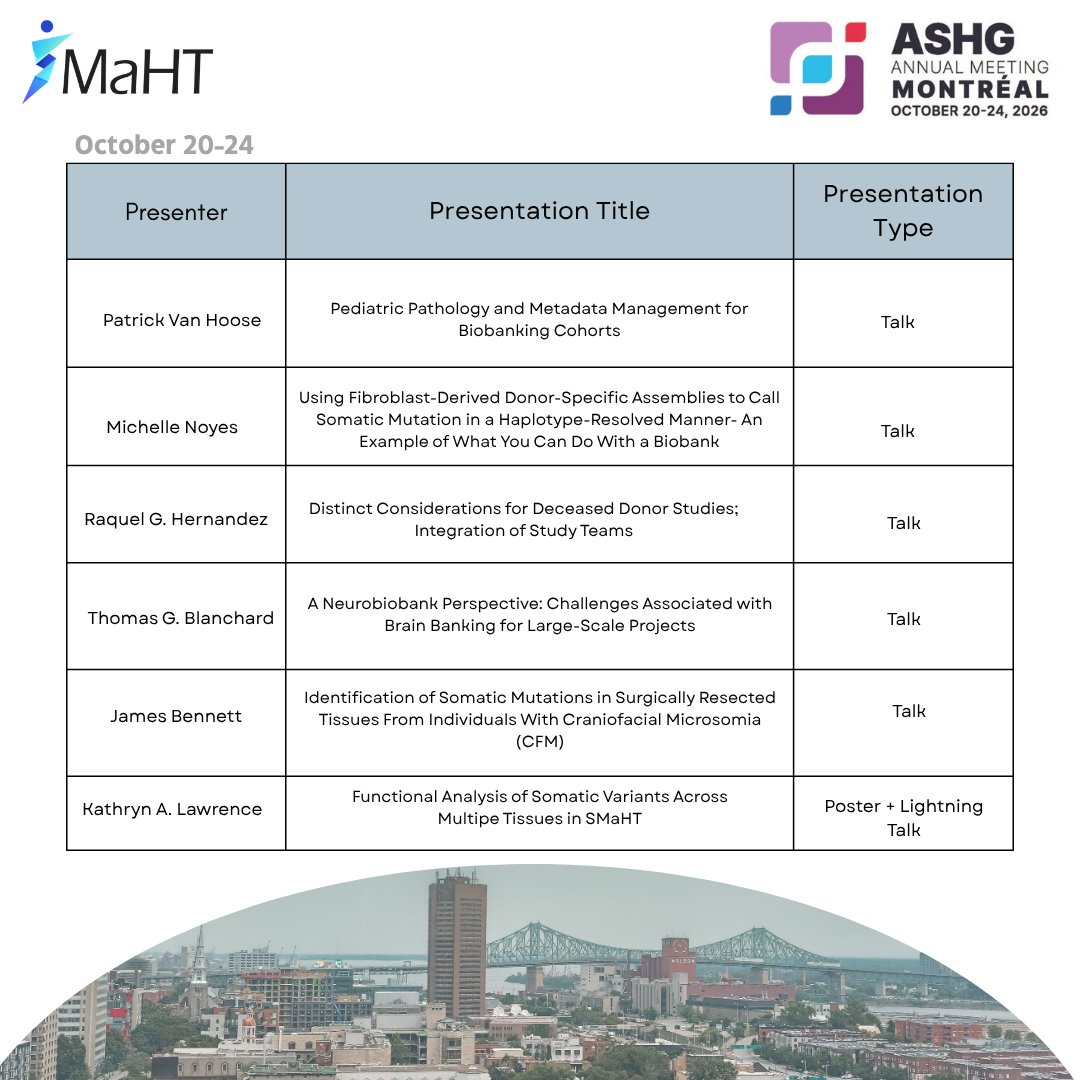
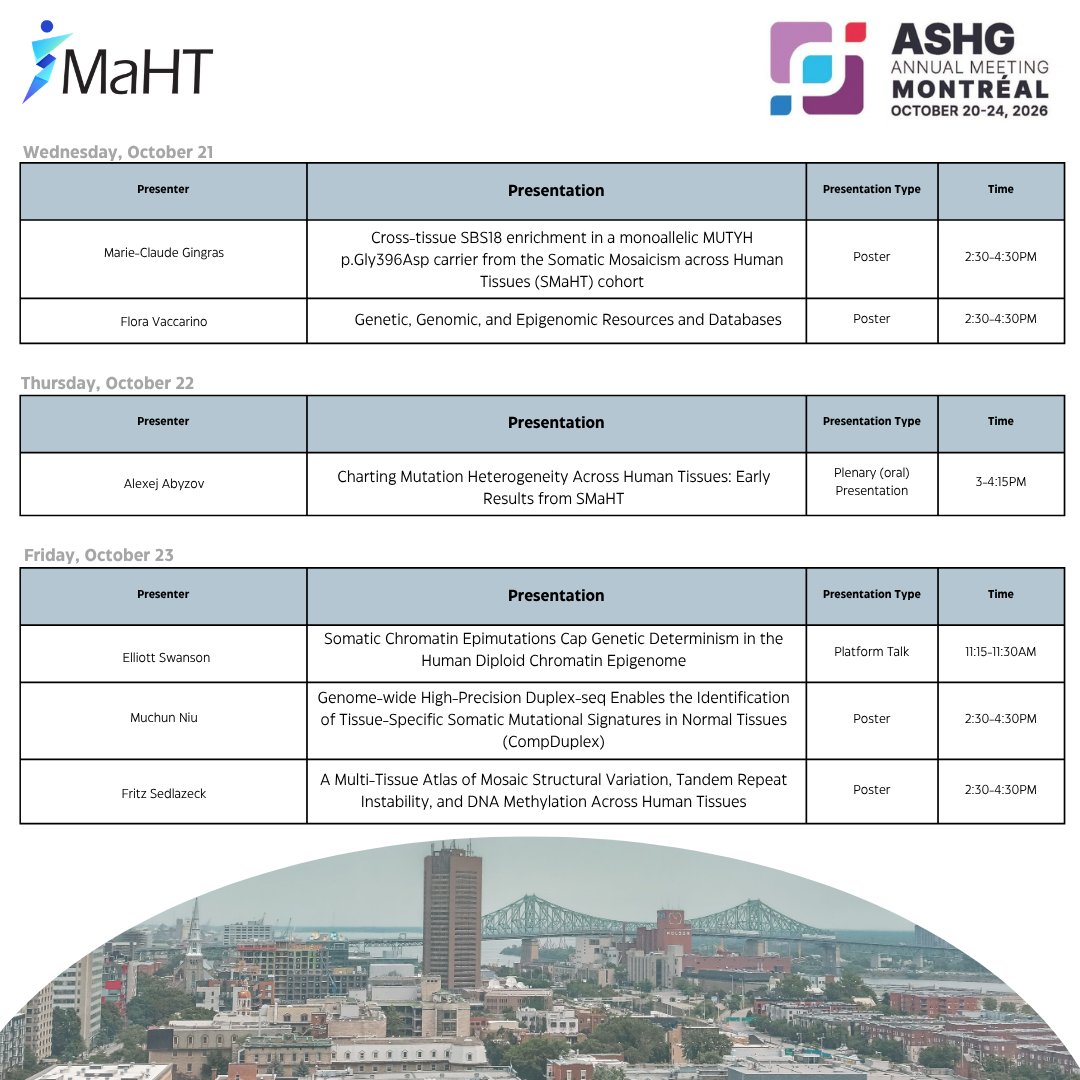
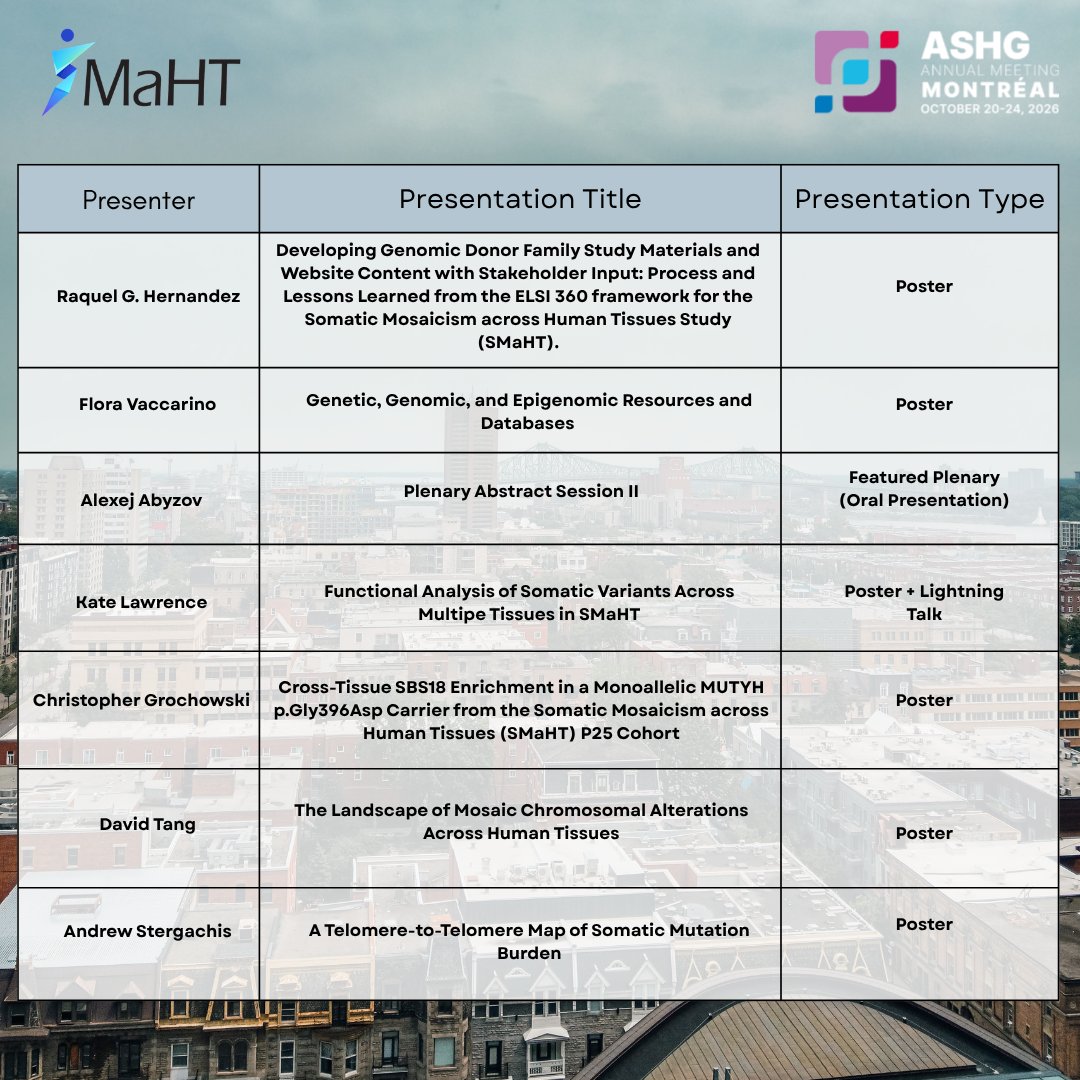
ASHG 2026 is in full swing!
SMaHT Network members will be sharing their research throughout the meeting.
See the schedule below for more information on SMaHT member presentations.
What’s new? 📰
The SMaHT Network’s benchmarking paper is published in @CellPressNews!
Explore how the Network evaluated approaches for detecting somatic mutations and developed resources to support more accurate analysis.
ASHG 2026 is only a week away!
SMaHT members will be presenting research throughout the meeting. Take a look at who to watch for, and stay tuned for more details.
See you in Montreal! 🇨🇦
A study of aging and Alzheimer’s disease brains found higher levels of somatic mutations, particularly in microglia.
The findings suggest these mutations may drive the expansion of inflammatory microglial cells and contribute to Alzheimer’s disease.
https://t.co/YJKslzjJcS
A new toolkit, Himito, uses long-read sequencing to analyze mitochondrial DNA, including genetic variants and DNA modifications.
Applied to All of Us data, it revealed mitochondrial diversity and age-related patterns.
Uncover the science behind it:
https://t.co/LUAy7lxms8
Detecting mosaic variants at low levels can be incredibly complex.
This study describes two ddPCR approaches helping researchers and clinicians accurately measure these variants, supporting interpretation of their potential health impacts.
https://t.co/dVaPeAoRVG
The Mobile Element (MEI) Analysis Focus Group within the SMaHT Network is dedicated to identifying and characterizing somatic mobile element insertions across diverse human tissues.
Learn more about this and other SMaHT working groups: https://t.co/4eG2dju4lj
Taking a closer look at how somatic mutations accumulate in different types of human cerebellar neurons reveals surprising similarities and distinct mutation patterns.
Research highlights how cell type and transcriptional activity may shape neuronal mutagenesis.
Learn more ⬇️
Two types of neurons in the cerebellum, Purkinje neurons (PN) and granule neurons (GN), have extreme differences in size and physiology.
Marta @GronskaPeski in our lab wondered: do they also acquire mutations differently with age?
Explore a step-by-step NanoSeq library preparation protocol using mung bean nuclease for whole-genome duplex sequencing.
Optimized across 15+ human tissues, the method enables improved genome coverage for high-sensitivity somatic mutation detection.
https://t.co/0eXMsFCVLK
NanoSeq-MBN enables near-genome-wide, high-fidelity detection of ultra-rare somatic variants.
This preprint expands the GIAB benchmark resource with a somatic layer, supporting rare-variant discovery, calibration and clinical assay validation.
https://t.co/g021DwrY6e
As we put the finishing touches on Vol. 3 of the SMaHT Network Q&A series, catch up on what SMaHT members have shared so far.
Hear perspectives on advances in somatic mosaicism research and why this work matters!
https://t.co/4uvNPF2QXF
SMaHT member Chris Walsh, MD, PhD, joins The Early Perspective to discuss how somatic mutations shape the developing brain and what they can reveal about neurodevelopmental and neurodegenerative diseases.
Tune in:
https://t.co/b8ku66XkIa
How well can we detect somatic structural variants at ultra-low allele fractions?
This preprint benchmarks 12 SV detection pipelines across sequencing platforms, providing best practices and data to support detection of mosaic SVs in non-cancer tissues.
https://t.co/TPCV9p8nxL
Accurate detection of somatic mutations is essential for studying mosaicism. This protocol describes CompDuplex-seq, a duplex sequencing method that combines genome-wide coverage with high accuracy using standard Illumina sequencing workflows.
Learn more:
https://t.co/9f4W4yK8Gx
Join the Human Reference Atlas webinar on Friday, July 31 from 1–2 pm ET to learn about new methods for analyzing endothelial cell environments across 12 organs and designing antibody panels for future spatial omics studies.
Register:
https://t.co/4ZInMEamIl,
Single-cell DNA sequencing can reveal how somatic mutations accumulate across tissues over time.
This preprint presents a validated framework for studying somatic mosaicism from development through aging.
https://t.co/jQu8pwh3P5
ASHG 2026 commences this October, with SMaHT members presenting posters, talks, and oral presentations throughout the meeting.
Here’s a preview of the research the SMaHT Network will be sharing with the genetics and genomics community.
Introducing D&D-seq, a single-cell technology for mapping DNA-protein interactions with improved sensitivity. Compatible with multi-omics workflows, the method offers new opportunities to study gene regulation in health and disease.
Learn more: https://t.co/ykKGuaX8ju
Tune in as SMaHT member Chris Walsh, MD, PhD, is featured on The Genetics Podcast.
Dr. Walsh discusses somatic mosaicism in the brain, its role in diseases ranging from epilepsy to Alzheimer’s, and how these discoveries could inform future therapies.
https://t.co/ED1w9JsnUN