The European Commission has unveiled a package of measures, including a data center classification & labelling scheme, alongside a public consultation on energy performance rules.
Driven by surging AI workloads, EU data center power use is projected to jump from 68 TWh in 2024 to 114 TWh by 2030.
The new rules apply to facilities above 500kW IT load, assessing power consumption, water usage, clean energy adoption, waste heat recovery and grid demand flexibility.
Recovering half of data centers’ waste heat could heat around 4 million European households.
The delegated regulation faces a 2-month review, with first sustainability labels expected in 2027. A 12-week consultation runs until 14 Dec 2026, feeding into legislative proposals in Q2 2027.
#DataCenter #GreenComputing #AIInfrastructure #EnergyEfficiency #SNEC
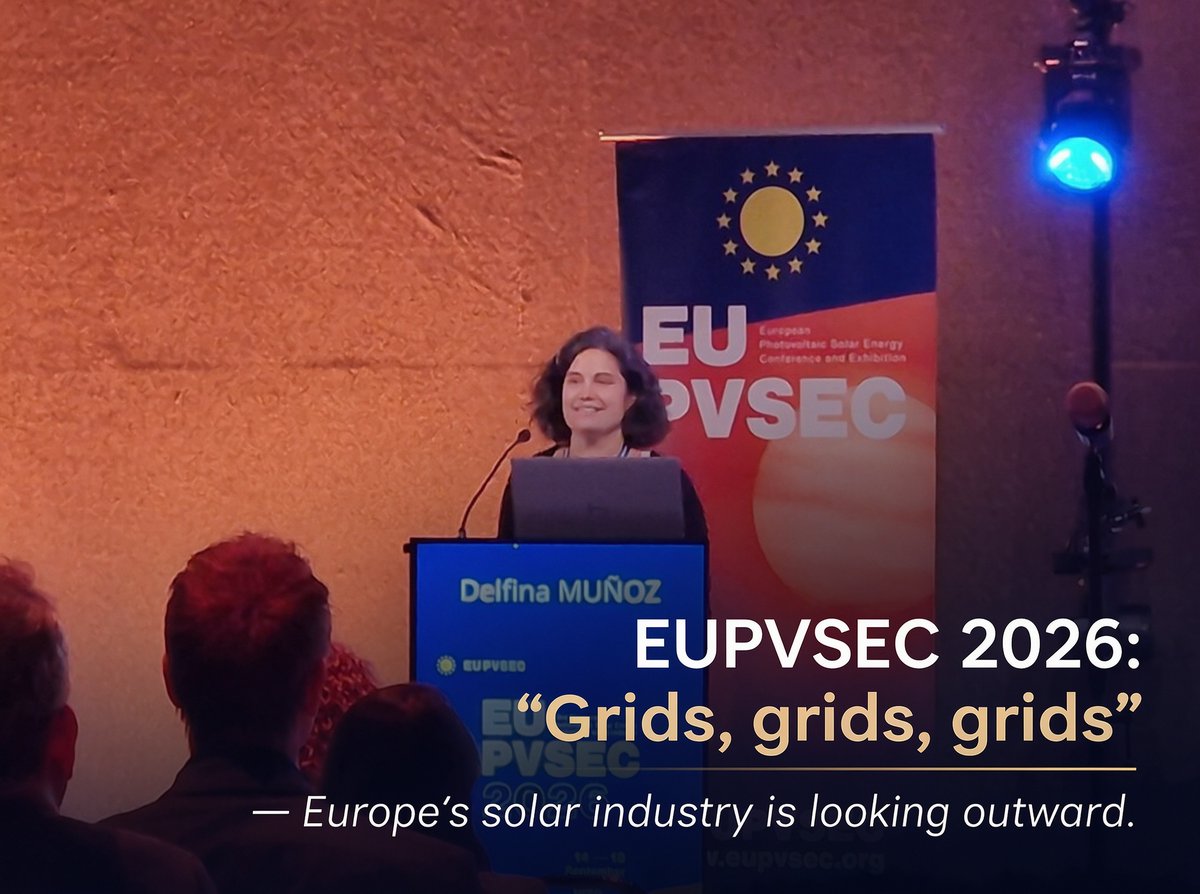
Now in its 43rd year, the European Photovoltaic Solar Energy Conference opened this week in Rotterdam. The message from day one: solar's biggest challenges are no longer about cells — they're about connections.
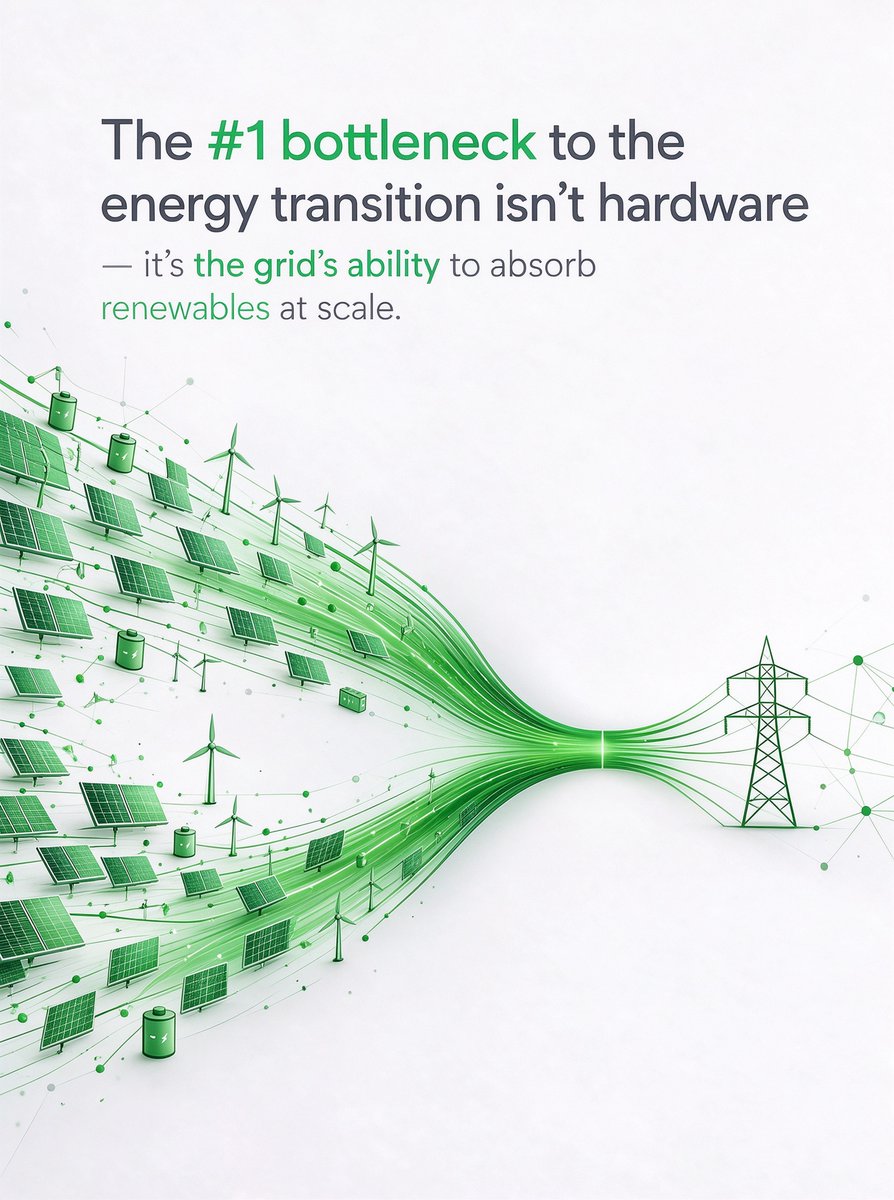
⚡ The grid is the bottleneck:
🔹 The Netherlands has Europe's highest per-capita PV capacity — and with it, growing congestion and curtailment
🔹 TU Delft's Peter Palensky: the market alone isn't solving grid congestion fast enough
🔹 His warning: "Every billion not invested in grids adds up to €10 billion in lost investment"
🤝 Interfaces everywhere:
Becquerel Prize winner Delfina Muñoz (CEA Liten) described solar's many "interfaces" — between cell layers, and between industries — as the place "where competition stops and collaboration begins."
Key interfaces under discussion:
▪️ Solar + grid
▪️ Solar + agriculture
▪️ Solar + built environment
▪️ Solar + recycling & waste
▪️ Solar + public trust
🤖 AI has landed:
Sessions dedicated to AI in PV operations — from analyzing inverter data to spot faults, to identifying individual modules in drone imagery. The flip side: the infrastructure needed to power AI, and solar's role in it.
💡 SNEC's Insights:
▪️ The conversation has shifted — from module efficiency to system integration. That's a sign of a maturing industry.
▪️ Grid investment is the decisive variable — underinvest, and you lose 10x that in wasted clean energy investment.
▪️ Solar's future is cross-sector — agriculture, buildings, recycling, AI. The winners will be those who manage these interfaces well.
▪️ Bottom line: solar no longer stands alone. Its success now depends on collaboration beyond its own industry.
👇 Is grid investment the biggest barrier to Europe's solar ambitions?
📖 Source: pv magazine
Read the full article:
https://t.co/lSrZkF2CK7
#Solar #EUPVSEC #Grid #EnergyStorage #Renewables #CleanEnergy #EnergyTransition #SolarPower #AI #Sustainability #NetZero #Europe #SNEC
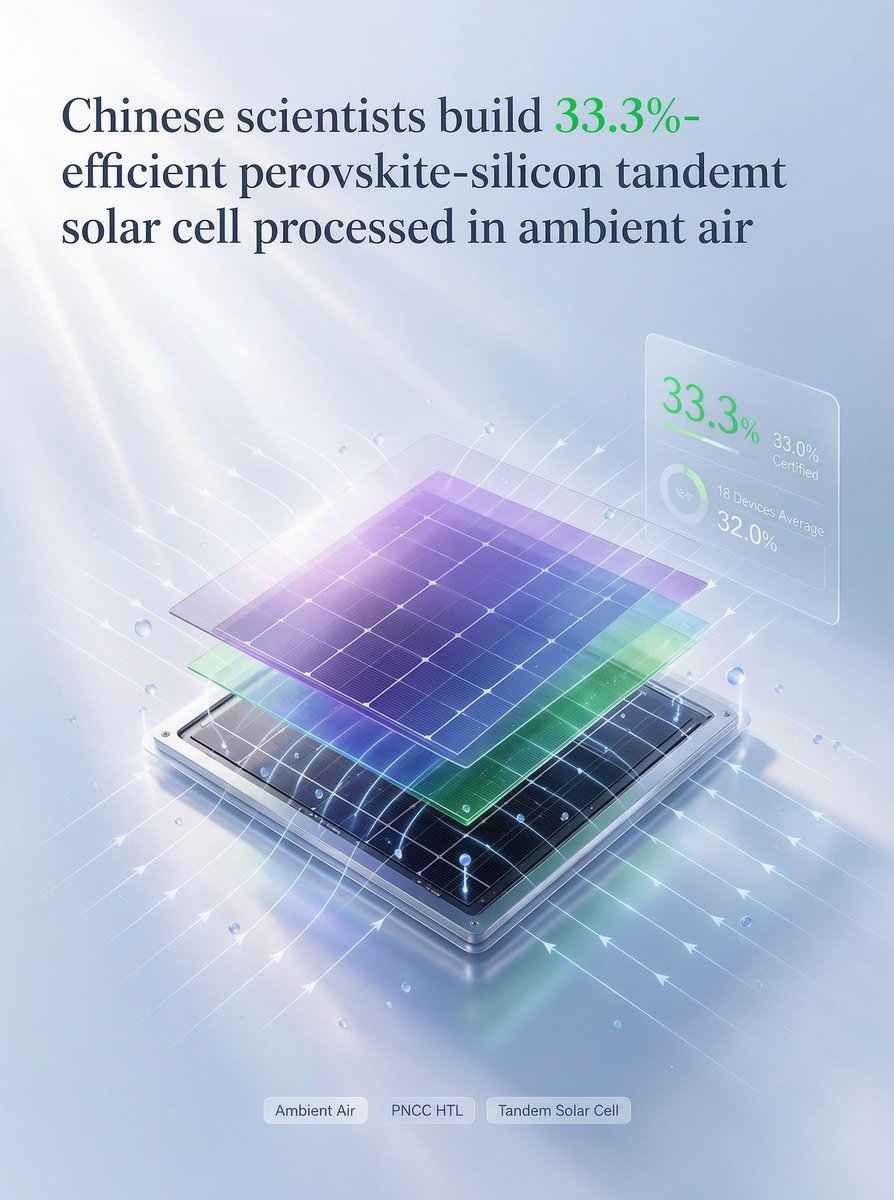
A Chinese research team has developed a high-performance perovskite-silicon tandem solar cell based on a newly designed polymer hole-transport layer. The technology enables device fabrication entirely under ambient air conditions, marking a key advance toward the scalable industrial production of perovskite photovoltaics.
🔹 Core breakthrough
The champion two-terminal perovskite-silicon tandem cell achieves a 33.3% power conversion efficiency (PCE), with an independently certified efficiency of 33.0%. Across 18 tandem devices, the team reported an average efficiency of 32.0%.
This performance is enabled by ambient-air blade coating — no inert atmosphere is required — which removes a major barrier to scaling perovskite manufacturing from lab-scale cells to large-area modules.
🔹 Key innovation: PNCC copolymer hole-transport layer
At the center of the breakthrough is PNCC, a co-polymer that integrates triarylamine and carbazole phosphonic acid (PACz) units. It was purpose-built to fix the inherent weaknesses of the two mainstream organic hole-transport materials:
- PTAA: strong charge transport but poor surface wettability, which hinders uniform perovskite deposition
- PACz-based self-assembled monolayers**: strong substrate adhesion but poor film uniformity, especially on textured silicon bottom cells
PNCC combines the high charge mobility of PTAA-like polymers with the strong substrate binding of PACz materials. It forms a highly uniform, void-free interface with the perovskite absorber, reduces non-radiative recombination and extends carrier lifetimes. The material is synthesized by copolymerizing PACz and triarylamine units at a 1:3 molar ratio.
🔹 Single-junction perovskite cell performance
Built with the same ambient blade-coating process, the single-junction p-i-n perovskite device delivers:
- 26.6% PCE (26.5% third-party certified)
- 1.21 V open-circuit voltage
- 26.1 mA/cm² short-circuit current density
- 84.1% fill factor
By comparison, reference cells based on conventional PTAA and Me-4PACz reached only 23.5% and 24.1% efficiency respectively.
🔹 Stability performance
- Single-junction cell: retains 99.8% of initial PCE after 1,200 hours of light soaking (~40 °C in air); 95.1% after 1,400 hours at 65 °C; 92.8% after 1,200 hours at 85 °C
- Encapsulated tandem cell: retains 85% of initial efficiency after 1,140 hours of 1-sun illumination at 65 °C in air
At the 2026 Global Low-Carbon Industry Forum (GLIF 2026), one consensus dominated the conversation: grid-forming technology + AI is the game-changing combination to unlock large-scale renewable deployment. Huawei Digital Power shared a field-proven, three-pillar playbook addressing the core barriers:
🛡️ Grid resilience
Grid-forming ESS delivers inertia and transient support even in ultra-weak grids (SCR < 1.5):
- RoCoF controlled within 0.5 Hz/s
- Fault voltage recovery in the hundred-millisecond range
- Outperforms conventional synchronous condensers
Deployed in ~100 benchmark projects globally, including the 30 MW PV + 6 MW/24 MWh Gertse project in China’s Ngari region.
💰 Project economics
AI-powered EMS optimizes generation forecasting, peak shaving and SOC management:
- Over 10% higher lifecycle project returns
- 10% revenue uplift at Germany’s AHS Business Park in 2 years
- ~40% lower electricity bills for a Carrefour supermarket in Spain (5-year payback)
🌍 Universal energy access
Pre-integrated microgrids deliver plug-and-play zero-carbon power for off-grid / weak-grid regions:
- >
> 90% of common faults resolved remotely via cloud-edge platform
- 40–60% lower LCOE vs. diesel generators
- Deployed across Africa, Southeast Asia and remote China
Momentum is building: the Global Joint Initiative on Grid Forming & AI was launched at GLIF to accelerate collaboration on standards, validation and global rollout.
💡 SNEC's Insights:
This is a paradigm shift: energy storage is evolving from a supporting grid asset into the foundation of dispatchable renewable power. AI is the operating system that makes this transition scalable and affordable.
What’s the biggest grid barrier to renewables in your region? Share your view in the comments.
📖 Source: pv magazine
Read the full article:
https://t.co/IZL2CPiNxS
#EnergyTransition #GridForming #EnergyStorage #AIinEnergy #RenewableEnergy #CleanTech #GLIF2026 #SNEC
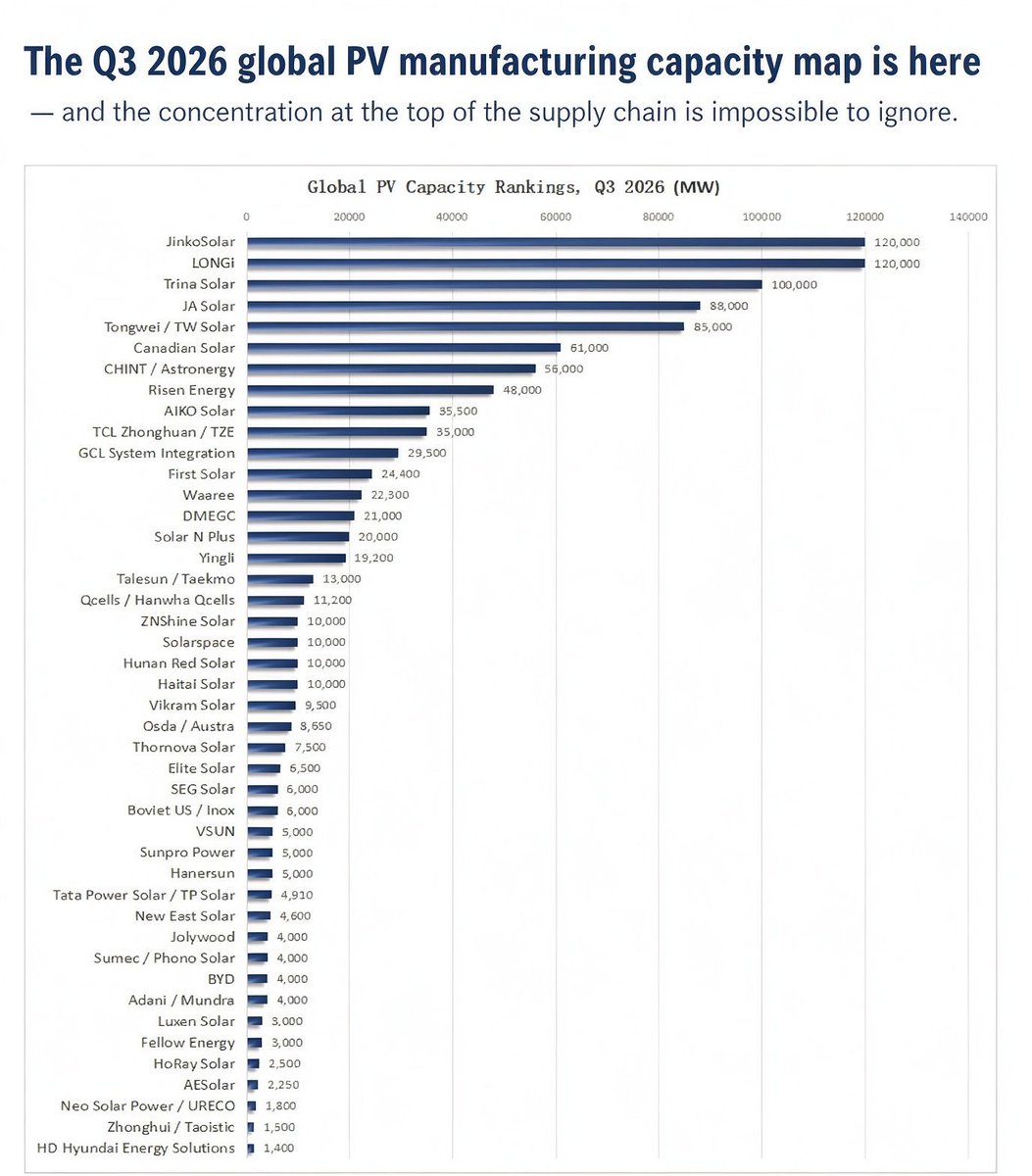
BloombergNEF’s latest Tier 1 ranking, sorted by annual production capacity, paints a clear picture of the market:
🏭 Top 6 manufacturers dominate
- JinkoSolar & LONGi: tied for 1st place, 120 GW annual capacity each
- Trina Solar: 3rd at 100 GW
- JA Solar: 88 GW
- Tongwei: 85 GW
- Canadian Solar: 61 GW
This small group accounts for the lion’s share of global module output, built on full vertical integration and decades of capital investment.
📊 The rest of the field
- Second-tier players (24–56 GW): Chint Astronergy, Risen Energy, Aiko Solar, TCL Zhonghuan
- First Solar ranks 12th at 24.4 GW — the only major thin-film maker in the cohort
- India’s domestic rise is tangible: Waaree (22.3 GW, 13th), Vikram Solar, Tata Power Solar and Adani Mundra all make the list
- A broad mid-tier (~10 GW) is emerging globally, serving both utility and distributed solar markets
⚠️ Key distinction everyone should know
Tier 1 is a bankability rating, not a quality or efficiency award. It measures financial resilience, long-term warranty viability and ability to deliver at scale — the metric that utility-scale investors and lenders care about most.
💡 SNEC's Insights:
Capacity isn’t everything, but it defines market power.
The gap between the top integrated giants and everyone else keeps widening. Scale, supply chain depth and balance sheet strength are now the biggest competitive moats in solar manufacturing.
That said, the slow geographic diversification of bankable suppliers — India, Europe and the US building up domestic capacity — is a healthy long-term trend. It reduces single-region supply risk and gives developers more options.
But let’s be realistic: for large-scale solar projects that need bankable modules in volume, the shortlist still starts and ends with a handful of Asian integrated players. That concentration is the defining feature of this industry — and it’s not changing anytime soon.
What’s the most underrated shift in the global PV supply chain right now? Let’s discuss in the comments.
📖 Source: pvtime
Read the full article:
https://t.co/8dosCeDgz2
#SolarEnergy #Photovoltaics #PVManufacturing #BloombergNEF #Tier1Solar #RenewableEnergy #EnergyTransition #SolarSupplyChain #JinkoSolar #LONGi #TrinaSolar #SNEC
On July 6, 2026, renewables briefly met 50.02% of India’s peak power demand of 221.5 GW—the second consecutive year this milestone was achieved. But the milestone masks a deepening structural crisis.
📈 The Boom
India’s renewable capacity has exploded from just 4 GW a decade ago to over 300 GW, now accounting for 54% of total installed capacity (552 GW). Solar alone stands at 164.59 GW, wind at 58.14 GW. Coal still supplies ~70% of electricity generation, but its share of installed capacity has fallen from 59% in 2014 to 40% in 2026.
🚧 The Bottleneck
India’s transmission infrastructure is not keeping pace. In Q1 2026, transmission constraints caused 300 GWh of renewable curtailment—nearly two-thirds of all curtailment nationally. About one in four inter-state transmission projects is delayed by more than a year, due to right-of-way disputes, land acquisition, and forest clearances. ICRA found only 12% of competitively bid transmission projects met their scheduled commissioning date; the rest were delayed by up to three years.
🏭 The Impact
ReNew Power CEO Sumant Sinha told the BBC: “This shows renewable energy is no longer a marginal energy source at the edge of the power system.” But he acknowledged the mismatch: “Generation projects can be built in 18–24 months, but transmission can take much longer—right-of-way, land acquisition, approvals, coordination across multiple agencies. It’s an execution problem, and it becomes more acute as the system scales.” ReNew itself sees up to 15% of its solar output wasted on some days because the grid cannot absorb peak generation.
🔋 The Storage Gap
The obvious fix—battery storage at renewable pooling stations—is stalled. Battery prices have surged, driven by the Middle East war disrupting raw material supply, China’s withdrawal of export incentives, and a ~10% rupee depreciation that raised BESS project costs by 9–10%. Around 260 GWh of planned storage projects are now at risk. Analyst Vibhuti Garg told the BBC: “Many storage projects that were supposed to come up have fallen through.”
⚠️ The Bottom Line
Ember calls the growing mismatch between fast-moving generation and slow-moving transmission “the most critical operational risk” to India’s 2030 target of 500 GW non-fossil capacity. India has built the capacity—now it must build the system to use it.
#India #RenewableEnergy #SolarPower #EnergyTransition #GridInfrastructure #BatteryStorage #Curtailment #ReNewPower #Ember #ICRA #Coal #CleanEnergy #IndiaEnergy #SNEC
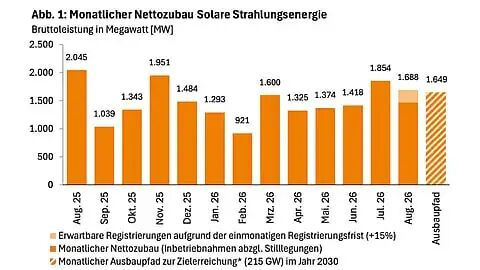
☀️ Germany added 1.688 GW of solar in August 2026, down from 1.85 GW in July and significantly lower than the 2.04 GW recorded in August 2025.
📊 Cumulative additions for January–August 2026 reached 11.25 GW, bringing Germany's total installed solar capacity to 129.25 GW. To hit its 2030 target of 215 GW, Germany needs to add 1.65 GW per month—August fell short of that pace.
🏗️ All three segments slowed month-on-month:
• Ground-mounted: 977.2 MW (vs. 1.05 GW in July)
• Rooftop PV: 440.3 MW (vs. 757 MW)
• Balcony/plug-and-play PV: 57.8 MW (vs. 66.2 MW)
⚠️ But a bigger concern is looming. The German government has proposed replacing feed-in tariffs (FIT) with market-based direct marketing for all new renewable projects under the revised EEG (Renewable Energy Sources Act). All installations would gradually transition to selling electricity on the power exchange, with a temporary "direct marketing bonus" for a four-year transition period.
📢 BSW-Solar warns that if the proposed measures pass in their current form, generation costs for new solar parks could rise by more than €0.01/kWh. The current bid ceiling of 5.9 ct/kWh for ground-mounted auctions may need to rise to 7.5 ct/kWh for projects to remain financially viable. The association warns of de facto "solar exclusion zones" in parts of Germany if the reforms go through unamended.
📉 The proposed changes include cutting curtailment compensation in grid-congested regions, capping feed-in capacity, introducing grid fees for solar electricity injection, and adding municipal levies—multiple cost burdens hitting simultaneously.
💡 Meanwhile, an Enervis study commissioned by BSW-Solar found that solar PV reduced Germany's electricity procurement costs by €15.7 billion in 2025. Without solar, wholesale power prices would have been about 20% higher. The economic value of solar—including €13.1 billion in avoided procurement costs and €2.6 billion in export revenues—was 40% higher than EEG support costs (€10.9 billion). A typical household saved nearly €100; an industrial firm consuming 10 GWh annually saved roughly €235,000.
🔑 The bottom line: Germany's solar expansion is slowing just as it needs to accelerate—and the proposed EEG reform risks making new solar parks even harder to finance.
Source: TaiyangNews
#Germany #Solar #Energiewende #EEG #FeedInTariff #BSWSolar #SolarPower #RenewableEnergy #EnergyPolicy #ClimateAction
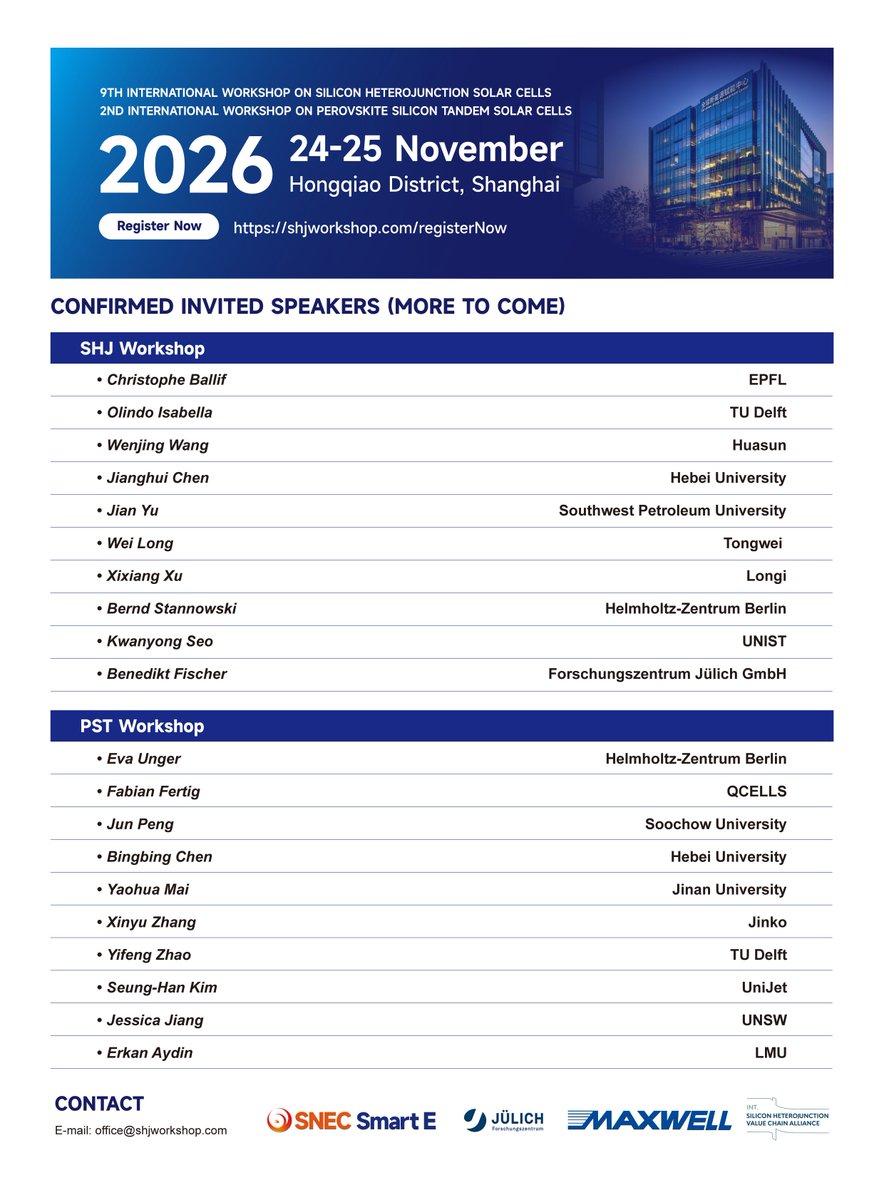
We are thrilled to announce that registration is officially open for this premier gathering of the global photovoltaic community. Mark your calendars for November 24-25, 2026, as we gather in Hongqiao District, Shanghai to explore the cutting-edge advancements in SHJ and Perovskite-Silicon Tandem technologies.
We are incredibly honored to unveil our first wave of Confirmed Invited Speakers—a truly world-class lineup representing top academic institutions and leading industry innovators from around the globe! 🌍
🎙️ Meet Our Distinguished Speakers (More to come!):
🔹 SHJ Workshop:
Christophe Ballif (EPFL)
Olindo Isabella (TU Delft)
Wenjing Wang (Huasun)
Jianghui Chen (Hebei University)
Jian Yu (Southwest Petroleum University)
Wei Long (Tongwei)
Xixiang Xu (Longi)
Bernd Stannowski (Helmholtz-Zentrum Berlin)
Kwanyong Seo (UNIST)
Benedikt Fischer (Forschungszentrum Jülich GmbH)
🔹 PST Workshop:
Eva Unger (Helmholtz-Zentrum Berlin)
Fabian Fertig (QCELLS)
Jun Peng (Soochow University)
Bingbing Chen (Hebei University)
Yaohua Mai (Jinan University)
Xinyu Zhang (Jinko)
Yifeng Zhao (TU Delft)
Seung-Han Kim (UniJet)
Jessica Jiang (UNSW)
Erkan Aydin (LMU)
This is your opportunity to network with the brightest minds, share insights, and shape the future of solar energy alongside these esteemed experts.
🎟️ Secure Your Spot Today!
Don't miss out on early registration!
👉 Register Here: https://t.co/aZHL2hznCi
A huge thank you to our organizers and partners: SNEC Smart E, JÜLICH, MAXWELL.
We look forward to welcoming you to Shanghai in 2026!
📧 For inquiries: [email protected]
#SolarEnergy #Photovoltaics #PV #SHJ #Heterojunction #HJT #Perovskite #TandemSolarCells #RenewableEnergy #CleanEnergy #SolarPower #GreenEnergy #Sustainability #EnergyTransition #SolarTech #Shanghai #China #Conference2026 #PVResearch #SolarInnovation #Engineering #Science #Networking #Semiconductors #MaterialsScience
AI data centers are redrawing the global power infrastructure playbook — and Battery Energy Storage Systems (BESS) are no longer just backup insurance. They’re fast becoming a strategic operational cornerstone of the digital economy.
Driven by the explosion of hyperscale, colocation and AI compute facilities — paired with surging power demands from GPUs/AI accelerators and growing grid constraints — data center BESS delivers four core value propositions:
🔹 Uninterrupted operations: Reliable backup power during grid outages and transition events
🔹 Grid efficiency: Peak shaving and demand response to maximize available grid capacity
🔹 Clean energy integration: Smoothing out intermittent renewable generation for lower carbon operations
🔹 High-density support: Advanced power management for power-hungry AI computing infrastructure
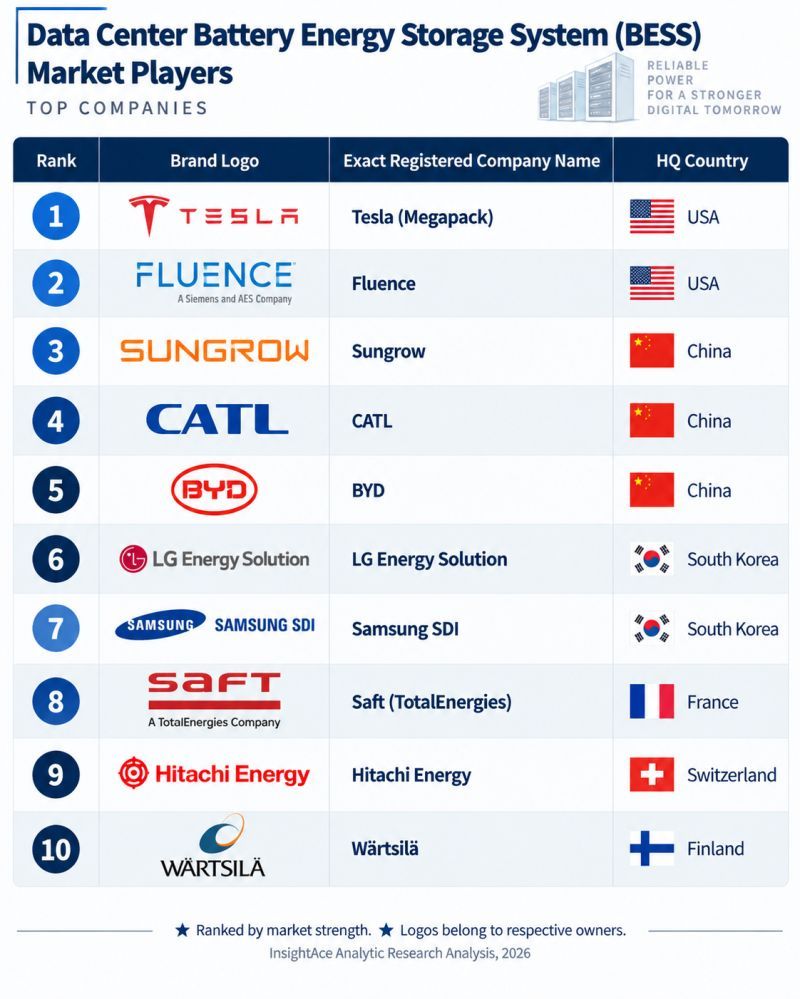
Top 10 Global Data Center BESS Players (2026, by market strength | InsightAce Analytic)
1. Tesla (Megapack) 🇺🇸
2. Fluence 🇺🇸
3. Sungrow 🇨🇳
4. CATL 🇨🇳
5. BYD 🇨🇳
6. LG Energy Solution 🇰🇷
7. Samsung SDI 🇰🇷
8. Saft (TotalEnergies) 🇫🇷
9. Hitachi Energy 🇨🇭
10. Wärtsilä 🇫🇮
SNEC's Insights:
The AI data center boom is unlocking a massive new growth vertical for the new energy sector, bridging energy storage technology with digital infrastructure at an unprecedented pace.
Chinese players already hold 3 of the top 5 spots, reflecting China’s competitive edge in battery manufacturing and end-to-end energy storage system integration. As AI power density continues to climb, we anticipate deeper cross-industry collaboration between battery suppliers, data center operators and renewable developers — a shift that will be critical to optimizing both total cost of ownership and decarbonization targets for next-generation data campuses.
What’s your biggest takeaway from the rise of data center BESS? Share your perspective in the comments.
Global Data Center Battery Energy Storage System (BESS) companies
Download Free PDF Brochure:
https://t.co/HFo9fZGJKE
#DataCenter #BESS #BatteryEnergyStorage #EnergyStorage #AIInfrastructure #RenewableEnergy #EnergyTransition #CleanEnergy #DataCenterInfrastructure #EnergyManagement #SNEC
The US-China summit has extended the trade truce and launched formal AI talks. It’s not a major breakthrough, but a valuable pause for global industries — especially the new energy sector.
✅ Core outcomes:
• Trade truce extended, reciprocal tariff cuts on $30bn goods, easing immediate supply-chain risks
• New AI dialogue channel to manage tech competition risks
• Deep structural disputes remain, including rare earths, export controls and industrial policy
• This is managed rivalry, not détente. Businesses still face lingering uncertainty.
SNEC's Insights:
This temporary trade breathing room creates a critical window for global renewable and energy storage players. Rare earths, battery materials, and power electronics are at the intersection of great-power competition.
While geopolitical rivalry persists, the extended truce stabilises cross-border supply chains for solar, BESS and clean energy hardware. The AI dialogue also matters: AI data centres are huge new power consumers, creating massive demand for energy storage and renewables.
For the new energy industry, this pause is not a finish line — it is time to strengthen technological self-reliance, diversify supply chains and seize opportunities in the global clean energy transition.
What’s your view on how this summit reshapes new energy supply chains? Leave your thoughts below.
#USChinaRelations #TradeTruce #EnergyTransition #RenewableEnergy #BESS #SupplyChain #CleanEnergy #AIInfrastructure #GlobalEnergy #SNEC
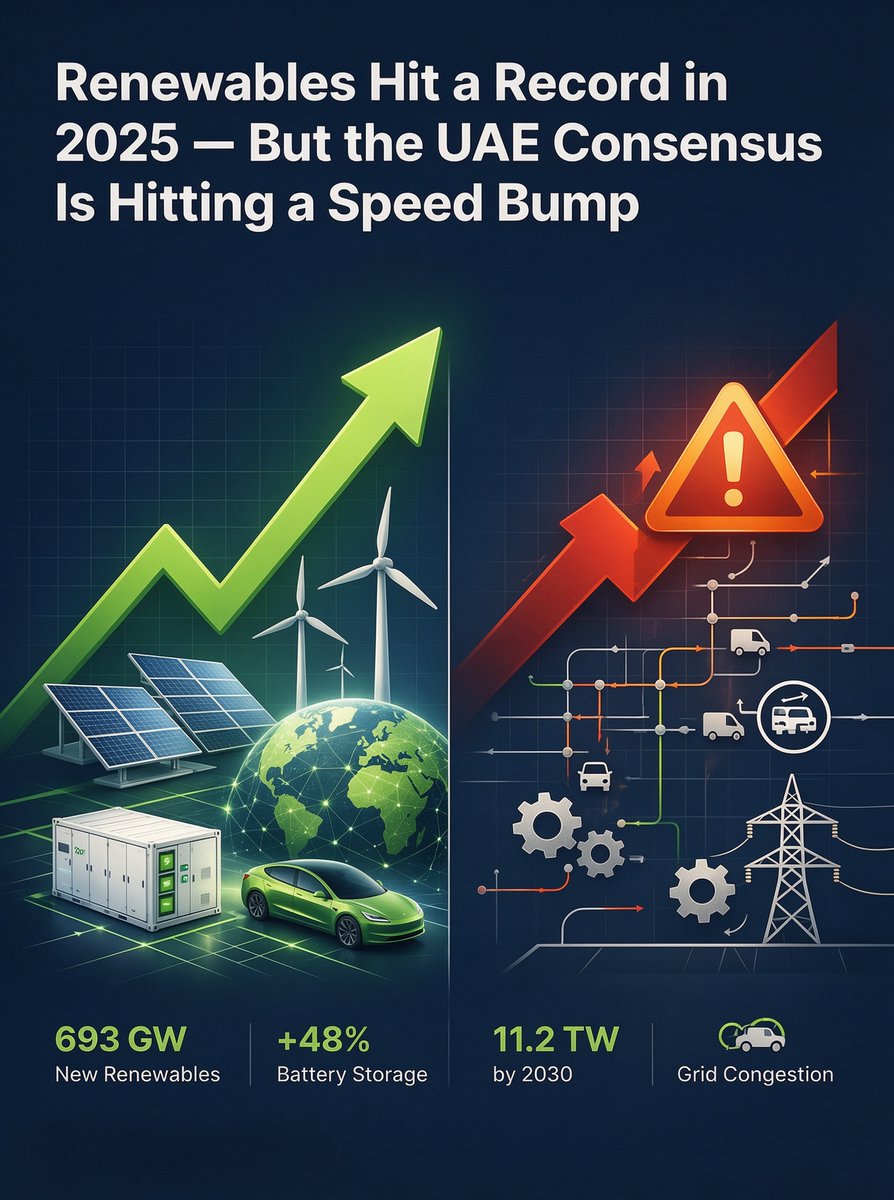
2025 was a blockbuster year for clean energy. Here's what the new IRENA report tells us:
📊 The good news:
• 693 GW of new renewable capacity added — an all-time record, up 15.5%
• Solar PV alone delivered 513 GW, now 46% of global renewable capacity
• Renewables saved the global economy USD 480 B in fossil fuel costs
• Battery storage surged 48% (+112 GW), with costs down 30% year-on-year
• EVs hit a record 26% of global new car sales
⚠️ The catch:
• The 3× renewables target (11.2 TW by 2030) still has a 0.6 TW gap
• We need to nearly double annual additions to ~1.2 TW/year through 2030
• Energy efficiency is the weak link ��� only 1.7% improvement vs. the 4% required
• Grid congestion and interconnection queues are choking deployment
• Without modernized grids, curtailment will erode the benefits of new capacity
SNEC's Insights:
The renewable energy story in 2025 is one of spectacular supply growth colliding with infrastructure and efficiency bottlenecks. China alone added 61 GW of battery storage — nearly half of the global total — underscoring how Asian manufacturing and deployment capacity is reshaping the energy transition.
Two signals matter most for the industry:
1️⃣ Storage is no longer optional. Battery costs have fallen 95% since 2010–2015, and with 112 GW added in a single year, BESS is becoming the default flexibility partner for wind and solar. Data centers, grid operators and industrial users are all converging on the same solution.
2️⃣ Efficiency and grids are the next battleground. Building more solar panels alone won't get us to 11.2 TW. The report is clear: modernizing grids, streamlining permits, and electrifying buildings, transport and industry are now the binding constraints. COP31 in Antalya putting electrification at its center is a smart pivot.
The transition is winning on economics — renewables are the cheapest source of new electricity in 90% of markets. The question now is whether policymakers can move fast enough to unlock the capacity already waiting in project pipelines.
What's your read on the biggest bottleneck — grids, finance, or policy? Drop it in the comments.
Source: IRENA
Download Free Report:
https://t.co/isAWwiJM4k
#RenewableEnergy #EnergyTransition #SolarPower #WindEnergy #BESS #BatteryStorage #EnergyEfficiency #COP31 #UAE Consensus #CleanEnergy #EnergyStorage #NetZero #GreenEnergy
The IEA PVPS Trends 2026 report is out, and the numbers are staggering:
☀️ 2025 by the numbers:
• 692 GW of new solar installed — another record, up 15%
• Cumulative global PV capacity hit 2.96 TW, generating ~12% of the world's electricity
• China alone added 415 GW (60% of global total); India surged to 54 GW
• 36 countries installed over 1 GW — solar is now truly global
• 1.3 Gt of CO₂ avoided, 8.2 million jobs, USD 400 B in market activity
⚠️ But here's the plot twist:
• Manufacturing overcapacity kept module prices near rock-bottom (~USD 0.09–0.10/W in China)
• Yet curtailment, negative prices and grid connection queues are rising
• Solar's "capture price" — what it actually earns — is falling as penetration grows
• In Germany, ~25% of solar generation now occurs during negative-price periods
SNEC's Insights:
Solar has officially moved from "build more" to "use it better."
Three shifts define the next chapter:
1️⃣ Solar + storage is no longer a premium option — it's the default. Battery costs fell another 40% in 2024 to ~USD 150/kWh, and BESS additions in Europe and the USA alone jumped 27-fold since 2020 (to 79 GWh). As standalone solar's market value erodes, co-located storage is how projects stay bankable.
2️⃣ China's dominance is reshaping the entire value chain. With 1.46 TW cumulative and 60% of global additions, China sets the cost curve. But persistent overcapacity is squeezing manufacturer margins — the industry needs demand-side growth (data centres, electrification, green hydrogen) to absorb the supply.
3️⃣ The next bottleneck is grids, not panels. The report is blunt: without modernized grids, flexible demand and market reforms, terawatts of projects will stay stuck in interconnection queues. Data centres, AI loads and electrified transport are the new demand story that could absorb all this solar — if grids can keep up.
Solar is cheap. Solar is everywhere. The question now is whether the world can build the grid and market rules to actually use it.
What's the bigger bottleneck for solar's next decade — grids, storage, or policy? Let's discuss.
Source: IEAPVP
Download Free Report:
https://t.co/ODlcmMoNYy
#SolarEnergy #Photovoltaic #RenewableEnergy #EnergyTransition #BESS #BatteryStorage #SolarPlusStorage #CleanEnergy #GridModernization #NetZero #GreenEnergy #EnergyStorage #SNEC
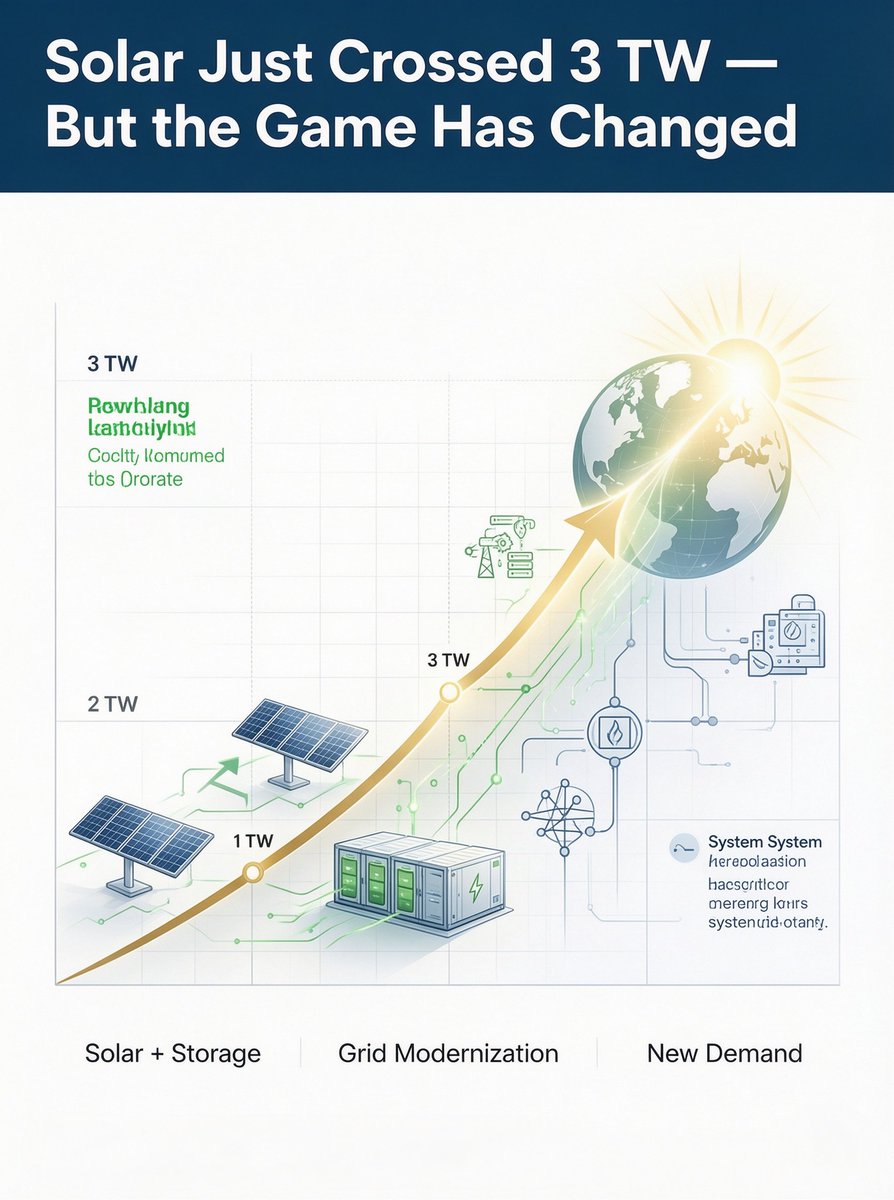
The IEA PVPS just dropped a striking fact: global solar is about to cross 3 TW cumulative, and annual installations are on track to hit 1 TW by end of decade.
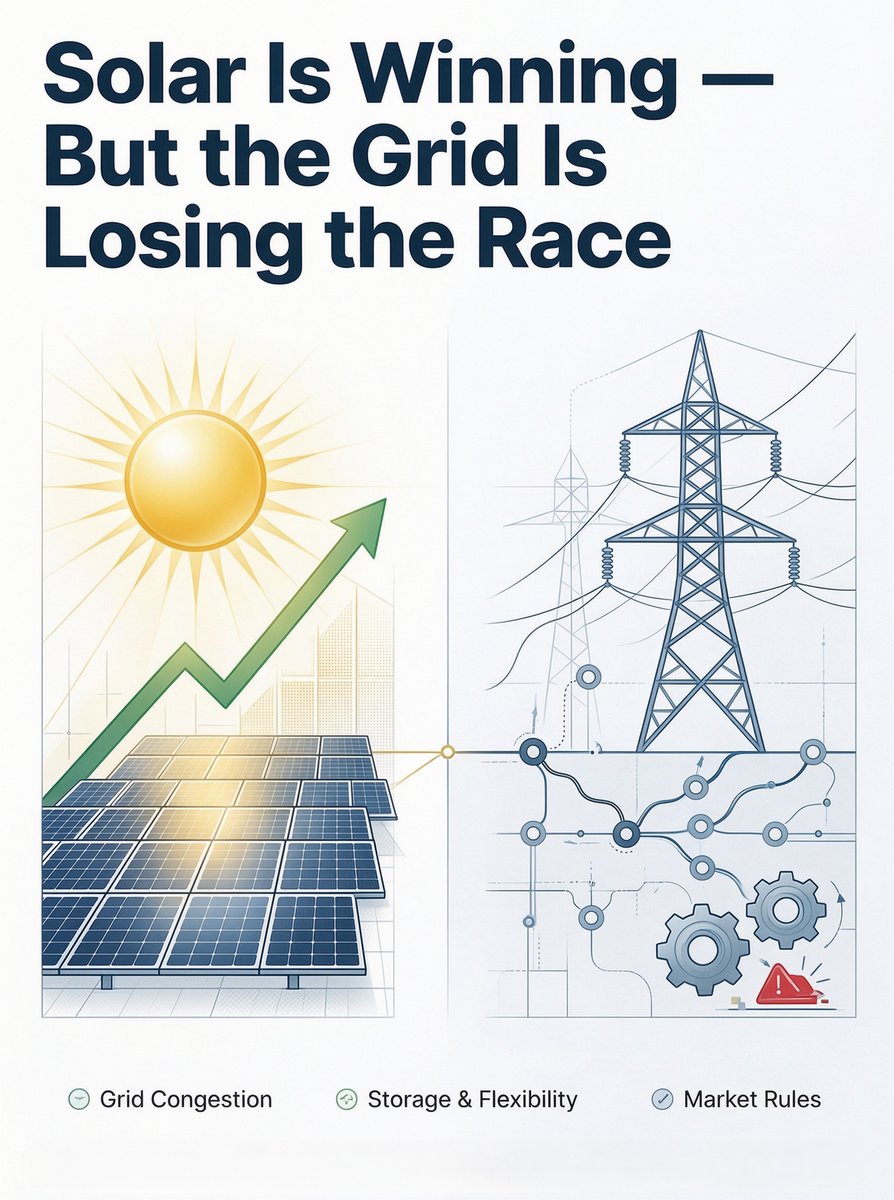
But here's the catch — panels are no longer the bottleneck. The grid is.
⚠️ What happens when solar meets its grid limits:
• Connection queues and interconnection delays are piling up
• Midday solar floods are crashing wholesale prices — sometimes below zero
• Operators need new tools: storage, demand response, flexible exports
• Reliability is being tested as variable solar's share climbs
🌍 How countries are responding — four playbooks:
1️⃣ Smarter grids, not just bigger grids
Dynamic export limits, flexible/curtailable connections, real-time monitoring. Australia lets rooftop inverters adjust exports automatically. The UK lets projects connect faster by accepting limited curtailment instead of waiting for full grid reinforcement.
2️⃣ Prices that signal scarcity
Germany just stopped paying rooftop solar during negative-price hours. Switzerland is phasing out fixed feed-in tariffs. The message: generate when the system needs you, not just when the sun shines.
3️⃣ Storage and flexibility as default partners
Italy is planning storage and demand response to move southern solar north to demand centres. Spain is exempting batteries from grid tariffs. Controlled EV charging and energy communities are turning consumers into flexibility assets.
4️⃣ Squeeze more from existing wires
The Netherlands pioneered "cable pooling" — letting solar, wind and electrolysers share one connection. Germany is publishing grid capacity maps to steer new projects away from congestion hotspots.
SNEC's Insights
This report signals a historic inflection point for the new energy industry. For 15 years, the solar story was about manufacturing scale and falling module prices. That era is essentially over.
The next decade belongs to grid services and system integration. Three implications stand out:
🔹BESS is no longer a side bet — it's the linchpin. Every successful high-solar market is converging on co-located storage, because capture prices erode as penetration rises. The report's examples from Italy, Spain, Portugal and Austria all point the same way.
🔹China's deployment model is about to face its own grid test. With 1.46 TW cumulative and still adding 400+ GW/year, China's grid congestion and curtailment experience will become the global textbook — for better or worse.
🔹Demand is the missing half of the equation. Data centres, AI loads, controlled EV charging and green hydrogen are not just nice-to-haves. They are the demand sinks that absorb midday solar peaks and make the whole system economics work.
Solar won the technology battle. The war now is about grids, markets and flexibility.
Which do you think will move faster — grid modernization or storage deployment? Let me know below.
Source: IEAPVP
Download the Fact Sheet:
https://t.co/g3JTHXDaEH
#SolarEnergy #GridIntegration #BESS #BatteryStorage #EnergyTransition #RenewableEnergy #SmartGrid #DemandResponse #CleanEnergy #EnergyStorage #Flexibility #NetZero #SNEC
The EU on Wednesday proposed new rules to encourage member states to favor domestic firms over Chinese bidders in government contract tenders. The reform aims to support European companies and strengthen the bloc’s 27 member states in key industries amid competition with China and the US.
🗣️ EU industry chief Stéphane Séjourné told reporters: “At a time when China, India, the US and other major powers are using public procurement to advance their industrial and economic strategies, public procurement is both a strategic tool and a powerful policy lever.”
📋 The European Commission’s proposal would:
• 🖥️ Create a single EU platform for public tenders, simplifying small firms’ participation and cutting paperwork.
• 🛡️ Require local authorities to assess suppliers on criteria such as critical infrastructure, cybersecurity, supply-chain security and “Europe First”—not just price.
• ⚖️ Award public contracts on “best value for money,” with quality standards worth at least 30% of the total score; at least 50% for labour-intensive contracts.
🏙️ Séjourné said local governments, EU states, municipalities and regions would set and apply these standards, ultimately choosing to buy European or local products. If a local authority chooses Chinese buses, Brussels could no longer be blamed, he said: “We are now giving them the means to favour European buses.” 🚌
🚫 The measures do not impose a blanket “Buy European” mandate, but would allow European authorities to exclude bids with less than 50% European content by value, restrict participation to EU operators, and prioritize EU firms in strategic sectors. 🤝 Countries with EU trade agreements and reciprocity in public procurement would not be excluded.
#EU #BuyEuropean #PublicProcurement #IndustrialPolicy #Competitiveness #SupplyChain #Cybersecurity #China #US #Trade #EuropeFirst
☀️ Brazil’s PV module imports fell 48% in H1 2026, dropping to 5.48 GW from 10.57 GW in H1 2025—an absolute decline of about 5.1 GW, according to consultancy Greener. The contraction reflects a sharp slowdown in local solar equipment demand, with utility-scale projects hit hardest. #Brazil #Solar #PVModules
📉 Imports declined year-on-year in nearly every month: March -71.6%, April -60.7%. May was the only exception, up 6.5%. In absolute monthly terms: Jan 2.33 GW → 1.12 GW; Feb 2.19 GW → 1.02 GW; Mar 2.03 GW → 576.7 MW. #SolarPower #Renewables
🏭 Utility-scale was hit especially hard: module imports plunged 82%, from 2.3 GW in H1 2025 to 430 MW in H1 2026. Greener market intelligence head Luiza Bertazzoli said curtailment is the main factor—reducing expected project revenue and increasing perceived risk for new investment. #UtilityScale #Curtailment
⚡ The supply-demand imbalance is also linked to a rush of projects approved to meet tariff-discount deadlines, while faster-than-expected growth in distributed micro- and mini-generation has intensified competition for grid capacity. Curtailment is weakening utility-scale profitability and dampening new equipment purchases. #Grid #EnergyTransition
🏠 Distributed generation fell more mildly: module imports dropped 39%, from 8.2 GW to about 5 GW. But its share of module imports rose from 78% to 92%, while centralized generation’s share fell from 22% to 8%. #DistributedGeneration #Solar
🔌 Greener attributes the distributed slowdown to a maturing market, high interest rates, reduced use of sales financing, and grid-connection constraints. Financing’s share of sales fell from 57% in 2021 to 41% in 2026. Distribution utilities rejecting grid connection due to reverse power flow is another barrier—especially in Minas Gerais, where 79% of system integrators reported this in 2025 vs. 33% nationally. Remote distributed generation is also affected by the gradual introduction of the “Fio B” component of the TUSD distribution tariff, reaching 60% in 2026. #TUSD #MinasGerais
💸 Prices rose as imports fell. H1 2026 weighted average module FOB price increased 12.9%, from $0.0802/W to $0.0906/W, concentrated in Q2. May averaged $0.1042/W—the highest of the period, 29% above January’s $0.0816/W. Greener attributes this to China phasing out its 9% PV module export incentive from April. #SolarPrices #China
🔮 Greener expects manufacturers to pass only a small part of the increase to buyers in H2. Bertazzoli said H1 2026 already absorbed the impact of the end of China’s module export subsidy—a permanent change—but pass-through may remain limited because Chinese overcapacity forces manufacturers to absorb some costs within margins. Polysilicon prices also began rising slightly in August after China introduced policies to curb overproduction, potentially adding further upward pressure on module prices. #Polysilicon #SolarImports
#Brazil #Solar #PVModules #Renewables #EnergyTransition #SolarPower #Greener #Curtailment #UtilityScale #DistributedGeneration #Grid #TUSD #Polysilicon #China #SolarImports #MinasGerais
Premier Energies commissions India’s largest solar cell fab — 7 GW n-type TOPCon in Andhra Pradesh 🇮🇳⚡
🏭 Premier Energies has commissioned a 7 GW n-type TOPCon G12R solar cell factory in Naidupeta, Andhra Pradesh. The 101-acre facility was built at an investment of INR 3,293 crore and was commissioned on time and within budget, according to Managing Director Chiranjeev Saluja.
📈 With this new facility operational, Premier Energies’ total solar cell manufacturing capacity has reached 10.6 GW, including its existing 3.6 GW, making it India’s largest solar cell manufacturer. The fab is designed to produce close to 88,000 solar cells per hour and is equipped with advanced digital systems, artificial intelligence, predictive performance analysis, and precision manufacturing, along with a Zero Liquid Discharge (ZLD) system to maximize water recycling and reuse 💧��️.
🎯 Once stabilization and ramp-up are complete, the company is targeting an average solar cell efficiency of approximately 25.8%. The factory is also designed to be future-ready, accommodating potential upgrades to next-generation TOPCon+ technologies, including poly-finger metallization and advanced edge-isolation processes 🔬.
📊 As of June 30, 2026, Premier Energies reported an order book worth INR 150 billion with a 100% domestic share, led by cells at 58%, followed by modules at 40%. Its solar module production capacity had reached 11.1 GW as of June 2026. The company is now planning to expand with 10 GW of ingot-wafer capacity, 18,000 MT of aluminum frames, and 12 GWh of battery energy storage systems (BESS) capacity 🔋.
🤔 With 10.6 GW of cell capacity now online and an order book entirely domestic, how soon can India realistically reduce its reliance on imported solar cells?
#SolarEnergy #RenewableEnergy #MadeInIndia #TOPCon #SolarManufacturing #EnergyTransition #BESS #PremierEnergies #SolarPV #CleanEnergy #India #NEIAAP
According to Precedence Research, solar is projected to grow from $303.9B in 2026 to $522.7B by 2035 — a 6.21% CAGR. Here's what actually matters inside the data:
📊 The market at a glance:
🔹 2025: $286.2B → **2026:** $303.9B → 2035: $522.7B
🔹 Largest region: Asia Pacific (36%+ share)
🔹 Fastest-growing region: North America
🔹 Dominant technology: PV systems (~70% share)
🔹 Dominant module type: Monocrystalline
🔹 Dominant application: Industrial (35%)
🔹 Fastest-growing application: Residential
⚡ The trends worth watching:
▪️ Utility-scale solar expanding rapidly in Australia and beyond
▪️ Rooftop solar booming as homeowners chase bill savings and independence
▪️ Storage integration becoming standard, not optional
▪️ AI + IoT driving predictive maintenance and plant optimization
▪️ High-efficiency modules — TOPCon, HJT, bifacial — moving mainstream
🚧 What's holding it back:
▪️ Intermittency still requires storage or backup
▪️ High upfront costs deter some residential buyers
▪️ Land and grid-connection constraints
💡 SNEC's Insights:
Three things stand out from this forecast:
1️⃣ First, solar's growth is no longer a climate story — it's an economics story. Declining module costs, rising fossil fuel prices and energy security concerns are doing more for adoption than any target or mandate.
2️⃣ Second, the bottleneck has shifted from generation to integration. The fastest-growing segments — residential, charging, heating — all depend on storage, smart grids and flexible demand. Solar alone doesn't solve the problem; solar-plus-storage-plus-grid does.
3️⃣ Third, the regional story is flipping. Asia Pacific dominates today on manufacturing scale, but North America's fastest-CAGR status signals where the next wave of investment and policy support is heading. Meanwhile, the EU's Solar Rooftops Initiative and India's PM Surya Ghar scheme show how mandates can accelerate distributed adoption.
The next decade of solar won't be won by whoever makes the most panels — it'll be won by whoever solves integration, storage and grid flexibility.
👇 Which segment do you think grows fastest by 2035: residential, industrial, or utility-scale?
📖 Source: Precedence Research
Read the full article: https://t.co/aV6VB9hjNe
#Solar #SolarPower #Renewables #CleanEnergy #EnergyTransition #EnergyStorage #BatteryStorage #PV #TOPCon #HJT #Sustainability #NetZero #SolarMarket #GreenEnergy #SNEC
InfoLink Consulting's latest data projects 46.1 GWh of residential energy storage additions this year, with Europe, Oceania and Asia leading the way.
🌍 Regional breakdown:
🔹 Europe — 15.4 GWh; Germany, Italy, Austria strong; Netherlands & UK growing on policy; Ukraine-led Eastern Europe emerging fast
🔹 Oceania — Australia's Cheaper Home Batteries Program (launched July 2025) could make it the world's largest single-country residential storage market in 2026
🔹 Asia — led by Pakistan, Philippines, Vietnam and Japan; outages + high power prices driving demand
🔹 Americas / MEA — smaller but growing; US-centered, with Latin America shifting from PV-only to PV+storage
🏆 Top 3 suppliers (H1 2026 shipments):
🥇 Fox ESS — 11.5%
🥈 Sigenergy — 11.3%
🥉 Deye — 11.0%
⚡ The market remains highly fragmented — even the leaders hold barely 11% each. The competitive landscape is far from settled.
📈 5 trends shaping 2026:
1️⃣ PV-plus-storage all-in-one systems rising — stackable designs from Sigenergy, GoodWe, plus new entrants like Sungrow's PowerHarbor and Huawei's LUTERRA S2
2️⃣ Expansion into C&I and balcony micro-storage as suppliers hunt new growth
3️⃣ Whole-home energy solutions — PV + storage + EV charging + heat pumps, with V2H/V2G pilots and AI-driven EMS
4️⃣ AI + VPP connectivity — shifting from self-consumption to revenue-generating dispatch
5️⃣ Regional differentiation — mature markets want aesthetics, efficiency and warranty; emerging markets want cost-effectiveness, safety and flexible cross-brand pairing
💡 SNEC's Insights:
The residential storage market is maturing — but in a very different way from utility-scale.
1️⃣First, policy is still the single biggest catalyst.
2️⃣Second, fragmentation is both an opportunity and a warning.
3️⃣Third, the value proposition is evolving.
4️⃣Fourth, one size no longer fits all.
👇 Which trend do you think will define residential storage in 2027?
📖 Source: ess news
Read the full article:
https://t.co/a4bkixk6Wh
#EnergyStorage #ResidentialStorage #BatteryStorage #Solar #VPP #VirtualPowerPlant #CleanEnergy #EnergyTransition #Renewables #SmartHome #V2G #Sustainability #NetZero
According to OPIS (a Dow Jones company), FOB China TOPCon cell prices declined again as the export-buying rush faded and wafer/silver costs eased.
📊 The numbers (week of Sept 15):
🔹 TOPCon M10 cells: $0.0469/W (−2.29% WoW)
🔹 TOPCon 210R cells: $0.0458/W (−1.72% WoW)
🔹 Both formats ~12% below late-August peaks — but still 18–20% above Aug 4 levels
🔍 What's behind the decline:
▪️ Export restocking fade — overseas buyers loaded up ahead of US Section 232 measures (effective Dec 4); warehouses are now full
▪️ Weak domestic demand — Document 136's shift to market-based electricity pricing has cut expected project returns vs. fixed tariffs
▪️ Cost relief — silver prices fell up to 9% from late-August peak; wafer prices also softening
🏭 Supply side:
▪️ China's August cell output: 67.02 GW (+1.9% MoM, but −12.9% YoY)
▪️ Jan–Aug output: 505.90 GW (−14.6% YoY)
▪️ M10 wafer prices flat at $0.149/pc; 210R down 1.92% to $0.153/pc
🔮 What to watch:
▪️ Will wafer makers cut prices further or reduce output to generate cash flow?
▪️ Reports of a production-cut agreement between CPIA and 10 major polysilicon makers — reportedly operating at 35% of nominal capacity (unconfirmed)
▪️ Wafer inventories are starting to decline — now under two weeks of production
💡 SNEC's Insights:
This update captures a market in transition — and the signals are mixed.
1️⃣First, the export rush was a pull-forward, not real demand. Buyers front-loaded ahead of US Section 232, and now that inventories are stacked in overseas warehouses, the underlying weakness is showing. This is a classic policy-driven demand bubble deflating.
2️⃣Second, domestic policy is reshaping economics. Document 136's move to market-based pricing is a structural shift — it forces projects to compete on real returns rather than guaranteed tariffs. Short-term pain, but arguably a healthier market long-term.
3️⃣Third, the polysilicon production-cut story matters — if true. Operating at 35% of nominal capacity would be a dramatic supply-side intervention. But until verified, treat it as a signal of intent rather than a done deal. If implemented, it could stabilize polysilicon prices and tighten wafer supply — but it also risks distorting the market further.
The bigger picture: solar manufacturing is still working through the overcapacity created by years of breakneck expansion. Price declines are painful for producers, but they're also the mechanism that forces consolidation and restores balance. The question isn't whether the shakeout happens — it's how long it takes and who survives.
👇 Do you think the reported polysilicon production cuts will actually materialize?
Source: OPIS / pv magazine
Read the full article: https://t.co/tqfsV4475v
#Solar #SolarCells #TOPCon #Polysilicon #Wafers #PV #SolarManufacturing #Renewables #CleanEnergy #EnergyTransition #SupplyChain #SolarPrices #Sustainability #SNEC
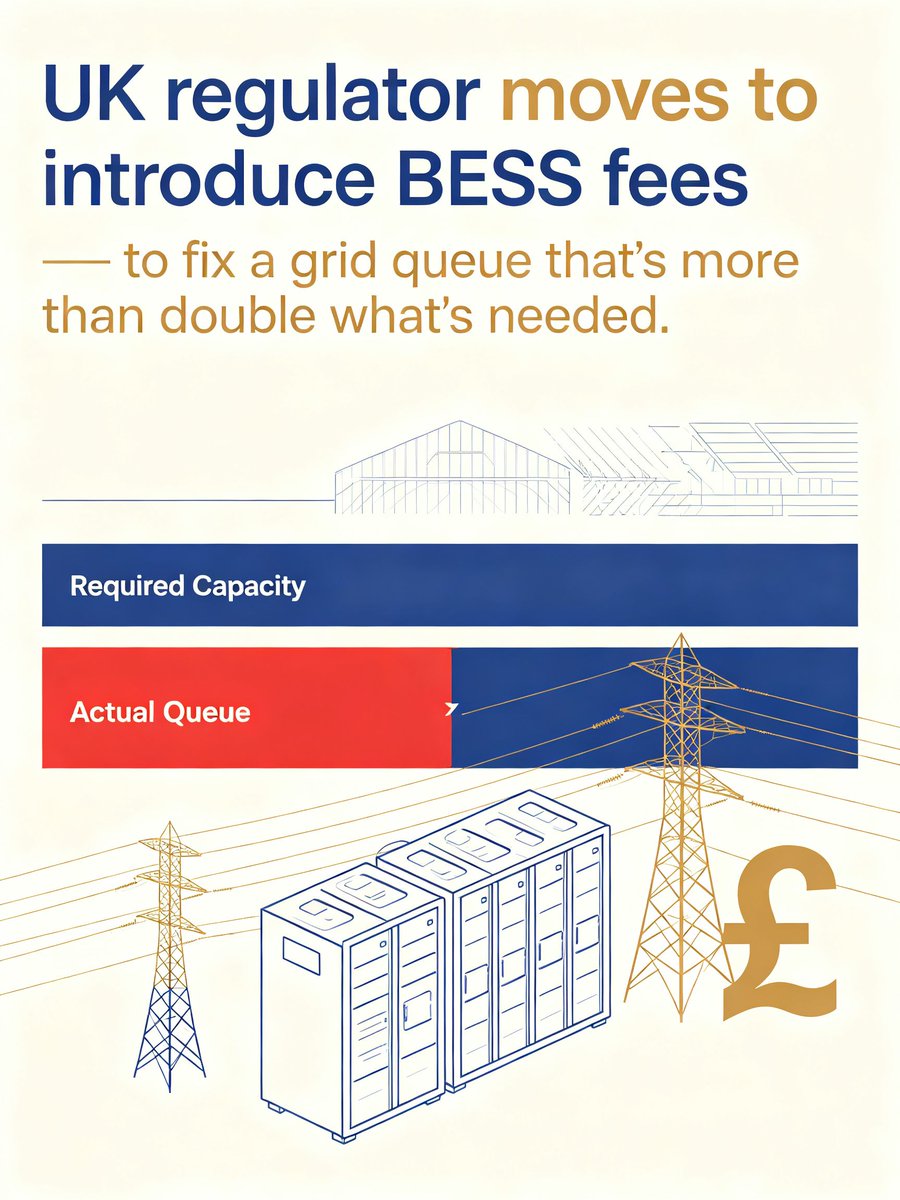
Ofgem is consulting on a new Oversubscribed Technologies Commitment Fee (OTCF) for battery storage in Great Britain's grid connection queue, calling it a "major intervention" to cut oversupply.
📊 The queue problem in numbers:
🔹 83 GW of grid-level battery capacity still prioritized in the new queue
🔹 +7 GW already operating
🔹 NESO cleared 40% of battery capacity from the queue in recent reforms — but the queue remains more than double what's needed for 2030 targets
🔹 If every project with a connection offer were built: 14.8 GW above NESO's 24 GW estimate for 2030, and 61.7 GW above the 29 GW needed by 2035
💰 How the fee would work:
▪️ Starts at £3,000/MW, rising to a maximum of £25,000/MW if the queue stays oversubscribed
▪️ Operators pay a security linked to proposed capacity to hold their place
▪️ Introduced via modification CMP470 — first proposed by developer Field Energy in March 2026
▪️ Likely to come into force July 2027
🔧 Possible adjustments under discussion:
▪️ Cap the fee at a project's maximum existing security exposure
▪️ Remove the fee once construction begins
▪️ Remove an exemption for certain co-located projects
🗓️ Industry consultation closes Oct 1, 2026
💡 SNEC's Insights:
This is a textbook example of a market design problem — and a lesson for every country scaling storage.
1️⃣First, grid queues are becoming the real bottleneck for storage, not technology or capital. When 83 GW is queued against 24 GW of need, the queue stops being a pipeline and becomes a speculative asset class. Projects hold places they may never build, blocking serious developers.
2️⃣Second, financial commitments are the right tool — if calibrated well. A £3,000–25,000/MW fee is designed to screen out speculation while remaining manageable for credible projects. The sliding scale is smart: it tightens automatically as oversubscription persists.
3️⃣Third, the design details matter enormously. Capping fees at existing security exposure, removing them at construction start, and revisiting co-location exemptions all determine whether this accelerates real projects or just adds friction. Badly designed, it could penalize legitimate hybrid projects.
The bigger picture: as storage scales globally, grid connection reform will become as important as cost reduction. Countries that build transparent, enforceable queue rules will deploy faster; those that don't will see their targets slip while paper projects pile up.
👇 Will financial commitment fees become standard practice for grid queues worldwide?
📖 Source: ESS News
Read the full article:
https://t.co/FtULSXwlYT
#EnergyStorage #BESS #BatteryStorage #Grid #Ofgem #UK #EnergyTransition #CleanEnergy #Renewables #GridConnection #Storage #Sustainability #NetZero #SNEC