𝗠𝗮𝗿𝗸𝗲𝘁 𝗲𝗻𝘃𝗶𝗿𝗼𝗻𝗺𝗲𝗻𝘁 𝗺𝗮𝘁𝘁𝗲𝗿𝘀 𝗺𝗼𝗿𝗲 𝘁𝗵𝗮𝗻 𝘀𝗲𝘁𝘂𝗽.
(𝗥𝗲𝗹𝗲𝘃𝗮𝗻𝘁 𝗳𝗼𝗿 𝗻𝗼𝘄)
One thing I learned over the years is you really have to pay attention to the market. I've not always been good at it, and if I see a good setup, I buy it, but there are market environments where you can actually get chopped around really bad if you just keep buying every good setup. And I think the next couple of months is gonna be a very challenging period for my type of long swing position trading.
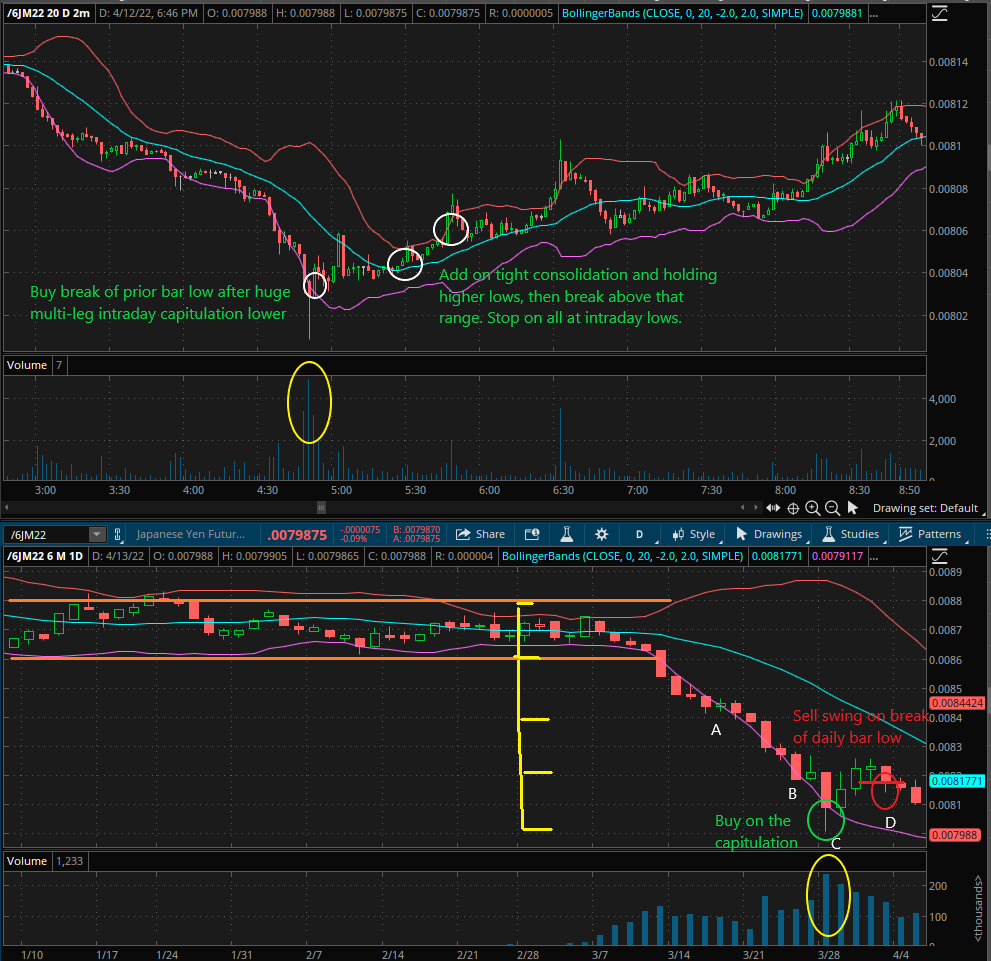
YEN DETAILED TRADE WRITEUP: Giving the people what they want! This was probably my second best trade of the year, but by far the easiest and likely the best EV. HT to CS for getting this on my radar.(1/3)
DISSECTED IN 60 SECONDS ⏱️
SEDG Intraday 10/20/23
-Earnings can lead to an in-play stock
-Opening imbalance as a sign of a player capitulating
-“Right side of the V” in action
-Exceptions to the trailing stop rule
Full library at https://t.co/fAfXJpr9LO
DISSECTED IN 60 SECONDS
NOVA INTRADAY 3/14/2024
Featured Insights:
-Bouncy ball pattern leads to a capitulation lower.
-Listening to the chart allows one to also catch a “right side of the V” long.
-As traders our only bias is what the pattern tells us.
THE FASTER YOU ADAPT, THE BETTER YOU PERFORM
A trader I work with recently used Claude to perform an analysis on his trading pnl and found that he could systematically decrease his size faster during slow periods and increase his size faster during hot periods based on pre-defined criteria.
It made sense. And the truth is, this data was highlighting what I suspect is a fairly universal heuristic for most discretionary traders, particularly swing traders. At every firm I work with, the more advanced traders adapt faster to market conditions. The less experienced traders adapt slower.
Yes, you could argue it is because identifying those criteria and market environments takes experience. But there is also a component where I simply think that humans are too conservative in both directions. Most of us are too slow to scale bigger and most certainly too slow to slam on the brakes when conditions change.
So, my challenge to you: markets have slowed for many the last few months. How quick were you to pull back? Any systematic way you could have done so quicker and more effectively?
MOMENTUM VS THEME
In the last couple of days, @PradeepBonde shared many valuable insights around themes and momentum. Many people interpreted it as a “vs” debate and reduced it to sector vs setup.
But there are two key aspects from his tweets that I want to elaborate on:
1) Themes always have momentum, but momentum does not always need to have a thematic move behind it.
The real question is what you approach first. Since themes will always reflect in momentum, if you focus on momentum first, you will naturally find the leading themes. But if you go theme first, you may miss strong momentum stocks where there is no obvious thematic driver.
2) The second important factor is that Pradeep is not against themes, but against the quantitative formulas people use to identify leading themes.
Most traders identify themes based on net change over a period like one month, three months, or six months. By the time a sector or theme appears as a leader through those methods, a large part of the momentum is already gone, along with the easy money opportunities.
But if you identify them through your momentum scans, it won’t lag. Let me explain it with an example:
On Friday, around half an hour after market open, while looking at the top gainers of the day, I noticed two stocks trending together: #NAZARA and #DELTACORP. Both belonged to the gaming sector, which had been impacted by retrospective GST policy issues since last several quarters.
The first correlation that came to my mind was that this move might be driven by anticipation of a GST resolution, which is why both were moving together.
Now that is a thematic move based on distress resolution, and you immediately know something is happening there. More importantly, it was Day 1 of the momentum itself.
So if you see, I looked at momentum first, and through that I was able to identify the theme that was moving. It was not lagging because it was the first day of the move itself.
So themes are not lagging, the way most people measure them is.
And it is not theme vs momentum, but what you choose to look at first.
I’ve completely rebuilt the leaderboard and sector/theme tracker.
The theme tracker now includes 1D, 1W, and 1M data — the fastest way to spot what’s trending at a glance. 🔥
I have the same information for International — any interest?
Most importantly to traders, you WILL increase your expected value and MAKE MORE MONEY by improving your sleep.
Decision making, willpower, and emotional resilience all improve w sleep.
Since tracking their sleep, I’ve had friends find out they have bad sleep apnea and add YEARS back onto their life.
I’ve had traders tell me how much better they trade and how strongly they see the correlation now in their data.
I know you think you feel fine now. I’ve heard it 100x. Truth is your body adapted and you no longer know what good feels like.
You think I constantly rant about sleep for no reason?
What are you waiting for?
https://t.co/2nsyayYx6j
PYRAMIDING (AND THE CRITICAL MISTAKES MANY MAKE)
Great read by my mate, 🥭, w tons I agree w and much to learn from (time stops, expected reactions vs reality).
That said, I’d like to explain how most people F* themselves w this method from my perspective.
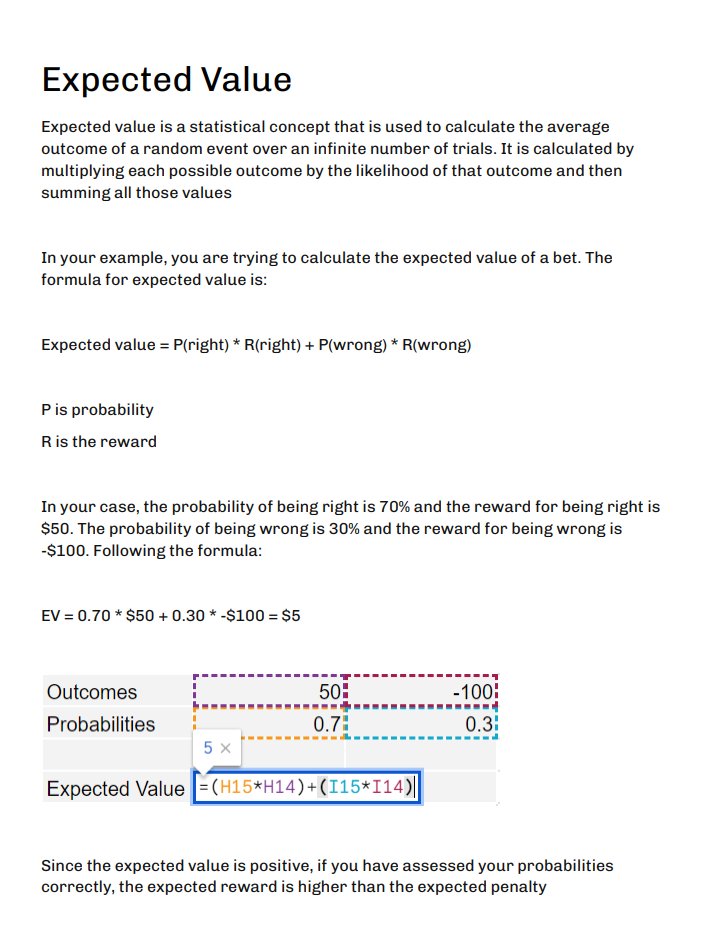
Expected value drives every trading decision you make. When you pyramid into a position, you need to be INDEPENDENTLY assessing the EV of each individual add.
With that said, generally (and all things equal), the best EV occurs at the true breakout level. Why? Because generally both the win rate and reward tend to be higher because you get the influx of all sorts of different traders.
Most people tend to pyramid in a way that actually RUINS their expected value due to two key mistakes:
1. So often I see people taking tons of -EV paper cuts ahead of the breakout level by trading in no man’s land and also longing areas below the resistance level that are actually probabilistically more likely to be the lower high. For Mango’s initial adds to make sense, they need to be +EV despite being in no man’s land (🥭 being a stud, I trust that he knew what he was doing).
2. The far more fatal mistake I see with pyramiding is that people will take starter size at the true breakout level which often has the best EV and is often where you want to be getting the most (intraday setup quality held equal). They do this bc there is the most uncertainty and psychological discomfort here.
As the trade then starts to work and psyche is comfortable, they then add way more size while “pyramiding” but they’re adding more and more size as the EV is getting more and more marginal, or often EV is becoming negative.
Edge is extremely hard to come by. You can’t just play the ADD ADD ADD game unless you’re exceptionally specific with where you add and what those setups look like. Otherwise doing so takes your starter size +EV position and mixes it with 3x or 5x as much mediocre or neg EV adds.
If you’ve followed 🥭’s posts on these subjects, he is always very specific w what he is looking for in his setups. Most are not 🥭 though and w/o emphasizing these details and an awareness of these pitfalls, more often than not, the average person tends to take a good trade and ruin it using pyramiding.
Stanley Druckenmiller on sizing from Michael Mauboussin
“There's one other thing [Druckenmiller] talked about and it was about position sizing.
Broadly speaking when you're trying to maximize your returns, you need two things.
(Expected value x size:)
One is you need some sort of an edge. Edge means you have a belief or a mathematical advantage that's not reflected in the current odds or in the market price.
The second thing is how much you can bet on that when you have that advantage. And the intuition is quite straightforward. If you had perfect information, you knew your bet was going to make you money. You would bet everything you could, right?
And then there are degrees of certainty about that. So there's this relationship between edge and betting size, and that leads to your total ability to generate excess returns.
What did you learn from Soros?
He said, the main thing that he learned from Soros was that position sizing was 70 to 80% of the game.
The reason that struck me is because, first of all, purportedly George Soros made money on fewer than 30% of his trades.
And that alone is worth letting settle in a bit. And he's one of the great investors of our time.
So what does that mean?
It means that he made a lot of investments that lost money. They probably did not lose much money.
And when he did make money, he made a lot of money, both by betting a lot of money and by letting it run simultaneously.”
What traders need to put on their wall:
'It's not about thinking I am right, it's about the expected value'
In essence, its not about missing one specific add or trade...
'If I did this 100 times, would I come out ahead?'
Slide deck drafts for the vids are done and have been sent to my editor, @MikeBellafiore! 😂
All that is left is to polish and record!
Sneak preview attached. I go deep on the advanced topic - Expected Value Dynamics!
EXPECTED VALUE DYNAMICS: Maybe the most important ADVANCED-LEVEL topic in trading is understanding how EV changes through time. As each bar elapses, the probabilities & risk/reward of the pattern are changing with it. One’s trading & system must dynamically reflect this. (1/6)
THE PENDULUM CONCEPT & TODAYS CLOSE
Many know I like to constantly think in terms of what I call “the pendulum concept”. In mid-April, stocks were clearly pricing in incredible bearishness. It was one of the sharpest downmoves EVER in history. Probably a -8 or -9 (on a scale of -10 to +10 | peak panic to peak euphoric).
In general terms, you want to be most long during those times.
Today’s closing print reflects a massive reversal in sentiment to what I’d say is about a +6 or even +7 on the scale. The pendulum has swung all the way to the other side of things. Incredibly, the Nasdaq is just a little over 5% off highs despite the risks still outstanding!
Does that mean the market can’t go higher!? Of course it can! Does that mean the market can’t make highs? Again, absolutely not. It can make highs next week.
What it DOES MEAN TO ME is simply that, WITHOUT CONSOLIDATION, I view the expected value of being long that Nasdaq print to be pretty unfavorable.
The geometry of the pattern has now covered so much ground that your reward to highs is defined and minimal, with low probability of success. While odds of a consolidation or rollover are significantly higher.
Remember… NOBODY ever knows what the next headline or price move will be. It is all a probabilistic game and our job is to position ourselves w positive EV.
This video and more FREE at https://t.co/8Urck7hQXF as part of @LanceMagnumOpus.
IMPORTANCE OF MENTALLY CONNECTING CHART PATTERNS!
Pattern recognition and the ability to compare & contrast charts is critical to trading. @InvestorsLive is fantastic at this.
Making the comparison of $BE last Friday to $PLTR in late August helped me crush the bounce.
Full video at: https://t.co/1DD0WKIYzr