Engineered DNA recombinases efficiently and specifically insert genetic cargos without the use of landing pads https://t.co/4ICZ9ljmJz
https://t.co/EJ5mCGgC6Y
Akademisyen, doktora öğrencisi ya da araştırmacıysan bu seni ilgilendiriyor 👇
OpenAI, araştırmacılara ücretsiz ChatGPT programını büyütüyor. Hedef dünya genelinde 200.000 kişi.
Nasıl işliyor:
• Başvurular 23 Kasım Pazartesi açılıyor
• Bu turda 50.000 hibe var, kura yok: şartları tutan ilk başvuranlar alıyor
• Her hibe sana ve en fazla 2 çalışma arkadaşına ücretsiz ChatGPT Plus veriyor
• Programda paylaştığın veri varsayılan olarak model eğitiminde kullanılmıyor
• Yanında eğitim ve destek de var
Bir detay: yazdaki pilot turda Pro veriliyordu. OpenAI çoğu katılımcının Plus limitlerini aşmadığını görünce bu turda Plus'a geçmiş, böylece daha çok kişiye yetiyor.
Pilota 33 ülkeden 20.000 araştırmacı katılmış. Anket yapılanlar, aynı işi aynı kalitede yapay zeka olmadan yapmanın neredeyse iki kat süreceğini söylemiş.
İlk gelen alıyor, 23 Kasım'ı takvime yaz. Tanıdığın bir hoca ya da doktora öğrencisi varsa ona da gönder. https://t.co/8zdVfRDlcH
Participants will receive access to our frontier models, including our GPT-5.6 family of models.
Each workspace includes business-grade privacy and security protections. Researcher data is not used to train our models by default, and participants can invite up to four collaborators.
The program also includes training, hands-on support, and opportunities to learn from other researchers. https://t.co/CFit8f79Nw
India is waging a war against its own researchers:
In Careers360’s Research Summit, Prof. Ram Gopal Rao, Vice Chancellor of BITS Pilani described India’s lack of investment in research beautifully. He said “India’s Higher Education is described as African Budgets, American ambitions, Russian methods, Chinese opacity and Indian Bureaucracy.
In the past decade, we have seen a slide in scientific temper and investments in research.
1. Non-NET fellowship are stuck at ₹8,000 a month since 2012, for 16,270 scholars in 45 central universities.
2. JRF stipend: In 2014, the JRF was Rs.25,000 per month. In 2019, it was revised to Rs.31m000. it is ₹37,000 PM. The hrowth hasn’t even kept pace with inflation and in real terms, it has FALLEN. IISc scholars even went on a hunger strike demanding an increase.
3. Maulana Azad fellowship: where more than 1,400 scholars have had stipends stalled since January 2025.
4. OBC fellowships: lists for three NET cycles in 2024-25 were held back, which the social justice ministry put down to insufficient funds.
5. INSPIRE: fellows have their stipends unpaid for 3 to 9 months. The schemes now under Vigyan Dhara fell 67.5% between 2016 and 2025.
6. KVPY: scrapped in 2022, after nearly two lakh students a year had taken its test.
7. JRF bottleneck: only 5,108 of 7,35,614 candidates (0.7%) got JRF in December 2025. Minister Sukanta Majumdar gave no year-wise data when asked.
8. The University of Hyderabad stopped Rohit Vemula’s ₹25,000 stipend in July 2015, and his last letter said he hadn’t been paid for seven months. He later committed suicide.
9. India’s R&D spending: fell from 0.82% of GDP in 2009-10 to 0.64% in 2020-21. PMRF spending was revised to ₹290 crore, less than half its ₹600 crore outlay.
10. SC fellowships: fell 61%, from 4,841 to 1,872, between 2020-21 and 2022-23.
If India indeed wants to be a Vishwa Guru, India should be investing in research, in creating quality Higher-Ed institutions. We cannot be cutting down on stipends, not paying our researchers, holding back payments, scrapping scholarships, not increasing fellowship amounts even to match inflation and still expect students to choose research.
The best part?
Harper is completely open-source.
You can inspect the code, modify it, build on top of it, or just install the browser extension and start writing.
It currently supports English, and it's designed for grammar checking, not AI rewriting.
Try it for free:
https://t.co/wchegdJqy4
GitHub:
https://t.co/9PzhRaoHk6
Bookmark this. You might never need to pay for basic grammar checking again.
New Letter: "SmartPE enables efficient prime editing in dicot crops" https://t.co/dizg8YSEq4
SmartPE is a newly developed prime editing system that combines a dual-pegRNA strategy with designed mismatched bases to markedly improve precise genome editing in dicot crops.
Multivalent ADAR1-recruiting RNA editing system (MARRS): an RNA editing platform for precise adenosine-to-inosine editing with high efficiency.
https://t.co/iXmUQIbNzN
We are looking for a Research Associate to work on Genome Editing of rice. Interested candidates with genome editing expertise can appear for a walk-in interview on 13th November at BRIC-NIPGR
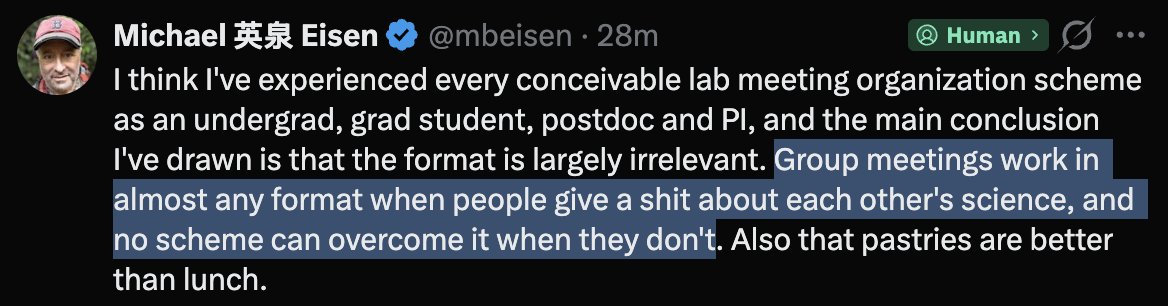
I think I've experienced every conceivable lab meeting organization scheme as an undergrad, grad student, postdoc and PI, and the main conclusion I've drawn is that the format is largely irrelevant. Group meetings work in almost any format when people give a shit about each other's science, and no scheme can overcome it when they don't. Also that pastries are better than lunch.
Are molecular biologists too used to digging enzyme tubes from many boxes? How’s this tube-clipping plate for @NEBiolabs tubes that fits in a freezer drawer? Madhu in our group collaborated with Conconi Family Biodevice Foundry and 3d printed this😍
Cell-type-specific PIN-FORMED 3-mediated polar auxin transport regulates cambial activity and tension wood formation in Populus tomentosa
https://t.co/1mOJkN65bp
How much do PhD students earn?
The first comprehensive overview of PhD income shows vast imbalances across much of Europe
Read the full story: https://t.co/AKk2SyX5cT https://t.co/EXVWETGS6W