Black tax for me is an honour. It was an honor to pay my brother's varsity fees. It's an honour for me to pay for my lil sisters nursing school. I do it proudly. I'd even starve myself just to do it
@SAPoliceService BLOEMFONTEIN, we have women and girls messaging us. They are telling us they are being followed, and they are scared of being published on our page! WHAT ARE YOU DOING ABOUT IT? We need action and intervention!
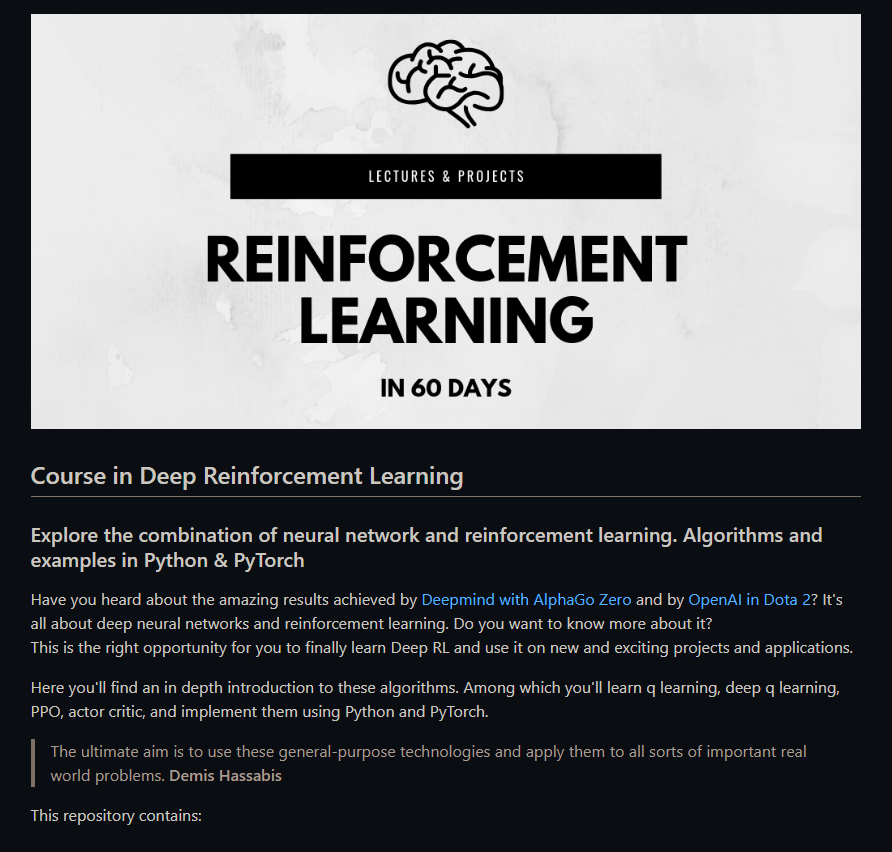
🤖 60 Days Of Deep Reinforcement Learning
In this repo, You'll find everything well arranged from articles, tutorials, YouTube videos, papers implementations, projects and codes.
This repository contains ML/AI Research Papers and everything you need to become proficient in #MachineLearning / #AI Research — compiled by @NainaChaturved8
https://t.co/yYOq1hYb6o
Here are 300 hours of curated courses focused on Machine Learning Engineering.
There are 15 courses. From beginner to advanced. From Google. For free.
Some of the topics they cover:
• Fundamentals of Machine Learning
• Feature Engineering
• Production Machine Learning Systems
• Computer Vision and Natural Language
• Recommendation Systems
• MLOps
• TensorFlow, Google Cloud, VertexAI
The courses are well structured. They aren't just links to YouTube videos. You have to join the course, and they have an interface that takes you through every module.
This is good content. And it's free.
https://t.co/eqTjRT6BZF
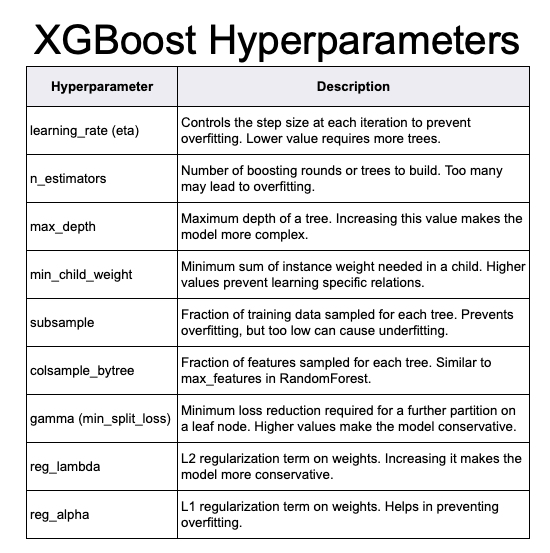
For years, I was hyperparameter tuning XGBoost models wrong. In 3 minutes, I'll share one secret that took me 3 years to figure out. When I did, it cut my training time 10X. Let's dive in.
1. XGBoost: XGBoost (eXtreme Gradient Boosting) is a popular machine learning algorithm, especially for structured (tabular) data. It's claim to fame is winning tons of Kaggle Competitions. But more importantly, it's fast, accurate, and easy to use. But it's also easy to screw it up.
2. Hyperparameter Tuning: To stabilize your XGBoost models, you need to perform hyperparameter tuning. Otherwise XGBoost can overfit your data causing predictions to be horribly wrong on out of sample data.
3. My 3-Year "Beginner" Mistake: XGBoost has tons of parameters. The mistake I was making was treating all of the parameters equally. This caused me hours of tuning my models. And my results weren't half as good until I started doing this.
4. How I improved my hyperparameter tuning: XGBoost has one parameter that rules them all. And after 3 years, I noticed that model stability was 80% driven by this parameter. What was it? Learning rate. When I figured this out that's when things started to change. My models got better. My training times were reduced. Win win.
5. My Simple 2 Step Hyperparameter Tuning Method for XGBoost: What I was doing wrong was doing random grid search over all of the parameters. This took hours. So I made a key change. I began isolating Learning Rate, tuning it first. This was Step 1. The search space for one parameter is super fast to tune.
6. What about the other parameters? Once learning rate was tuned, I then opened the search space to more parameters. This is Step 2. The rest of the parameters have maybe 20% contribution to performance, so that means I can reduce the search space dramatically.
7. The big benefit: Separating tuning into 2 steps cut my training times by a factor of 10X. And my models actually became better. Faster training, better models. Win win.
Good luck!
===
Ready to learn Data Science for Business?
I put together a free on-demand workshop that covers the 10 skills that helped me make the transition to Data Scientist: https://t.co/LR39RJ5XKB
And if you'd like to speed it up, I have a live workshop where I'll share how to use ChatGPT for Data Science: https://t.co/EaMpKrJiqX
If you like this post, please reshare ♻️ it so others can get value.