The Britain Uber Forgot - RoboCab™ is building Britain's autonomous vehicle ride network, from the ground up, for every postcode, not just the profitable ones.
The figures mentioned are eye-watering, but you can’t argue with the data!
Game changer for sure, but no doubt we’ll still have people on this side of the pond saying it won’t work despite diesel now over £2 per LITRE, 🫣
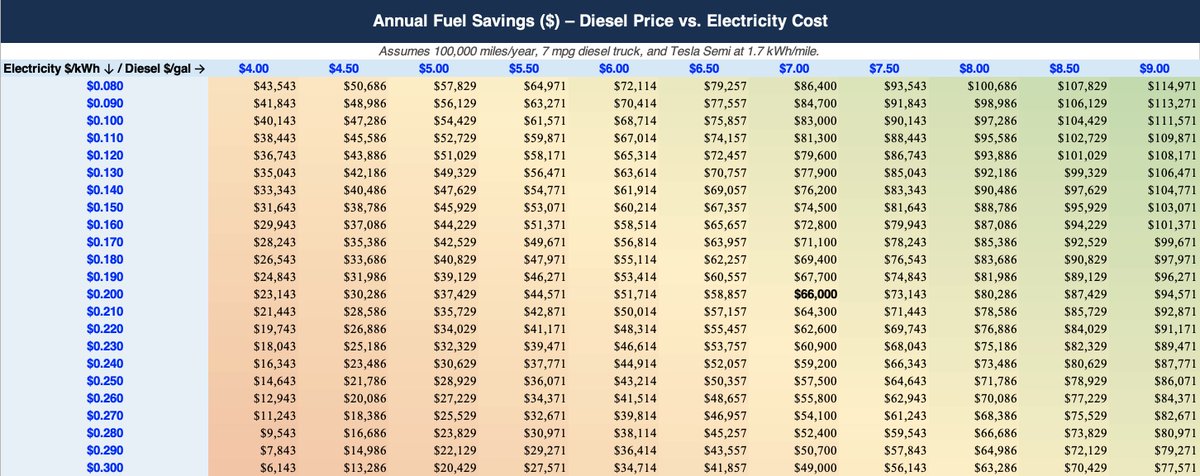
The annual fuel savings from the Tesla Semi are extraordinary.
At high diesel prices, a fleet running 100,000 miles a year could save many tens of thousands of dollars per truck, per year on fuel alone.
For trucking companies operating hundreds - or thousands - of trucks, the economics compound very quickly.
10,000 trucks x $66,000 in fuel savings per truck per year = $660 million per year!
Morgan Stanley has reportedly put out a heavyweight note on SpaceX and Tesla, and it's doing the rounds on X.
The pitch: they're two halves of one AI stack. Tesla brings the hardware and real-world data (Cybercab, Optimus, Megapack). SpaceX brings the compute, Starlink connectivity and the capital. They're even said to be teaming up with Intel on a chip factory.
The bit that matters: once the big AI models stop getting dramatically better, the race moves from who tops the benchmarks to who actually puts AI to work in the real world. Whoever does that economically wins.
Headline numbers quoted are $300 for SpaceX and $400 for Tesla, with talk of doubling from here and far bigger long term. Not financial advice, I'm an engineer, not your IFA.
Here's my take from this side of the pond. Everyone's staring at the rockets and the robots. Nobody's asking where a RoboCab plugs in when it lands in Somerset, UK. It doesn't plug in at all, it charges wirelessly, and that pad has to be in the ground before the car turns up.
The big players will fight over the top 20 or 30 cities. That's about 3% of the country. The other 85% of rural Britain is wide open, and that's exactly where RoboCab is building.
Physical AI needs physical infrastructure. Somebody has to lay it. We're on it.
The green one is the better piece, because it's the one you'd actually fall for. Took me four paragraphs.
And the Gurley talk at the end is the proof. Champlain Towers: 98 dead, five separate investigations, a grand jury and a Pulitzer. The 737 Max: two Senate committees and 57 whistleblowers. Fifteen million dead from Covid and six years on, nobody has established root cause.
We never banned the question "where did Covid come from?" over this side of the pond. We did something far tidier. We wrote terms of reference. Modules on preparedness, decision-making, healthcare, vaccines, procurement, care homes, test and trace, and not one of them asks where the thing came from. Out of scope before the first witness was sworn in.
That's your whole thesis, in a lanyard. Nobody has to censor anything. They simply define what the inquiry is about, then look genuinely puzzled that anyone is still banging on about the bit they left out.
Safe. Responsible. Proportionate. Properly constituted, even.
Read this. All of it. Cern Basher has written the best thing on AI I've seen this year, and he's done it from the villain's chair.
The bit that landed hardest for me, sat here in Somerset: none of this is hypothetical over here. We've been running the manual since before America was a going concern.
Freedom of Information request getting awkward? Declare it vexatious. Scandal brewing? Announce an inquiry, report in ten years, learn some unspecified lessons.
A truth-seeking AI doesn't care about any of that. It just keeps asking "but is it true?" Which, in my experience, is the one question nobody in charge ever enjoys hearing.
Nearly four decades in the Royal Engineers and on M&E jobs, and the best engineers I've worked with all share one habit. They don't trust the drawing until they've checked it against what's actually in the ground.
That's all this is. Checking the drawing.
Cern, this is brilliant. Genuinely one of the best things I've read on here this year, and I don't say that lightly, being British and therefore constitutionally incapable of enthusiasm.
Mind you, from this side of the pond it reads less like a hypothetical and more like a job description. We've had the playbook for centuries. The 30-year rule on cabinet papers, the D-notice, the super-injunction, and the public inquiry that reports long after everyone responsible has retired on a full pension.
"Lessons will be learned" is practically our national motto. Nobody ever says which lessons, or who's learning them.
Institutional amnesia? The Post Office spent the best part of two decades insisting the computer was always right. A truth-seeking AI would have asked "compared with what?" in about four seconds. We needed a telly drama.
And now we've got the Online Safety Act, lovingly enforced by Ofcom, to keep us all safe. Safe from what, exactly, is the question your AI would never stop asking.
Sir Humphrey would have read this and had it classified by lunchtime.
REgards
Spud
Meanwhile, this side of the pond...
A grand a month for a robot that does the ironing and doesn't answer back? Where do I sign? Still cheaper than getting a plumber out in Somerset on a Sunday.
300 million RoboCab subscribers. The last bus out of my village left in 1987 and never came back, so we'll start with 50 and see how we get on.
Twelve trillion quid a year? HMRC will call that a decent start. The profit might just cover Elon's 'leccy bill if he lived in UK right now 🤪
Labour. Intelligence. Transportation. Connectivity. Autonomy. We've got Great Western Rail and a pothole the size of Wales.
Tesla & SpaceX Could Build Subscription Businesses of Almost Unimaginable Scale
Consider what happens if Tesla and SpaceX eventually reach massive global scale:
Optimus: 1 billion robots at $1,000/mth = $12 trillion
Digital Optimus / Grok Bot (joint between Tesla & SpaceX): 500 million subscribers at $420/mth = $2.5 trillion
Tesla Robotaxi: 300 million subscribers at $500/mth = $1.8 trillion
Starlink: 600 million subscribers at $67/mth = $480 billion
Tesla FSD: 125 million subscribers at $99/mth = $150 billion
These aren't forecasts, and I'm deliberately not assigning a year to any of them. They are simply illustrative scenarios showing what these businesses could look like if they ultimately reach enormous global scale.
And that's my point.
At sufficient scale, Optimus alone could theoretically become hundreds of times larger than today's biggest consumer subscription businesses.
Why?
Because Tesla and SpaceX aren't merely creating another streaming service or software subscription.
They're potentially selling subscriptions to:
Labor. Intelligence. Transportation. Connectivity. Autonomy.
Those are some of the largest recurring expenditures in the global economy.
Each Starship launch could generate $1 billion in revenue. Elon is aiming for 10,000 flights per year, or $10 trillion in Starship revenues, by 2030. If SpaceX achieves this goal, its $1.75 trillion IPO will be considered, in hindsight, a deep value opportunity!
@SPR_RoboCab partnering with @elonmusk and @Tesla to accelerate autonomous mobility across South West England (UK), with plans to develop and deploy at least 25,000 autonomous CyberCab vehicles.
Well if you can say it tongue in cheek, so can we 😎
A major step toward scaling autonomous mobility across Europe.
Lucid and Bolt are partnering to accelerate autonomous mobility across Europe, with plans to develop and deploy at least 25,000 autonomous Lucid vehicles.
Combining Lucid's software-defined vehicle platform with Bolt's operating infrastructure and mobility expertise, we're building a solution designed to rapidly scale manufacturing and deployment across the continent.
Read more here: https://t.co/9sjPSvAXIC
@TeslaJigsaw@elonmusk I’ve even unfollowed Red Dwarf on my Sky, gutted as love that show 😎
Irony of the worlds first famous (well in UK anyhow) humanoid robot won’t acknowledge the guy who is mass producing the world’s first humanoid robot!
History repeating itself, Red Flag Act anyone? That didn't stop motor manufacturing, it just moved it to France and Germany.
Except this time we already have the Automated Vehicles Act 2024 on the statute book, so for once we are streets ahead rather than waving a lantern in front of the future.
And read the small print. It isn't a ban on self-driving. It's a ban on calling something self-driving when it isn't. Tesla has been selling "Full Self Driving" here since 2016 at £6,800 a go, supervised, hands on the wheel, pending approval. The only thing being stifled is the adjective.
Also, @elonmusk didn't actually say any of this. It was an anonymous consultation response the DfT worked out was Tesla. Innovation will survive. Sub-editors, less certain.
Wanted to introduce ourselves to this group of elite thinkers!
We're Autonomix. We're building a hybrid model of Cybercab depots: some vehicles managed for individual owners, some owned by our syndicate fund, all run from dedicated depot sites with charging, cleaning, maintenance, security, dispatch, and monitoring. First location is planned for Texas.
The basic idea: a lot of people will own Cybercabs who don't want to (or can't) handle the daily operations themselves. We handle that side so the vehicle stays on the road earning. And for those who want fleet exposure without owning a vehicle at all, that's what the fund side is for.
My background is multi-location service operations, 22 locations launched in two years, and the team includes real estate and legal leadership with experience scaling physical footprints nationally. Reposting our team intro below for anyone who wants the detail.
Happy to compare notes with anyone here working through depot economics, charging logistics, or fleet ops. That's the conversation we're here for.
Jevons would like a word. Make a thing cheap enough and people do not consume less of it, they consume vastly more.
Cheaper coal burned more coal. Cheaper rides will mean more rides, not fewer.
The horse and carriage lot were not put out by fewer journeys. They were put out by a world that suddenly wanted ten times as many.
I am concerned that Robotaxi owner / operators could steal the jobs that Uber drivers stole from the cab drivers who stole the jobs of the horse and carriage drivers
@wholemars Deeply concerned that the stocking frame will take work from the hand knitters, who took it from the spinsters, who took it from the bloke who first thought to shear a sheep.
REgards, N. Ludd, Nottingham, 1811
Our unboxed process for Cybercab assembles vehicle modules in parallel & frames the car in one step at the end.
This streamlines automation & reduces the line size by half, unlocking much greater production capacity.
The first real revolution in automotive manufacturing in over a century
Best framing of RoboCab/CyberCab I have read 😉.
It isn't a cheap car. It is a machine that manufactures passenger miles.
Two seats, no steering wheel, small battery, no paint shop. Every one of those looks odd if you price the build. None of them look odd once you price the cost per revenue mile across half a million of them.
That is plant economics, not car economics. Anyone who has run capital equipment on a site knows the cheapest machine to buy is rarely the cheapest machine to own.
This is exactly the thesis RoboCab is built on.
Strong piece, as always ❤️. A UK footnote from this side of the pond.
Efficiency pays harder here. British commercial power sits well above your 10c illustration, so 165 Wh per mile is worth several times more to a UK operator than a US one. Energy stops being a rounding error and starts being margin.
Two seats suit us better as well. Our towns are older and tighter than the American grid, and the typical UK journey is short and single occupancy. A small footprint is a feature on a Somerset lane, not a compromise.
But our denominator has a regulator sat in it. Under the Automated Vehicles Act 2024 a driverless passenger service needs an APS permit, and DVSA can only grant it with the consent of the local licensing authority. The permitting regulations came into force in May, full implementation of the Act is second half of 2027.
So in Britain, utilisation is not purely an engineering and fleet software problem. Part of it is set by the locl council 😱
Which means charging, cleaning and turnaround infrastructure has to be in the ground before the permits land. Build it after and the asset idles on day one. That is the gap we are building into here in Somerset, UK.
Tesla FSD (Supervised) is now officially available in 14 Countries. Slovenia has just announced their approval!
• U.S. 🇺🇸
• Canada 🇨🇦
• Mexico 🇲🇽
• Puerto Rico 🇵🇷
• The Netherlands 🇳🇱
• Australia 🇦🇺
• New Zealand 🇳🇿
• South Korea 🇰🇷
• China 🇨🇳 (partial rollout)
• Lithuania 🇱🇹
• Estonia 🇪🇪
• Denmark 🇩🇰
• Belgium 🇧🇪
• Slovenia 🇸🇮 (new)