What’s next for global energy markets? On @CNBC’s Power Lunch, S&P Global Vice Chairman Daniel Yergin discussed how geopolitical tensions involving Iran could begin showing up more clearly in oil supply and inventory data as early as July. He also explored China’s oil surplus, shifting market dynamics, and the broader outlook for the energy complex.
Watch his conversation with Brian Sullivan:
https://t.co/czpTpMynBA
The 2026 men’s FIFA World Cup will take place across Canada, Mexico and the US from June 11 to July 19, with 48 national teams competing in 16 host cities—two in Canada, three in Mexico and 11 in the US. As attention turns to the tournament’s economic implications, the key question is whether an event of this scale can meaningfully shift activity in two large, diversified North American economies.
Get more insights with @SPGMarketIntel:
https://t.co/fNGIMLgRhV
Indonesia must adopt a balanced, integrated approach to its aluminum supply chain to avoid repeating oversupply pressures that have weighed on the nickel market, industry experts said June 4 at the 2026 Indonesia Critical Minerals Conference in Jakarta.
Indonesia emerged as the world's leading nickel producer after a 2020 ban on nickel ore exports prompted predominantly Chinese capital into domestic processing facilities. The Southeast Asian country produced 66.6% of the world's mined nickel in 2025, according to @SPGMarketIntel data.
Read more with @EnergySPG: https://t.co/7uPQb1Q48S
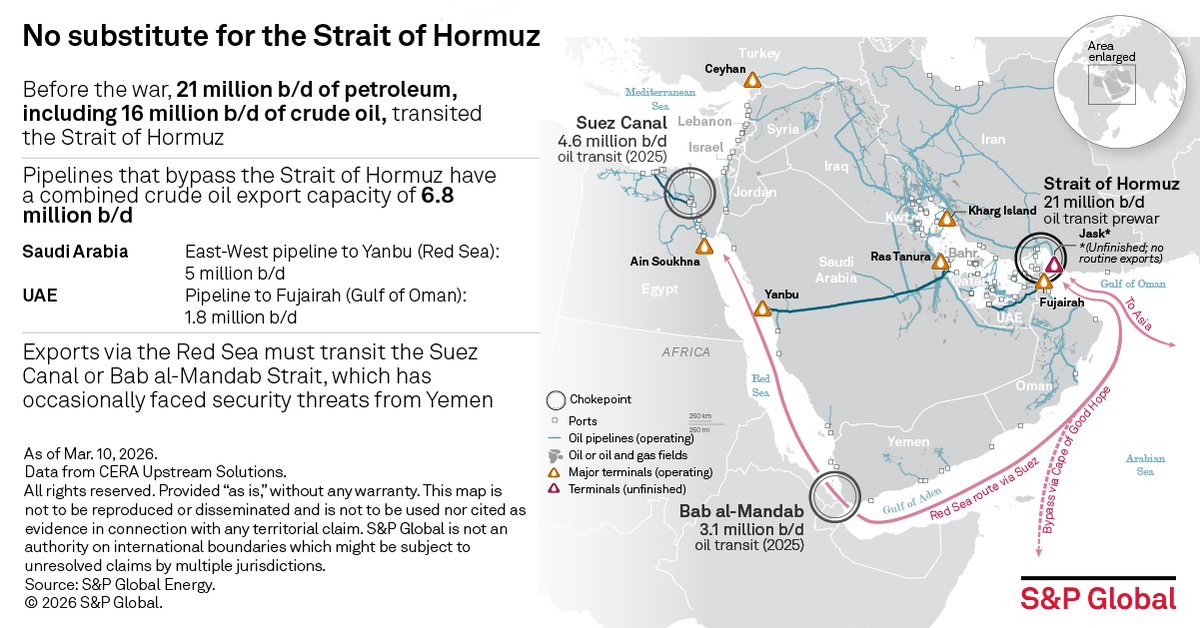
Global energy markets continue to navigate the ripple effects of disruptions in the Strait of Hormuz.
S&P Global Vice Chairman Daniel Yergin joined Geoff Bennett and PBS NewsHour to discuss why inventories have helped stabilize markets, the growing strain on fertilizer and fuel supplies, and what prolonged disruption could mean for the global economy. He also shared insights on America’s evolving role as the world’s largest oil producer and the challenges facing energy recovery efforts.
Watch the full interview: https://t.co/ghfkeYs0Dj
Metals markets are navigating a complex landscape where easing geopolitical tensions are intersecting with persistent supply chain vulnerabilities and robust structural demand. Following record highs earlier in May, industrial metals prices have pulled back as markets react to a fragile ceasefire in the Persian Gulf and renewed hopes for a US-Iran diplomatic agreement. This recalibration removes some of the "war-hedge" premium that had recently elevated prices for commodities like copper and silver.
Read more with @SPGMarketIntel:
https://t.co/c3JZMQZqa3
The current energy crisis should advance a more reliable and resilient energy system. Timelines for short-, medium- and long-term actions must align to make primary energy choices that benefit energy consumption across end users. Policymakers and regulators can accelerate the reform agenda, but the pace of change will be dictated by the Indian energy market’s dependence on global energy flows and supply chains.
Read the full report here: https://t.co/8NTHg0W9eW
Global exploration budgets for key battery metals fell sharply in 2025, declining 43% to $958 million. While this downturn reflects broad market oversupply, its impact has not been uniform. New analysis from @SPGMarketIntel shows how policy, project maturity, and corporate strategy are creating resilient hotspots even in a weaker market.
The latest research, "Battery Exploration Trends," provides a data-driven look at where investment has proven most resilient and where it has retreated fastest.
Get more insights: https://t.co/V36Ibq9d4F
The Trump administration's imposition of a 50% tariff on imports of aluminum and steel has helped build momentum in the US for metals projects, but industry experts say shifting trade policy may be limiting the tariffs' impact on investments.
President Donald Trump doubled the Section 232 tariffs for steel and aluminum in June 2025, raising each to 50%. Trump said the higher charges would boost domestic production and reduce US reliance on foreign imports.
Read more with @EnergySPG:
https://t.co/Y5i5ElTSWq
As vaults take over finance, Vault Summit took over the NYSE.
We connected the world's largest institutions with the teams building the future of finance onchain.
Special thanks to our host @Morpho, co-host @SPGlobal, and Title sponsors @gauntlet_xyz, @FordefiHQ, and @Visa. Next stop, Singapore.
From @EnergySPG: The growth of data centers, and the amount of electricity expected to be required to meet that demand, is probably the biggest issue in the US power sector.
US grid power supplied to hyperscale, leased and crypto-mining data centers reached about 64.4 gigawatts in 2025, nearly tripling since 2020. And that growth is accelerating.
In this episode, host Dan Testa speaks with Brandon Oyer, head of energy and water for the Americas at Amazon Web Services. Oyer breaks down what he describes as misperceptions regarding the water and power impacts of data centers, the ways in which many people rely on data centers without realizing it and how AWS works with utilities to develop new projects.
Listen to the latest Energy Evolution podcast episode:
https://t.co/iuFaXJlrEW
Australian beef exports to China are rapidly approaching a key threshold, with 90% of the country's quota already exhausted as of June 1, China's Ministry of Commerce said June 2.
Once the quota is exhausted, a 55% out-of-quota tariff will take effect from the third day thereafter, raising the risk of a sharp slowdown in trade flows.
China's country-specific safeguard measures were announced on Dec. 31, 2025, following the conclusion of a safeguard investigation into beef imports launched on Dec. 31, 2024. The measures were introduced to protect China's domestic cattle farming and beef industry after a surge in imported beef volumes.
Read more with @EnergySPG:
https://t.co/ZmOYxGXdVJ
Tune in to our latest podcast episode featuring insights into private credit.
This episode features Blair Jacobson, Co-President of Ares Management Corporation, discussing private credit investment strategies, risk management, and firm growth. He shares insights on how Ares maintains a conservative approach to avoid losses, the importance of relationships and reputation in deal origination, and the firm’s expanding areas like asset-backed credit and wealth management.
Listen to the full episode here >> https://t.co/BnuTGqQ1Ww
As institutional capital moves deeper into digital assets, one question is becoming increasingly relevant: what, exactly, should crypto fund managers be measured against?
That was the central issue in a recent webinar, “Benchmarking Digital Asset Funds: Are Managers Measuring Performance Effectively?” hosted by Crypto Insights Group with participation from @SPDJIndices (S&P DJI), Amitis Group and Syncracy Capital. The discussion brought together the perspectives of S&P DJI, an index provider with a range of S&P Digital Asset Indices, an active manager and a fund allocator—offering a useful snapshot of how institutional standards are beginning to form in a market that still lacks a universally accepted playbook.
Get more insights: https://t.co/9JTH1myTDX
S&P Global announces a strategic collaboration with Cohere, a global AI platform for governments and regulated industries, to bring its trusted financial data directly into Cohere's secure enterprise platform, North. The collaboration will leverage S&P Global's essential intelligence and ensure that AI and agentic workflows are grounded in verifiable fact, speeding up research, improving accuracy, and reducing manual data-gathering and validation for customers with trusted, source-based information.
Today's announcement reflects S&P Global’s strategy to integrate its differentiated data across AI platforms, driving productivity wherever customers operate.
Read the full press release: https://t.co/BNw2uMViwX
The disruption in the Strait of Hormuz has triggered one of the biggest and most consequential energy shocks the global economy has ever experienced. It will have far-reaching and long-lasting consequences, and it could challenge India’s dual vision of becoming Viksit Bharat by 2047 and achieving net-zero emissions by 2070.
Read the full report here: https://t.co/ypBafQjUaE
A surge in gold prices to record highs has reignited investment in exploration, driving budgets up for the first time in three years. However, new analysis from @SPGMarketIntel reveals a critical imbalance: while companies are capitalizing on high prices, a persistent decline in grassroots exploration threatens the long-term health of the project pipeline.
The latest research report, Gold Exploration Trends, unpacks the forces driving this recovery and the structural risks emerging from the industry's risk-averse strategy.
Get more insights: https://t.co/UC17B6b6To
In our latest episode of the Look Forward podcast, host Aries Poon is joined by Carlos Pascual, head of geopolitics and international affairs at S&P Global’s Energy Division, to examine the Middle East conflict through a wider geopolitical lens.
Listen to the full episode: https://t.co/zEt4wPsjI5
All tracked geographies and sectors reflect notable increases in AI investment and planned capital allocation compared to the 2024 PMI survey, indicating a growing commitment to AI.
Read our latest research exploring the AI and labor landscape: https://t.co/vHq2HZge0W
Congratulations to our Chief AI Officer Bhavesh Dayalji on being named one of AI Magazine's Top 10 AI Leaders in Financial Services.
Bhavesh has always believed that AI is for everyone. Not just the engineers building it, but everyone across our organization whose work it elevates. This belief is at the center of how S&P Global approaches AI: investing in the skills to empower our workforce, building tools that teams can make their own, and developing AI solutions that put our trusted data to work wherever our customers operate.
Building an AI-first culture means giving people the flexibility to experiment and grow as the technology evolves. Bhavesh works to champion this spirit of innovation across the enterprise every day.
Read more: https://t.co/dLliSZuTlh
The Middle East war has been the biggest test of India’s resilience in recent years. It triggered the largest energy shock on record, and its consequences extend to freight and insurance costs, supply chains, and fertilizers, which have a multidimensional impact on the economy. Its ultimate impact will depend on the scale, intensity and duration of the conflict.
Read the full report here: https://t.co/LhLdE00qsj