China’s economic growth has many advantages for Europe, but more domestic consumption would benefit both China and the euro area, Chief Economist Philip R. Lane tells @XHNews.
He also discusses trade, energy and AI.
Read the article https://t.co/16yZXjfY5P
Despite a rise in energy prices in 2026, the euro area economy proved resilient.
This blog examines how lower vulnerability to energy shocks, policy support and the global AI upswing helped cushion the impact, and what is needed to sustain that resilience https://t.co/I3vLowU2L2
International liquidity lines support the smooth transmission of monetary policy, says Chief Economist Philip R. Lane at the CF40-Euro50 luncheon in Shanghai.
Read the speech https://t.co/ga5XY6maGb
Has food inflation lost its bite?
We explain why food inflation has fallen sharply, why new pressures are building from energy and extreme weather, and why many households are still feeling the impact of higher food prices https://t.co/F5wP8BlT45
Can you spot a scam?
In our latest podcast episode, Catherine follows the trail of a fake ECB email to uncover how fraudsters exploit trust, create urgency and use new technologies to trick people – and what you can do to stay one step ahead.
Listen 👉 https://t.co/ljHMDQZ7Fh
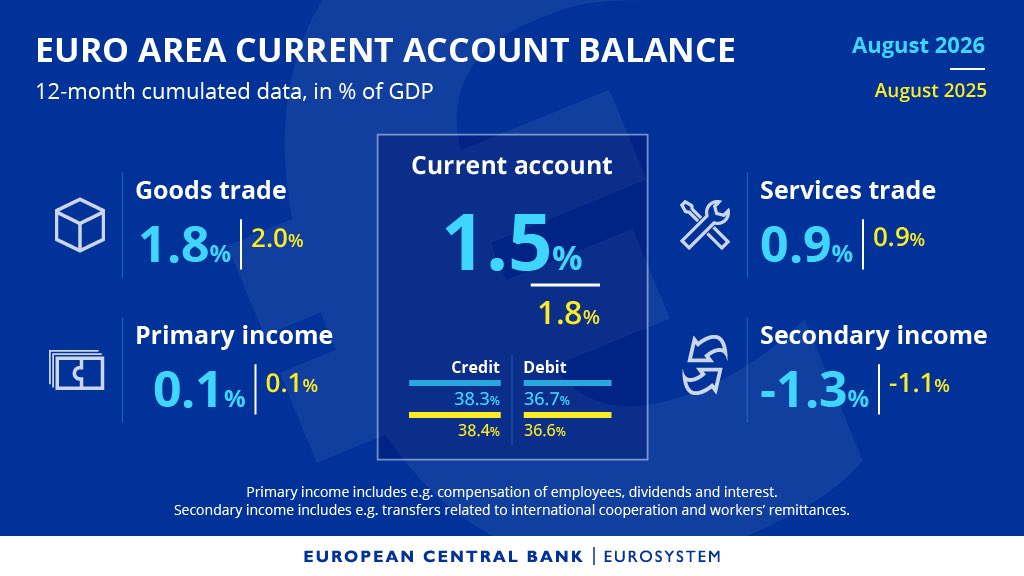
How did the euro area current account balance evolve in August? How does it compare with the same month a year earlier?
Find out more in the press release https://t.co/WgnRjUa2pS
Simplification and integration are two sides of the same coin, which is the competitiveness agenda, Supervisory Board Vice-Chair Frank Elderson tells @DiePressecom.
That’s why it’s crucial that the European Commission's banking reform package keeps both sides together https://t.co/HffmO2uGki
From Keynes’s famous “digging holes” example to modern stabilisation policy, Economics has come a long way in understanding how governments can respond to crises.
The 2026 Nobel Prize recognises that progress. This blog post explains the research behind it https://t.co/O5S99Vmm9K
Climate change and nature degradation are a certainty in an uncertain world, says Executive Board member Frank Elderson.
Stronger resilience requires adaptation and mitigation, sustained investment, international cooperation, and early, decisive action https://t.co/cXW2KciImF
Watch live at 8:00 CET: Executive Board member Frank Elderson talks about navigating climate risks in an uncertain world at the Green Swan conference in Manila, organised by @BIS_org, @BangkoSentral, @bancaditalia and @NGFS_.
https://t.co/z1HlVRJLgP
The global economy has proven surprisingly resilient to uncertainty, says President @Lagarde. A return to an international economic order grounded in openness, predictability and the rule of law would help trade and investment. Read the IMFC statement https://t.co/gH41KmaisG
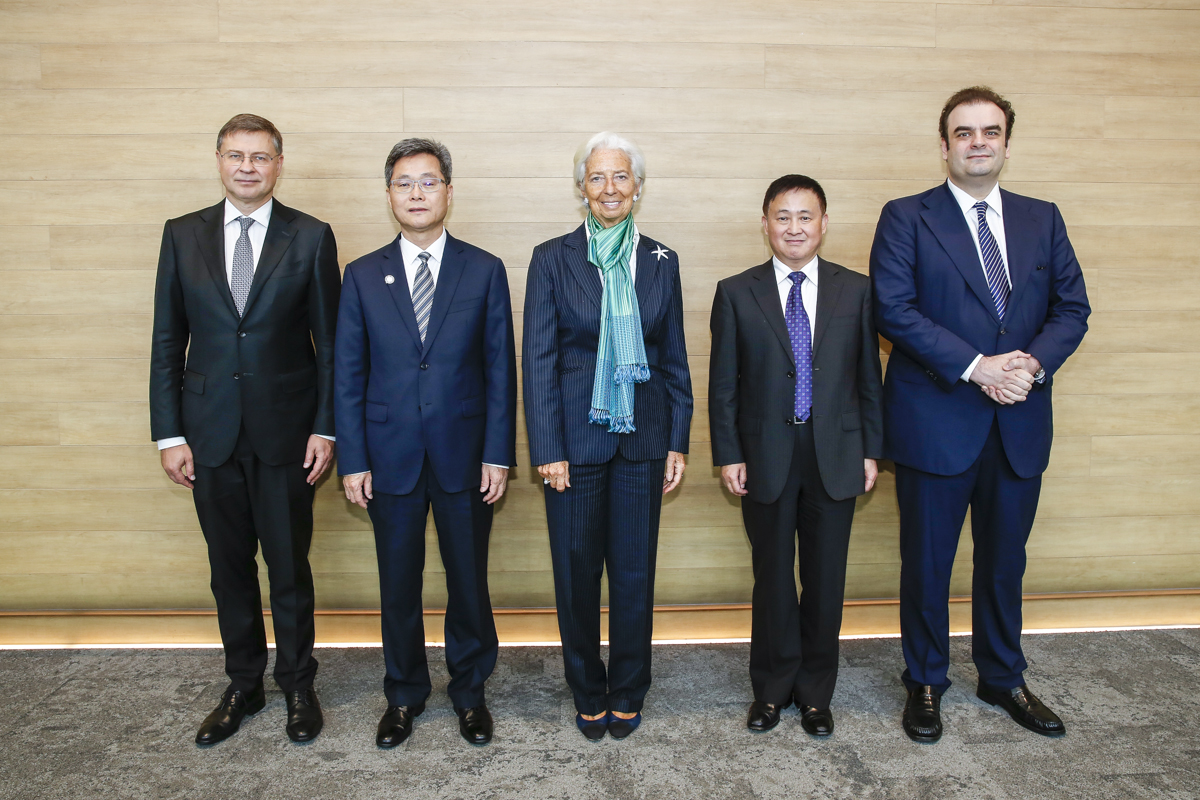
.@EU_Commission@ecb#Eurogroup to set up a dialogue with China to discuss macroeconomic policy.
We aim to foster mutual understanding, sustainable growth and a vibrant industry while preserving the rules-based international order.
We look forward to continuing this work.
The world is becoming more complex, more interconnected and more uncertain on a daily basis, says Supervisory Board Vice-Chair Frank Elderson.
In this environment, banks need to build their resilience and prepare adequately for unexpected surprises https://t.co/7OMixX4yEe
Europe has much to gain from AI, says Chief Economist Philip R. Lane at the International AI Summit in Dublin. Realising these benefits will require action from a wide range of actors to support the sustainable transformation of the economy.
Read the speech https://t.co/VlqL5D2HIX
Live now: Chief Economist Philip R. Lane takes part in a fireside chat on inflation dynamics in the euro area at the @SocieteGenerale Global Markets Conference.
Watch the livestream https://t.co/xpmlQCzTws
Climate change and the transition to a carbon-neutral economy do not affect everyone equally.
The distributional effects of climate change and the transition can become relevant for price and financial stability https://t.co/qw8NTgb57r