Once upon a time India encouraged people to eat healthy and nutritious food by telecasting the “Sunday ho Monday roz khao ande” jingle on national TV.
And today we are focused on converting entire cities to vegetarianism.
2000: Saddam Hussein announces Iraq will sell oil in euros instead of dollars.
2001: Israel creates false flag attack on U.S. soil, Netanyahu comes to Congress and convinces U.S. to attack 7 middle eastern countries
2003: Iraq is invaded and oil immediately switched back to dollars. Saddam is lynched.
2009: Gaddafi proposes a gold-backed African currency called the "gold dinar" for oil trade.
2011: NATO bombs Libya. Gaddafi sodomized and murdered. Libya now has open slave markets.
2018: Maduro starts selling oil in yuan, euros, and other currencies (not USD) - Venezuela has 5x more oil than Saddam and Gaddafi combined
2026: Maduro and his wife are kidnapped and taken hostage - Venezuelan opposition leader announces immediate ties with Israel
“When Students Don’t Come Home”
I am writing this as a conscious journalist from the Northeast, carrying the weight of years of silence, loss and unanswered questions.
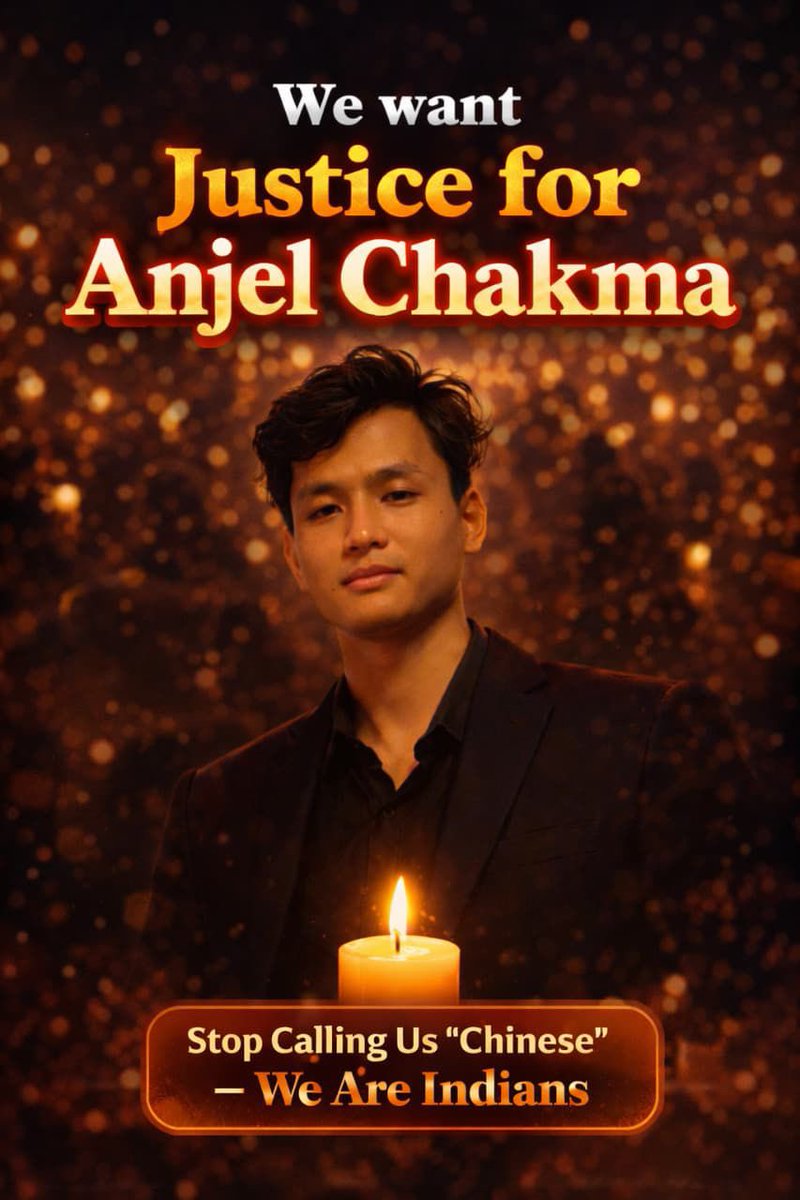
Late Anjel Chakma was preparing to return to his hometown for the holidays, a routine moment of relief every student understands. But that journey never happened. Instead, Anjel’s life was violently altered and ultimately taken in Dehradun, far from home, far from safety and far from the comfort of those who raised him.
His death is not an isolated tragedy. It is a painful and familiar reminder for every family in the Northeast that sends its children away in search of education and a better future.
More than a decade has passed since Nido Taniam, a young student from Arunachal Pradesh, was killed in South Delhi’s Lajpat Nagar. That incident shook the nation’s conscience. Committees were formed, guidelines were drafted, helplines were launched, and special police units were introduced to protect people from the Northeast living outside their home states.
Yet today, looking at Anjel Chakma’s death, we must ask: what truly changed?
What we have not honestly acknowledged is that the Northeast continues to be seen as “different” in the national imagination. That difference has become dangerous. It manifests as casual slurs, suspicion, ridicule and at times, fatal violence. This mindset was not created overnight and it has not disappeared with laws or advisories.
We often comfort ourselves by saying systems are in place. But systems do not control the minds of men. The prejudice that fuels such attacks has existed since the earliest days of our collective existence, passed on quietly, normalised, and tolerated. The question before us is uncomfortable: do we keep forgiving a rotten mindset until more innocent lives are lost?
Enough is enough.
Special helplines and designated police units are not enough to protect students who are targeted because of how they look, speak or belong. What is needed is institutional seriousness, not symbolic gestures. A dedicated national ministry or statutory body that focuses solely on the vulnerabilities, safety and dignity of Northeastern people across India, without distractions, without dilution, must be debated urgently.
Will it work? That remains to be seen. But doing nothing has already failed too many times.
In response to Anjel Chakma’s death, the Chakma Students’ Union proposed a protest at Jantar Mantar, New Delhi, on December 28, 2025, demanding justice and stronger safeguards for students from the Northeast. This protest was not only for Anjel. It was for every student who left home with hope and returned in a coffin or never returned at all. However, the proposed protest by the Chakma Students’ Union Delhi was postponed after police permitted only 50 participants.
Anjel Chakma’s death is not just news. It is memory. It is a warning. It is grief carried by an entire Northeast region.
I write this not to provoke sympathy, but to demand recognition, that the Northeast is not an exception within the nation, and its children are not expendable.
I write this because silence, at this point, is no longer an option.
@pushkardhami@DrManikSaha2@uttarakhandcops@HMOIndia@DelhiPolice@mygovtripura@tripura_cmo@PMOIndia@NodalofficerNE
#JusticeForAnjelChakma
#NortheastLivesMatter
#EnoughIsEnough
#ProtectNortheastStudents
🚨 BIG BREAKING 🚨 People Win! 🔥
Central Government BANS ALL MINING IN ARAVALI 🏞️ This is what happens when the voice of common people becomes unstoppable.
Every one who knows me even in the most cursory manner knows how much I am against the traditional concept of Parda but it doesn’t mean that by any stretch of imagination I can accept what Mr Nitish Kumar has done to a Muslim lady doctor . I condemn it in very strong words . Mr Nitish Kumar owes an unconditional apology to the lady .
It’s shameful to see an adult, in a responsible seat as that of the Chief Minister to touch the veil of a lady in front of him.
In any other nation, the ruling establishment would have punished such an act, the media would have lambasted this act and the person would have resigned from public life in shame.
Be it a hijab, be it a ghoongat, be it a face mask or be it whatever the lady is wearing, NOBODY has the right to touch her, or to pull it off or force it on.
What’s more disgusting is someone defending the act as “father figure” or a minister saying “touched only the naqab, what if he had had touched elsewhere”.
He must be your father figure, isn’t hers! And if he was, it still gives him no right to do this.
If this is the state of politics, and this is acceptable to you, remember it starts with them but comes to you.
When you don’t raise your voice for someone else facing injustice, thinking it’s someone else, the unjust act will come to you, and you won’t be able to raise your voice.
What a shame!
@ZARA@ZARA_Care
I want to exchange an item of my prepaid order, but your app is showing only return option. Can you facilitate the same. Sharing pictures.
Lol, it didn't mean the law is blind, it meant the justice would be delivered without discrimination. Blindfold meant that you check the weight/argument of both sides without knowing them.
In 1996, Indian actor Suniel Shetty saved 128 Nepalese women from a sex trafficking ring in Mumbai. When the Nepalese government refused to repatriate them, Shetty bought airfare for their return and ensured their safety. He kept this act private until one survivor revealed the story 24 years later in an interview.