Sierra Remote Observatories (SRO} is a remotely operated Astronomical Observatory in the Sierra Nevada Mountains, known for unparalleled seeing and darkness.
This spectacular LRGB image of the Cygnus Wall (of NGC 7000) was taken and processed by Ryan McMurray at Sierra Remote Observatories (SRO) in September and October of 2025.
More from Ryan McMurray:
Image Source: https://t.co/ECPvMN4U1F
Discussion by Ryan McMurray: “I shot this data while waiting for my other target to rise enough and ended up capturing quite a bit of data on it. It wasn’t my intention to get quite so much data. I feel like a similar result could have been had with half of what I have here. Although I will say, the masters were virtually free from noise. Made stretching the data real easy and quite enjoyable, ha. The OIII signal in here isn’t too weak, but it also isn’t crazy strong. Just a general overall dusting throughout the nebula that add just enough to make the colors a little more interesting. I chose the more traditional color for the OIII here. The red colors of the ionized hydrogen alpha data dominate this FOV. A more greenish tone for the OIII data against that red…….well, let’s just say, it didn’t make the cut. Ha-ha
For information about the various versions shown, please refer to the image source.
The North American Lagoon
By Ryan McMurray
Published: Oct 6, 2025
Equipment:
- Telescope: AG Optical iDK 14.5 inch F6.7
- Camera: FLI PL16803
- Mount: Software Bisque Paramount ME II GEM
- Filters: Chroma Blue 50x50 mm, Chroma Green 50x50 mm, Chroma H-alpha 3nm Bandpass 50x50 mm, Chroma Lum 50x50 mm, Chroma OIII 3nm Bandpass 50x50 mm, Chroma Red 50x50 mm
- Accessory: Optec Sagitta Off-Axis Guider
- Software: Pleiades Astrophoto PixInsight, Stefan Berg Nighttime Imaging 'N' Astronomy (N.I.N.A. / NINA)
Image Aqcuisition:
Image Acquisition:
Total integration: 60h 35m
Integration per filter:
- Lum/Clear: 18h 5m (217 × 300")
- R: 8h 15m (99 × 300")
- G: 8h 5m (97 × 300")
- B: 7h 40m (92 × 300")
- Hα: 11h 30m (46 × 900")
- OIII: 7h (28 × 900")
Observatory: Sierra Remote Observatories, Auberry, California, USA
Visit us at: https://t.co/lJOzovdMs4 or https://t.co/PIMOKp55No
This vivid and beautiful LRGB image of LDN 1295 was taken and processed by Ryan McMurray at Sierra Remote Observatories (SRO) in August and September of 2025.
More from Ryan McMurray:
Image Source: https://t.co/E0lUP66gpf
Discussion by Ryan McMurray: “This was another fun one I’m calling done. I wanted to get some more L, always need more L. But I’m not sure how much more L would have even added. There is quite a bit of dust here. Ha-ha. More L would have certainly made the image a little smoother. But the noise here isn’t too bad. There is a gradient in the background I could not get rid of. Tried a lot of different methods and it was persistent throughout. When looking at other images of this area, a lot of them do show some mild red tint it the background. So I decided to stop messing with it and call it real! This area is quite stunning in a wide field frame. But I also find it very interesting when just framing LDN 1295/96. Hope you like my version of this dark nebula in Cepheus! Thanks for looking!”
LDN 1295
By Ryan McMurray
Published: Oct 2, 2025
Equipment:
- Telescope: AG Optical iDK 14.5 inch F6.7
- Camera: FLI PL16803
- Mount: Software Bisque Paramount ME II GEM
- Filters: Chroma Blue 50x50 mm, Chroma Green 50x50 mm, Chroma Lum 50x50 mm, Chroma Red 50x50 mm
- Accessory: Optec Sagitta Off-Axis Guider
- Software: Pleiades Astrophoto PixInsight, Stefan Berg Nighttime Imaging 'N' Astronomy (N.I.N.A. / NINA)
Total integration: 27h 10m
Integration per filter:
- Lum/Clear: 15h 35m (187 × 300")
- R: 4h (48 × 300")
- G: 3h 55m (47 × 300")
- B: 3h 40m (44 × 300")
Observatory: Sierra Remote Observatories, Auberry, California, USA
Visit us at: https://t.co/lJOzovekhC or https://t.co/PIMOKp5DCW
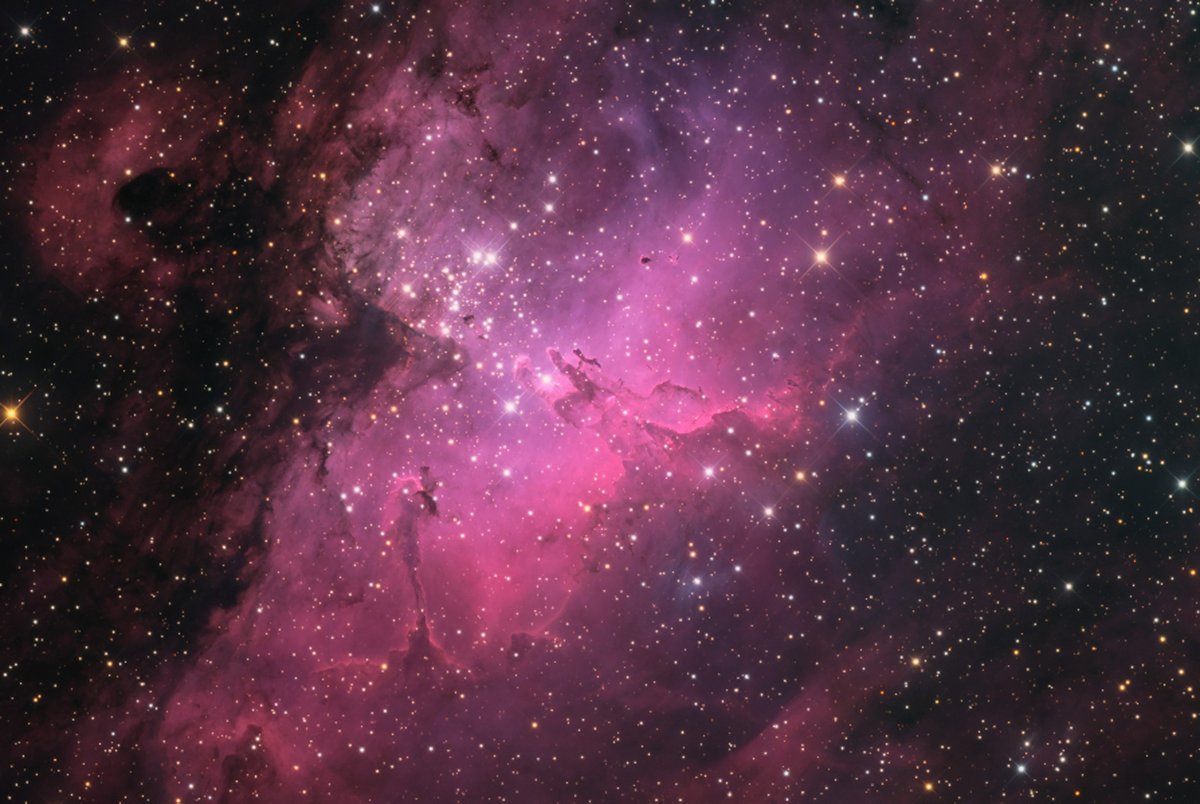
This vivid and beautiful LRGB image of M16 was taken and processed by Ryan McMurray at Sierra Remote Observatories (SRO) in August and September of 2025.
More from Ryan McMurray:
Image Source: https://t.co/WTPKzZOHCu
Discussion by Ryan McMurray: “Shot and processed this nebula back in July but set it down for a little while and just came back with fresh eyes. I did shoot a ton of Ha for it as well, but this area is already so strong with Ha that there honestly wasn’t too much of difference between the R and the Ha. So I just left it out on this one! I’ve never been a very big fan of this nebula. I mean, the pillars are pretty spectacular, but overall something about this nebula I just don’t like. And I shot it hoping I could end up liking it, but alas, my feelings remain! Who knows, maybe it’s the beginning of a love story in which I hate it, but I have to keep coming back to it and adding more data until I end up with an SHOLRGB image and THEN I can find my peace with it.....sounds like a terrible movie. Anyhooooooooo, hope you enjoy my take on one of the most photographed nebulas in the sky. Nothing fancy here, just some pink LRGB, and maybe, just maybe next year I’ll get S and O data, and then, I will be happy.”
M16 LRGB
By Ryan McMurray
Published: Sep 15, 2025
Equipment:
- Telescope: AG Optical iDK 14.5 inch F6.7
- Camera: FLI PL16803
- Mount: Software Bisque Paramount ME II GEM
- Filters: Chroma Blue 50x50 mm, Chroma Green 50x50 mm, Chroma Lum 50x50 mm, Chroma Red 50x50 mm
- Accessory: Optec Sagitta Off-Axis Guider
- Software: Pleiades Astrophoto PixInsight, Stefan Berg Nighttime Imaging 'N' Astronomy (N.I.N.A. / NINA)
Image Acquisition:
Total integration: 14h 40m
Integration per filter:
- Lum/Clear: 6h 40m (80 × 300")
- R: 2h 40m (32 �� 300")
- G: 2h 40m (32 × 300")
- B: 2h 40m (32 × 300")
Observatory: Sierra Remote Observatories, Auberry, California, USA
Visit us at: https://t.co/lJOzovekhC or https://t.co/PIMOKp5DCW
This golden composite Ha/LRGB image IC 342 was taken and processed by Ani Shastry, from data obtained at Sierra Remote Observatories (SRO) in September and October of 2024.
More from Ani Shastry:
Image Source: https://t.co/DMbsER7kb2
Discussion from Ani Shastry: “IC 342 is an intermediate spiral galaxy in the constellation of Camelopardalis as seen from the Earth. Because of its location behind the dusty areas of the galactic equator, it's rather difficult to observe, giving it the nickname "The Hidden Galaxy". It is estimated to be between 7 and 11 million light years away, around 75,000 light years across, and contains approximately 100 billion stars.
I had previously captured this target in early January, with approximately 20 hours of data. However, neither having been satisfied with the amount and quality of the data at the time due to bad seeing conditions, nor the processing and framing of it, I spent the last several weeks gathering another 25 hours or so of data on it. After pruning the lower quality subs from the combined dataset, I was able to aggregate approximately 37 hours of data across two seasons. I also wanted to zoom into the core of the galaxy versus showing the entire field of view; while the IFN surrounding this galaxy is interesting, it is very hard to elucidate sufficient detail from it, plus I wanted to get as much clarity from the galactic structure itself without having to spend a lot of cycles on the rest of the frame.”
Entitled: The Hidden Galaxy (IC 342) Deep-Field in Ha/LRGB
by Ani Shastry
Published: Oct 13, 2024
Equipment:
- Telescope: Planewave CDK14
- Camera: ZWO ASI6200MM Pro
- Mount: Planewave L-350
- Filters: Chroma Blue 50x50 mm, Chroma Green 50x50 mm, Chroma H-alpha 5nm Bandpass 50x50 mm, Chroma Lum 50x50 mm, Chroma Red 50x50 mm
- Accessories: ASG Astronomy ASG Photon Cage, Optec Gemini Rotating Focuser, Optec Sagitta Off-Axis Guider, Pegasus Astro Ultimate Powerbox 3, Planewave Reducer 0.66x CDK12.5-14-17, Rouz Astro Reducer-OAG Kit, ZWO EFW 7 x 50mm Square
- Software: Adobe Photoshop, Pleiades Astrophoto PixInsight, Stefan Berg Nighttime Imaging 'N' Astronomy (N.I.N.A. / NINA)
Image Acquisition:
Total integration: 37h
Integration per filter:
- Lum/Clear: 13h 25m (161 × 300")
- R: 5h 40m (68 × 300")
- G: 5h 50m (70 × 300")
- B: 6h 15m (75 × 300")
- Hα: 5h 50m (35 × 600")
Observatory: Sierra Remote Observatories (SRO), Auberry, CA, USA
Visit us at: https://t.co/lJOzovdMs4 or https://t.co/PIMOKp55No
This beautiful and dramatic composite LRGB/narrow band image of the supernova remnant “SNR G108.2-0.6” was taken and processed by Ani Shastry and Jonas Moiel, from data obtained at Sierra Remote Observatories (SRO) in September and October of 2024.
More from Ani Shastry and Jonas Moiel:
Image Source: https://t.co/Ha6VLlSl4O
Discussion from Ani Shastry and Jonas Moiel: “Anirudh Shastry (@starman_astro) and I (@hyperspaced_imaging) are excited to present our deep-field and extensive 167 hour collaborative image on SNR G108.2-0.6! This spectacular supernova remnant is located in the Cepheus constellation, directly adjacent to the Wizard nebula! Ani pointed out that the white IFN resembles the shape of an elephant and how it looks to be hallucinating in those colorful gasses – hence the title.”
For much more information go to the image source, noted above.
Entitled: "Elephant in the Sky with Diamonds" - A 167 Hour Deep-Field Collaboration
by C. Jonas Moiel and Ani Shastry
Published: Oct 13, 2024
Equipment:
- Telescope: Planewave CDK14
- Cameras: QHYCCD QHY600 Pro M, ZWO ASI6200MM Pro
- Mount: Planewave L-350
- Filters: Astrodon Gen1 E-Series Tru-Balance Blue, Astrodon Gen1 E-Series Tru-Balance Green, Astrodon Gen1 E-Series Tru-Balance Lum, Astrodon Gen1 E-Series Tru-Balance Red, Astrodon H-alpha 5nm 50x50 mm, Astrodon OIII 3nm 50x50 mm, Chroma Blue 50x50 mm, Chroma Green 50x50 mm, Chroma H-alpha 5nm Bandpass 50x50 mm, Chroma Lum 50x50 mm, Chroma OIII 3nm Bandpass 50x50 mm, Chroma Red 50x50 mm
- Accessories: Planewave Reducer 0.66x CDK12.5-14-17, Rouz Astro Reducer-OAG Kit
- Software: Adobe Photoshop, Pleiades Astrophoto PixInsight
Image Acquisition:
Total integration: 167h 10m
Integration per filter:
- Lum/Clear: 21h 55m (263 × 300")
- R: 12h 10m (146 × 300")
- G: 12h (144 × 300")
- B: 11h 25m (137 × 300")
- Hα: 55h (330 × 600")
- OIII: 54h 40m (328 × 600")
Observatory: Sierra Remote Observatories (SRO), Auberry, CA, USA
Visit us at: https://t.co/lJOzovekhC or https://t.co/PIMOKp5DCW
This amazing composite LRGB image of the Iris Nebula (NGC 7023) was taken and processed by Ani Shastry from data obtained at Sierra Remote Observatories (SRO) in September of 2024.
More from Ani Shastry:
Image Source: https://t.co/2kJ0M6aktv
Discussion from Ani Shastry: “A brilliant blue pearl hidden at the center of a celestial oyster, the Iris Nebula (NGC 7023), is a reflection nebula in the constellation of Cepheus. This is one of my favorite targets as there is so much latitude to process it to better highlight and focus on different structures. I've shot this with various different telescopes, but this time I wanted to get a lot of data, and try to bring out what I perceive as the dimensionality to the nebular structures. I can see it in the processing, but I also created a composition in after effects showing how I think the nebula might actually look like in 3 dimensions.
This was the depth mask that I generated from the super-luminance data, with the addition of HDR multiscale transform, and additional processing in Photoshop to make the core feel deeper and buried within the rest of the outer structures of the nebula. I also did further processing to selectively separate layers in the wispy structures in the corners of the image, which elucidates the layering of gas and dust in the video rendition.”
For more information and detail go to the image source noted above.
The Iris Nebula (NGC 7023) in LRGB with structural dimensionality by Ani Shastry
Published: Sep 30, 2024
Equipment:
- Telescope: Planewave CDK14
- Camera: ZWO ASI6200MM Pro
- Mount: Planewave L-350
- Filters: Chroma Blue 50x50 mm, Chroma Green 50x50 mm, Chroma Lum 50x50 mm, Chroma Red 50x50 mm
- Accessories: ASG Astronomy ASG Photon Cage, Optec Gemini Rotating Focuser, Optec Sagitta Off-Axis Guider, Pegasus Astro Ultimate Powerbox 3, Planewave Reducer 0.66x CDK12.5-14-17, Rouz Astro Reducer-OAG Kit, ZWO EFW 7 x 50mm Square
- Software: Adobe Photoshop, Pleiades Astrophoto PixInsight, Russell Croman Astrophotography BlurXTerminator, Russell Croman Astrophotography NoiseXTerminator, Russell Croman Astrophotography StarXTerminator, Stefan Berg Nighttime Imaging 'N' Astronomy (N.I.N.A. / NINA)
Image Acquisition:
Total integration: 35h 20m
Integration per filter:
- Lum/Clear: 11h 50m (142 × 300")
- R: 6h 35m (79 × 300")
- G: 7h 25m (89 × 300")
- B: 9h 30m (114 × 300")
Observatory: Sierra Remote Observatories (SRO), Auberry, CA, USA
Visit us at: https://t.co/lJOzovdMs4 or https://t.co/PIMOKp55No
This misty composite luminance + narrow band image of LDN 1368 was taken and processed by Sam Miller at Sierra Remote Observatories (SRO) in November of 2025.
LDN 1368 is a small dark nebula located in the constellation Cassiopeia, approximately 7,500 light-years away from Earth. Embedded within the iconic Heart Nebula (IC 1805), this cloud is composed of dense interstellar dust that absorbs and blocks light from background stars and glowing gas, causing it to appear as a stark dark silhouette.
More from Sam Miller:
Image Source: https://t.co/0rCZzTtMtN
The LDN 1368
by Samuel A Miller
Published: Dec 9, 2025
Equipment:
- Telescope: RCOS 12.5" f/9 Carbon Tube Ritchey-Chrétien
- Camera: ZWO ASI6200MM Pro
- Mount: Planewave L-350
- Software: Adobe Lightroom Mobile, Open PHD Guiding Project PHD2, Pleiades Astrophoto PixInsight, Stefan Berg Nighttime Imaging 'N' Astronomy (N.I.N.A. / NINA)
Image Acquisition:
LDN 1368 in OSS
HA 49 @ 600s 8hr 10
Oiii 56 @ 600s 9hr 20
Sii 49 @ 600s 8hr 10
Lum 30 @ 300s 2hr 30
Observatory: Sierra Remote Observatories (SRO), Auberry, California, USA
Visit us at: https://t.co/lJOzovekhC or https://t.co/I4hBDKRufP
This beautiful composite RGB + Ha image of IC 1805 was taken and processed by Sam Miller at Sierra Remote Observatories (SRO) in February of 2026.
Located within the constellation Cassiopeia at a distance of roughly 7,500 light-years, IC 1805 is a large emission nebula commonly referred to as the Heart Nebula. This designation stems from its morphology, where luminous ionized gas and obscuring dust lanes trace the outline of a heart.
More from Sam Miller:
Image Source: https://t.co/VDgt2RMMaW
Heart Nebula: IC 1805
by Samuel A Miller
Published: Feb 28, 2026
Equipment:
- Telescope: Sharpstar 61EDPH III
- Camera: ZWO ASI1600MM COOL
- Mount: Planewave L-350
Image Acquisition:
RGB/Ha Image
Observatory: Sierra Remote Observatories (SRO), Auberry, California, USA
Visit us at: https://t.co/lJOzovekhC or https://t.co/I4hBDKRufP
This stunning narrow band image of LDN 895 was taken and processed by Sam Miller at Sierra Remote Observatories (SRO) in February and November of 2025.
Located approximately 5,500 light-years away in the constellation Cygnus, LDN 895 (Lynds' Dark Nebula 895) is a dense interstellar cloud. As a member of Beverly Lynds' definitive 1962 catalogue of dark nebulae, it consists of concentrated cosmic dust and gas. Because these elements absorb and scatter visible wavelengths, the structure effectively blocks light emanating from background stars or nearby glowing emission nebulae
More from Sam Miller:
Image Source: https://t.co/QnhNOGZ9kF
Discussion by Sam Miller: “I’ve been staring at this one for too long and sick of making little tweaks to it.
This is a revision to data from Oct 2025, this time using Seti Astro’s tools (fantastic kit) such as Palette picker and the DBE. Seti’s tools bring life to the image, and I’m a huge fan.”
The LDN 895, Revision Edition
by Samuel A Miller
Published: Dec 1, 2025
Equipment:
- Telescope: RCOS 12.5" f/9 Carbon Tube Ritchey-Chrétien
- Camera: ZWO ASI6200MM Pro
- Mount: Planewave L-350
- Software: Adobe Lightroom Mobile, Open PHD Guiding Project PHD2, Pleiades Astrophoto PixInsight, Stefan Berg Nighttime Imaging 'N' Astronomy (N.I.N.A. / NINA)
Observatory: Sierra Remote Observatories (SRO), Auberry, California, USA
Visit us at: https://t.co/lJOzovekhC or https://t.co/I4hBDKRufP
This exquisite LRGB image of NGC 4395 was taken and processed by Jason and James Providakes at Sierra Remote Observatories (SRO) in February and March of 2026.
More from Jason and James Providakes:
Image Source: https://t.co/DZixGW1pa1
Discussion by Jason and James Providakes: “Captured NGC4395 over multiple nights using LRGB Filters. NGC 4395 is a nearby low surface brightness spiral galaxy located about 14 million light-years from Earth in the constellation Canes Venatici [Ref: WikiPedia]”
NGC 4395 in LRGB
by James, Jason Providakes
Published: Mar 23, 2026
Equipment:
- Telescope: Planewave CDK20 (f/6.8 version)
- Camera: ZWO ASI6200MM Pro
- Mount: Planewave L-500
- Filters: Antlia Blue 2", Antlia Green 2", Antlia Red 2"
- Accessory: Planewave Integrated Rotating Focuser
- Software: Pleiades Astrophoto PixInsight, Russell Croman Astrophotography BlurXTerminator, Russell Croman Astrophotography NoiseXTerminator, Russell Croman Astrophotography StarXTerminator, Stark Labs PHD Guiding, Stefan Berg Nighttime Imaging 'N' Astronomy (N.I.N.A. / NINA), Steffen Hirtle GraXpert
Observatory: Sierra Remote Observatories (SRO), Auberry, California, USA
Visit us at: https://t.co/lJOzovekhC or https://t.co/I4hBDKRufP
This lovely composite HOO image of IC 1318 was taken and processed by James and Jason Providakes from data obtained from Sierra Remote Observatories (SRO) in October of 2025.
He used a color camera for this, assigning the Ha signal to the red channel and the OIII data to the green and blue channels (OIII is centered at 500.7 nm, right at the junction of green and blue). The image is assembled as an HOO image.
Image Source: https://t.co/yCP39NDya9
Discussion by Jason and James Providakes: “The Gamma Cygni Nebula, or Sadr Region, is a large diffuse emission nebula in Cygnus the Swan. Centered around the bright star Sadr, this region near the Milky Way is rich in glowing hydrogen gas and dark dust. [Ref: Telesopius]”
IC1318 Gamma Cygni Nebula - HOO Color Pallet
by James and Jason Providakes
Published: Sep 7, 2025
Equipment:
- Telescope: Askar 185APO
- Camera: ZWO ASI2600MC Pro
- Mount: Software Bisque Paramount ME GEM
- Filter: Optolong L-eXtreme 2" (Optolong 2" L-eXtreme Dual Band 7nm HA/OIII)
- Accessories: Atik Filter Wheel EFW2, Pegasus Astro Falcon Rotator 2, PrimaLuceLab SESTO SENSO 2, ZWO OAG-L
- Software: Pleiades Astrophoto PixInsight, Russell Croman Astrophotography BlurXTerminator, Russell Croman Astrophotography NoiseXTerminator, Russell Croman Astrophotography StarXTerminator, Software Bisque TheSky, Stark Labs PHD Guiding, Stefan Berg Nighttime Imaging 'N' Astronomy (N.I.N.A. / NINA)
Image Acquisition:
Total integration: 7h 25m
Integration per filter:
- Multiband: 7h 25m (89 × 300")
Observatory: Sierra Remote Observatories (SRO), Auberry, California, USA
Visit us at: https://t.co/lJOzovekhC or https://t.co/I4hBDKRufP
This vivid composite Ha/LRGB image of SH2-140 was taken and processed by Jason Providakes at Sierra Remote Observatories (SRO) in August of 2025.
Sh2-140 is a compact emission nebula and active stellar nursery located 3,000 light-years away in the constellation Cepheus. Part of the expansive Cepheus Bubble, its signature red glow is powered by the star HD 211880, which ionizes surrounding hydrogen. This energetic environment serves as a primary site for new star formation within a massive shell of cosmic gas and dust.
Often called the "hidden" nebula, its interior is partially obscured by the dark foreground cloud LDN 1204. A prominent feature is its bright bow shock, created as radiation from young stars slams into the edge of a nearby molecular cloud. This interaction creates a striking visual contrast between glowing ionized gas and dense, dark dust.
More from Jason Providakes
Image Source: https://t.co/IKymoqIaYc
Discussion from Jason Providakes: “Sharpless 140 is an H II region and emission nebula in the Cepheus constellation, 3,000 light years from the Solar System. It is part of the Cepheus bubble.[Ref: WikiPedia]”
SH2-140 Emission Nebula
by James, Jason Providakes
Published: Aug 25, 2025
Equipment:
- Telescope: Planewave CDK20 (f/6.8 version)
- Camera: ZWO ASI6200MM Pro
- Mount: Planewave L-500
- Filters: Antlia 3nm Narrowband H-alpha 50 mm, Antlia Blue 2", Antlia Green 2", Antlia Red 2"
- Accessory: Planewave Integrated Rotating Focuser
Image Acquisition:
Total integration: 12h 45m
Integration per filter:
- R: 3h 15m (39 × 300")
- G: 2h 55m (35 × 300")
- B: 2h 45m (33 × 300")
- Hα: 3h 50m (46 × 300")
Observatory: Sierra Remote Observatories (SRO), Auberry, California, USA
Visit us at: https://t.co/lJOzovekhC or https://t.co/PIMOKp5DCW
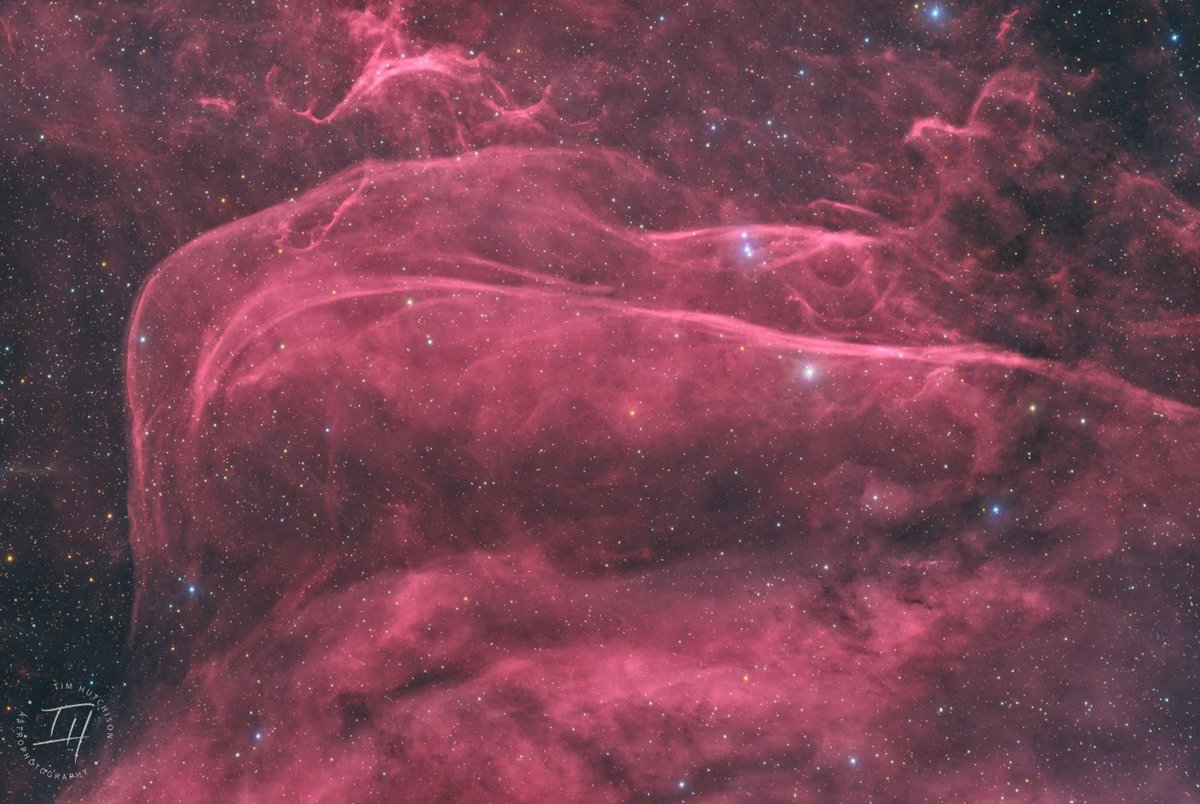
This wispy and delicate composite RGB + Narrow Band image of LBN 380 was taken and processed by Tim Hutchison at Sierra Remote Observatories (SRO) in October of 2023.
LBN 380 is a faint, rarely imaged HII emission nebula located in the constellation Cygnus. It acts as a vibrant star-forming region, featuring complex filaments of glowing hydrogen, sulfur, and oxygen. Despite being located near the brighter Sh2-115, LBN 380 holds its own structural significance, providing a complex, intricate target rather than just being a part of its neighbor.
More from Tim Hutchison:
Image Source: https://t.co/6JeKfOikON
Discussion by Tim Hutchison: “Back in July I was looking for an Ha target during a bright moon. I poked around in Cygnus and said "let's give this a shot...". I was pleasantly surprised with the resulting image. It is not one that is often the main target of astrophotographers, but I thought the wispy structures were kind of pretty.”
Published: Oct 12, 2023
Equipment:
- Telescope: TEC APO200FL
- Camera: Moravian Instruments C3-61000 PRO
- Mount: 10Micron GM2000 HPS II
- Filters: Chroma Blue, Chroma Green, Chroma H-alpha 3nm Bandpass 50 mm, Chroma OIII 3nm Bandpass 50 mm, Chroma Red, Chroma SII 3nm Bandpass 50 mm
- Software: Pleiades Astrophoto PixInsight, Starkeeper Voyager
Image Acquisition:
Total integration: 67h 30m
Integration per filter:
- R: 2h 30m (30 × 300")
- G: 2h 30m (30 × 300")
- B: 2h 30m (30 × 300")
- Hα: 30h (60 × 1800")
- SII: 15h (30 × 1800")
- OIII: 15h (30 × 1800")
Observatory: Sierra Remote Observatories (SRO) in Auberry, California, USA
VISIT US AT: https://t.co/lJOzovekhC or https://t.co/PIMOKp5DCW
This composite RGB + Narrow Band image of NGC 1491 was taken and processed by Tim Hutchison at Sierra Remote Observatories (SRO) in October of 2023.
NGC 1491, commonly known as the Fossil Footprint or Little Pacman Nebula, is a vibrant emission nebula and H II region located roughly 9,800 to 10,700 light-years away in the constellation Perseus. Discovered by William Herschel in 1790, this star-forming cloud lies within the Milky Way's Perseus arm.
The nebula is powered by massive, hot stars, particularly the 11th-magnitude blue star BD+50 886, which emits intense ultraviolet radiation that ionizes surrounding hydrogen, causing it to glow in deep red hues. Strong stellar winds from this central star have carved a distinct bubble and complex structures into the gas, creating a shape reminiscent of the Bubble Nebula.
More from Tim Hutchison:
Image Source: https://t.co/J1otaS3lIe
Discussion by Tim Hutchison: “I framed this specifically to get the little "cluster" in the lower left, only to find that I am unable to find any object designation for it. Does anyone have any ideas???”
Published: Oct 24, 2023
Equipment:
- Telescope: TEC APO200FL
- Camera: Moravian Instruments C3-61000 PRO
- Mount: 10Micron GM2000 HPS II
- Filters: Chroma Blue, Chroma Green, Chroma H-alpha 3nm Bandpass 50 mm, Chroma OIII 3nm Bandpass 50 mm, Chroma Red, Chroma SII 3nm Bandpass 50 mm
- Software: Pleiades Astrophoto PixInsight, Starkeeper Voyager
Image Acquisition:
Total integration: 21h
Integration per filter:
- R: 2h (12 × 600")
- G: 2h (12 × 600")
- B: 2h (12 × 600")
- Hα: 5h (15 × 1200")
- SII: 5h (15 × 1200")
- OIII: 5h (15 × 1200")
Observatory: Sierra Remote Observatories (SRO) in Auberry, California, USA
VISIT US AT: https://t.co/lJOzovekhC or https://t.co/PIMOKp5DCW
This beautiful composite RGB + Narrow Band image of NGC 281 was taken and processed by Tim Hutchison at Sierra Remote Observatories (SRO) in December of 2023.
More from Tim Hutchison:
Image Source: https://t.co/klkSh9zoYW
Discussion by Tim Hutchison: “NGC281 is a bright emission nebula in Cassiopeia and is part of the Milky Way’s Perseus arm. It was recently estimated at 9200 light years from Earth.
This is the third time that I have imaged this object, once with an 8" SCT, once with a 130mm refractor, and now with my TEC-200 8" refractor. I'm getting happier with the results each time. I guess it's time for a new telescope J”
Published: Dec 7, 2023
Equipment:
- Telescope: TEC APO200FL
- Camera: Moravian Instruments C3-61000 PRO
- Mount: 10Micron GM2000 HPS II
- Filters: Chroma Blue, Chroma Green, Chroma H-alpha 3nm Bandpass 50 mm, Chroma OIII 3nm Bandpass 50 mm, Chroma Red, Chroma SII 3nm Bandpass 50 mm
- Software: Pleiades Astrophoto PixInsight, Starkeeper Voyager
Image Acquisition:
Total integration: 45h
Integration per filter:
- R: 5h (30 × 600")
- G: 5h (30 × 600")
- B: 5h (30 × 600")
- Hα: 10h (30 × 1200")
- SII: 10h (30 × 1200")
- OIII: 10h (30 × 1200")
Observatory: Sierra Remote Observatories (SRO) in Auberry, California, USA
VISIT US AT: https://t.co/lJOzovekhC or https://t.co/PIMOKp5DCW
This lovely Luminance image of NGC 2403 was taken and processed by Robert Majewski at Sierra Remote Observatories (SRO) in January of 2026.
NGC 2403, also known as Caldwell 7, is a vibrant intermediate spiral galaxy situated roughly 8 to 10 million light-years away in the constellation Camelopardalis. A key member of the M81 Group, it is often nicknamed the "Little Triangulum" due to its striking similarity to the Triangulum Galaxy. Though it is about half the size of the Milky Way, spanning 50,000 to 90,000 light-years, its loosely wound spiral arms and faint central bar make it a standout subject for deep-space observation.
This galaxy is a powerhouse of cosmic activity, recognized as a "starburst" hotspot filled with over 100 glowing H II regions where new stars are rapidly being born. Beyond its intense star formation, NGC 2403 is notable for its history of supernovae, including the famous SN 2004dj, which was the brightest event of its kind seen in over a decade. These dynamic features, from its pinkish hydrogen clouds to its explosive stellar deaths, make it a vital laboratory for understanding galactic evolution.
More from Robert Majewski:
Image Source: https://t.co/FyuI8wWadu
NGC 2403
by Robert Majewski
Published: Feb 9, 2026
Equipment:
- Telescope: Celestron EdgeHD 11"
- Camera: ZWO ASI2600MM Pro
- Mount: Astro-Physics 1150GTO-AE
- Filter: Antlia Luminance 2"
- Accessory: MoonLite CSL 2.5 inch Large Format Crayford SCT/RC Focuser
- Software: Pleiades Astrophoto PixInsight, DIY Image Auto-guiding
Image Acquisition:
Total integration: 8h
Integration per filter:
Lum/Clear: 8h (2880 × 10")
Observatory: Sierra Remote Observatories (SRO) in Auberry, California, USA
VISIT US AT: https://t.co/lJOzovekhC or https://t.co/PIMOKp5DCW
This beautifully detailed RGB image of M1 (The Crab Nebula) was taken and processed by Robert Majewski at Sierra Remote Observatories (SRO) in November and December of 2025.
More from Robert Majewski:
Image Source: https://t.co/o2iRxcHvG7
Discussion by Robert Majewski: “This RGB image of the Crab Nebula (M1) uses short 15-second exposures to maximize fine detail and avoid saturating the bright filamentary structure. The brief exposure time was selected to preserve the intricate network of expanding gas filaments, while maintaining color fidelity across the nebula's dynamic range. The image was processed to provide a misty look and feel.
M1 is the remnant of a supernova explosion observed by Chinese astronomers in 1054 CE. Located in Taurus at approximately 6,500 light-years distance, this expanding cloud of gas and dust is powered by a pulsar at its core - a rapidly rotating neutron star spinning 30 times per second.
The reddish filaments visible throughout are primarily hydrogen-alpha emission from shocked gas expanding at roughly 1,500 km/s. The bluish glow comes from synchrotron radiation produced by high-energy electrons spiraling in the pulsar's intense magnetic field.
The Pulsar (bright star at the center of this image) and inner polar jet shock-waves at the 2 and 8 o'clock positions are well defined in this image.”
M1 - Inside the Crab: Short Exposures Preserve Pulsar Wind Structure
by Peter Boreland, Robert Majewski
Published: Dec 16, 2025
Equipment:
- Telescope: Celestron EdgeHD 11"
- Camera: ZWO ASI2600MM Pro
- Mount: Astro-Physics 1150GTO-AE
- Filters: Antlia Blue 2", Antlia Green 2", Antlia Red 2"
- Accessory: MoonLite CSL 2.5 inch Large Format Crayford SCT/RC Focuser
- Software: Pleiades Astrophoto PixInsight, Russell Croman Astrophotography BlurXTerminator, Russell Croman Astrophotography NoiseXTerminator
Image Acquisition:
Total integration: 12h 19m
Integration per filter:
- R: 5h 36m (1344 × 15")
- G: 3h 21m 30s (806 × 15")
- B: 3h 21m 30s (806 × 15")
Observatory: Sierra Remote Observatories (SRO) in Auberry, California, USA
VISIT US AT: https://t.co/lJOzovekhC or https://t.co/PIMOKp5DCW
This stellar Luminance image of NGC 891 was taken and processed by Robert Majewski at Sierra Remote Observatories (SRO) in November of 2025.
Located roughly 30 million light-years away in the Andromeda constellation, NGC 891 is a striking spiral galaxy often called the Silver Sliver. Because it is oriented nearly 90 degrees from our line of sight, we see it perfectly edge-on, making it a "twin" for how the Milky Way would appear to an outside observer. This unique perspective features a massive, dark lane of interstellar dust that cuts right through its glowing center, bisecting the galaxy’s long axis.
As the primary member of the NGC 1023 group, this galaxy is a goldmine for scientists studying vertical galactic structures. High-resolution images from the Hubble Space Telescope have captured delicate filaments of gas and dust reaching hundreds of light-years above and below its main plane. Researchers believe these dramatic plumes are the result of intense star formation and supernova explosions—"galactic winds" that blast material out from the disk into the surrounding halo.
More from Robert Majewski:
Image Source: https://t.co/1jx1M18qDg
by Robert Majewski
Published: Nov 30, 2025
Equipment:
- Telescope: Celestron EdgeHD 11"
- Camera: ZWO ASI2600MM Pro
- Mount: Astro-Physics 1150GTO-AE
- Filter: Antlia Luminance 2"
- Accessory: MoonLite Revised CHL 2.5 inch Large Format Crayford EDGE Focuser
- Software: Pleiades Astrophoto PixInsight, Russell Croman Astrophotography BlurXTerminator, DIY Image Auto-guiding
Image Acquisition:
Total integration: 10h 8m
Integration per filter:
Lum/Clear: 10h 8m (3648 × 10")
Observatory: Sierra Remote Observatories (SRO) in Auberry, California, USA
VISIT US AT: https://t.co/lJOzovekhC or https://t.co/PIMOKp5DCW
This majestic and complex composite LRGB + Ha/SII/OIII image of SH2-101 was taken and processed by Terry Kiser. The image was taken at Sierra Remote Observatories (SRO) in July of 2025.
More from Terry Kiser:
Image Source: https://t.co/fUDik4iwDz
Discussion from Terry Kiser: “Continuing my new experiences with using my 11" Edge SCT and off-axis guiding, I chose this bright, but seemingly somewhat less popular, nebula to test my NB processing in PixInsight after several years off from Astrophotography. I was surprised with the many changes and new processes available in that short time.
This project took place from 07/03/2025 - 07/08/2025 and 07/14/2025 - 07/16/2025. This is my 1st time collecting RGB data to provide RGB stars and in using StarXterminator to aid in some processing steps. I'm not sure it's much better than taking stars from the separate NB masters and simulating RGB stars using the Seti Astro script "NB to RGBStar Combination". Maybe others familiar with this process can chime in and correct or advise me.”
Sh2-101 Tulip Nebula HubblePalette by Terry Kiser
Published: Aug 3, 2025
Equipment:
- Telescope: Celestron EdgeHD 11"
- Camera: ZWO ASI2600MM Pro
- Mount: Astro-Physics 1100GTO
- Filters: Astronomik Deep-Sky Blue 2", Astronomik Deep-Sky Green 2", Astronomik Deep-Sky Red 2", Astronomik H-alpha CCD 6nm 2", Astronomik L-2 Luminance UV/IR Block 2", Astronomik OIII CCD 6nm 2", Astronomik SII CCD 6nm 2"
- Accessories: Celestron 0.7X Reducer EdgeHD1100 (94241), Optec TCF-Leo Low Profile Focuser, Pegasus Astro Falcon Rotator, Pegasus Astro Powerbox Advance, ZWO EFW 7 x 2″, ZWO OAG M68
- Software: Pleiades Astrophoto PixInsight, Russell Croman Astrophotography BlurXTerminator, Russell Croman Astrophotography NoiseXTerminator, Russell Croman Astrophotography StarXTerminator, Stefan Berg Nighttime Imaging 'N' Astronomy (N.I.N.A. / NINA), Steffen Hirtle GraXpert
Image Acquisition:
Total integration: 31h
Integration per filter:
- R: 20m (40 × 30")
- G: 20m (40 × 30")
- B: 20m (40 × 30")
- Hα: 10h 30m (126 × 300")
- SII: 9h 30m (114 × 300")
- OIII: 10h (120 × 300")
Observatory: Sierra Remote Observatories (SRO), Auberry, California, USA
Visit us at: https://t.co/lJOzovekhC or https://t.co/PIMOKp5DCW







![SRO_RemoteObs's tweet photo. This exquisite LRGB image of NGC 4395 was taken and processed by Jason and James Providakes at Sierra Remote Observatories (SRO) in February and March of 2026.
More from Jason and James Providakes:
Image Source: https://t.co/DZixGW1pa1
Discussion by Jason and James Providakes: “Captured NGC4395 over multiple nights using LRGB Filters. NGC 4395 is a nearby low surface brightness spiral galaxy located about 14 million light-years from Earth in the constellation Canes Venatici [Ref: WikiPedia]”
NGC 4395 in LRGB
by James, Jason Providakes
Published: Mar 23, 2026
Equipment:
- Telescope: Planewave CDK20 (f/6.8 version)
- Camera: ZWO ASI6200MM Pro
- Mount: Planewave L-500
- Filters: Antlia Blue 2", Antlia Green 2", Antlia Red 2"
- Accessory: Planewave Integrated Rotating Focuser
- Software: Pleiades Astrophoto PixInsight, Russell Croman Astrophotography BlurXTerminator, Russell Croman Astrophotography NoiseXTerminator, Russell Croman Astrophotography StarXTerminator, Stark Labs PHD Guiding, Stefan Berg Nighttime Imaging 'N' Astronomy (N.I.N.A. / NINA), Steffen Hirtle GraXpert
Observatory: Sierra Remote Observatories (SRO), Auberry, California, USA
Visit us at: https://t.co/lJOzovekhC or https://t.co/I4hBDKRufP](https://pbs.twimg.com/media/HLEoWdrasAEie8g.jpg)
![SRO_RemoteObs's tweet photo. This lovely composite HOO image of IC 1318 was taken and processed by James and Jason Providakes from data obtained from Sierra Remote Observatories (SRO) in October of 2025.
He used a color camera for this, assigning the Ha signal to the red channel and the OIII data to the green and blue channels (OIII is centered at 500.7 nm, right at the junction of green and blue). The image is assembled as an HOO image.
Image Source: https://t.co/yCP39NDya9
Discussion by Jason and James Providakes: “The Gamma Cygni Nebula, or Sadr Region, is a large diffuse emission nebula in Cygnus the Swan. Centered around the bright star Sadr, this region near the Milky Way is rich in glowing hydrogen gas and dark dust. [Ref: Telesopius]”
IC1318 Gamma Cygni Nebula - HOO Color Pallet
by James and Jason Providakes
Published: Sep 7, 2025
Equipment:
- Telescope: Askar 185APO
- Camera: ZWO ASI2600MC Pro
- Mount: Software Bisque Paramount ME GEM
- Filter: Optolong L-eXtreme 2" (Optolong 2" L-eXtreme Dual Band 7nm HA/OIII)
- Accessories: Atik Filter Wheel EFW2, Pegasus Astro Falcon Rotator 2, PrimaLuceLab SESTO SENSO 2, ZWO OAG-L
- Software: Pleiades Astrophoto PixInsight, Russell Croman Astrophotography BlurXTerminator, Russell Croman Astrophotography NoiseXTerminator, Russell Croman Astrophotography StarXTerminator, Software Bisque TheSky, Stark Labs PHD Guiding, Stefan Berg Nighttime Imaging 'N' Astronomy (N.I.N.A. / NINA)
Image Acquisition:
Total integration: 7h 25m
Integration per filter:
- Multiband: 7h 25m (89 × 300")
Observatory: Sierra Remote Observatories (SRO), Auberry, California, USA
Visit us at: https://t.co/lJOzovekhC or https://t.co/I4hBDKRufP](https://pbs.twimg.com/media/HLEhkvkboAAQ0-w.jpg)
![SRO_RemoteObs's tweet photo. This vivid composite Ha/LRGB image of SH2-140 was taken and processed by Jason Providakes at Sierra Remote Observatories (SRO) in August of 2025.
Sh2-140 is a compact emission nebula and active stellar nursery located 3,000 light-years away in the constellation Cepheus. Part of the expansive Cepheus Bubble, its signature red glow is powered by the star HD 211880, which ionizes surrounding hydrogen. This energetic environment serves as a primary site for new star formation within a massive shell of cosmic gas and dust.
Often called the "hidden" nebula, its interior is partially obscured by the dark foreground cloud LDN 1204. A prominent feature is its bright bow shock, created as radiation from young stars slams into the edge of a nearby molecular cloud. This interaction creates a striking visual contrast between glowing ionized gas and dense, dark dust.
More from Jason Providakes
Image Source: https://t.co/IKymoqIaYc
Discussion from Jason Providakes: “Sharpless 140 is an H II region and emission nebula in the Cepheus constellation, 3,000 light years from the Solar System. It is part of the Cepheus bubble.[Ref: WikiPedia]”
SH2-140 Emission Nebula
by James, Jason Providakes
Published: Aug 25, 2025
Equipment:
- Telescope: Planewave CDK20 (f/6.8 version)
- Camera: ZWO ASI6200MM Pro
- Mount: Planewave L-500
- Filters: Antlia 3nm Narrowband H-alpha 50 mm, Antlia Blue 2", Antlia Green 2", Antlia Red 2"
- Accessory: Planewave Integrated Rotating Focuser
Image Acquisition:
Total integration: 12h 45m
Integration per filter:
- R: 3h 15m (39 × 300")
- G: 2h 55m (35 × 300")
- B: 2h 45m (33 × 300")
- Hα: 3h 50m (46 × 300")
Observatory: Sierra Remote Observatories (SRO), Auberry, California, USA
Visit us at: https://t.co/lJOzovekhC or https://t.co/PIMOKp5DCW](https://pbs.twimg.com/media/HI6FTMebAAAwwXR.jpg)