@eliz883 Your gesture is truly inspiring ❤️
Not just because of the gift, but because of your pure and sincere intention to bring joy and peace to the hearts of others.
I hope that whoever receives this gift will experience a genuine smile and a sense of kindness 🌟
I actually enjoyed the simplistic elegance of the paper. You really have to write a DSL to understand the consequences of what he's proposing. The core translation—mapping truth to 0, logical connectives to polynomial operations—provides a direct path from specifications to verifiable computation.
The polynomial semantics proved remarkably faithful to logical structure. Conjunction and universal quantification map to addition, exploiting the property that sums of non-negative values vanish only when all summands vanish. The squaring operation in equality predicates (t=u) ↦ (t-u)² ensures soundness by preventing cancellation between positive and negative values—a subtlety whose importance only became apparent during implementation.
However, several challenges emerged. Polynomial degree grows exponentially with disjunction depth, as each OR operation multiplies degrees. A formula with n nested disjunctions yields degree O(2ⁿ), quickly exceeding practical bounds. The sign gadget for negation, while theoretically sound, introduces auxiliary Boolean variables that complicate the constraint system.
A real R1CS compiler following this approach requires sophisticated engineering. Wire allocation demands careful state management to avoid redundant constraints. Subexpression caching proved essential—without it, common terms generate duplicate constraint sets. The compilation pipeline involves polynomial flattening, degree analysis, and constraint minimization phases that significantly exceed the complexity suggested by the paper's mathematical exposition.
Tooling infrastructure remains underdeveloped for all these types of approaches, but much more so here. Integration with production zkSNARK systems (Groth16, PLONK, Halo2) requires additional translation layers. Debugging tools are primitive—logical errors manifest as unsatisfiable constraints with no clear correspondence to source formulas. The semantic gap between high-level specifications and low-level polynomial constraints necessitates extensive intermediate representations.
If one want to run a back of the napkin performance analysis you can start with Cryptographic primitives, which compile inefficiently: a SHA-256 hash function, typically requiring ~30,000 hand-optimized constraints, expands to millions through direct compilation. No optimization strategies exist for recognizing and efficiently compiling common patterns like range proofs or elliptic curve operations.
Tl;dr its brilliant, but not a practical approach.
I reviewed the paper and wrote an EDSL in Lean based on it. My implementation demonstrates how first-order logic compiles directly to polynomial constraints, providing the missing link between high-level cryptocurrency invariants and low-level zkSNARK circuits. By mapping logical formulas to R1CS, developers can specify complex financial systems declaratively while achieving cryptographic verifiability.
The core insight: monetary invariants are logical statements. "Total supply remains constant" becomes ∀tx. sum(inputs) = sum(outputs). "No double spending" becomes ∀coin. spent(coin) ⇒ ¬spendable(coin). These specifications compile automatically to polynomial constraints, eliminating manual circuit construction—the primary barrier to zkEVM adoption.
The polynomial semantics handles the full complexity of financial logic. Negation through sign gadgets enables expressing invalidity conditions—quantifiers over finite domains model transaction batches. The sparse polynomial representation keeps verification costs manageable even for complex state transitions. Most critically, conjunction's additive compilation means combining multiple invariants doesn't compound proof complexity, essential for composable financial protocols.
The R1CS output integrates directly with existing zkSNARK toolchains (Groth16, PLONK, Halo2). A balance check requiring hundreds of hand-written constraints reduces to a single logical formula. The compiler handles witness generation, wire allocation, and constraint optimization automatically.
Here's the code:
-- ArithFOL.lean — Lean 4 EDSL for Gabbay-style arithmetised first-order logic
-- Author: Charles Hoskinson License: MIT
--
-- * Full polynomial semantics (truth ≙ 0) + complete R1CS compiler.
-- * Extra Poly utilities (pow / evaluate / degree / leadingCoeff / isZero / isConst).
-- * Pretty R1CS printer and runnable examples at bottom.
-- ---------------------------------------------------------------------------
import https://t.co/omgOUO8seD.RBMap.Lemmas
open Std (RBMap)
/-! ### Signature --------------------------------------------------------- -/
structure FuncSymbol where name : String := "" ; arity : Nat := 0
structure PredSymbol where name : String := "" ; arity : Nat := 0
/-! ### Syntax: de-Bruijn terms & formulas -------------------------------- -/
inductive Term : Nat → Type
| var {n} : Fin n → Term n
| const {n} : Rat → Term n
| indet {n} : Term n -- distinguished X
| add {n} : Term n → Term n → Term n
| mul {n} : Term n → Term n → Term n
| neg {n} : Term n → Term n
| func {n} : (f : FuncSymbol) → (Fin f.arity → Term n) → Term n
inductive Formula : Nat → Type
| top {n} : Formula n
| bot {n} : Formula n
| eq {n} (t u : Term n) : Formula n
| pred {n} (P : PredSymbol) (args : Fin P.arity → Term n) : Formula n
| and {n} (φ ψ : Formula n) : Formula n
| or {n} (φ ψ : Formula n) : Formula n
| forall {n} (φ : Formula (n+1)) : Formula n
| exists {n} (φ : Formula (n+1)) : Formula n
| notG {n} (φ : Formula n) : Formula n -- sign-gadget ¬φ
/-! ### Polynomial datatype ----------------------------------------------- -/
structure Poly where coeffs : RBMap Nat Rat compare
deriving Repr, DecidableEq
namespace Poly
def zero : Poly := ⟨RBMap.empty⟩
def const (q : Rat) : Poly := if q = 0 then zero else ⟨RBMap.ofList [(0,q)]⟩
def X : Poly := ⟨RBMap.ofList [(1,1)]⟩
@[inline] def clean (m : RBMap Nat Rat compare) :=
m.fold (init:=RBMap.empty) (fun acc k v => if v=0 then acc else acc.insert k v)
@[inline] def add (p q : Poly) : Poly :=
⟨clean <| p.coeffs.fold (init:=q.coeffs)
(fun m k v => m.insert k (v + m.findD k 0))⟩
@[inline] def neg (p : Poly) : Poly :=
⟨p.coeffs.fold (init:=RBMap.empty) (fun m k v => m.insert k (-v))⟩
@[inline] def mul (p q : Poly) : Poly :=
⟨clean <|
p.coeffs.fold (init:=RBMap.empty) (fun acc kp vp =>
q.coeffs.fold (init:=acc) (fun acc2 kq vq =>
let k := kp+kq
let c := acc2.findD k 0 + vp*vq
if c = 0 then acc2.erase k else acc2.insert k c))⟩
@[inline] def square (p : Poly) : Poly := p.mul p
@[inline] def pow (p : Poly) : Nat → Poly
| 0 => const 1
| 1 => p
| n+1 =>
let q := pow p (n/2)
let q2 := q.mul q
if n % 2 = 0 then q2 else q2.mul p
@[inline] def ratPow : Rat → Nat → Rat
| _, 0 => 1
| r, 1 => r
| r, n+1 =>
let half := ratPow r (n/2)
let sq := half*half
if n%2=0 then sq else sq*r
@[inline] def evaluate (p : Poly) (x : Rat) : Rat :=
if x = 0 then p.coeffs.findD 0 0 else
if x = 1 then p.coeffs.fold (init:=0) (fun acc _ v => acc+v) else
p.coeffs.fold (init:=0) (fun acc k v => acc + v * ratPow x k)
@[inline] def degree (p : Poly) : Option Nat :=
p.coeffs.fold (init:=none) (fun o k _ =>
match o with | none => some k | some d => some (max d k))
@[inline] def leadingCoeff (p : Poly) : Option Rat :=
match https://t.co/NUQRQDMSTU with | none => none | some d => p.coeffs.find? d
@[inline] def isZero (p : Poly) : Bool := p.coeffs.isEmpty
@[inline] def isConst (p : Poly) : Option Rat :=
if p.isZero then some 0
else if p.coeffs.size = 1 ∧ p.coeffs.min?.map (·.1) = some 0 then
some (p.coeffs.findD 0 0) else none
@[inline] def compose (p q : Poly) : Poly :=
p.coeffs.fold (init:=https://t.co/3SEz1SZPwQ) (fun acc k c =>
acc.add (Poly.const c).mul (q.pow k))
end Poly
/-! ### Environment -------------------------------------------------------- -/
structure Env (n : Nat) where
varVal : Fin n → Rat
domain : List Rat
namespace Env
def extend {n} (e : Env n) (a : Rat) : Env (n+1) :=
{ varVal := fun
| ⟨0,_⟩ => a
| ⟨i+1,h⟩ => e.varVal ⟨i, https://t.co/4W29PpJzEa_of_succ_lt_succ h⟩,
domain := e.domain }
end Env
/-! ### Interpretation ----------------------------------------------------- -/
mutual
def interpTerm {n} (ρ : Env n) : Term n → Poly
| .var i => Poly.const (ρ.varVal i)
| .const q => Poly.const q
| .indet => Poly.X
| .add s t => (interpTerm ρ s).add (interpTerm ρ t)
| .mul s t => (interpTerm ρ s).mul (interpTerm ρ t)
| .neg t => Poly.neg (interpTerm ρ t)
| .func _ _ => https://t.co/3SEz1SZPwQ
def liftTerm {k} : Term k → Term (k+1)
| .var i => .var ⟨i.val+1, Nat.succ_lt_succ i.isLt⟩
| .const q => .const q
| .indet => .indet
| .add s t => .add (liftTerm s) (liftTerm t)
| .mul s t => .mul (liftTerm s) (liftTerm t)
| .neg t => .neg (liftTerm t)
| .func f as => .func f (fun i => liftTerm (as i))
def liftFormula {k} : Formula k → Formula (k+1)
| .top => .top
| .bot => .bot
| .eq t u => .eq (liftTerm t) (liftTerm u)
| .pred P as => .pred P (fun i => liftTerm (as i))
| .and φ ψ => .and (liftFormula φ) (liftFormula ψ)
| .or φ ψ => .or (liftFormula φ) (liftFormula ψ)
| .forall φ => .forall (liftFormula φ)
| .exists φ => .exists (liftFormula φ)
| .notG φ => .notG (liftFormula φ)
def interpFormula {n} (ρ : Env n) : Formula n → Poly
| .top => https://t.co/3SEz1SZPwQ
| .bot => Poly.const 1
| .eq t u => (interpTerm ρ t).add (Poly.neg (interpTerm ρ u)) |> Poly.square
| .pred _ _ => Poly.const 1
| .and φ ψ =>
let p := interpFormula ρ φ
let q := interpFormula ρ ψ
p.square.add q.square
| .or φ ψ => (interpFormula ρ φ).mul (interpFormula ρ ψ)
| .forall φ =>
ρ.domain.foldl (init:=https://t.co/3SEz1SZPwQ) fun acc a =>
acc.add ((interpFormula (ρ.extend a) φ).square)
| .exists φ =>
match ρ.domain with
| [] => Poly.const 1
| a :: _ => interpFormula (ρ.extend a) φ -- naive witness
| .notG φ =>
let φ' := liftFormula φ
let b : Term (n+1) := .var ⟨0, https://t.co/trl8mEqTRn_lt_succ n⟩
let boolB := Formula.eq (.mul b (.add b (.const (-1)))) (.const 0)
let conj0 := Formula.and (Formula.eq b (.const 0)) φ'
let conj1 := Formula.and (Formula.eq b (.const 1)) https://t.co/sktOSlvgnq
let gadget := Formula.and boolB (Formula.or conj0 conj1)
let p0 := interpFormula (ρ.extend 0) gadget
let p1 := interpFormula (ρ.extend 1) gadget
p0.mul p1
end
/-! ### R1CS infrastructure ---------------------------------------------- -/
structure Wire where id : Nat
deriving Repr, DecidableEq, Ord
instance : Ord Wire := ⟨fun a b => compare https://t.co/RVRV9o7ifC https://t.co/a8rGZdhoUS⟩
namespace Wire
def X : Wire := ⟨0⟩
def one : Wire := ⟨1⟩
def zero : Wire := ⟨2⟩
end Wire
structure Constraint where A B C : RBMap Wire Rat compare deriving Repr
structure Ctx where
next : Nat := 3 -- after reserved
rows : List Constraint := []
powers : RBMap Nat Wire compare := {}
polyWires : RBMap Poly Wire compare := {}
namespace Ctx
def fresh : StateM Ctx Wire := do
let s ← get; set {s with next := s.next+1}; pure ⟨https://t.co/DIe5OYDd5t⟩
def push (row : Constraint) : StateM Ctx Unit :=
modify fun s => {s with rows := row :: s.rows}
-- wires for X^k, cached
partial def getPower (k : Nat) : StateM Ctx Wire := do
let s ← get; match s.powers.find? k with
| some w => pure w
| none =>
if k=0 then pure https://t.co/1J1PtTNeXz else
if k=1 then pure Wire.X else
let wPrev ← getPower (k-1)
let wk ← fresh
push {A := RBMap.singleton Wire.X 1,
B := RBMap.singleton wPrev 1,
C := RBMap.singleton wk 1}
modify fun s => {s with powers := s.powers.insert k wk}
pure wk
-- wires for arbitrary polynomial value
partial def getPolyWire (p : Poly) : StateM Ctx Wire := do
let s ← get; match s.polyWires.find? p with
| some w => pure w
| none =>
match p.isConst with
| some 0 => pure https://t.co/d6CrD1sneN
| some 1 => pure https://t.co/1J1PtTNeXz
| _ =>
let w ← fresh
compilePolyDef p w
modify fun s => {s with polyWires := s.polyWires.insert p w}
pure w
-- emit rows for Σ c_k X^k = w
partial def compilePolyDef (p : Poly) (w : Wire) : StateM Ctx Unit := do
let mut lin := RBMap.singleton w (-1)
for ⟨k,c⟩ in p.coeffs.toList do
let wk ← getPower k
lin := lin.insert wk (c + lin.findD wk 0)
push {A := lin, B := RBMap.singleton https://t.co/1J1PtTNeXz 1, C := RBMap.empty}
end Ctx
/-- compile equality p=0 into rows -/
private def compilePolyEq (p : Poly) : StateM Ctx Unit := do
if p.isZero then return ()
let w ← Ctx.getPolyWire p
Ctx.push {A := RBMap.singleton w 1, B := RBMap.singleton https://t.co/1J1PtTNeXz 1, C := RBMap.empty}
/-- substitute concrete a into a 1-bound formula (for ∀/∃ instantiation) -/
def substFormula {n} (φ : Formula (n+1)) (a : Rat) : Formula n :=
Formula.eq (Term.const ((interpFormula ⟨fun _ => a, []⟩ φ).evaluate 0)) (Term.const 0)
/-! full compilation ------------------------------------------------------ -/
open Ctx
mutual
partial def compileFormula (φ : Formula 0) (env : Env 0) : StateM Ctx Unit :=
match φ with
| .top => return ()
| .bot => compilePolyEq (Poly.const 1)
| .eq t u =>
let diff := (interpTerm env t).add (Poly.neg (interpTerm env u))
compilePolyEq diff
| .pred _ _ => compilePolyEq (Poly.const 1)
| .and φ ψ => compileFormula φ env >> compileFormula ψ env
| .or φ ψ => -- enforce wφ · wψ = 0
let pφ := interpFormula env φ; let pψ := interpFormula env ψ
let wφ ← getPolyWire pφ; let wψ ← getPolyWire pψ
push {A := RBMap.singleton wφ 1, B := RBMap.singleton wψ 1, C := RBMap.empty}
| .forall φ => -- all instantiations must be 0
for a in env.domain do compileFormula (substFormula φ a) env
| .exists φ => -- naive witness = first element
match env.domain with
| [] => compilePolyEq (Poly.const 1)
| a :: _ => compileFormula (substFormula φ a) env
| .notG φ =>
compilePolyEq (interpFormula env (.notG φ))
end
/-- Public entry: compile closed formula to R1CS rows. -/
def compileFormulaToR1CS (φ : Formula 0) (domain : List Rat := []) : List Constraint :=
let env : Env 0 := ⟨fun _ => 0, domain⟩
((compileFormula φ env).run {}).2.rows.reverse
/-! ### Pretty printer & validation -------------------------------------- -/
namespace Constraint
def termStr (w : Wire) (c : Rat) : String :=
let wS := if w = Wire.X then "X"
else if w = https://t.co/1J1PtTNeXz then "1"
else if w = https://t.co/d6CrD1sneN then "0"
else s!"w{https://t.co/mndJbGn66k}"
if c = 1 then wS else if c = -1 then s!"-{wS}" else s!"{c}·{wS}"
def sideStr (m : RBMap Wire Rat compare) : String :=
if m.isEmpty then "0"
else String.intercalate " + " (https://t.co/lJ8SnW7r6W (fun (w,c) => termStr w c))
def toString (c : Constraint) : String :=
s!"({sideStr c.A}) × ({sideStr c.B}) = {sideStr c.C}"
end Constraint
def validateR1CS (rows : List Constraint) (w : Wire → Rat) : Bool :=
rows.all fun c =>
let eval (m : RBMap Wire Rat compare) :=
m.fold (init:=0) fun acc i coeff => acc + coeff * w i
eval c.A * eval c.B = eval c.C
-------------------
Give my regards to Gabbay> I enjoyed reading the paper and wish you guys well with your project
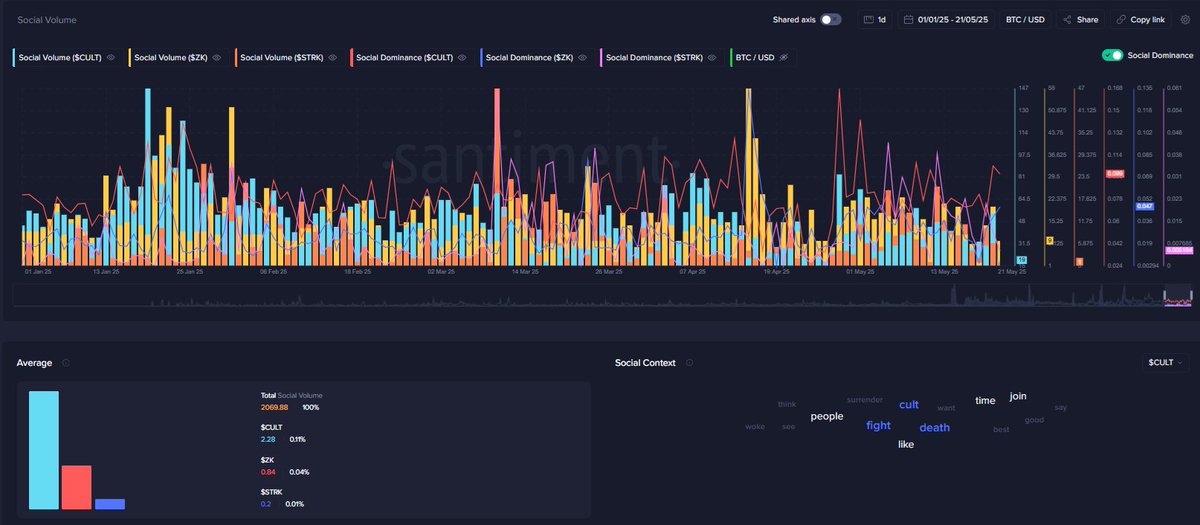
Just a quick reminder that YTD $CULT has 3 times the social volume of $ZK. 10 times the social volume of $STRK, and has never given out an airdrop & never raised VC funding.
Stark raised $282.50M from VCs, airdropped $1.8Bn. zkSync raised $458M from VCs airdropped $1.1Bn...