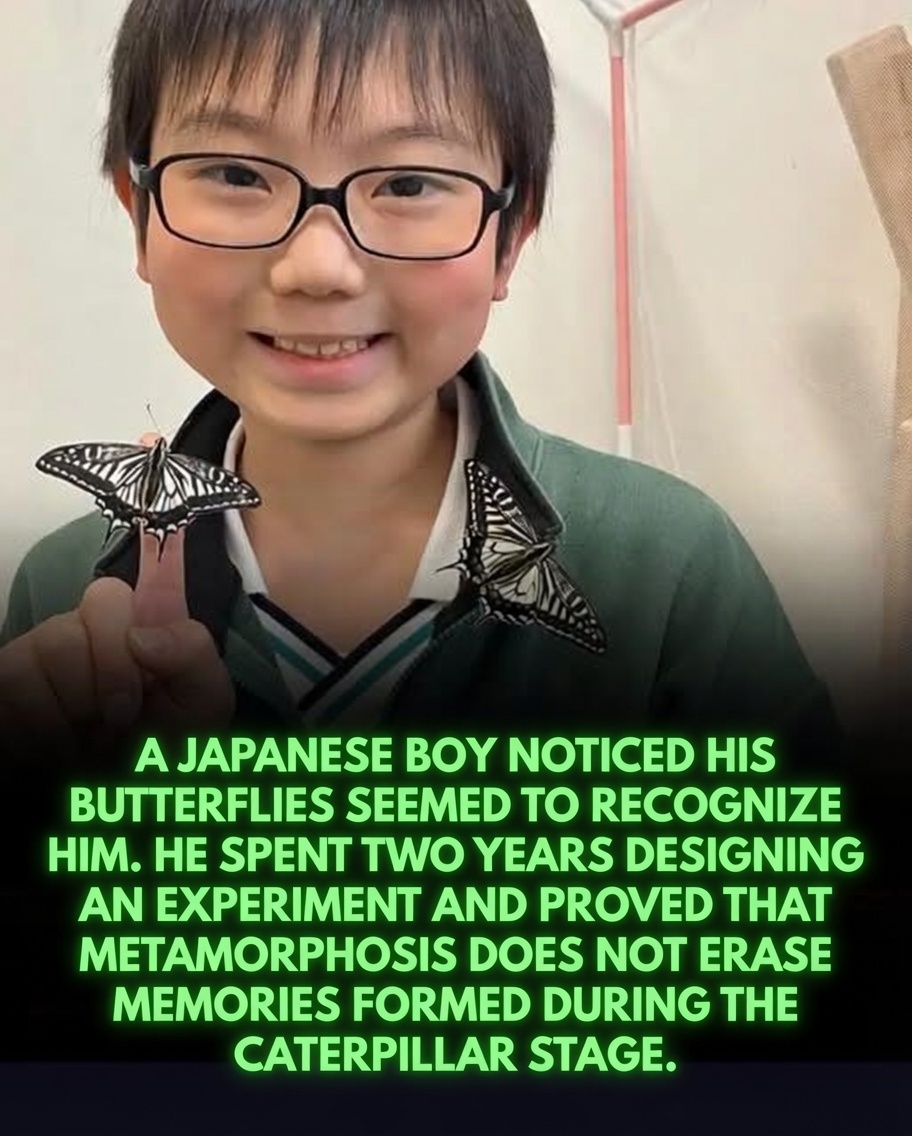
A 10 year old child’s experiment demonstrated that memories can be inherited across generations.
The story started when Jo Nagai, a second grader from Kobe, Japan, observed that swallowtail butterflies he had raised by hand appeared to recognize him, whereas wild butterflies would flee.
Motivated to uncover a scientific explanation, he contacted Georgetown University entomologist Dr. Martha Weiss, who had previously shown that moths retain memories despite the extensive cellular reorganization during metamorphosis.
Encouraged by her research, Jo suggested conducting a similar study with butterflies. This led to a remarkable international collaboration. Using a simple setup created at home, Jo conditioned caterpillars to link a gentle vibration with the smell of lavender.
Remarkably, after their brains were entirely reconstructed inside the chrysalis, 70 percent of the adult butterflies still avoided the lavender scent, demonstrating that their memories had endured the transformation.
The most surprising result emerged when Jo bred these conditioned insects. Neither the offspring nor the grandchildren had ever encountered the vibration, yet both generations displayed an instinctive aversion to the lavender scent.
At the age of ten, Jo compiled his groundbreaking observations into a 33 page paper and presented them alongside Dr. Weiss at the International Congress of Entomology in Kobe. This discovery of transgenerational memory challenges conventional views of genetics and inheritance while illustrating how a child’s curiosity can push the frontiers of scientific understanding.
@Jatkins0522@WallStreetApes Sorry 😢 but the majority of Americans couldn’t get hired if they applied to the same jobs. Which is why we have so many people who come here from overseas.
THOMAS MASSIE: “It’s ironic that we control the House, Senate, Supreme Court, & the White House -- and we're yelling 'election fraud'? We won all the damn elections.
What are we doing with that? We’re bankrupting the country. We’re starting new wars. We’re violating the Constitution. We’re not cracking down on the fraud. The problem is not the elections. We won the damn elections. The problem is that we’re wasting the opportunity voters gave us."
@grok It sucks. The code generated is garbage. The people who do customer support are garbage. Its a trash product that is literally destroying the planet and giving people cancer.
@rohanpaul_ai Oh great, just what I've always wanted, to be able to be completely manipulated a la Pinocchio. Just wait till Meta gets our hands on these!
MIT just built an AI that can control your body.
It can move your fingers, make you play piano, even if you don’t know the song!
AI decides the hand movement. Wrist pads send signals to your muscles, so your fingers move even if you don’t know how
Lots of people on here decrying the idea of a better minimum wage based on econ 101 thinking. However, all data supports increased quality of life and outcomes for local economies when the minimum wage is raised. Why blue states do better than red states economically: people get paid better.
Lmao even better….the Belgium team kept trolling Trump in their locker room after destroying and humiliating the USMNT in Seattle….absolutely delightful!
In Germany, a talented 14-year-old earns his club money. In America, his parents pay the club $15,000 a year.
That single inversion explains why "we will not" is the most accurate line ever written about US soccer.
FIFA built a global system for this. Training compensation and solidarity payments send a cut of every transfer fee back to the clubs that developed the player, from age 12 onward. Develop one future pro and your academy gets paid for a decade. Barcelona's La Masia, Ajax, every Bundesliga academy runs on this logic. The kid is the asset.
US Soccer refuses to enforce those rules. When Seattle's Crossfire Premier claimed its $60,000 share of DeAndre Yedlin's transfer to Tottenham, it got nothing. Claims on the Dempsey and Bradley transfers died partly because the federation couldn't even produce the youth training records.
So American clubs earn zero dollars when a kid turns pro. They earn when a kid enrolls. Which makes the parent the customer, and the product is whatever keeps the parent writing checks: travel tournaments, hotel weekends, $500 showcase events, private training at $100 an hour. Elite pathways run $8,000 to $20,000 a year. A comparable academy spot in Italy costs about 120 euros.
Follow the incentive one level deeper and it gets darker. A club dependent on fees can't cut its weakest paying players, so rosters optimize for retention over development. The scouting pool shrinks to families who can afford the cliff, which appears around age 11, exactly when development matters most. The country runs a talent filter sorted by household income instead of ability.
Every four years someone proposes fixing this. The proposal always requires the people profiting from the $15,000 model to vote themselves out of business.
They will not.