Check this out:
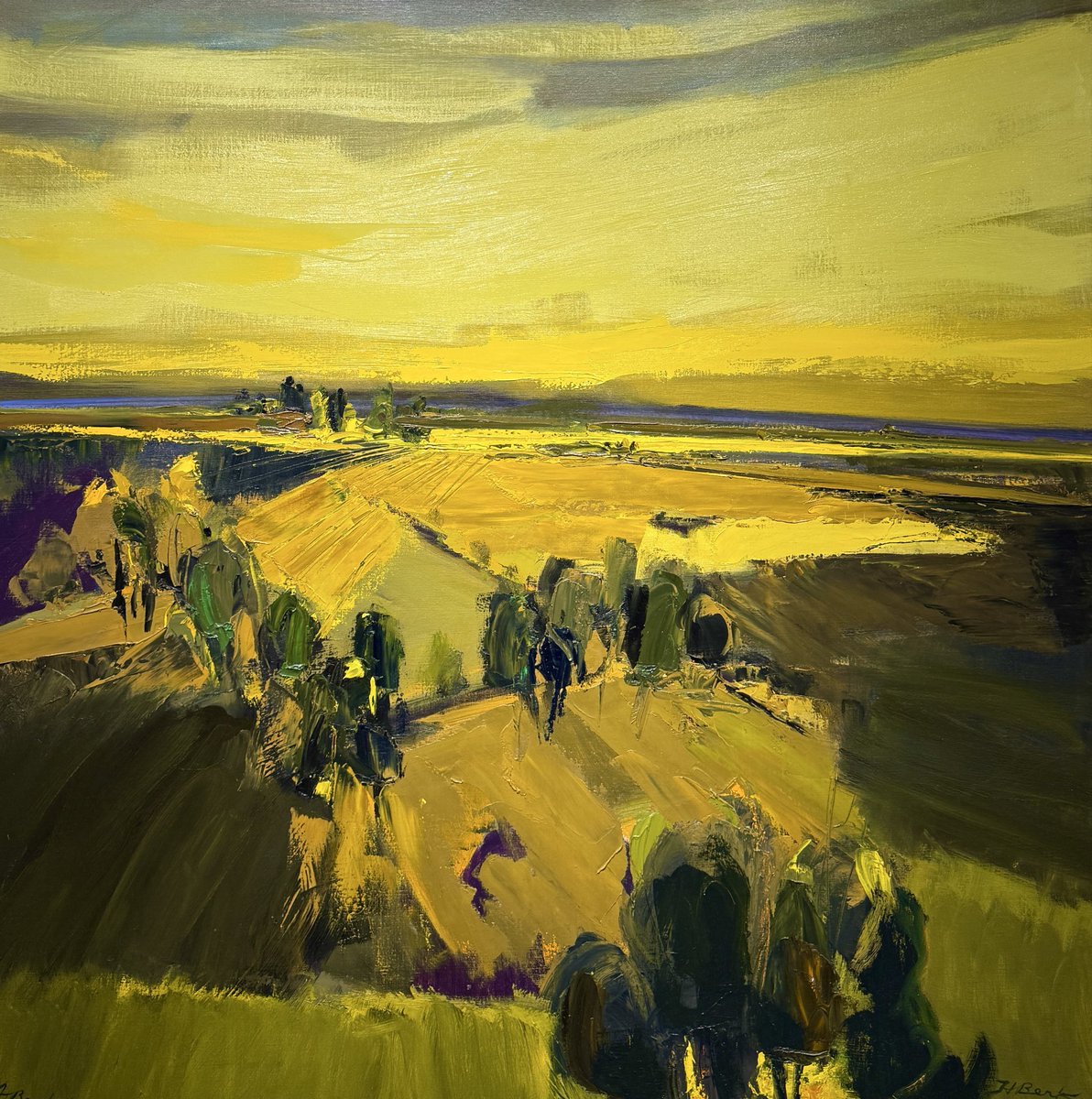
Henrietta Berk
Winter Dawn, circa 1965
Oil on Canvas
48 x 48 inches
A powerful example of postwar California modernism, “Winter Dawn”reflects Henrietta Berk’s masterful balance between abstraction and landscape.
Edgar Alwin Payne (1883–1947)
Navajo Riders
c. 1925–1929
Oil on canvas
16” x 20”
A master of design, light, and the structural rhythms of landscape, Edgar Payne brought the same compositional rigor to his figural works as to his celebrated California and Western vistas. Navajo Riders presents three mounted figures paused along a high desert overlook, their silhouettes set against a vast, luminous sky. Payne organizes the composition through strong horizontals—the mesa’s edge, the distant plateau, the cloud bands—anchored by the vertical accents of the riders and their horses.
Rather than ethnographic detail, Payne emphasizes painterly unity: bold planes of color, confident impasto, and a restrained palette of sun-struck earth tones and cool atmospheric blues. The figures become part of the land itself, embodying a quiet stillness and dignity that reflects Payne’s broader vision of the American West as timeless and monumental. Painted during the period when he frequently traveled and worked in the Southwest, the canvas demonstrates his ability to merge Impressionist light with a distinctly modern sense of design.
Renowned for her luminous depictions of birds and botanical subjects, Jessie Arms Botke created a distinctive body of work that bridges California Impressionism and the decorative elegance of the Arts and Crafts movement. White Peacocks exemplifies her mature style: a harmonious orchestration of radiant color, flattened pattern, and rhythmic design. The artist renders the birds’ cascading plumage with meticulous attention, transforming natural form into an almost textile-like surface of repeating shapes and iridescent whites.
Botke drew inspiration from Asian art, particularly Japanese screens and prints, evident in the painting’s shallow space, ornamental composition, and emphasis on contour. Rather than situating the peacocks in a naturalistic landscape, she presents them as emblems of beauty and serenity, suspended in a timeless decorative field. The restrained palette—soft ivories, pale golds, and cool blues—enhances the work’s ethereal stillness while underscoring the symbolic purity long associated with white peacocks.
Celebrated during her lifetime and widely exhibited in California and beyond, Botke’s work helped elevate bird painting into a refined decorative art. Today, White Peacocks stands as a quintessential example of her ability to merge observation, design, and symbolism into a singular vision of tranquil splendor.
Raimond Staprans
Boats, 1958
Oil on canvas
Painted in 1958, Boats stands at a pivotal moment in Raimond Staprans’s artistic development, when representation and abstraction were beginning to merge into the distinctive visual language that would define his mature work. While the subject suggests a recognizable harbor scene—boats resting near shore—the forms are intentionally simplified, flattened, and reorganized into a carefully balanced composition.
Staprans employs thick, tactile brushwork and a bold, expressive palette dominated by saturated oranges, deep blues, and muted greens. These colors are not descriptive but emotional, transforming the maritime motif into a meditation on structure, rhythm, and surface. Boats become geometric anchors within the painting, serving as stabilizing elements amid shifting planes of color and texture.
This early work already reveals Staprans’s lifelong concern with spatial ambiguity: foreground and background compress, horizons dissolve, and solid objects hover between abstraction and recognition. Boats exemplifies the artist’s ability to distill the physical world into a poetic arrangement of color and form, anticipating his later landscapes while preserving the raw energy of mid-century modern painting.
Henrietta Berk
View of San Francisco, 1962
Oil on canvas
36 × 48 inches (91.4 × 121.9 cm)
Painted at the height of her mature period, View of San Francisco captures the city as a living, atmospheric presence rather than a topographical record. Berk employs broad, confident brushwork and a luminous, high-key palette to convey the city’s rolling terrain, clustered architecture, and expansive bay. Landmarks dissolve into color and gesture, allowing light and movement to take precedence over strict detail.
Working within a postwar modernist sensibility, Berk bridges urban landscape and painterly abstraction. The dynamic handling of paint—particularly in the sky and hillside passages—suggests shifting weather and time, reinforcing San Francisco’s reputation as a city defined by change. This painting exemplifies Berk’s ability to balance structure and spontaneity, placing her work in dialogue with mid-20th-century American modernism while remaining deeply rooted in place.