Leo Röhlke finds no evidence that early adolescents spend less time on enrichment, physical activity, or sleep after acquiring their first mobile phone. Read this open access article here: https://t.co/H2HH7qR5xJ...
Work from Lea Becher, Guido Mehlkop, and Sebastian Sattler investigates the connection between status and aggression. This article is open access--read more here: https://t.co/H2HH7qR5xJ...
Ariane Bertogg, @ppraeg and Klara Reiber
show that caregiving improves cognitive functioning for both men and women in later life. Read this open access article here: https://t.co/H2HH7qRDnh...
Tibor Rutar and Marko Hočevar find that over-time increases in economic freedom predict decreases in relative poverty in developed, individualist societies. Open access here: https://t.co/H2HH7qRDnh...
@zafer_113 finds that parent-child relationships intensified in contact, closeness, and functional support after adult children's job loss. This article is open access: https://t.co/H2HH7qRDnh...
@tvanheuvelen@Jesshimmel@ReginaSBaker
investigate whether unionization reduces earnings disparities between Black and White workers in the public sector. https://t.co/H2HH7qRDnh...
Jon Overton and Gideon Cunningham examine political homogeneity and extremism in American politics. Read this open access article here: https://t.co/H2HH7qR5xJ...
Dieuwke Zwier finds that schools with progressive learning concepts are less popular among lower-SES students, while higher-SES students are comparatively less likely to choose labor market-themed schools. This article is open access: https://t.co/H2HH7qRDnh...
Micah H. Nelson examines whether survey items measure the same constructs equivalently when administered to Democrats and Republicans. https://t.co/H2HH7qR5xJ...
From Yuxin Zhang and colleagues, "Is political interest tracked in schools? Evidence from Germany" is open access and available here: https://t.co/H2HH7qR5xJ...
Big congrats to @MasoudMovahed, whose article titled "Intergenerational income mobility in the United States: A racial-spatial account" just won the ASA's Mathematical Sociology Section’s Outstanding Graduate Student Paper Award! https://t.co/XYoEab9fvd
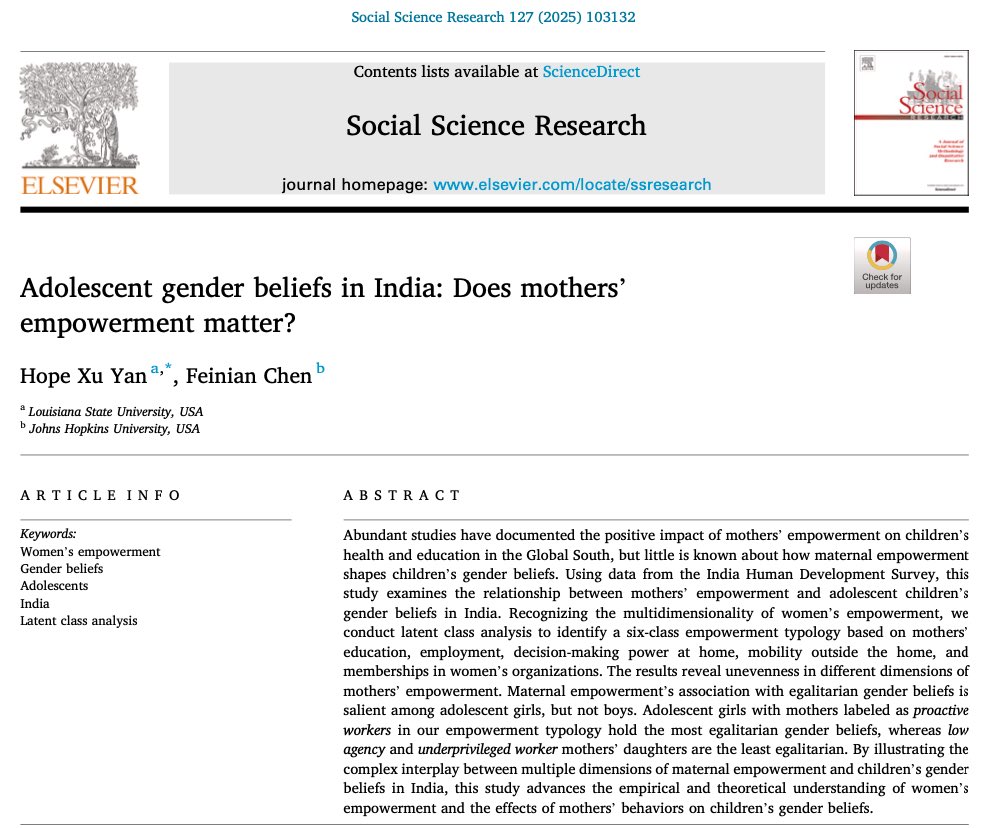
Our paper is out in @SSReditorial! We conduct latent class analysis to illustrate the complex interplay between multiple dimensions of maternal empowerment and children’s gender beliefs in India. See full paper here: https://t.co/KPv40bpF9C
We know people with black-sounding names are discriminated against in the U.S. labor market. Was there such name-based discrimination in the early 20th century? See what this new study found! https://t.co/q4i7D5bn69
Results of online survey experiment show that on factual questions, less-educated people are more strongly influenced by highly-educated outgroup individuals than by less-educated ingroup individuals. On opinion questions, status orientation & ingroup orientation are about equal.
People are influenced by members of high-status groups & members of their ingroup. Are lower-status people more influenced by members of higher-status outgroups or by members of their lower-status ingroup? https://t.co/449fmtJhV3
Analysis of longitudinal data from China reveals a hidden form of education inequality: low-SES parents not only hold lower educ expectations but are more likely to decrease their expectations when child academic performance declines, which further reduces their educ involvement.
The link between parental educational expectations & children’s educational outcomes is well-established in the literature. This study addresses how parental expectations respond to children’s academic performance. https://t.co/12vzuvc4SJ @ShenWensong