If you want to land your first 100 customers fast, you need to understand these basics:
1) Generate, leverage and capture demand.
2) Gather and sample audience data fast.
3) Leverage platform algorithms and build frequency.
4) Focus on product competitive advantages.
Out of time to do marketing? No problem.
Inside the Growth Workspace, you can use the built-in prompt library to ask Notion AI to create your messaging for you.
This isn’t generic AI copywriting.
Notion AI works from the Growth Principles playbook inside the training modules, plus the market research, so the prompts are built around strategy first, not random copy formulas.
It generates copy from customer psychology and strategic logic, using your ICP, positioning, value proposition, objections, demand stage, and Message Architecture doc as the foundation.
So you can move from:
Raw product idea → strategy → messaging → homepage copy → page-based HTML mockup
In seconds.
No guessing what to write.
No guessing how to structure the page.
No starting from a blank page.
Just a guided growth system that turns your positioning, customer psychology, and value proposition into something you can see, review, refine, and build from.
Access the system: https://t.co/rjjAZifPAA
“I have traffic but no signups” sounds like a traffic problem.
But most of the time, it’s a conversion clarity problem.
If people are landing on your homepage or product page and not taking action, ask:
- Are we attracting the right people?
- Is the offer obvious in 5 seconds?
- Does the page reflect the customer’s pain, motivation and buying trigger?
- Is the value clear enough to make the next step feel worth it?
- Are we building trust before asking for the signup?
Traffic doesn’t convert just because it arrives.
Your landing page has to connect the dots between the visitor’s problem, your unique value prop and the next action.
That’s why in the Growth System, we don’t just chase “more traffic.”
We work through:
ICP → positioning → message architecture → homepage/product page messaging → testing → conversion optimisation.
Because if your page can’t convert the traffic you already have, more traffic just gives you a bigger sample size of the same problem.
Good question. the library isn't just asking notion Al to "write landing page copy."
The prompts are designed to pull from the strategy work first, especially the Message Architecture doc you can generate inside the Growth Workspace.
That includes your ICP, pains, motivations, objections, positioning, differentiators, value prop, tone of voice, and demand stage.
So instead of starting with a blank Al prompt, you use the Message Architecture doc as the foundation - backed by market research and the Growth Principles playbook.
The result: copy generated from your customer psychology and strategic logic, not a generic Al copywriting prompt.
Don’t know how to create homepage landing page messaging that converts? No problem.
Use the prompt library inside the Growth Workspace.
With the built-in Notion AI prompt library, you can generate homepage messaging copy in seconds:
→ Hero section
→ Social proof
→ Differentiation
→ Product introduction
→ Benefits recap
→ How it works
→ Closing CTA
No blank page. No guessing what to say.
Just structured, conversion-focused homepage copy built from your positioning, customer segment and message architecture.
Try it: https://t.co/Vjy1oQJ84i
A homepage landing page should move visitors through one clean conversion path:
Clarity → Trust → Differentiation → Understanding → Motivation → Action
Section order:
Hero: what it does + who it’s for
Social proof: why trust it
Differentiation: why this, not alternatives
Product intro: how it helps
Benefits: why it matters
How it works: make it feel easy
CTA: one next step
The goal isn’t to explain everything.
It’s to make the right visitor understand the value in 5 seconds then keep reducing doubt until they act.
Totally, intuition matters, especially early on. The point isn’t to replace instinct with dashboards. Use data on purpose: one North Star + a few stage metrics that show what to do next.
More data will give me clarity” is a trap.
You need one anchor metric, the North Star plus a few stage metrics that show where the funnel is breaking.
More data often creates analysis paralysis. Clarity comes from knowing what to do next.
First 100 users come from learning fast, not just getting traffic.
For your first 100 users, don’t treat email, social, and ads as separate channels. Build one growth loop.
1. Social creates demand:
Use it to make the problem visible, educate your ICP, test hooks, surface objections, and start conversations.
Post about the pain, the old way vs new way, mistakes people make, customer insights, founder POV, and simple product examples.
2. Email converts demand:
Use founder-led outreach to reach targeted prospects, then use follow-up emails to build trust, explain the use case, handle objections, and move people toward signup, demo, trial, or purchase.
Email works best when it feels personal and relevant, not like a newsletter blast.
3. Ads accelerate learning:
Don’t use ads as a scale button too early. Use small-budget tests to compare audiences, hooks, messages, offers, and landing pages.
Ads expose weak positioning fast, but they also help you find what resonates.
4. Create the loop:
Post on social → start conversations → send people to one focused landing page → follow up by email → use ads to test and retarget → measure signup, activation, and conversion → improve weekly.
Social builds attention.
Ads test and capture intent.
Email turns interest into action.
@tibo_maker Social creates demand, ads test and capture intent, email converts interest into action. Post around the ICP’s pain, run small ad tests for positioning (hooks and audiences), follow up personally by email, then measure signup, activation, and conversion weekly.
Most founders don’t need to “post more.”
They need a process for turning organic into a growth loop.
Here’s how to create organic social posts:
1. Start with one ICP moment:
Pick a real situation your audience recognises immediately: a complaint, workaround, repeated objection, comparison, or “why is this so hard?” moment.
2. Reframe the problem:
Challenge the assumption they have accepted as normal.
Make them think: “Wait, that is the real issue.”
3. Make the cost of the status quo visible:
Show what staying the same is costing them: time, money, mistakes, missed growth, slow adoption, lost trust, or extra manual work.
4. Use evidence to build authority:
Add simple math, a teardown, customer language, a pattern you have noticed, a before/after, or a real example.
Evidence turns opinion into trust.
5. Teach the better way:
Do not pitch too early. Show the shift in thinking, workflow, decision rule, or simple process that helps them make progress.
6. Connect the idea to first value:
Give them something useful: a checklist, template, question, example, script, teardown, or next step they can apply immediately.
7. Show the product as the mechanism:
If relevant, introduce the product as the thing that makes the better way easier, faster, or more repeatable, not as the whole point of the post.
8. Turn engagement into the next post:
Use comments, objections, questions, and DMs as market research.
Write follow-up posts within 48 hours while the signal is fresh.
A strong organic post should do at least one of these jobs:
- create demand by making the audience problem-aware
- reinforce your positioning
- build trust in your point of view
- help the audience get a quick win
- move engaged people toward activation or first value
Organic social compounds when every post teaches the market what to believe, repeats the same core positioning, and creates a path from:
Attention → trust → first value → demand.
It’s not just strategy, also here's an example of what you can prompt the Notion AI to do inside the Growth Program:
"Write 1 month of LinkedIn posts using this organic posting plan doc."
That's the kind of execution you get without starting from scratch.
New use case inside Growth Program by Sasha:
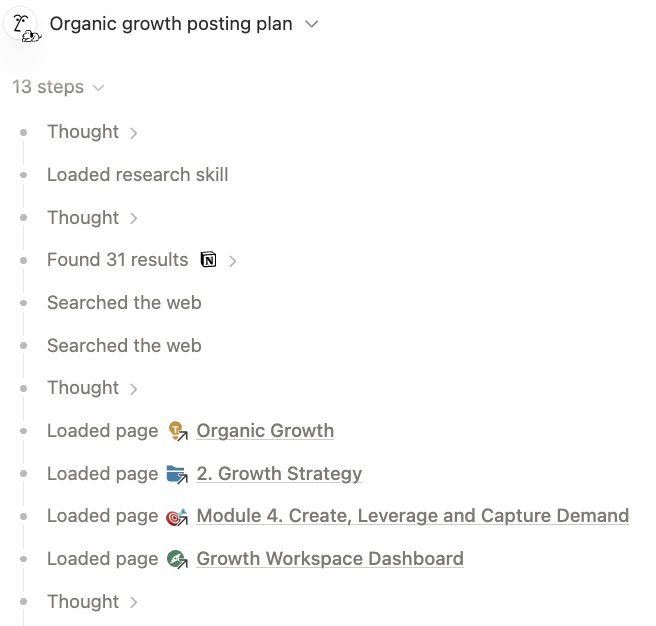
Use the built-in Notion AI prompt library to generate a 4-week organic posting plan from your product strategy.
It connects market research, ICP, positioning, content pillars and Create → Leverage → Capture Demand logic.
No blank content calendar.
Try it: https://t.co/Vjy1oQJ84i
New use case inside Growth Program by Sasha:
Use the built-in Notion AI prompt library to generate a 4-week organic posting plan from your product strategy.
It connects market research, ICP, positioning, content pillars and Create → Leverage → Capture Demand logic.
No blank content calendar.
Try it: https://t.co/Vjy1oQJ84i
Your best positioning is not the one that sounds smartest in your strategy doc.
It’s the one the market responds to.
Run small, targeted demand tests before you rewrite your site or roadmap:
1. 2–3 audience segments
2. 2–3 positioning angles
3. Ads + homepage messaging
4. 14 days of response data
Then watch what happens. Who clicks? Who converts? Who replies? Who shows intent?
Demand tells you where the energy is. Let the market choose the narrative.
Ship the winner, log the learning, re-rank the backlog.
Random tests don't compound. Your growth loop will.
Reply and tell me what you’re testing. I’ll help you check if you’re on the right layer.
Testing everything at once isn't speed. It's noise.
Pricing, targeting, ad copy all at once? You won't know what worked.
Not a tactics problem. An isolation problem.
How to test the right things 👇
Be specific. Vague experiments give vague results.
Sequence it: Acquisition → Activation → Revenue. 1–2 tests, no overlap.
Size the sample before you launch. Don't peek early.
p < 0.05 or it was chance👇
Here’s the step process to design clean growth experiments that move the numbers that matter:
1. Start with reality, not vibes:
Research the market, competitors, customers, complaints, and missing gaps.
2. Turn strategy into hypotheses:
Define your ICP, positioning, message, channel, and funnel assumptions.
3. Pick one growth goal:
Choose the stage you’re testing: acquisition, activation, revenue, retention, or conversion.
4. Define the question:
Don’t “try marketing.” Ask: what exactly are we trying to learn?
5. Choose the right test:
A/B test, landing page test, ad test, messaging test, cohort test, interview, or funnel analysis.
6. Set the success metric before you launch:
North Star, primary metric, secondary signals, and leading indicators.
7. Track it properly:
UTMs, pixels, GA4 events, campaign tags, funnel steps. No tracking = no learning.
8. Read the signal honestly:
Did it work, fail, or produce noise? Don’t force certainty from weak data.
9. Ship one improvement:
Scale what worked, fix the friction, sharpen the message, or kill the bad idea.
Clean experiments don’t prove you’re right.
They help the market teach you faster.